
Backloading Removals: How to Save on Interstate Moves
You've found a Melbourne removalist quote that looks dramatically cheaper than the other option. Then you notice the delivery window is broad, your apartment lift can only be booked at a fixed time, and your new home may not be ready on the day the truck arrives. That's where backloading removals become more complicated than a simple “cheap versus expensive” decision.
Backloading can be an excellent way to reduce the transport cost of an interstate move. It can also become poor value when storage, split deliveries, missed building bookings, or special handling enter the picture. The right question isn't just, “What's the cheapest quote?” It's, “What will this move cost when the timing has to work in real life?”
What Backloading Removals Mean
A Melbourne renter moving to Sydney has furniture from a two-bedroom apartment and two quotes in hand. One covers a dedicated vehicle. The other charges for the space the furniture occupies. The lower quote reflects a shared truck, not a smaller version of the same service.
Backloading is a load-consolidation model. A removalist already has a vehicle scheduled for a particular route, then combines compatible consignments so unused capacity carries paying goods. Each customer pays for the truck space their items occupy, which can reduce interstate transport costs, as explained in this overview of backloading removals.

Why the shared space costs less
A dedicated truck is organised around one customer's route, crew and timing. Backloading spreads the operating cost across several consignments already travelling between cities. The saving comes from sharing capacity, while the customer gives up control over the schedule.
That arrangement suits a partial household load, a smaller apartment move, or a customer who can adjust plans around transport availability. It is a poor fit when furniture must arrive on one tightly controlled date, when a lift booking is difficult to secure, or when the new property may not be ready. Review these interstate moving services before comparing quotes.
Flexibility is the trade-off. Pickup and delivery depend on compatible loads, available capacity and other consignments on the route. A delivery window may replace a fixed appointment, leaving you to manage temporary storage or rebook a building lift if the timing changes.
Practical rule: Backloading costs less because the removalist controls more of the route. If your Melbourne building allows loading only at a fixed time, or your destination cannot receive the goods promptly, price storage and access changes before accepting the lower quote.
For Melbourne to Sydney, published transit windows commonly sit between 1 and 5 days. Melbourne to Brisbane is commonly quoted at 2 to 5 days, while Melbourne to Adelaide may take 1 to 7 days, according to this Melbourne interstate backloading guide. These windows reflect shared-truck scheduling. They can also create extra handling or split deliveries when the route includes multiple consignments, so confirm whether your goods will arrive together.
How the Backload Model Works Behind the Scenes
Backloading removals follow a practical logistics chain. The removalist isn't waiting for your furniture before deciding where the truck should go. The company identifies scheduled interstate movements, checks available capacity, then matches customer loads that can travel along compatible routes.
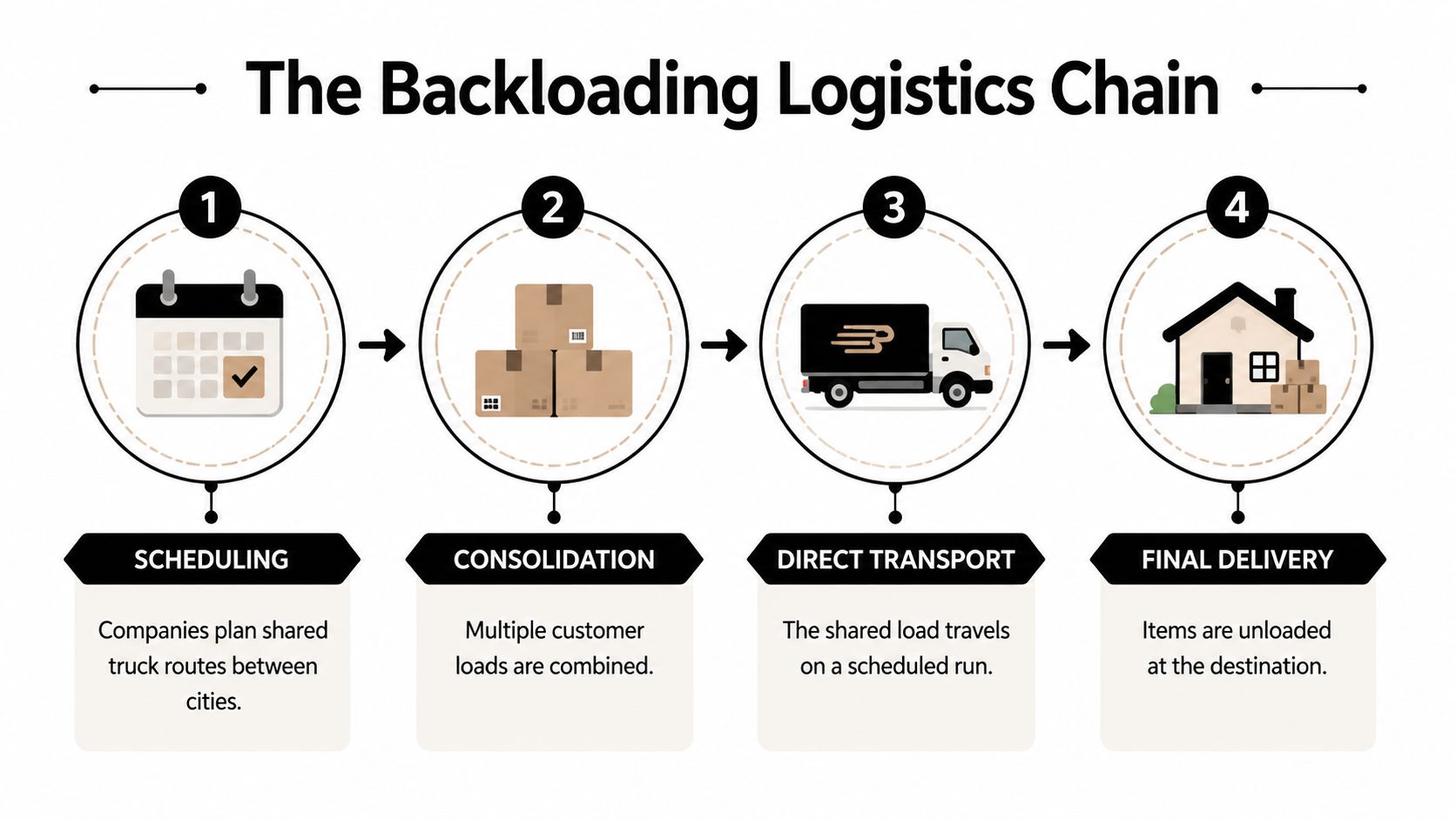
The four stages of a shared interstate run
Scheduling: The removalist plans a vehicle movement between Melbourne and one or more destination cities. The schedule may include planned collection and delivery points.
Consolidation: Customer loads are assessed by size, destination and handling requirements. The company combines consignments that can share the vehicle without creating an impractical route.
Direct transport: The truck travels the planned interstate corridor. Your items remain part of a shared load, so the vehicle may complete other deliveries before reaching your address.
Final delivery: The crew unloads your consignment at the destination, subject to access, address readiness and the agreed delivery window.
Route density matters. Busy corridors generally offer more opportunities to match compatible loads. Less frequent routes can require a wider window because the removalist may need to wait for a suitable vehicle or enough compatible freight.
Melbourne to Perth commonly carries a 5 to 14 day transit window. Melbourne to Darwin can range from 7 to 28 days, reflecting the longer and less frequent corridor. These published windows are outlined in the route-specific Melbourne backloading information.
Why your goods may take longer than a dedicated move
A dedicated truck can collect your furniture, travel directly and deliver according to a planned appointment. A shared truck must protect several customers' goods while completing a route that works for the whole load.
That can mean additional coordination before pickup, extra stops during transport and more uncertainty around the final arrival day. It doesn't mean the goods are abandoned or handled casually. It means your booking sits inside a larger transport plan. Customers considering long-distance movers should ask for the realistic pickup and delivery windows before making any accommodation or lift arrangements.
The practical test is simple. If you can accept the truck's timetable, backloading can work well. If your settlement, lease, lift booking or business opening depends on one exact arrival date, shared logistics may be the wrong tool.
Comparing Backloading and Dedicated Truck Costs
A low backloading quote can become an expensive move when Melbourne timing works against you. The base price may look attractive by volume, yet storage, missed lift bookings, extra handling and split deliveries can quickly change the total.
Published Australian guides show wide variation in backloading rates. Some quote around $60 to $75 per m³, while other industry pricing places rates closer to $150 to $260 per m³, depending on distance, inclusions, route and service level, as outlined in this Australian removalist cost guide. Another published example estimates a two-bedroom apartment at about 30 m³, with pricing of $200 to $300 per m³, producing an implied transport range of roughly $6,000 to $9,000. The example appears in this backloading cost comparison.
Three Melbourne move scenarios
Treat the transport quote as a starting figure. Ask what happens if settlement is delayed, the property is not ready, the lift booking is missed, or the truck reaches Melbourne outside your building's loading period.
| Scenario | Transport Cost Estimate | Potential Hidden Costs | Total Estimated Range |
|---|---|---|---|
| Flexible backload | Around $60 to $75 per m³ in some published guides | Usually limited if pickup and delivery are flexible | Transport-only quote, based on measured volume |
| Backload plus storage | Around $60 to $75 per m³ in some published guides | Temporary storage, extra handling, second delivery and possible access charges | Transport quote plus all storage and re-delivery charges |
| Dedicated truck | Quoted for exclusive vehicle use rather than shared cubic metres | Premium transport price, but fewer timing-related costs | Higher transport quote, with a more controlled schedule |
A flexible backload is usually the strongest value when the destination is ready and you can accept a delivery window. It becomes less attractive when your Melbourne lease starts before the truck arrives, leaving a storage gap between collection and occupation. Storage fees, handling at the warehouse and a second delivery can erase the initial saving.
Lift bookings create another cost risk. Melbourne apartment buildings may require a fixed loading period, protective coverings and advance approval. If a shared truck misses that slot, you may pay for a rescheduled booking, additional access or another delivery attempt. A dedicated truck costs more upfront, but its schedule is easier to coordinate with settlement and building management.
Split deliveries and access charges
Split deliveries also deserve a written answer before booking. If the carrier cannot deliver the full load together, beds, appliances or work equipment may arrive separately from the remaining furniture. That creates extra coordination, additional labour and a period in which part of your household is unavailable.
Compare the complete move, not only the cubic-metre rate. Request an itemised cost of movers estimate covering storage, stairs, long carries, lift access, packing, disassembly, reassembly and delivery attempts. Confirm whether split delivery is possible and who pays if the property is not ready.
Backloading saves money when your dates are flexible, your goods can travel with other consignments and the destination is ready on arrival. Choose a dedicated truck when settlement, lift access or business opening depends on a controlled delivery date.
Backloading Versus Dedicated Removals Compared
Backloading and dedicated removals solve different problems. Backloading prioritises space efficiency and price. A dedicated truck prioritises control, speed and exclusivity.
The choice becomes clearer when you assess the move by category rather than relying on a generic promise that one service is always cheaper.
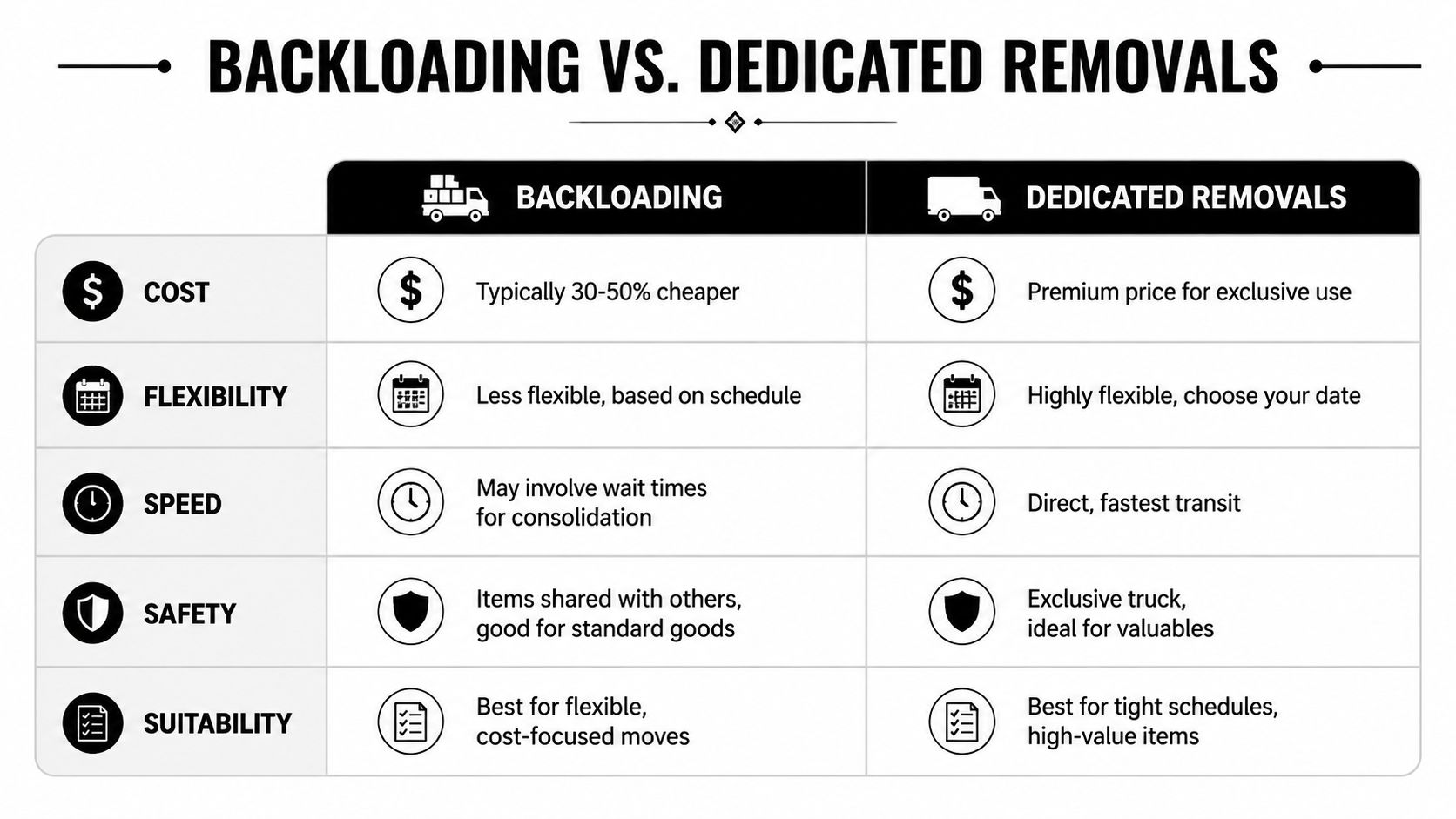
A practical decision matrix
| Criterion | Backloading | Dedicated removals |
|---|---|---|
| Cost | Often attractive for partial loads and flexible moves | Premium price for exclusive truck use |
| Flexibility | Delivery depends on shared scheduling | Customer has more control over the moving date |
| Speed | May involve waiting for consolidation and other deliveries | Direct transport generally gives a tighter schedule |
| Item safety | Suitable for standard goods when packed and secured correctly | Exclusive space can reduce handling and movement between consignments |
| Specialty items | Requires advance assessment and suitable handling | Better fit for high-risk, oversized or valuable goods |
| Best use | Non-urgent, cost-focused interstate moves | Tight deadlines, complex access and premium belongings |
Standard household goods usually suit the shared model. Beds, boxed clothing, dining furniture, shelving and ordinary appliances can travel effectively when the removalist wraps and secures them properly.
When premium handling changes the answer
Pianos, pool tables, fragile antiques, artwork and sensitive business equipment need more than available floor space. They may require disassembly, specialist packing, controlled positioning, careful lifting and a delivery plan that avoids unnecessary handling.
White-glove packing can work alongside a backload, but the service must be specified clearly. Ask who packs the item, what protective materials are used, whether it will be separated from other consignments, and how the crew will unload it at the destination.
A low transport rate is not a bargain if the handling plan doesn't match the item.
Backloading is strongest when the inventory is standard, the customer can accept a broad window and the load is not so large that it fills most of a truck. Dedicated removals make more sense when the move involves irreplaceable belongings, a hard business deadline or a narrow apartment access booking. A broader comparison of interstate removalists across Australia can help you frame the questions, but the final decision should come from your inventory and dates.
Who Should Choose Backloading and Who Should Not
Backloading removals are a strong choice for a Melbourne renter with a modest household load, a destination that's ready and enough flexibility to accept the carrier's delivery window. They're also sensible for customers moving standard furniture between major cities without requiring exclusive truck use.
They're a poor fit for someone whose entire move depends on a precise handover. That includes an apartment resident with one lift booking, a homeowner whose settlement dates cannot move, and a business that needs desks, stock or equipment operating immediately after arrival.

Backloading usually suits these movers
- Flexible renters: You can arrange temporary essentials separately and don't need every item delivered on a fixed day.
- Smaller households: Your furniture occupies part of a vehicle rather than requiring exclusive use.
- Budget-focused relocations: You're willing to exchange timing control for a lower transport quote.
- Standard inventories: Your items don't include fragile antiques, large specialty pieces or equipment requiring controlled handling.
- Prepared businesses: Your office can operate during the transition, or the move is staged around the delivery window.
The biggest mistake is assuming backloading stays cheap as the load grows. Volume-based pricing means a larger household can produce a substantial quote, especially when the rate includes packing, storage, access difficulties or special handling. Published Australian content describes backloading for two-bedroom and three-bedroom moves at prices ranging from around $490 to several thousand dollars, depending on route and volume, as discussed in this backloading pricing overview.
Choose dedicated transport when timing controls the move
A dedicated truck deserves serious consideration when your settlement and occupancy dates are close together. It's also the safer planning choice for a scheduled event, office reopening, commercial delivery or a property with strict loading rules.
High-risk belongings require the same discipline. A piano, pool table or delicate antique may justify dedicated handling even if the rest of the household could travel as a backload. You can separate the inventory, but only if the removalist explains how each consignment will be packed, transported and delivered.
You're not wasting money by choosing a dedicated truck when a failed delivery would create storage, accommodation or access costs. You're buying control over the part of the move that can't be easily fixed after the truck leaves Melbourne.
How to Book a Backload and Prepare for Your Move
Start with an accurate inventory. List furniture by type and dimensions where possible, include every box category, identify awkward items and disclose stairs, lifts, narrow driveways and restricted loading areas. Underestimating volume can lead to a revised quote or a load that can't fit as planned.
Use a cubic metre calculator as a planning aid, then ask the removalist to verify the estimate against your item list. Don't accept a low figure based on a vague description of “one apartment” if the quote doesn't state what the company believes you're moving.
Questions that belong in writing
Request clear answers about:
- Pickup and delivery: What are the expected windows, and can the company explain how storage or a delayed address will be handled?
- Pricing: Is the quote based on estimated or confirmed volume, and which labour, access and handling charges are included?
- Protection: What wrapping, restraints and packing materials will the crew use?
- Insurance: What transit cover applies, what exclusions matter, and do valuable items need separate disclosure?
- Inventory control: Will you receive an itemised consignment record at pickup?
Shared-truck transport rewards organised packing. Disassemble suitable furniture, wrap exposed surfaces, protect corners, label every box and keep an inventory for your own records. Clear access at both addresses helps the crew load efficiently and reduces the chance that a lift booking becomes unusable.
Manage the date gap before it becomes a crisis
Speak with your building manager early. Confirm lift access, loading rules, parking requirements and the consequences of missing the allocated slot. If settlement dates don't align, price storage before booking the backload, not after the truck is already scheduled.
Keep documents, medication, valuables and immediate essentials with you rather than placing everything on the shared vehicle. For broader planning help, this stress-free relocation guide offers useful preparation principles that apply well to interstate moves.
Your Backloading Decision Checklist
Run through these questions before accepting a backloading removals quote:
- Can you accept a delivery window instead of one guaranteed date? If not, price a dedicated truck.
- Will your destination be ready when the truck arrives? If not, add storage and possible second handling to the comparison.
- Does your building have a fixed lift booking? Confirm the removalist can meet it, or choose a service with tighter scheduling.
- Is the inventory mostly standard household furniture? Pianos, pool tables, antiques and sensitive equipment need a specialist handling plan.
- Is the load partial? Compare the shared-space price with exclusive transport if your household occupies a substantial portion of the vehicle.
- Have you included access, packing, storage and re-delivery costs? Transport-only pricing doesn't represent the full move.
- Are your goods packed, labelled and inventoried? Shared transport demands disciplined preparation.
- Does the insurance match the value and risk of your belongings? Read exclusions before pickup.
Choose backloading when flexibility is real, the goods are suitable and the all-in cost remains lower after storage and access risks. Escalate to a dedicated truck or white-glove service when timing, value or handling complexity matters more than the initial transport quote.
Get n Go Removals Melbourne can assess your inventory, compare a flexible backload with dedicated interstate transport, and coordinate packing, storage, lift bookings and specialist handling where required. Visit Get n Go Removals Melbourne to request a move assessment built around your actual dates, access conditions and household contents.