

Best Time to Move House in Melbourne and Beyond
You've got the keys, the contract is signed, and the settlement window is suddenly real. Now you need to choose a moving date that works for more than your diary. In Melbourne, the right day must line up with settlement, lease notice, removalist capacity, lift access, parking, traffic and the weather. Pick badly and a straightforward relocation turns into a costly scramble. Pick well and the crew can load, travel and unload without fighting the city at every step.
There isn't one universal best time to move house. There's a best date for your settlement, your building and your route. The advice below is the practical version, based on Australian moving patterns and the realities Melbourne removalists deal with every week.
Why the Date You Pick Changes Everything
Your offer has been accepted. The conveyancer confirms that settlement will happen within the contract window, and suddenly the date you've been waiting for becomes a date you have to organise around. You may feel ready to leave immediately, but the removalist crew, apartment lift, parking space and new property all need to be ready at the same time.
A family moving from Hawthorn to Glen Waverley can usually move more smoothly on a weekday morning than on a crowded Saturday. An apartment resident in the CBD has a different problem. The service lift may only be available during a narrow booking window, loading access may depend on building approval, and a truck can lose valuable time waiting on a congested street.
The date also affects how much preparation you need. A popular summer weekend can require early booking, while an off-peak weekday often gives you more choice of start times. Availability, access and timing can matter as much as the distance between the two homes.
Operator's rule: Choose the date around the property transaction first. Choose the season and preferred weekday second.
The national moving calendar is heavily seasonal. About two-thirds of Australian moves happen between October and March, and more than 1.5 million Australians move into new homes during that spring-to-summer window, according to Australian moving and migration statistics. That demand coincides with the spring selling season, lease changes and family planning before the school year.
For a household, the practical question isn't whether the weather looks pleasant. It's whether the crew can arrive at the agreed time, whether the truck can park close enough to the entrance, whether your building will release the lift, and whether settlement has completed. Good planning around professional removal services removes much of that uncertainty.
How Australian Seasons Shape Moving Demand
Australia's moving year has a clear pattern. The warmer half of the year carries the heaviest demand, while winter usually gives households more room to negotiate start times and capacity. The most useful national benchmark is the estimate that around 1.14 million households, or 12% of all households, moved at least once in 2019–2020, based on Australia's mover statistics and relocation patterns.
January is the standout month. Budget Direct's quote-based research identifies January as the most popular month to relocate in every Australian state and territory, with Victoria recording 13.68% of moves in January in that dataset. The same research says Australians are up to 50% more likely to move in January than in any other month, while March is the second-most popular month, as reported in the Australian moving-month analysis.
A practical demand ranking
The table below translates that pattern into booking decisions. Price descriptions are qualitative because the actual rate depends on inventory, access, crew size, travel distance and the removalist's quote.
| Month | Demand Level | Typical Lead Time | Price vs. Winter Base |
|---|---|---|---|
| January | Very high | Book well ahead | Usually higher |
| February | High | Book ahead | Often higher |
| March | High | Book ahead | Often higher |
| April | Moderate | Flexible | Closer to standard |
| May | Moderate | Flexible | Closer to standard |
| June | Low | More flexible | Often lower |
| July | Low | More flexible | Often lower |
| August | Low to moderate | Flexible | Often lower |
| September | Rising | Book ahead | Starting to rise |
| October | High | Book early | Often higher |
| November | High | Book early | Often higher |
| December | Mixed, with holiday disruption | Variable | Depends on date |
October through March is the busiest broad window, not because every day is equally difficult, but because property sales, school planning and rental changes cluster together. January and the wider December to February period are the clearest historical peak. If you're tied to those months, secure the crew before the rest of the move becomes urgent.
What winter buys you
June, July and August are the sensible choice when your priority is capacity. You'll generally have more access to preferred start times and less competition for trucks and crews. Winter brings wet-weather risk, so the bargain only works if you protect floors, plan covered loading and check driveway conditions.
Spring is the strongest compromise for many Melbourne households. September to November offers shoulder-season conditions before the summer rush fully builds, but October and November still need early planning. If you're considering a warm-weather move, use the practical advice in these summer moving tips to protect people, furniture and electronics.
Anchoring Your Move to Settlement in Victoria
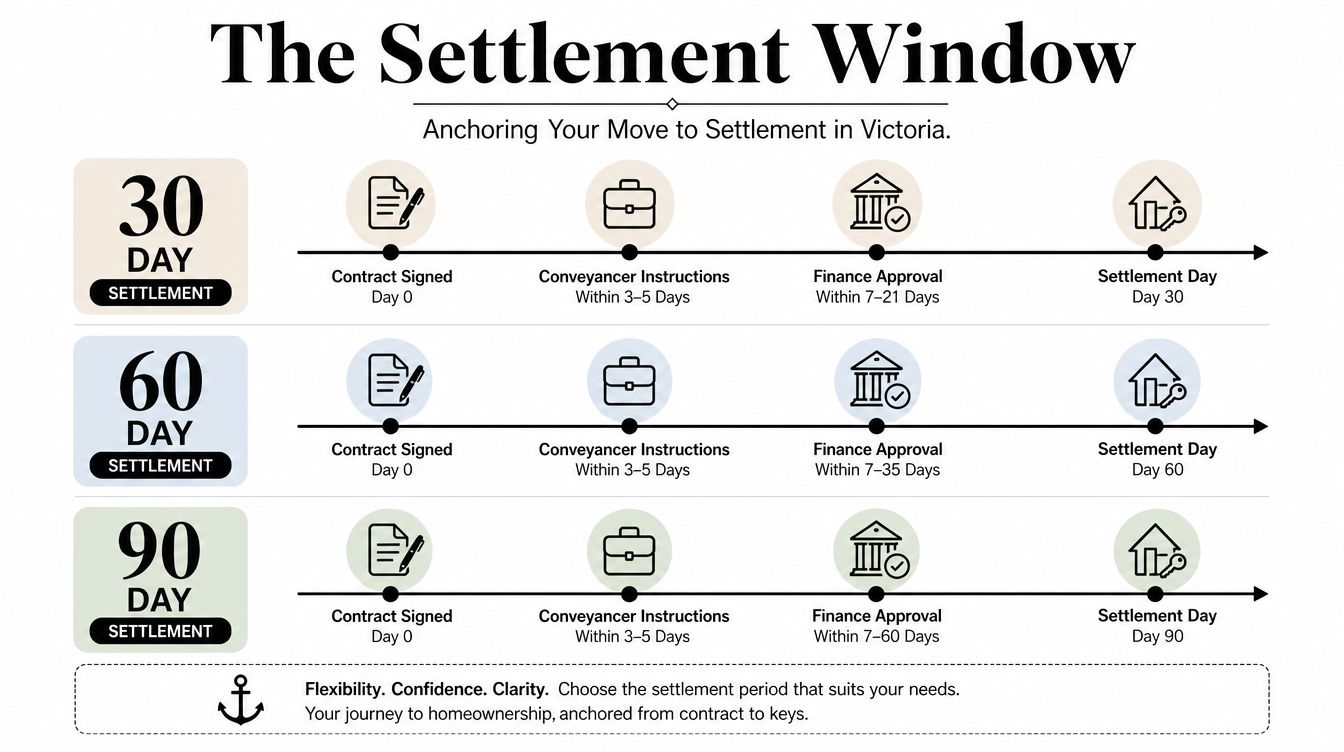
In Victoria, settlement is the anchor. The seller sets the settlement date in the contract, and settlement usually occurs 30 to 90 days after signing, according to the Victorian settlement timing explainer. Your physical move should normally happen on settlement day or immediately afterwards, not on an arbitrary date chosen before the transaction is complete.
That distinction matters because you may not have legal access to the new property until settlement finishes. If you book the truck for the morning and settlement is delayed until the afternoon, the crew may have nowhere to unload. You could also end up paying for access to both properties at once if you leave the old home before the new one is available.
Build the move around handover
Victorian settlements commonly complete in the afternoon. Industry explanations refer to completion windows around 2pm to 4pm and by 5pm, which can push key collection and move-in well beyond a normal morning start. A Friday afternoon settlement is especially awkward. You either arrange a short-notice same-day move, pay for temporary storage, or move on the next practical weekday.
A Thursday morning settlement is cleaner. It gives your conveyancer time to resolve any last-minute issue, leaves room for key collection, and makes a Friday move-out or move-in easier to coordinate. For an apartment, the building's service lift still decides whether that plan works.
Reverse-engineer the date
Start with the fixed points:
- Settlement: Ask your conveyancer to confirm the agreed date and likely completion window.
- Lease: Victorian renters usually give 28 days' notice when ending a tenancy at the end of a rental agreement, as set out by Consumer Affairs Victoria's renter notice guidance.
- Building access: Ask the owners' corporation or building manager about service-lift reservations, loading zones, move-in rules and protective coverings.
- Utilities: Arrange electricity, gas, internet and final meter details around the handover date.
- Removalist: Confirm the date only after the settlement timing and access restrictions are clear. Guidance on relocating within Victoria is useful, but your contract and building rules remain decisive.
Choosing the Right Day of the Week and Time of Day
If settlement is complete and the keys are ready, a Tuesday, Wednesday or Thursday morning gives you the cleanest moving window in Melbourne. These weekdays usually offer more flexibility with crew availability, truck access and apartment loading areas than Saturday. Book early regardless, because a service lift can determine the day more than the calendar does.
Saturday suits shift workers and families, but it creates pressure at both ends. Apartment buildings fill their lift calendars, parking is harder near shops and homes, and other households compete for the same morning start. Friday works for a local move, while a late start is risky if you must meet a lease handover or load an interstate truck before its weekly departure.
Compare the main options
| Slot | Cost | Traffic & Parking | Lift Availability | Best For |
|---|---|---|---|---|
| Monday to Wednesday morning | Often more favourable | Generally easier than weekends | Better chance of a workable window | Flexible households and inner-city moves |
| Thursday morning | Often favourable | Good access before later-week congestion | Usually manageable with early booking | Settlement-linked moves |
| Friday morning | Variable | Better early, more pressure later | Must be confirmed early | Local moves and interstate loading |
| Saturday morning | Often higher | Busy around homes, shops and apartment buildings | Can fill quickly | Shift workers and school-free households |
| Sunday | Variable | Some streets are quieter, but building rules vary | Check approval carefully | Households with limited weekday availability |
| Afternoon slot | May be less flexible | Peak-hour traffic can disrupt the route | Handover delays become more dangerous | Moves with confirmed access and short travel distances |
For a house move, 8am is the start time I'd recommend. The crew can load before the day becomes hotter, and the early departure avoids some school drop-off congestion around Hawthorn, Caulfield and Glen Waverley. It also leaves recovery time if packing, access or loading takes longer than planned.
For apartments, confirm the service lift and loading bay with the body corporate or building manager 2 to 4 weeks ahead. Ask about protective coverings, booking length, vehicle restrictions and the penalty for overrunning the reserved window.
Melbourne traffic can change the whole schedule. Routes using the M1, CityLink or West Gate lose time during peak periods, and a delay at the first property pushes every later task back. Set a realistic arrival window, especially when the destination has a strict lift booking or settlement-related access deadline.
Before you confirm the crew, use this guide to choosing a removals firm that fits your move to check insurance, access requirements, inventory details and how waiting time is handled. The right weekday and start time still fail if the operator has not accounted for the building rules.
Weather, School Terms and Family-Friendly Timing
For Melbourne families, late autumn through spring is usually a better operational choice than peak summer. Victoria has mild shoulder seasons, while summer conditions can become hot and unpredictable, making furniture handling, stair carries and truck loading harder. Tenants Victoria's moving and tenancy guidance also reflects the practical importance of timing a move around the end of a tenancy.
Summer remains popular because families want to settle before the new school year. School breaks are concentrated around four periods, with the main summer holiday running from mid-to-late December into late January or early February, according to Australian school-term calendar information. That makes January attractive for families, but it also places them in the busiest part of the moving calendar.
The four seasons in practice
Summer, December to February: Best for families who need to move before school begins, but the toughest period for availability. Hot days increase the physical load on crews and can expose electronics, timber and upholstered furniture to heat while the truck is being loaded.
Autumn, March to May: A strong choice for comfort and scheduling. March still carries significant demand, while April and May are generally easier to book. Autumn is particularly suitable for local house moves where the household can choose its date.
Winter, June to August: The best season for flexibility and often lower scheduling pressure. Rain can slow loading on unsealed driveways, create slip hazards and require floor protection at both properties. Covered access is valuable.
Spring, September to November: My preferred Melbourne window when settlement allows it. The weather is usually more manageable than summer, but demand rises through the season, especially in October and November. Book before the calendar becomes crowded.
School timing without wishful thinking
Families often focus on school holidays, but avoiding disruption matters more than chasing a particular month. Moving between terms can reduce the chance of pulling children out during major assessment periods. The gaps between Terms 2 and 3, and Terms 4 and 1, are often the most convenient opportunities for a family relocation, provided the property and rental dates line up.
For children facing NAPLAN, VCE or university exams, protect the study routine first. A quiet weekday move during term time may be less disruptive than a chaotic holiday move when every truck, lift and storage unit is under pressure.
The short version is simple. Choose spring or autumn for the best balance, winter for availability, and summer only when school, settlement or lease deadlines make it necessary.
Planning Interstate Moves Around Weekly Departures
Interstate moves need a different calendar from local Melbourne relocations. A truck travelling to Sydney, Brisbane or regional New South Wales may operate around a fixed departure rhythm, so your loading day affects the route, transit planning and delivery window.
For a Sydney move, a Thursday or Friday morning load is often the safest choice when the truck must leave Melbourne for a weekend delivery. Brisbane needs more planning, particularly during spring and summer, when demand is heavier. A winter move generally gives you more room to secure a suitable departure.
Match the load to the route
Use this planning sequence:
- Confirm the destination and access. Check whether the delivery property has stairs, narrow streets, loading restrictions or apartment-lift requirements.
- Ask about the fixed departure. Don't assume a truck can leave whenever your household finishes packing.
- Protect the delivery window. Keep a buffer day where the route, weather or access could affect unloading.
- Prepare for seasonal road conditions. Summer storms between Coffs Harbour and Brisbane and winter fog along the Goulburn Valley stretch can complicate travel.
- Book the right truck size. An undersized vehicle creates avoidable handling and delivery problems, while an unsuitable large truck may struggle with access.
Tuesdays and Wednesdays can be quieter on the Hume and Pacific Highways, which may make them useful for route planning, although the departure schedule still controls the move. For a broader preparation resource, homeowners can also use landscape design software for homeowners to plan furniture placement, outdoor access and truck positioning before delivery.
Book Sydney relocations 4 to 6 weeks ahead when possible. Brisbane moves may need 6 to 8 weeks during spring and summer peaks, while winter bookings can sometimes be arranged with 2 to 3 weeks' notice, according to the supplied interstate planning guidance. These are planning windows, not guarantees. The actual requirement depends on inventory, pickup suburb, destination access and the departure date you need.
A fixed weekly run can be useful because it gives the operator a repeatable route and a clearer delivery plan. Ask direct questions about loading cut-off, storage during transit, delivery timing, insurance and what happens if the destination property isn't ready. The interstate removalist selection guide can help you compare those details before committing.
Locking In Your Move Date With Confidence
The right date emerges when you separate the fixed items from the flexible ones. Settlement, lease end, school commitments and contract commencement belong in the first group. Season, weekday, start time, lift window and route tolerance come afterwards.
A typical Melbourne sale-and-purchase might involve a Friday afternoon settlement in February. That isn't a good setup for a same-day full move, especially if keys aren't released until late in the day. A Tuesday morning move gives the household time to complete handover, confirm access, pre-book the lift, arrange parking and have the removalist crew ready without relying on a rushed afternoon unload.
Use this order of decisions
- Confirm the legal date: Get the settlement date and expected completion timing from the conveyancer.
- Check the old home: Match the move against lease notice, vacant-possession requirements or sale obligations.
- Secure the building: Book the service lift, loading bay and protective coverings before confirming the crew.
- Choose the working slot: Prefer a weekday morning where your access and route allow it.
- Share the inventory: Include bulky, fragile or specialist items so the truck and crew are suitable.
- Set a fallback: Agree on what happens if rain, settlement delay or access failure prevents unloading.
- Complete the handover plan: Keep keys, documents, medication, chargers and essential clothing with you rather than in the truck.
Before moving morning, confirm the booking, insurance arrangements, utilities, packing completion, lift access and parking instructions. Walk through both properties and identify fragile surfaces, narrow turns, low ceilings and items that need disassembly or special handling.
You can't control every part of settlement day, but you can stop avoidable problems from stacking up. If your date is fixed, book the crew, lift and access arrangements as soon as the contract or lease makes the timing clear. If your date is flexible, choose a weekday morning in autumn, spring or winter, depending on whether your priority is weather or availability.
Get n Go Removals Melbourne offers local house and apartment moves, office relocations, interstate transport, packing, furniture disassembly and storage, with flexible scheduling around settlement and lift bookings. Once your settlement or lease date is confirmed, visit Get n Go Removals Melbourne to discuss the access details, inventory and moving slot before the date disappears.