

Mail Redirection Australia: A Practical 2026 Guide
You've got boxes in the hallway, a settlement date on the calendar, and a pile of letters on the old kitchen bench that you still haven't opened. That's usually when people realise mail redirection isn't admin fluff, it's the thing that stops a missed bill, a lost notice, or a government letter from becoming a real problem. In Australia, it sits in the middle of the moving process for a reason, because the old address stops working the moment you hand back the keys.
For most households, mail redirection Australia is the bridge between two lives. It keeps the paperwork moving while the lease ends, the new place settles, and the utilities catch up. If you get that timing wrong, the first warning is rarely dramatic. It's usually a bill, a reminder, or a letter that turns up somewhere you've already left.
Why Mail Redirection Matters When You Move in Australia
The mistake I see most often is simple. Someone moves, updates their bank, tells the power company, and assumes the rest will follow. Then a fine, a licence notice, or a medical letter lands at the old address and the new tenant is the one who sees it first.
Australia Post says around 1.14 million Australians move house every year, and about 84% of those movers use its Mail Redirection service, which works out to roughly 957,600 people relying on it annually. That tells you everything you need to know about how central it is to moving in Australia, especially when the handover, settlement, and first week in the new place don't line up neatly. The official mover data is here, and it shows redirection as a normal part of the moving process, not a luxury add-on: Australia Post movers statistics.
Practical rule: if your old address is no longer under your control, your mail needs a new home before the move does.
The real job of redirection
Mail redirection isn't just about convenience. It protects the paper trail that keeps your life moving, things like bills, identity documents, and government notices. When those letters miss you, the cost is never just postage, it's time, stress, and follow-up calls.
That's why I tell Melbourne clients to think of redirection as a moving-day bridge. The old address shuts down, the new one isn't fully live yet, and redirection carries the gap. If you're moving interstate, that gap usually lasts longer than you think.
Australia Post's personal service is offered for fixed terms of 1, 3, 6, or 12 months on its service pages, so you're buying a nominated period, not an open-ended forwarding solution. That's the right way to frame it. It's a buffer, not a permanent fix. The pricing and term structure are set out on Australia Post's personal redirection page: Australia Post mail redirection and mail hold.
How to Apply for Mail Redirection in Australia
The cleanest path is online if your paperwork is ready and the move date is locked in. The slower path is in person at a Post Office, which is still the better choice if your identity documents are awkward, your household is shared, or the address setup is messy.
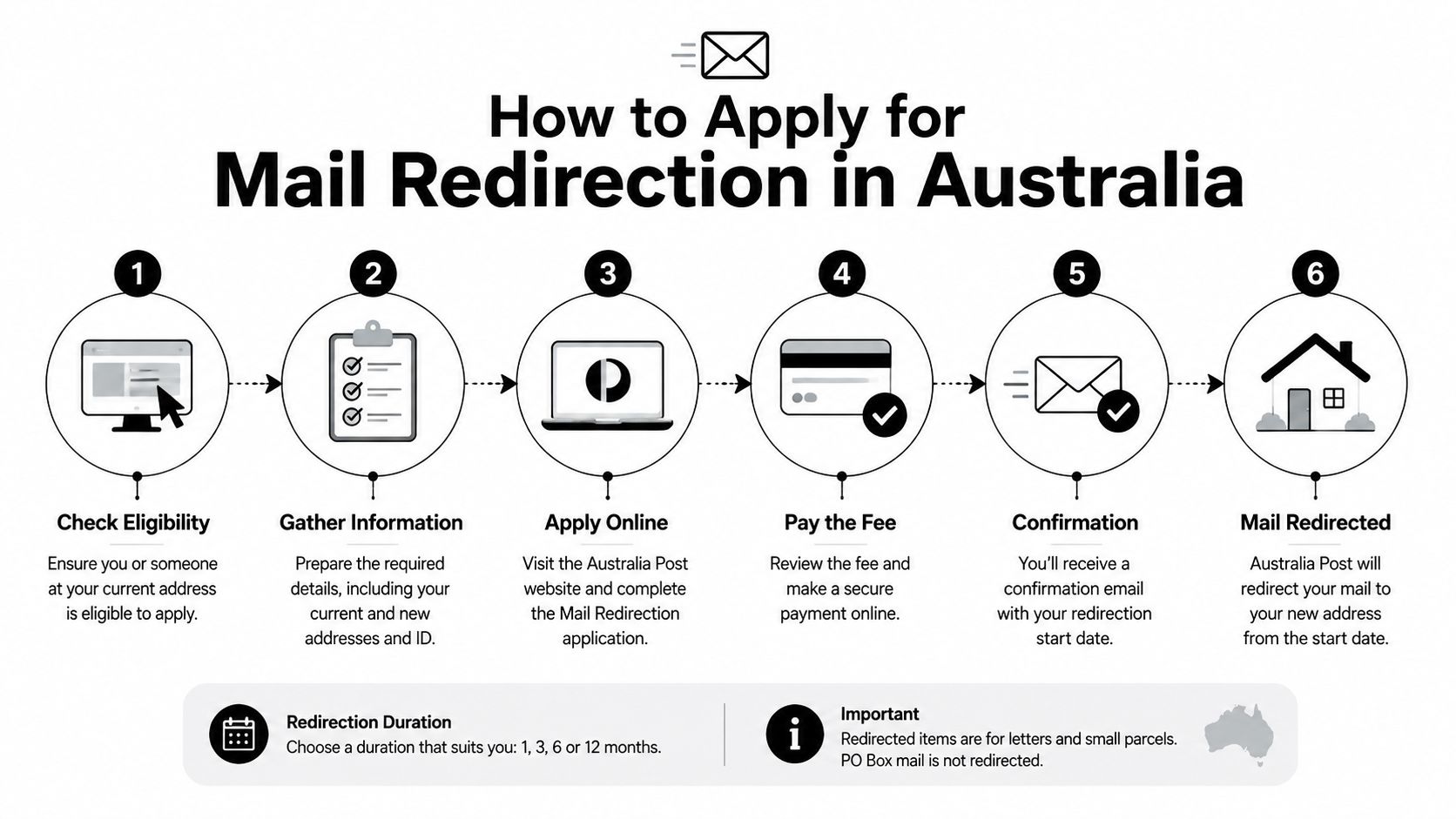
The online application flow
Start by choosing whether you need a personal or business redirect. Then enter the old address, the new address, the names to be covered, and the period you want. Pay, submit, and keep the confirmation for your records.
That's the path I recommend because it's quicker and easier to line up with settlement day. Service NSW also confirms that mail redirection can be purchased for 1, 3, 6, or 12 months, and that one application can include up to six names, which makes it practical for households and shared offices: Service NSW mail redirection referral.
When the Post Office visit makes sense
Go in-store if you're unsure about identity checks, need help sorting out a shared address, or are dealing with a business setup that doesn't fit the standard mould. The counter staff can walk through the details, which matters when a move involves multiple people, a home office, or a property where names and delivery patterns don't line up neatly.
The online process is usually the faster one if your documents are already in order. The in-person option is the safer one if you'd rather solve problems before they become rejected applications. If you're lining up your move tasks, pair the redirect with a proper checklist like this moving house checklist so it doesn't get buried under boxes and bond paperwork.
Apply online if your documents are ready and your move is settled, go in-store if you're unsure about eligibility or you share a tricky address. That's the decision rule. Don't overcomplicate it.
Mail Redirection Costs and Duration Options in Australia
The term you choose matters more than the sticker price. I see plenty of people grab the shortest option because it looks cheaper, then miss the first wave of utility notices, bank letters, and insurer mail that keeps arriving after the keys have changed hands.
Match the redirection to your move window, not to your budget alone.
| Personal Mail Redirection Pricing and Best-Fit Scenarios | ||
|---|---|---|
| Duration | Australia-Wide Price | Best For |
| Up to 1 month | $24.30 | A same-city move with very little overlap |
| Up to 3 months | $48.60 | A typical lease transition where dates don't line up cleanly |
| Up to 6 months | $72.90 | An interstate move where bills and subscriptions lag behind |
| Up to 12 months | $121.50 | A sale-and-buy situation with a long settlement chain |
Australia Post lists those personal redirection prices on its current redirection page, and the service is built around a nominated period, not an open-ended fix: Australia Post personal redirection pricing.
How I'd choose the term
A 1-month redirect suits a tight local move where the old and new places overlap barely at all. Use it only if settlement, handover, and utility changeover all happen in a neat line.
A 3-month redirect is the default for most renters because it catches the messy middle of a lease change. That is the point where one address has already been handed back, but a few senders still think the old one is active.
A 6-month redirect is the safer interstate pick. When you move from Melbourne to somewhere like Sydney or Brisbane, some senders update quickly and others drag their feet, so the mail trail lasts longer than the move itself. A 12-month redirect makes sense when you are selling, buying, and sitting through a slow settlement chain, or when the overlap between addresses is stretched out by utility transfers and delayed account updates.
If you are watching every dollar, do not just ask what the service costs. Ask how long your move will still be messy after handover, because that is where the missed notices show up. For a broader look at the expenses people forget while planning a move, see hidden costs in moving house.
Documents and Identity Verification You Need
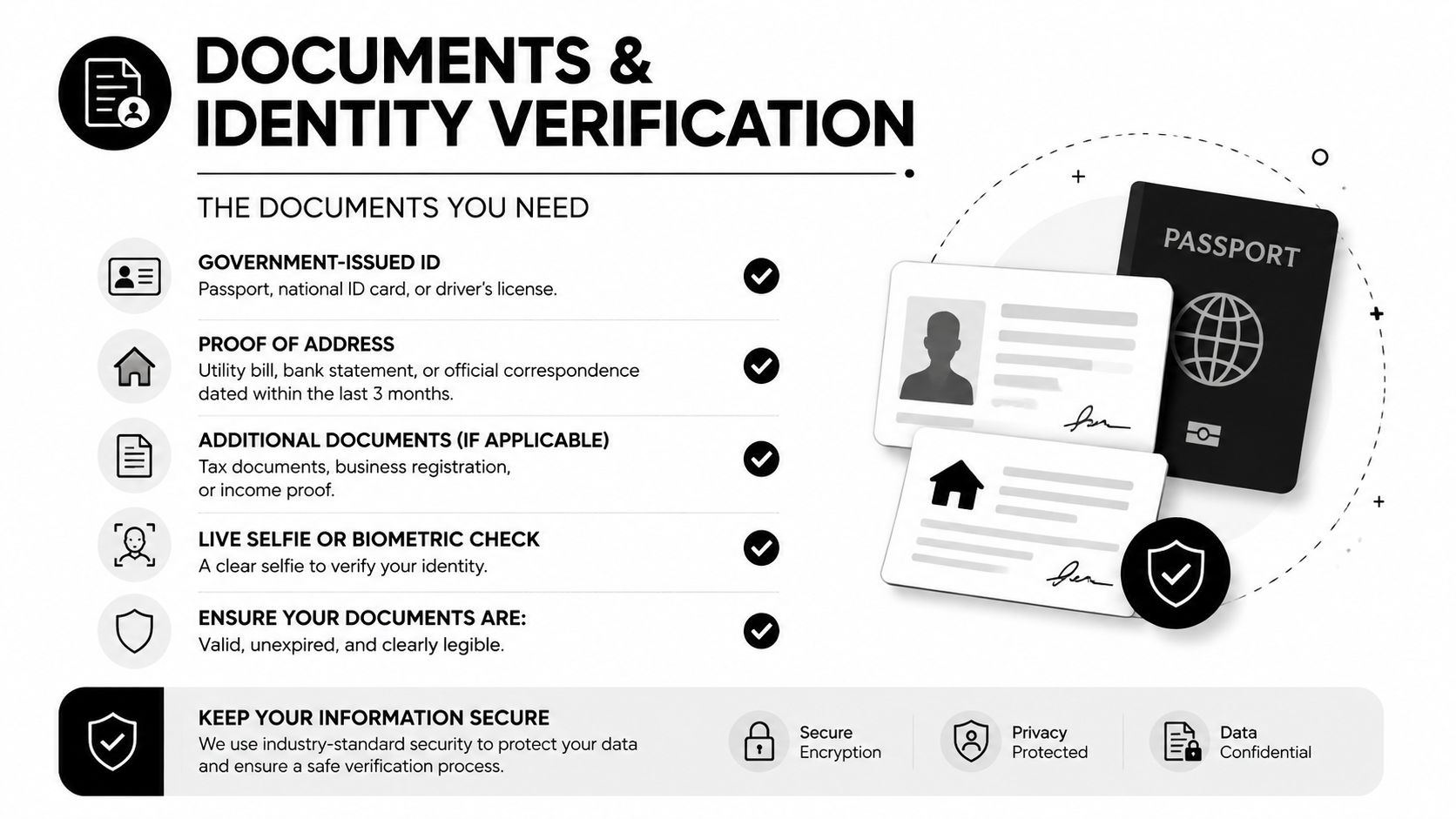
People get caught out at the counter. They arrive expecting a quick formality, then the application stalls because the ID does not line up with the name or address on the form. Incomplete applications stall here, and it is avoidable with the right documents in hand.
Australia Post requires either one primary ID document or two documents under its alternate pathway. The primary document can be an Australian driver licence, passport, birth certificate, citizenship certificate, or ImmiCard. If you do not have one of those ready, the alternate pathway asks for a document showing your name and Australian residential address, plus a signed document: Australia Post identity requirements.
What usually goes wrong
The usual failure point is simple. The name on the application does not match the name on the ID, or the address on a supporting document is already out of date. Expired IDs stop the process too, and people still bring them in hoping the clerk will make an exception.
If your name has changed, your address has just changed, or the paperwork is split across different people in the same household, sort that before you apply. Do not let the Post Office be the first place you find the mismatch. That warning matters even more if you are moving through a settlement period and still have letters flowing to the old place, because weak mail handling leaves sensitive notices exposed. A secure mailbox prevents identity theft through secure mailbox prevents identity theft, and that matters if your old or new property has poor mail security.
The identity check is there to stop misuse, but it also stops redirection being set up in the wrong name or against the wrong address.
Personal redirection versus business redirection
Personal redirection follows the person or household. Business redirection follows the trading name and registered address, and it still relies on one old delivery address. If a business runs from more than one site, each delivery address needs its own application.
That catches out sole traders and home-based operators who assume a personal redirect will pick up business mail as well. It often does not, especially when suppliers, the ATO, or ASIC use different naming on envelopes and account records. Business operators also run into trouble when mail is tied to a mixed-use property or a site with multiple delivery points. If you are lining up the rest of the move, keep the paperwork in order with the essential moving home to-do list.
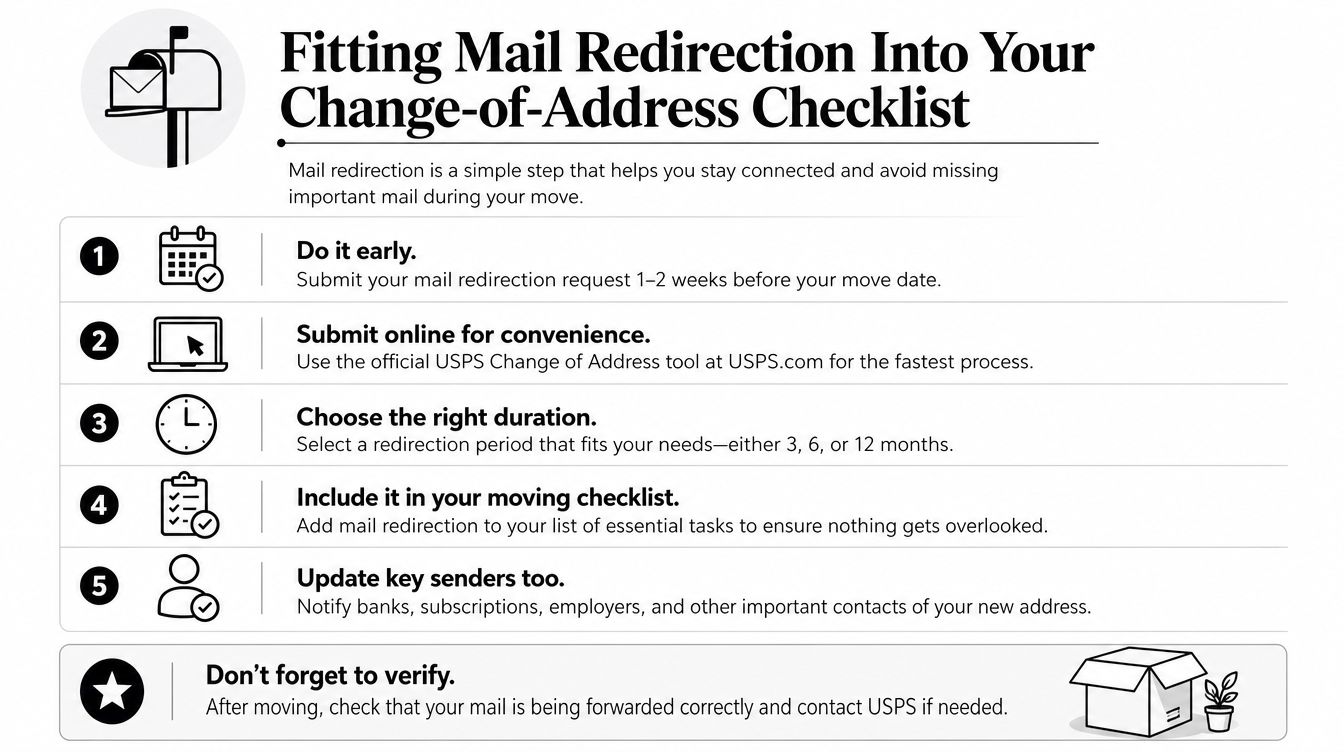
Fitting Mail Redirection Into Your Change-of-Address Checklist
Mail redirection works best when it sits in the middle of the change-of-address chain, not at the end. If you leave it until after settlement, you've already given senders a chance to post into the gap.
Start with the addresses that affect compliance and identity. Then cover the financial and utility accounts that send reminders, statements, and notices without asking whether you've moved yet. That order is the difference between an organised move and a week of chasing envelopes.
- Update your driver licence and vehicle registration first. These are the documents most likely to create follow-on mail, so get the source details right early.
- Set up mail redirection before settlement. That gives you cover for letters that go out during the handover period.
- Notify banks, insurers, energy, and telco providers. These senders are slow to catch up and often mail to the old address after your email is already updated.
- Change subscriptions and loyalty programs last. They're lower priority, but they still generate mail that can expose the old address.
The logic is simple. A 3-month or 6-month redirect is the safety net that catches the senders who miss the update, and they will miss it. The redirect does not replace direct address changes, it backs them up. If you're also sorting the rest of the move, keep the address work aligned with this moving house address change checklist.
Interstate Moves, Overlap, and Hidden Weaknesses of Redirection
Interstate relocation exposes the cracks fast. Settlement, lease handover, and utility cutover rarely line up neatly, so mail redirection has to cover the gap between addresses, not just the moving day itself. Melbourne to Sydney or Brisbane is the common headache, because the old property can still be producing letters while the new one is already receiving account notices and tenancy paperwork.
The weak points you need to plan around
Mail can still pass through automated sorting before the redirect catches it, so a few items will always slip through early or land late. Variant address formats create another failure point, especially when one sender uses the street address and another keeps an older version of the same details. Redirection also follows the delivery address, not the person, so inconsistent addressing gives the service less to work with.
Expiry is the other weak point. Once the chosen term ends, the redirect stops, even if your utilities, insurers, or government records are still catching up. People lose bills and notices there, not because the service is broken, but because the move takes longer than the redirect.
What to use as backup layers
A PO Box at the new address gives you one stable place for mail that should not sit in the letterbox at the house. A digital mail service helps if you are often away, or if you want to see incoming items before you are fully unpacked. Direct updates to each sender still do the core work, because redirection only catches what is already addressed to the old place.
For bigger moves, the backup plan needs more discipline. If you are crossing states with a full household or lining up a chain of settlement dates, use a mover who understands interstate timing, like long distance movers, so the paperwork gap is smaller and the mail problem does not get wider.
Redirection catches most mail, but senders who never receive your new address will keep posting to the old one regardless.
Mover's Checklist and What to Do When Mail Goes Missing
A move exposes every gap in your paperwork. Start the redirection before settlement, line up your mail redirection so it covers the handover gap, update banks and insurers by email, and keep a running list of every sender you notify. The first week at the new address needs close attention. That is when missing bills, licence notices, and other awkward surprises usually show up.
| Mover's Mail Redirection Timeline | ||
|---|---|---|
| When | Action | Why It Matters |
| Before settlement | Confirm the redirect start date | Mail needs to start catching items before the handover gap opens |
| At least five business days before settlement | Lodge the application | Gives the service time to commence properly |
| During the same week | Email banks and insurers | The direct update reduces reliance on redirection |
| Moving week | Keep a sender list | Helps you spot who still hasn't updated their records |
| First week after arrival | Check every item that lands | Anything unexpected may show you who missed the address change |
If mail still turns up at the old place, treat that as a signal to check the basics. Look at the sender address format first, because a changed street number, unit format, or old postcode can keep mail tied to the wrong address. Then check whether the redirect has expired. If you still need coverage, extend it or add a backup layer like a PO Box or digital mail service so the overflow has somewhere stable to go.
Missing items need a straight response. Chase the sender first, then Australia Post. The service can only move what has been addressed properly, and parcels follow their own rules, with extra conditions for redirection and retrieval noted in Australia Post parcels in transit. If a parcel was sent to a street address, a MyPost account is part of the process, and the delivery window can stretch while it is held and re-routed.
The hard part of moving is that admin and access changes collide in the same week. Lease handover, cleaning, keys, utilities, and post often overlap, and that is where mistakes happen. A detailed move-out checklist helps because the clean-up side and the mail side are usually happening at the same time, not one after the other. If your transition also includes end-of-lease work, the guide on move out deep cleaning San Antonio is a practical reminder of how quickly those jobs stack up.
A redirection service works best when it sits inside a full move plan, not as a standalone fix for a messy transition. If you're moving in Melbourne and want the relocation side handled properly, Get n Go Removals Melbourne can help with local, interstate, home, and office moves while you keep the paperwork moving in the background.