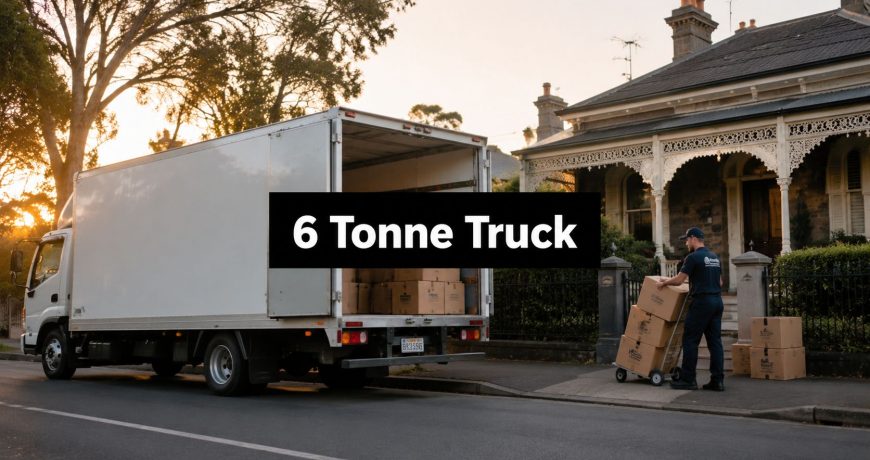
Your 6 Tonne Truck Guide for Moving in Melbourne 2026
You're probably staring at a growing stack of boxes, a couch that suddenly looks twice as large, and a dining table you swear was easier to get in than it'll be to get out. The question that usually follows is simple: will a 6 tonne truck fit my move, or am I about to book the wrong size?
That's a fair question, because “6 tonne truck” sounds precise, but in removals it often isn't. Customers use it to mean a practical moving truck for a house or apartment relocation. Operators use it as a vehicle class. What matters to you is more direct. How much can it take, can it get into your street, and will it save you from a second trip?
In Melbourne, this truck size often sits in the sweet spot. It's big enough for a substantial move, but still manageable in tighter suburban streets, apartment loading zones, and mixed-density neighbourhoods where a larger truck becomes more trouble than help.
Decoding the 6 Tonne Truck for Your Move
A lot of people ring up and describe the move before they ask about the truck. That's usually the right instinct. They'll say they've got a two-bedroom townhouse, a storage cage, outdoor furniture, and a narrow street in Brunswick. Or they're leaving an apartment in Southbank with a booked lift and strict loading time. In both cases, the truck choice affects the whole day.

A 6 tonne truck is often the removals industry workhorse for exactly that reason. It gives you meaningful carrying space without pushing into the access headaches that come with a much larger vehicle. If you're trying to estimate whether your contents are in the right range, a moving volume calculator is a useful starting point before anyone even talks truck size.
Why this size is so common
In Australia, trucks aren't a niche part of transport. The Australian Bureau of Statistics reported over 1.2 million registered road vehicles classified as trucks in recent national motor vehicle statistics, and for moving businesses the 6 tonne truck sits in the workhorse category used for suburban house moves because it's large enough for substantial payloads while remaining manoeuvrable in dense city streets, as noted in this trucking statistics overview.
That lines up with what works on real moving days. A smaller truck can be ideal for compact jobs, but once you add whitegoods, mattresses, dining settings, packed cartons, and the awkward extras like bikes or pot plants, the space disappears fast.
Practical rule: The right truck isn't the biggest one available. It's the one that balances volume, access, loading time, and how many trips the move needs.
What customers usually get wrong
The most common mistake isn't booking too big. It's assuming the truck size only relates to what fits inside. In practice, truck choice also affects parking, carrying distance, labour time, and whether the crew can work efficiently at both ends.
That's why a 6 tonne truck tends to suit Melbourne moves so well. It's often the point where you get solid carrying capacity without making the day harder in laneways, tight corners, apartment zones, or busy shopping strips.
What a 6 Tonne Truck Actually Holds
The term sounds straightforward, but it causes confusion all the time. Some people hear “6 tonne” and assume that means 6 tonnes of your belongings. That isn't how moving trucks work. The number usually refers to the vehicle's Gross Vehicle Mass, not the pure weight of what goes in the back.

GVM versus what you can actually load
A 6 tonne truck is classified by its Gross Vehicle Mass of 6,000 kg. Its real payload is the GVM minus the truck's own mass, fuel, and fitted equipment. Overloading can increase stopping distance and component wear, which is why professional movers check compliance plates and axle ratings before loading, as outlined in this explanation of truck weight classifications.
If you want a plain-English explanation of how truck weight ratings work, Patriot CDL's GVWR guide is one of the clearer breakdowns online.
When you book a suitcase with an airline, the weight allowance includes limits the carrier has already set. You don't get to ignore the structure holding it all together. A moving truck works the same way. The truck body, tail lift if fitted, protective pads, trolleys, straps, fuel, and crew all affect what can be carried legally and safely.
What that means for a household move
For most customers, weight isn't the main issue. Volume and shape are. Furniture takes space long before it becomes too heavy. Sofas, bed frames, fridges, washing machines, tallboys, modular lounges, and boxed-up kitchens create a loading puzzle, not just a weight total.
A 6 tonne truck usually suits moves where you have a genuine mix of furniture and cartons rather than just loose bags and a few small items. It's often chosen for:
- Family homes: the usual spread of beds, whitegoods, lounge furniture, dining furniture, and boxed storage
- Larger apartments: especially when there's lift access but you still need one efficient run
- Office relocations: desks, chairs, boxed files, monitors, and small shelving units
- Moves with awkward pieces: items that don't weigh much but take up a lot of room
A truck can look half full and still be close to properly loaded if the contents are bulky, stack-sensitive, or need protection between layers.
Why packing method changes capacity
Two customers can have the same number of rooms and need very different truck space. One has dismantled furniture, uniform cartons, and nothing loose. The other has assembled bed frames, open baskets, plants, garage gear, and fragile pieces that can't be stacked tightly.
That's why removals crews focus on loading sequence and furniture prep, not just room count. If you've got oversized or dense pieces, proper heavy furniture moving preparation makes a major difference to how safely and efficiently the truck can be packed.
A better way to think about truck capacity
Instead of asking, “Can a 6 tonne truck carry six tonnes?”, ask these three questions:
- How much floor-to-ceiling space do my contents take once packed properly?
- Do I have bulky items that limit stacking?
- Will access conditions make one well-packed trip more practical than multiple smaller runs?
Those answers are far more useful than the label on the side of the truck.
Is a 6 Tonne Truck Right for Your Move
A 6 tonne truck makes sense when you want enough room for a substantial load without stepping into the size penalties of a much larger truck. In Melbourne, that trade-off matters. Urban moves often involve detached homes, townhouses, and apartments in the same week, and a 6 tonne truck can handle multi-bedroom contents without the higher operating costs and access limitations of larger rigs, as discussed in this freight and truck-use overview.
The moves it suits best
If your move includes standard household furniture, packed cartons, whitegoods, and a few bulky extras, this truck size is often a sensible fit. It's particularly useful when you want to reduce the chance of needing a second run but still need a vehicle that can work around suburban parking and tighter streets.
It also suits office moves where the job isn't massive but still involves enough furniture and equipment that a van or smaller truck would create unnecessary back-and-forth.
The moves where it may be too small or too large
A 6 tonne truck isn't automatically right. For some jobs, it's more truck than you need. For others, it creates false confidence and leads to overflow.
| Truck Size | Best For | Typical Capacity |
|---|---|---|
| 4.5 tonne | Compact apartment moves, smaller homes, lighter office relocations, jobs with severe access limits | Best when contents are modest and carefully packed |
| 6 tonne | Many suburban house moves, larger apartments, townhouse relocations, small to medium office moves | A strong middle ground for volume and manoeuvrability |
| 8 to 10 tonne | Larger family homes, moves with extensive garage or outdoor contents, bigger commercial relocations | Better when overall volume is clearly beyond a mid-sized truck |
A quick self-check
You're often in 6 tonne territory if several of these apply:
- You have multiple major furniture pieces: beds, sofas, whitegoods, dining furniture, desks
- You're moving from a townhouse or family home: not just a lightly furnished apartment
- You want one efficient trip if possible: especially when building bookings or travel time matter
- Your property has access limits, but not extreme ones: the truck still needs to fit and turn safely
If your move is compact and minimalist, going smaller can save time and cost. If you've got extensive garage shelving, gym gear, a packed shed, outdoor settings, and business stock mixed into the move, you may need to size up.
The cheapest truck on paper can become the more expensive choice if it forces extra trips, longer loading time, or poor use of booked lift and parking windows.
If you're weighing truck size against budget, timing, and labour, it also helps to review what moving house costs in Melbourne so you can compare the effect of truck size on the full job rather than just the hourly line item.
Navigating Access Parking and Permits
A truck that suits your furniture still has to suit your street. That's where many moves either run smoothly or become frustrating. In Melbourne, access is often the deciding factor. A job can look simple on an inventory list, then turn difficult because the building has a narrow laneway, no legal stopping area, or a loading dock that only allows short booking windows.
Inner-city access changes everything
A 6 tonne truck often earns its place here. Truck size is only one factor. Operational safety matters too. Research on truck blind spots, often called dead angles, highlights the risks around larger vehicles, which is one reason a more manoeuvrable 6 tonne truck can be a practical advantage in tight streets and shared loading areas, as explained in this article on truck dead angles.
That doesn't mean every 6 tonne truck can go anywhere. It means the truck is often easier to position, reverse, and work around compared with larger vehicles.
What to check before moving day
Walk both addresses as if you were driving the truck in yourself. Look for the details that affect setup and carrying distance.
- Street parking: check clearways, permit zones, school restrictions, and event-day changes
- Driveway entry: look for tight turns, steep gradients, soft edges, and overhanging branches
- Building conditions: ask about lift bookings, dock access, height restrictions, and concierge procedures
- Neighbourhood layout: watch for tram corridors, laneways, one-way streets, and busy retail frontage
If you want to understand route-planning tools that help drivers avoid unsuitable roads and awkward turns, it's worth taking a look at guides that compare leading truck navigation tools.
Apartment moves need earlier planning
Apartment relocations usually reward early paperwork more than brute force. Lift reservations, loading dock bookings, caretaker approvals, and building move-in rules can matter just as much as truck size. A 6 tonne truck may be the right operational choice, but the day still falls apart if the truck arrives and there's nowhere legal to stop.
Ask your building manager one direct question: “Where exactly can the truck stand, and for how long?” That answer saves more time than almost any packing tip.
For a smoother run through strata rules, booking windows, and common apartment pitfalls, this apartment move planning guide is a practical reference.
Booking Your Truck and Choosing Services
Once you know a 6 tonne truck is the right fit, the next decision is how much help you want on the day. That's where people often underbook. They focus on the truck and forget the labour, packing support, insurance, and timing around keys, settlement, or building access.
Book around your constraints, not just your preferred date
The best booking time is the one that matches your access conditions. If your apartment only gives a morning dock slot, or your settlement happens midday, the truck and crew need to be scheduled around that reality.
When you book, be ready to provide:
- Property type: house, townhouse, apartment, office
- Access details: stairs, lifts, laneway access, parking limits
- Large or delicate items: piano, marble table, oversized fridge, gym equipment
- Timing restrictions: key collection, settlement, loading dock window, body corporate rules
Choose the service level that matches the move
A basic truck-and-labour option works well when you're already packed, furniture is disassembled, and access is straightforward. A broader removals service makes more sense when the move includes fragile packing, heavy lifting, difficult access, or tight scheduling.
Common service add-ons include:
- Packing and unpacking: useful when you're short on time or want glassware, kitchenware, and fragile items handled professionally
- Disassembly and reassembly: especially helpful for beds, dining tables, office desks, and modular furniture
- Protective materials: blankets, mattress covers, shrink wrap, trolley use, straps
- Transit and liability cover: important to discuss clearly before move day so you understand what is and isn't covered
For customers comparing options, this guide to choosing the right removals firm lays out the practical questions worth asking before you commit.
What works and what doesn't
What works is giving an accurate inventory, mentioning access issues early, and choosing a service level that reflects the job. What doesn't work is saying “it's just a quick move” when the job includes multiple flights of stairs, flat-pack assembly, storage stacking, and a late lift booking.
One practical option in Melbourne is Get n Go Removals Melbourne, which operates company-owned trucks from smaller sizes through to larger vehicles and handles local and interstate moves, packing, storage, and furniture handling. The useful point for customers isn't the brand name. It's that you want a provider whose truck range and service scope match the move you're planning.
Your Melbourne and Interstate Moving Checklist
A 6 tonne truck is often the right call when your move is too large for a small truck but too access-sensitive for a bigger one. Its value lies in this balance. It handles substantial household or office contents while still staying practical for Melbourne streets, apartment loading areas, and time-sensitive jobs.

Melbourne move checklist
Use this before a local house or apartment relocation:
- Confirm truck access: inspect the street, driveway, laneway, and stopping options at both addresses
- Lock in building requirements: book lifts, loading docks, and move windows with enough time to spare
- Pack for fast loading: uniform cartons, labelled rooms, dismantled furniture, nothing loose in bags if it can be boxed
- Check local disruptions: roadworks, event-day closures, school zones, and tram corridor restrictions
- Protect key items: mattresses, TVs, artwork, and whitegoods should be identified before the crew arrives
- Prepare an essentials kit: chargers, medications, kettle, toiletries, basic tools, documents
Interstate move checklist
Longer runs need a slightly different mindset:
- Confirm the collection and delivery window: don't assume interstate timing works like a same-day local move
- Separate urgent items: keep essentials with you rather than loading everything into the truck
- Photograph fragile or valuable pieces: useful for condition records before transit
- Organise utility timing carefully: align electricity, internet, and access at the new address
- Review access at the destination too: interstate customers often plan the departure well and forget the arrival conditions
- Think about storage contingencies: if keys, settlement, or site access shift, temporary storage can keep the move on track
A smooth move usually comes down to three things. Accurate information, realistic truck sizing, and access planning done early.
If you're unsure, ask for advice based on your inventory and addresses, not just your room count. That's how you avoid the usual moving-day surprises.
If you want practical advice on whether a 6 tonne truck suits your Melbourne house, apartment, office, or interstate move, Get n Go Removals Melbourne can help you assess the contents, access, and service level needed for a smoother relocation.