
Decoding Interstate Moving Costs in Australia
Embarking on a move to another state is a massive step, and getting a handle on the costs involved is the first hurdle. So, how much are you looking at? In Australia, the average interstate moving costs typically land somewhere between $1,400 and $5,000. The final figure truly hinges on the volume of your belongings and the distance of your journey.
For a clearer picture, moving a standard three-bedroom house usually costs between $3,625 to $5,075 for a traditional, dedicated removalist service.
A Snapshot Of Your Moving Budget
Trying to budget for an interstate move can feel like assembling a complex puzzle. Nailing down the costs early on is the most critical piece, helping you make informed decisions and avoid last-minute financial stress. The price isn't a single flat figure; it’s a composite of various factors, from the volume of your goods to the specific moving service you select.
To give you a clearer idea, let's break down the numbers. While a standard move for a three-bedroom home (around 25-35 cubic metres) sits in the $3,625 to $5,075 range, there are more strategic ways to relocate. Opting for a flexible service like backloading can dramatically slash that cost, bringing it down to between $2,375 and $3,325. This represents a significant saving and highlights why understanding your options is paramount.
For those who appreciate the details, current industry rates place standard moves at approximately $176.78 per cubic metre. In contrast, backloading can start from as low as $95 per cubic metre, as highlighted in a comprehensive analysis of Australian moving costs on bestratedtransport.com.au.
Comparing Standard Moves And Backloading
So, what’s the real difference between these services? A standard move is akin to chartering a private jet—you secure the entire truck for your exclusive use, with a fixed, predictable schedule. It's built for convenience. Backloading, on the other hand, is more like a ride-share for your belongings; you share truck space with other customers' items, which significantly reduces the cost. The trade-off is a need for more flexibility with your delivery window.
Our team of expert long distance movers can guide you through which option best aligns with your timeline and budget.
To simplify this further, let's examine a quick table that breaks down the potential costs.
Estimated Interstate Moving Costs At A Glance
This table provides a rough guide to what you might expect to pay when moving between major Australian cities. It compares the prices for a standard, dedicated removalist service against the more budget-friendly backloading option.
| Home Size (Bedrooms) | Average Volume (Cubic Metres) | Estimated Standard Cost Range | Estimated Backloading Cost Range |
|---|---|---|---|
| 1-Bedroom Home | 5-10 m³ | $1,400 – $2,500 | $750 – $1,500 |
| 2-Bedroom Home | 15-20 m³ | $2,500 – $3,800 | $1,500 – $2,500 |
| 3-Bedroom Home | 25-35 m³ | $3,625 – $5,075 | $2,375 – $3,325 |
| 4+ Bedroom Home | 40+ m³ | $5,000 – $8,000+ | $3,500 – $5,500+ |
As you can see, the savings with backloading become even more significant as the size of your home increases. It's a fantastic option if you have some flexibility in your moving schedule.
Here's how it plays out for different home sizes:
- 1-Bedroom Home (5-10 m³): A smaller move like this is practically designed for backloading. You can easily save hundreds of dollars.
- 2-Bedroom Home (15-20 m³): This is often the sweet spot. It’s well worth getting quotes for both standard and backloading services to compare the value proposition.
- 3-Bedroom Home (25-35 m³): As we've seen, the savings can exceed a thousand dollars if you choose the right service.
- 4+ Bedroom Home (40+ m³): For large family homes, the price gap between a standard move and backloading is massive, making it a seriously attractive way to reduce expenses.
What Actually Determines Your Moving Bill?
Have you ever looked at a moving quote and wondered how the final number was calculated? It’s not an arbitrary figure. Your total interstate moving costs are determined by a combination of key factors. Think of it as a formula with four main variables: the volume of your belongings, the distance of the move, the accessibility of your properties, and the timing of your relocation.
Understanding these elements allows you to see precisely what you’re paying for. It transforms the large, mysterious number on the quote into a clear, itemised breakdown, empowering you to plan more effectively and potentially reduce costs. Let’s delve into the components that make up your moving bill.
The flowchart below provides a quick visual comparison of the two primary pricing models for interstate moves, illustrating the difference between a standard dedicated service and a backloading option.
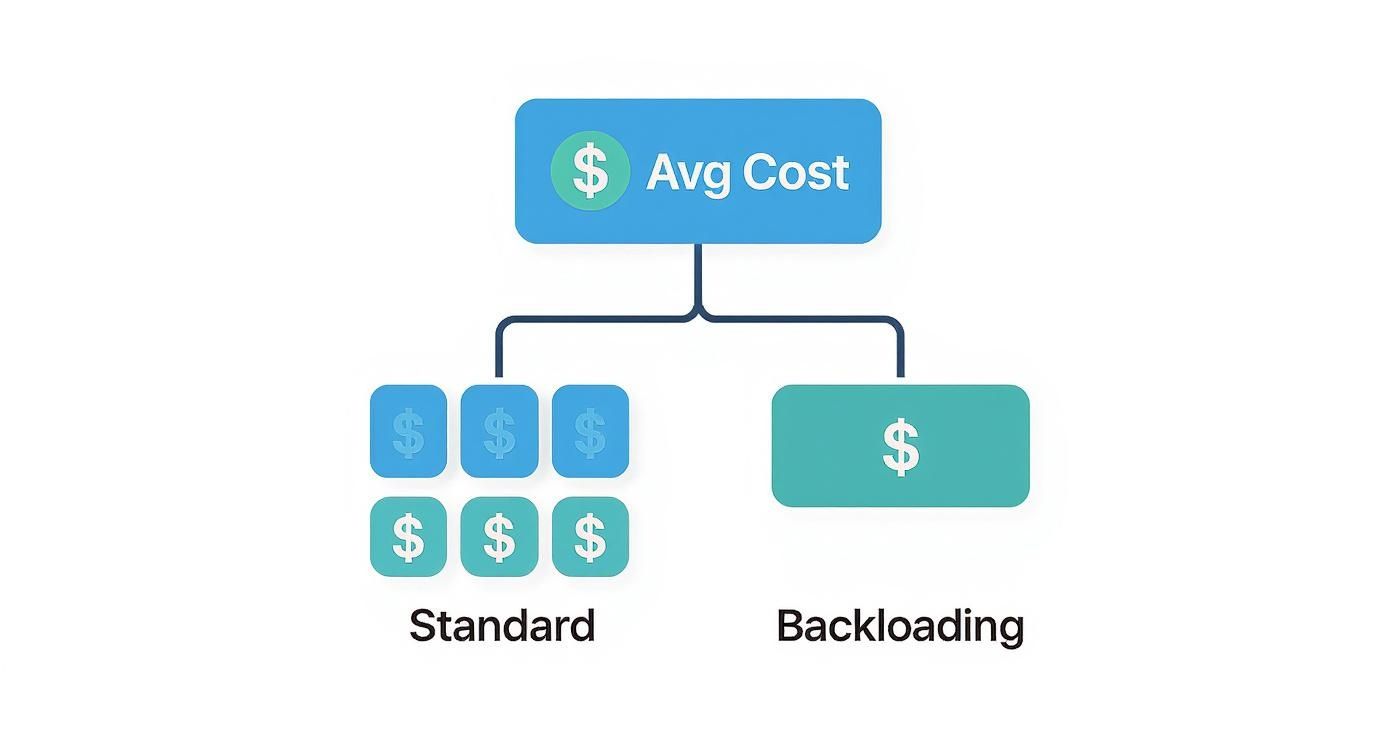
As you can see, while a standard move provides a dedicated truck, backloading can be a much more economical choice because you are sharing the transport space and associated costs.
Volume: The Foundation Of Your Quote
The single most significant factor driving your moving bill is volume. In simple terms, this is the total space all your belongings occupy in the truck, measured in cubic metres (m³). The more items you have, the higher the price. It's not just about the quantity of things, but their overall size. A couple of large, bulky sofas can easily take up more room than dozens of small boxes.
Professional removalists are experts at estimating volume. They will typically request a detailed inventory of your items or conduct a virtual or in-person walk-through of your home to calculate this figure accurately. This is precisely why a thorough declutter before you request a quote is one of the most effective ways to lower your interstate moving costs. Less stuff means less space, which translates directly to less money.
Distance: The Long Haul Factor
It’s self-evident that the distance of your move plays a massive role in the final cost. A relocation from Sydney to Brisbane presents a completely different logistical challenge than a cross-country journey from Sydney to Perth. Longer distances mean more fuel consumption, more hours on the road for the crew, and consequently, higher labour costs.
Distance also influences factors like fuel levies, which can add up substantially on long-haul routes. Consider the 2024 figures: a standard move from Perth to Sydney is approximately $5,412, but this can drop to around $3,000 with a backloading service. Similarly, a Perth to Melbourne move might be $5,614 for a standard service, with a backloading price of $2,873. Fuel levies can account for about 20% of the cost for trips over 80 kilometres, and toll fees might add another $15 to $50.
Key Takeaway: The further the truck has to travel, the more you should expect to pay. This isn't just about fuel; it covers vehicle wear and tear and the wages for the team's transit time.
Accessibility: How Easy Is The Job?
Accessibility refers to how easy—or difficult—it is for the removalists to transport your belongings from your house to the truck and vice versa at the destination. This is one of the hidden factors that can add unexpected charges to your bill if not disclosed upfront.
Consider the potential hurdles at both your origin and destination properties:
- Stairs: Are you living on the third floor of an apartment building with no lift? Each flight of stairs adds extra labour and time.
- Parking: Can the moving truck park directly outside your front door? If the crew has to carry everything over a significant distance (known as a "long carry"), this adds to the labour time and cost.
- Lifts: Does your building require a specific lift booking? Any delays or restricted access can disrupt the schedule and increase the cost.
- Narrow Streets: If a large truck cannot get close due to tight street access, a smaller shuttle vehicle may be required, which is an additional expense.
Being transparent about these details from the outset allows the moving company to provide a much more accurate quote. For a deeper dive into how these factors affect pricing, please see our guide on understanding moving company costs.
Timing: When You Choose To Move
Finally, when you move can make a significant difference to the price. Much like the travel industry, the removalist business has distinct peak and off-peak seasons.
- Peak Season (Higher Cost): Summer, school holidays, and the end of the month are invariably the busiest periods. Demand is at its peak, so prices increase accordingly.
- Off-Peak Season (Lower Cost): Moving in autumn or winter, mid-month, and during the middle of the week is almost always more affordable. Companies have more availability and may offer better rates to fill their schedules.
If your schedule allows for flexibility, planning your move for an off-peak period is a simple yet highly effective way to reduce your final bill.
Reading Between The Lines Of Your Quote
Receiving a moving quote can sometimes feel like trying to decipher a complex code. You see various line items, industry jargon, and a final total at the bottom. While that total commands your attention, the real key to avoiding a budget blowout on moving day is understanding how the removalist arrived at that number. It’s about looking beyond the basic transport fee to grasp the full story of your interstate moving costs.
This is where you can take genuine control of your budget. When you know what to look for, you can identify potential extra charges before they arise and ask the right questions to ensure your quote is truly all-inclusive. Let’s pull back the curtain on the common add-ons and hidden fees that can inflate your final invoice.
Common Add-On Services And Their Costs
Most removalists offer a menu of optional services designed to make your move less stressful. These are conveniences that come with a price tag, and it is entirely your decision whether they are a worthwhile investment for your circumstances.
-
Professional Packing: If the thought of wrapping every plate and boxing up your entire life is causing you stress, this service is a lifesaver. Professional packers can complete the job in a fraction of the time, but it will add to the cost, typically between $300 and over $1,500, depending on the size of your home.
-
Packing Materials: Even if you pack yourself, you will still need boxes, tape, and protective wrap. You can certainly source these yourself, but purchasing them directly from your removalist is often more convenient, though usually slightly more expensive. Budget anywhere from $100 to $400+ for a complete set of materials.
-
Furniture Disassembly and Reassembly: That complex flat-pack wardrobe or king-sized bed frame may need to be dismantled to fit through the door. Removalists are proficient at this, but it will be listed as a separate charge on your quote. This can add $75 to $300 to your bill, based on the complexity of the furniture.
-
Temporary Storage: Is there a gap between leaving your old residence and gaining access to the new one? You’ll need a place to store your belongings. Many movers offer this service, with prices depending on the volume of your goods and the duration of storage required.
It is always best to be clear about which of these services you require from the outset. Adding them on at the last minute is almost always more expensive.
Shining A Light On Hidden Fees
Even more frustrating than optional extras are the surprise charges that can appear on your final invoice. These "hidden" fees are not usually malicious; they often arise from access issues or delays that were not factored into the original quote.
A truly transparent quote should account for all foreseeable challenges. The best way to avoid surprises is to provide your removalist with every detail about both your pickup and delivery locations.
Here are the most common culprits to watch for:
- Stair Carry Fee: If your apartment is on the third floor and there is no lift, you can expect an additional charge. This fee covers the extra time and physical effort required from the crew.
- Long Carry Fee: This fee applies when the moving truck cannot park directly outside your front door. If the team has to carry everything beyond a certain distance (e.g., 15-20 metres), a fee is usually added to cover the extra labour.
- Shuttle Service Fee: If you live on a narrow street or in an area where a large moving truck cannot fit, a smaller "shuttle" truck may be needed to transport your goods from the main truck to your door. This can be a significant additional cost.
- Waiting Time or Delay Fee: If you are not ready when the movers arrive, or if the settlement on your new home is delayed, you could be charged an hourly rate for the crew's downtime.
The best way to get a firm quote and avoid these issues is to provide a detailed inventory of your belongings. For an excellent tool to assist with this, you can calculate the volume of your items with our handy cubic metre calculator. This helps ensure you are not paying for truck space you do not need. By being upfront about any potential obstacles, you provide the removalist with all the information necessary to offer a fixed price you can rely on.
Proven Strategies To Reduce Your Moving Costs
Understanding the factors that influence your moving quote is one thing, but actively taking steps to lower that final number is where you can make a real impact. With a few strategic moves, you can significantly reduce your interstate moving costs without turning your relocation into a stressful ordeal. It’s all about being savvy and knowing where your efforts will yield the greatest financial benefit.
Consider this section your strategic plan for a more affordable move. We will explore practical, proven tips—from the substantial savings of backloading to simple actions like decluttering and sourcing free boxes. Each strategy is straightforward and designed to put you in control of your budget.
Embrace The Power Of Backloading
If there is one secret weapon for slashing your moving bill, it is backloading. Imagine it as a carpool for your furniture. When a moving truck completes a job and needs to return to its home base, it often travels empty. Backloading allows you to book that empty space for your belongings, meaning you only pay for one leg of the journey, not the round trip.
This simple concept can lead to enormous savings, often reducing your transport bill by up to 50% compared to booking a dedicated truck. The only consideration is that you may need to be more flexible with your delivery dates. However, for most people, the money saved far outweighs this.
Declutter Before You Do Anything Else
Every single box, piece of furniture, and decorative item you move adds to the total volume of your load. Since volume is a primary driver of your final price, the logic is simple: the less you move, the less you pay. Before you even request a quote, be ruthless with decluttering.
Go through each room and sort everything into three categories: keep, donate/sell, and discard. This not only reduces the amount you need to transport but selling unwanted items can also generate some extra cash. It simply doesn't make financial sense to pay to move something you no longer need or want.
By eliminating just 10% of your belongings, you could save hundreds of dollars on your final moving bill. It’s the most direct way to control the primary cost factor of your move.
Master The Art Of DIY Packing
While hiring professionals to pack for you is incredibly convenient, that convenience comes at a significant cost. If you are budget-conscious, rolling up your sleeves and packing yourself is a guaranteed way to save a substantial amount of money.
Start several weeks before the move and tackle it one room at a time. It certainly requires effort, but the savings can easily amount to several hundred dollars or even more, depending on the size of your home. For extra guidance, check out these tips to keep your moving costs down to make your DIY packing even more efficient.
Source Your Packing Materials For Free
The cost of new boxes, tape, and bubble wrap can accumulate quickly. With a little forward planning, however, you can find most of what you need without spending a cent.
- Local Businesses: Supermarkets, liquor stores, and large retail outlets often have stacks of sturdy cardboard boxes they are happy to give away. Simply ask a manager for the best time to collect them.
- Online Marketplaces: Check websites like Facebook Marketplace or Gumtree. You will often find people who have just moved and are eager to dispose of their perfectly good boxes.
- Creative Padding: Use what you already own! Towels, blankets, sheets, and even clothing are perfect for wrapping fragile items, which means you won't need to purchase rolls of bubble wrap.
When you're trying to trim the budget, it's also worth looking into whether you can find a cheap interstate courier service to handle a few smaller or single items separately.
Choose Your Moving Date Wisely
When it comes to moving, timing is everything. The removals industry has its own peak and off-peak seasons, and the date you choose can have a massive impact on your quote.
To secure the best possible rates, try to book your move during the off-season, which is generally from February to September. Avoid school holidays and the end of the month, as this is when demand (and prices) skyrockets. If you have the flexibility, aim for a weekday move—particularly from Tuesday to Thursday—as weekends are always the most expensive.
To make it even clearer, here’s a quick checklist to help you identify where the savings are.
Your Cost-Saving Checklist For An Interstate Move
| Action Item | Standard Approach (Higher Cost) | Money-Saving Alternative | Potential Savings |
|---|---|---|---|
| Transport | Booking a dedicated moving truck for your exclusive use. | Using a backloading service to share truck space. | Up to 50% on transport costs. |
| Volume | Moving everything you own, including unwanted items. | Decluttering and selling/donating items before getting a quote. | $100s – $1,000s, depending on volume. |
| Packing | Paying for a full professional packing service. | Packing all boxes and items yourself. | $300 – $1,000+ |
| Materials | Buying brand-new boxes, tape, and bubble wrap from a supplier. | Sourcing free boxes and using household linens for padding. | $100 – $300+ |
| Timing | Moving on a weekend, during school holidays, or at month's end. | Booking a mid-week move during the off-peak season (Feb-Sep). | 15-30% on the total moving cost. |
A little bit of planning really does go a long way. By implementing even a few of these strategies, you can make your interstate move significantly more affordable without adding extra stress.
Navigating The Australian Removalist Industry
Choosing a company for your interstate move can feel like an overwhelming task. You are not just booking a truck; you are entrusting your entire household of possessions to a team of people. To make the right decision, it helps to understand the Australian removalist industry itself. It is a large, competitive market, which is beneficial for finding a good price but also means you must be vigilant to avoid unreliable operators.
When you understand the business side of things, you become a more discerning customer. It puts the figures on your quote into context, helping you recognise why some prices are fair and why others are likely too good to be true. This insight allows you to evaluate companies based on their professionalism and value, not just the final dollar amount.
The Scale Of The Moving Market
The Australian moving industry is a significant contributor to the national economy. It has experienced substantial growth and is now valued at approximately $2 billion annually as of 2025. The majority of this revenue comes from long-distance and interstate moves, which generate $786.2 million—a substantial 42.6% of all revenue.
With roughly 14,000 companies competing for business, the market is described as "highly fragmented." This simply means there is a vast number of different movers, which explains the wide variation in prices and service quality you will encounter. For a deeper look at these trends, the ABS has some great data on interstate migration patterns.
This fierce competition is a double-edged sword. While it encourages companies to offer competitive deals, it can also create a "race to the bottom" where some operators cut corners on safety, training, and equipment to provide an unbelievably low quote.
The sheer number of movers means that thorough research is non-negotiable. A cheap price might be tempting, but it could end up costing you dearly in terms of reliability, professionalism, and the safety of your belongings.
Understanding The Costs Behind The Quote
So, what are you actually paying for when you receive a quote? While fuel and truck maintenance are significant expenses, the single largest cost for any moving company is labour. Of the industry's $2 billion annual revenue, a staggering $1.2 billion is allocated to wages.
This highlights why professional movers charge what they do. You are paying for the skill, physical labour, and time of a properly trained crew. Reputable companies invest in their people—through proper training, background checks, and fair wages—and this is always reflected in their pricing.
When weighing your options, consider what a fair price actually secures for you:
- A well-maintained fleet of trucks that are unlikely to break down mid-journey.
- Experienced, full-time staff who know how to handle your furniture and precious items with care.
- Comprehensive insurance coverage, such as public liability and transit insurance, to protect you if something goes wrong.
- Professional equipment, from trolleys and protective blankets to straps that keep everything secure.
Understanding these operational costs helps you view a quote not just as a number, but as a reflection of the quality and security you are receiving for your money. For guidance on identifying the best in the business, our article on the best interstate removalists in Australia offers valuable tips to help you find a truly trustworthy partner for your move.
Your Final Interstate Moving Checklist
Let's consolidate everything into a practical action plan. Think of this checklist as your roadmap for a calm, affordable, and organised interstate move. We’ve broken it down by timeline, transforming a massive undertaking into a series of simple, manageable steps.
Following this will minimise stress and keep your interstate moving costs under control, ensuring there are no unpleasant surprises.
8 Weeks Before Your Move
The focus now is on planning and research. The work you do at this stage will save you significant stress later. This is where you lay the foundation for a smooth relocation.
- Build Your Moving Budget: Outline every potential cost. Go beyond the removalist fee—include packing supplies, travel expenses, and even the takeaway meals for your first night.
- Shop Around for Removalists: Begin getting quotes from at least three different companies. Don't just look at the price; compare their insurance policies, services offered, and online customer reviews.
- Start the Big Cull: This is the perfect time to go through every room and declutter ruthlessly. Create piles for keeping, selling, donating, and discarding. Fewer items mean a cheaper move.
4 Weeks Before Your Move
With one month to go, things are becoming more tangible. This is the time to finalise your decisions and begin the hands-on preparation. Staying organised is your best strategy.
Pro Tip: This is the ideal time to arrange insurance. You need to ensure your belongings are covered from door to door. Review your current policies or look into specific moving insurance. For a detailed overview, this guide on Home Insurance Personal Property Coverage is an excellent resource.
- Book Your Removalist: Have you found the right company? Lock them in. Get your moving dates confirmed and ensure you have everything in writing—every service, every cost, every detail.
- Gather Your Supplies: It's time to assemble your packing toolkit. Stock up on boxes, packing tape, bubble wrap, and high-quality markers.
- Pack the Non-Essentials: Begin with items you won't need for the next few weeks, such as books, out-of-season clothing, spare linens, and decorative objects.
- Handle the Life Admin: Start notifying relevant parties of your move. Arrange for utilities to be connected at the new address and disconnected at the old one. Update your address with your bank and subscriptions, and set up mail forwarding.
1 Week Before Your Move
It’s the final countdown. This week is about double-checking details and packing the remaining items. Completing these tasks now will ensure moving day runs as smoothly as possible.
- Check In with Your Removalist: Give them a quick call to confirm their arrival time and review any access details, like tricky parking or stairwells.
- Finish Packing: Box up everything else. Prepare an "essentials box" with everything you'll need on the first night: toiletries, phone chargers, medications, a kettle, coffee, and basic kitchen supplies.
- Prep Your Appliances: Defrost the fridge and freezer (don't leave this until the last minute!). Disconnect the washing machine and ensure it's fully drained.
- Secure Important Documents: Gather all crucial paperwork—passports, birth certificates, moving contracts—and keep them with you in a safe, easily accessible place.
On Moving Day
The big day is here. Your primary role is to direct the process and ensure the plan comes together. Be available to answer questions and guide the movers.
- Protect Your Floors: Before any boxes are moved, lay down old sheets, cardboard, or protective coverings to prevent scuffs on your carpets and floors.
- Supervise the Loading: Remain present while the truck is being loaded. You can point out fragile boxes and answer any questions the crew may have.
- Do One Last Lap: Once the truck is full, walk through your empty home one final time. Check every cupboard, corner, and the garage to ensure nothing has been left behind.
- Sign Off on the Paperwork: Before the truck departs, carefully review the inventory list (bill of lading) and sign it. This document is your official record of what is on board.
Frequently Asked Questions
When you are planning a major move, questions are bound to arise. To help you feel completely prepared, here are some direct answers to the most common queries we receive about interstate moving costs.
Is It Cheaper To Move My Own Furniture Interstate?
At first glance, a DIY move might seem more economical, but hidden costs can quickly add up. You must account for truck rental, fuel for a very long journey, packing materials, potential accommodation, and the value of your own time and physical effort. It's a significant undertaking.
For long distances across Australia, hiring a professional is often the more financially prudent and far less stressful option. Services like backloading can be surprisingly affordable, removing the complex logistics from your plate so you don't have to manage everything yourself.
How Can I Get The Most Accurate Moving Quote?
The secret to obtaining an accurate quote is simple: provide comprehensive details. A precise inventory list is your most valuable tool. List every piece of furniture, estimate the number of boxes, and be sure to highlight any particularly large, heavy, or fragile items.
It is also crucial to be upfront about any access challenges at both your origin and destination properties. Are there flights of stairs? A long driveway? Is parking difficult? Mentioning these factors from the outset prevents unexpected charges. A pro tip: offering a video call walkthrough with the removalist is an excellent way to ensure your quote is solid.
What Is The Best Time Of Year To Move Interstate?
If your schedule has some flexibility, you can save a significant amount of money. The most affordable time to move is during the off-peak season, which in Australia generally runs from February to September.
To maximise your savings, avoid school holidays and the last few days of the month. This is when demand, and consequently prices, skyrockets. A move booked for the middle of the week and middle of the month will almost always be cheaper than a Friday or weekend slot.
Do I Really Need Moving Insurance?
Absolutely, yes. While professional removalists are extremely careful, the reality is that incidents can occur when your life's possessions are travelling thousands of kilometres. Many people assume their standard home and contents insurance covers their items in transit, but most policies do not.
Any reputable mover will offer transit insurance, which is specifically designed to protect your goods while they are being moved. It is a small price to pay for complete peace of mind, ensuring your valued belongings are properly protected from door to door.
Ready to get a clear, no-nonsense quote for your big move? The team at Get n Go Removals Melbourne has been making interstate relocations smooth and affordable for over a decade. We use our own fleet and our full-time, police-checked staff, so you know your belongings are in the safest hands possible. Plan your stress-free move by visiting us at https://www.getngoremovals.com.au today.