

ADL to MEL Moving Costs and Timeline
A low headline price can cost more than a direct move. The Adelaide to Melbourne drive takes about 8–9 hours, but household delivery timing depends on the load, access and date flexibility. A shared run may leave you waiting while your beds and other essentials are still in transit.
Before booking an ADL to MEL removalist, check whether your keys, building access and temporary living arrangements can accommodate a flexible delivery date. If a delay means extra rent, storage or a missed settlement, the cheapest backload may cost more overall.
ADL to MEL Cost Bands and Delivery Windows
Driving time and collection-to-delivery time are different measures. The driver has to load, secure the furniture, take required rest, reach the delivery address and unload within its access conditions. A shared truck also has other consignments to accommodate.
Published interstate estimates span roughly AU$1,550–AU$5,850, while broader consumer-facing listings run from about AU$2,500 to AU$9,500 or more, with inventory, access, service level and scheduling affecting the price, according to this Adelaide-to-Melbourne interstate moving guide. Those are market planning bands, not a price list for a particular home.
ADL to MEL planning bands by home size
Use the following as a booking framework, not a delivery guarantee. The tighter windows are options to request and confirm in writing, rather than promises that follow automatically from bedroom count.
| Home and service | Delivery window | When it fits |
|---|---|---|
| Studio or 1 bedroom, shared weekly run | Collection day plus 1–4 days | Small volume and dates can slide |
| 2 bedroom, shared weekly run | Collection day plus 1–4 days | Typical home with a flexible handover |
| 3 bedroom, shared or part-dedicated | 1–3 days | More volume or a preferred delivery day |
| 4 bedroom, dedicated direct truck | About 1–2 days after loading | Fixed settlement and a full household |
| Date gap held in storage | Days to months on top of transit | Lease or settlement does not overlap |
A lightly furnished apartment can suit the lower end of a shared-load budget if collection and delivery remain flexible. Add a packed garage, outdoor furniture and difficult stairs, and the bedroom label stops being a useful guide.
A larger household doesn't automatically require a dedicated vehicle. However, a full load combined with an immovable handover can make dedicated transport the more workable choice.
What pushes a job towards the higher band
Volume determines space; access determines labour. A sofa that rolls straight through a ground-floor doorway is a different task from the same sofa carried along a corridor, into a small lift and through a tight apartment entrance.
Packing changes the scope too. Loose kitchen contents, dismantled furniture and an unprotected television require different preparation from sealed, labelled cartons and furniture ready to carry.
- Bulky pieces: List pianos, pool tables, large fridges and oversized lounges separately.
- Access restrictions: Record stairs, lift dimensions, loading distances and building booking conditions.
- Date certainty: Identify the date that cannot move, rather than marking every preferred date as essential.
- Extra handling: Include storage transfers, unpacking and furniture assembly in the comparison.
Budget rule: Price the option that meets your non-negotiable handover first. Then work out whether flexibility produces a genuine saving.
Before requesting a dollar figure, prepare an inventory and estimate the cubic volume. Add photos of awkward items and access at both addresses. That gives the estimator something more reliable than “a fairly normal house” and reduces the chance of discovering an omitted room or difficult carry on collection day.
Itemised Quotes and the True Cost of Cheap Moves
A low transport price can be accurate and still be the wrong total budget. The problem starts when you compare a transport-only offer with a quote that includes packing, difficult access and delivery conditions.
Compare the same inventory, service scope and date requirements. Otherwise, you're comparing different jobs.
Hidden costs behind an ADL to MEL quote
| Cost line | What it covers | Hidden risk if missing |
|---|---|---|
| Transport | Truck, driver and run type | Shared collection and delivery dates may shift within the agreed window |
| Packing and disassembly | Cartons, wardrobe boxes, beds and tables | Owner-packed cartons may be excluded or capped by insurance |
| Stairs and lift | Carry time and lift car booking at both ends | A missed lift can mean overnight holding |
| Storage | Short-term or long-term holding | Storage rent plus a second handling fee |
| Insurance | Transit cover and excess | Excess and caps on high-value or owner-packed goods |
| Duplicate rent or accommodation | Nights when keys and truck are not aligned | Can exceed the transport saving |
The key distinction is included, optional or conditional. A stair charge might be included for the disclosed address but change if the delivery moves to another building. Storage might cover holding only, with collection from storage charged separately.
For small offices dispatching stock during the move, separate product packaging from furniture protection. You can find ecommerce shipping film solutions through Crayex Corporation when assessing dispatch materials, but shipping film isn't a substitute for furniture blankets, corner protection or a television crate.
Compare the whole handover
Say your lower-priced option requires you to keep the delivery day open, but your new building only accepts furniture during a booked slot. Add the cost of accommodation, holding and rebooking before deciding which offer is cheaper.
Don't treat a deposit as confirmation of every detail. The written booking should identify what was accepted, what remains provisional and who contacts you if access or timing changes.
Use the interstate moving quote request to submit a consistent scope. Photos are particularly useful when a written description doesn't explain a narrow staircase or long walk from the loading area.
Copy this into your quote email:
- Inventory: Please price the attached room-by-room list and bulky-item photographs.
- Transport: Identify the service type and written collection and delivery windows.
- Preparation: Separate packing materials, packing labour, disassembly and reassembly.
- Access: Include the disclosed stairs, lifts, parking restrictions and carrying distances.
- Cover: Identify the applicable policy, excess, exclusions and declared-value requirements.
- Holding: Separate storage rent, intake, release and redelivery charges.
- Changes: Explain which charges change if access, inventory or the delivery date changes.
The useful quote isn't necessarily the longest. It's the one that lets you identify the final scope without guessing.
Choose the Run That Matches Your Keys
The cheapest shared price becomes expensive when you buy flexibility you can't use. If settlement is fixed and the goods lift is booked, an open-ended arrival isn't a small inconvenience. It can prevent delivery altogether.
Choose the service around when you can legally and practically receive the furniture. A promised arrival is of little use if you don't yet have possession or permission to unload.
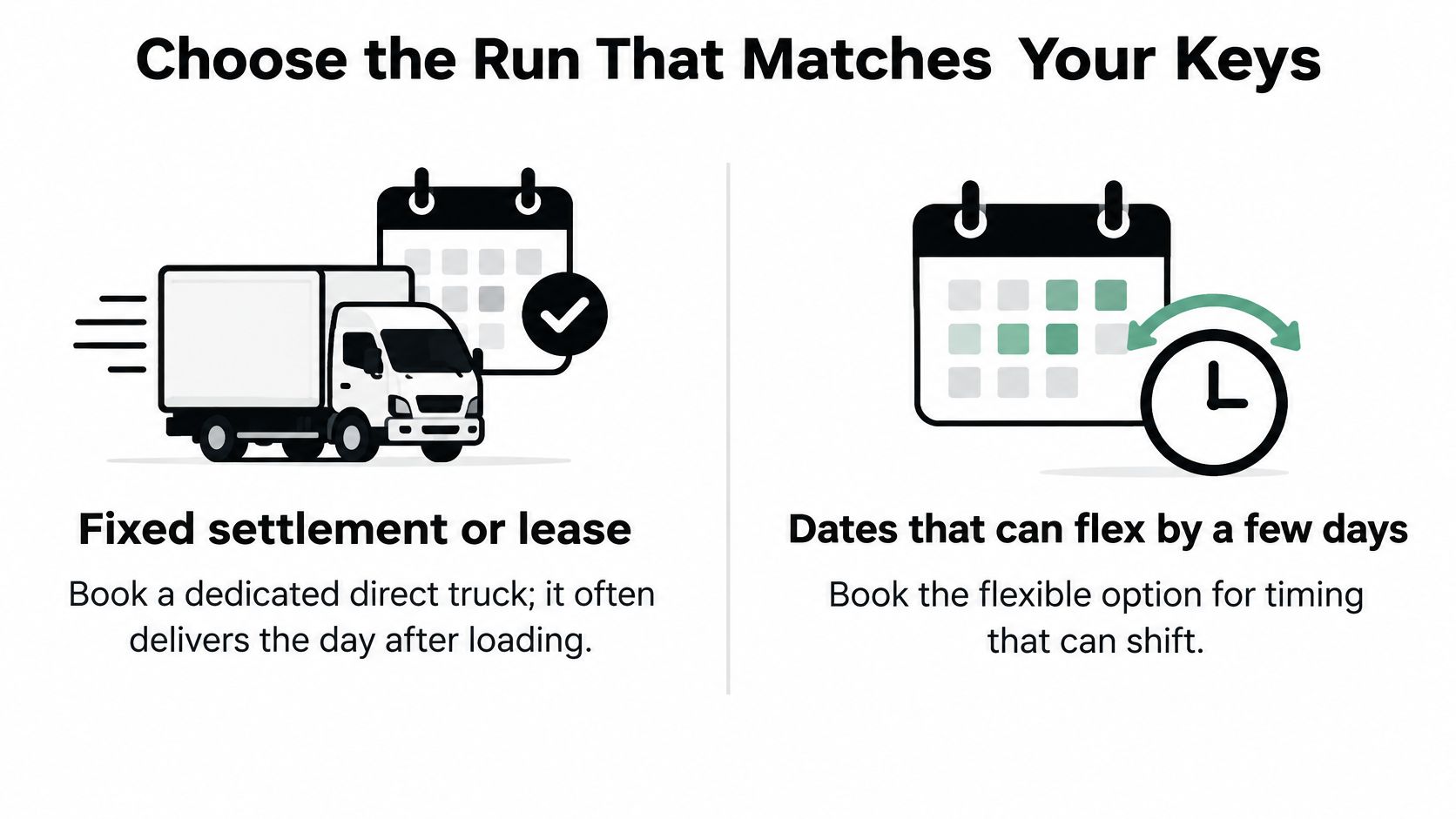
Which ADL to MEL option matches the keys
| Option | Best when | Delivery certainty | Cost risk people miss |
|---|---|---|---|
| Dedicated direct truck | Settlement or lease start cannot move | High, often the day after loading | Higher transport line than a shared run |
| Weekly shared direct run | Handover can flex by a few days | Medium, usually a 1 to 4 day window | Cheap freight, costly if keys or a lift are missed |
| Short-term storage | The two homes do not overlap | Goods wait until delivery is rebooked | Storage rent plus a second handling fee |
These are service-selection expectations, subject to the actual booking. Neither a dedicated truck nor a shared run overrides driver rest, unsafe conditions or a building that refuses access.
Don't use flight schedules to estimate furniture delivery. The BITRE domestic aviation activity report concerns passenger aviation, not a household removal service with loading, handling and property-access requirements.
Dedicated, shared or held until you're ready
For an immovable handover, I'd start with a dedicated direct option and establish the arrival commitment. Confirm what happens if settlement runs late before arranging the unloading crew or lift.
For flexible dates, backloading removals can make sense. The important questions are whether collection is fixed, how delivery notice works and whether your goods remain on the same vehicle or transfer through another facility.
When homes don't overlap, planned storage is cleaner than asking a truck to wait for uncertain keys. Set the release process before collection, including who authorises delivery and how much notice the booking team needs.
A direct route describes the transport arrangement. It doesn't mean the customer can ignore the delivery window.
Roadworks, incidents, winter weather, bushfires and extreme summer heat can interrupt the corridor. Build the booking around a workable fallback rather than assuming the fastest possible journey will happen.
We're based in Melbourne and handle long-distance moves to and from the city. Our listed interstate destinations include Sydney, Brisbane, Sunshine Coast, Canberra, Adelaide, Cairns, Townsville, Gold Coast, Newcastle, Mackay and Coffs Harbour; we also provide Melbourne packing and unpacking support and secure short-term and long-term storage.
A customer described our packing and unpacking team as making their Melbourne move completely worry-free. The practical standard behind that outcome is clear responsibility: know who prepares the goods, who controls access and who confirms delivery.
Send the room count, bulky-item photos, addresses, access notes and immovable key date together. Then choose the run that fits those conditions, not the lowest line on the estimate.
How to Schedule the Move Week by Week
Work backwards from possession of the Melbourne property, not forwards from the day you'd like to leave Adelaide. Confirmed access is the anchor for the rest of the booking.
Melbourne recorded an estimated 18.2 billion tonne-kilometres of metropolitan road freight in 2024–25, the largest capital-city estimate reported in BITRE's freight chapter. That describes a busy freight environment, not a prediction for your truck, so plan metropolitan loading and access as carefully as the highway leg.
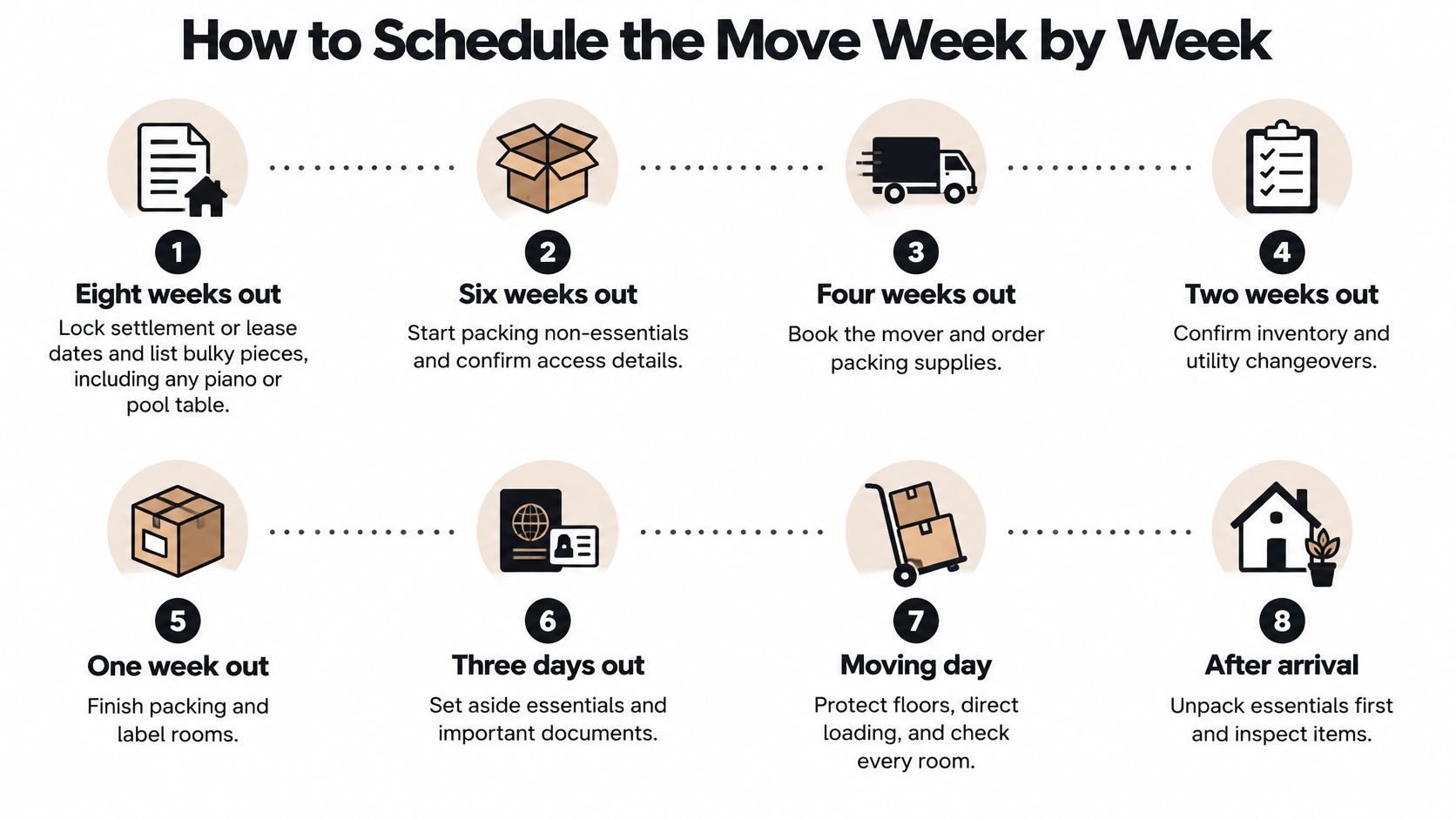
Work backwards through these booking checkpoints
The following is a suggested preparation schedule. Bring tasks forward if your building requires early reservations or your inventory needs specialist assessment.
Eight weeks out, settle the dates. Confirm the lease or settlement position and list bulky pieces, including a piano or pool table. Don't describe specialist items as ordinary furniture.
Six weeks out, measure and compare. Measure sofas, fridges, doorways and tight turns, then request itemised quotes against the same inventory. Overall width alone won't tell you whether a sofa turns into a hallway.
Four weeks out, book the run and access. Reserve the chosen transport arrangement and obtain written lift approval at both buildings. A transport booking doesn't reserve a building's loading facilities.
Three weeks out, remove unwanted volume. Sell, donate or responsibly dispose of items that won't fit or earn their place in the new property. Don't pay to carry a damaged cabinet you already intend to replace.
Two weeks out, pack by destination room. Label cartons for their Melbourne rooms and photograph valuable items and existing marks. Avoid packing everything into miscellaneous boxes that no one can place.
One week out, verify the truck approach. Confirm loading zones, parking arrangements, after-hours access and truck-size restrictions. Tell the building manager the vehicle details once allocated.
The night before, separate essentials. Keep passports, laptops, medication, chargers, keys and clothing with you. Check cupboards and drawers before sealing the last cartons.
On delivery, check the inventory. Walk through the delivered items before the crew leaves and record visible concerns on the paperwork promptly. Follow the applicable claims process for anything discovered during unpacking.
Leave room for a disrupted arrival
Don't book the end-of-lease cleaner against the earliest possible truck departure. Cleaning should follow completed loading, not compete with furniture moving through wet floors.
Consider a mid-week collection if it gives you better access to building management, cleaners and utility support. It's a planning preference, not a guarantee of quieter roads or available capacity.
Use the interstate moving checklist as your working document, with one person responsible for updating confirmed arrangements.
Copy into your calendar: Eight weeks, dates and bulky inventory; six weeks, measurements and quotes; four weeks, transport and lifts; three weeks, declutter; two weeks, cartons and photos; one week, vehicle access; night before, essentials; delivery, inventory and condition check.
Packing Cover and Items to Leave Behind
Choose owner-pack or professional packing before ordering materials. Owner-packing gives you control over sorting and preparation, but you also take responsibility for choosing suitable cartons, cushioning and protection. A valet arrangement changes who does that work, so make the scope clear.
Don't leave fragile preparation until the crew arrives. A television leaning against the lounge isn't ready for interstate transport just because someone has wrapped it in film.

Pack for handling, not just for storage
Use small cartons for books and dense contents, wardrobe cartons for hanging clothes and mattress bags for mattresses. A television needs purpose-made protection that supports the screen and corners, ideally its original packaging or an appropriate crate.
Disassemble beds before collection where that task is yours. Put fittings in labelled bags and secure them to the matching frame without applying damaging adhesive to finished surfaces.
- Carton strength: Use sound moving cartons, tape the base securely and cushion empty spaces.
- Room labels: Mark the destination room clearly on the top and a side.
- Fragile contents: Identify delicate cartons visibly and keep heavy items out of them.
- Specialist pieces: Declare pianos and pool tables separately so handling equipment and preparation can be planned.
WorkSafe Victoria's moving and lifting guidance identifies heavy, bulky and awkward objects as manual-handling hazards, particularly when work occurs above shoulder height or below knee height. Use trolleys, sliders and clear pathways rather than relying on lifting technique alone.
Keep unsuitable goods off the load
Don't pack fuel, gas bottles, aerosols, hazardous chemicals or perishable food into ordinary household cartons. Disclose questionable items before collection and arrange an approved alternative or appropriate disposal. Drain equipment where appropriate and follow its manufacturer's preparation instructions.
Transit cover needs policy wording, not reassurance. Declare valuables, photograph their condition and establish the excess, valuation basis and treatment of owner-packed cartons.
For business owners comparing transport-related policies, ABS Insurance Brokers Pty Ltd provides practical coverage guidance for courier businesses. Courier business insurance isn't automatically equivalent to household-goods cover, so use it as background rather than proof that your belongings are insured.
Review the goods-in-transit insurance information alongside the actual terms applying to your booking. Check how to report damage and what supporting photographs or records are needed.
First-night rule: Your essentials box travels with you, not behind the lounge on the truck.
At the Melbourne end, make beds and linen accessible first, followed by bathroom supplies, the kettle and basic crockery. Leave decorative items until the household can sleep, wash and eat.
Apartments Rentals and Small Offices
Access can stop a delivery even when the highway journey goes to plan. Apartments, rentals and offices each need a different document ready before the vehicle arrives.
The useful question isn't whether the truck can reach the address. It's whether the crew can legally park, protect the route and carry everything into the correct room.
Apartment with a restricted goods lift
Say your Melbourne apartment accepts deliveries only through a booked goods lift. Measure the lift doorway, internal car and corridor turns, then compare those measurements with the largest furniture pieces.
Confirm whether the building requires lift padding, lobby protection, an induction or a loading-bay reservation. Tell the manager about truck dimensions once known, and check whether the unloading area has height or vehicle-length restrictions.
A truck arriving outside the approved slot may be unable to unload. Don't assume the concierge can extend the booking or that another resident's reservation can be moved.
- Extra task: Obtain written goods-lift and loading approval showing the address, date, access period and building contact.
- Preparation aid: Use the apartment moving plan to organise measurements and building requirements.
Rental with cleaning and utility changeovers
The Victorian Government's Melbourne rental guidance says tenants arrange services such as electricity, gas, water, telephone and internet, and describes a rental bond as generally about one month to six weeks' rent, held by the Residential Tenancies Bond Authority until the tenancy ends. It also explains that legitimate cleaning or repair costs may be deducted when the bond is returned.
Arrange essential connections before move-in. Keep the old property's services available for the final clean and inspection where needed, rather than disconnecting everything as soon as the furniture leaves.
Photograph the empty property after loading and again after cleaning. Keep inspection records, key-return confirmation and invoices together so the handover doesn't depend on searching through packed paperwork.
Extra task: Hold a confirmed bond-clean booking that follows the completed load, with a contact process if collection changes.
Small office with staff still working
Appoint a move coordinator and give every workstation a destination label. Separate equipment that must remain operational from items that can leave early, and nominate who authorises shutdown and reconnection.
WorkSafe Victoria's office relocation guidance recommends a systematic, sequential move, employee consultation, suitable equipment and clear access routes. Staff shouldn't become the fallback carrying crew for awkward cabinets or heavy equipment.
Back up systems, label cables against their devices and keep confidential files under controlled custody. Give staff clear notice of when desks and screens will be unavailable, then test essential connections before normal work resumes.
Extra task: Prepare a staff run-sheet naming the coordinator, shutdown sequence, destination layout and person responsible for reopening each work area.
Get n Go Removals Melbourne offers interstate household and office relocations, packing and unpacking, furniture handling, and secure short-term or long-term storage for your Adelaide-to-Melbourne move. Visit Get n Go Removals Melbourne with your inventory, both addresses, access photos and fixed key date to request an itemised quote matched to your handover.