Furniture Removal Trolley Guide for Safe Moves
Manual handling is a leading cause of workplace injury. For a Melbourne move, choose wheels you can start, steer and stop along the actual route. WorkSafe Victoria's manual-handling guidance explains how to reduce risks when moving loads.
A furniture removal trolley is a wheeled aid that reduces the amount of carrying involved in moving household or office goods. The options include two-wheel hand trucks, platform trolleys, four-wheel furniture dollies, stair climbers and specialist piano boards. A lounge, fridge, wardrobe, stack of cartons and piano each need equipment suited to their shape and handling requirements.
The wheels only help if they suit the floor and direction of travel.
Follow the item all the way to the truck
A fridge may leave a Melbourne apartment across a smooth kitchen floor, then pass a doorway track, carpeted corridor, lift entrance and sloping driveway. An appliance trolley that balances it indoors may be difficult to control on the driveway.
The trolley transfers some of the load to its wheels. You still need to balance and restrain the fridge, manage changes in surface and prevent it from striking the building.
Practical rule: Choose for the hardest part of the route, not the easiest stretch of floor.
Wheels change the task rather than remove it
A trolley reduces carrying, but the operator still controls the load, its direction and its speed. Victorian manual-handling guidance can help you assess those demands before moving an item.
What a Furniture Removal Trolley Actually Does
A furniture removal trolley is a wheeled aid that takes some of the carrying out of moving household or office goods. The family includes two-wheel hand trucks, platform trolleys, four-wheel furniture dollies, stair climbers and specialist piano boards. A lounge, fridge, wardrobe, stack of cartons and piano don't belong on the same equipment just because they're all heavy.
Think of the trolley as borrowing a temporary set of legs for the item. Those legs only help if they suit the floor and the direction of travel.
Follow the item all the way to the truck
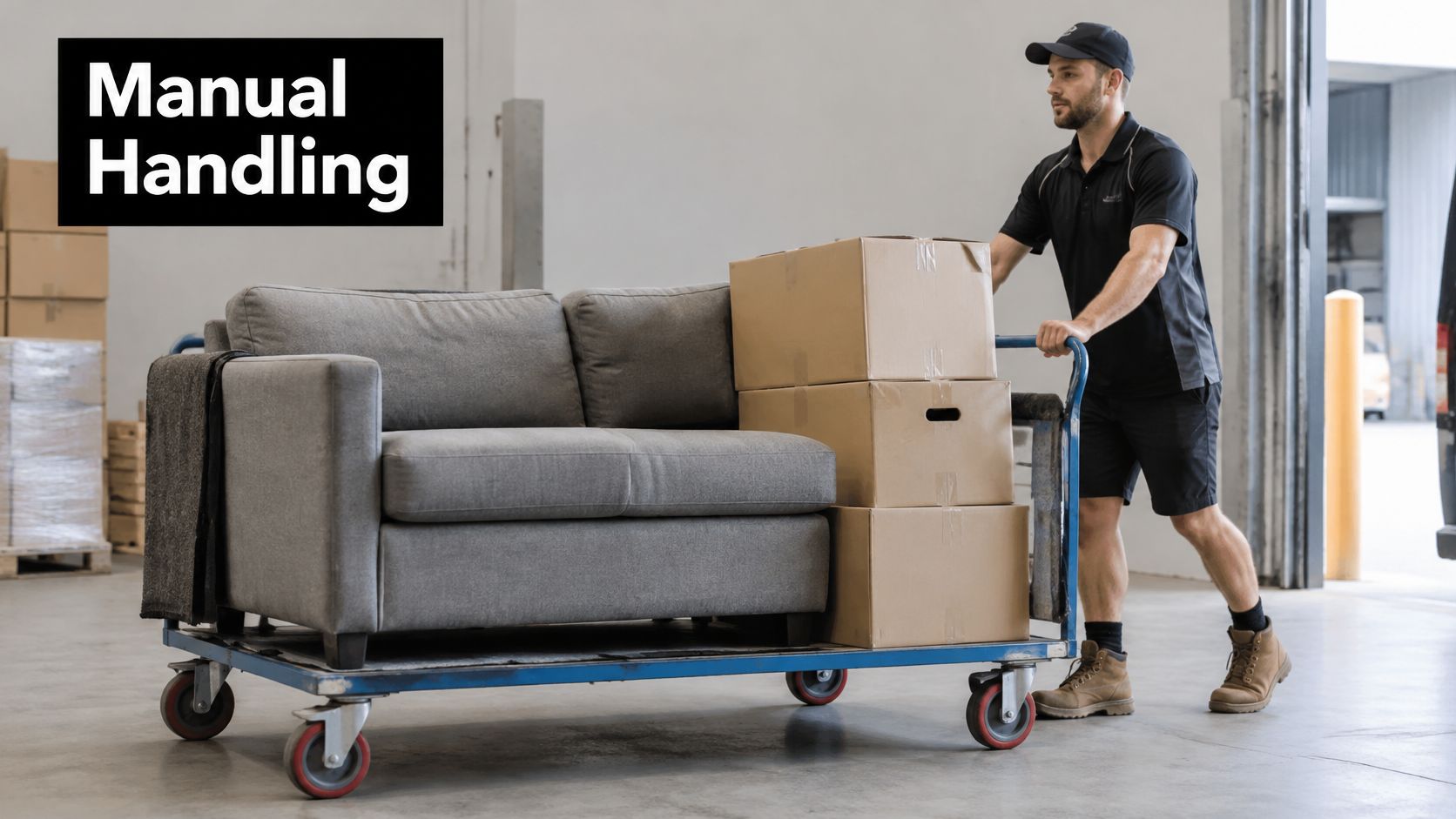
Say you're moving a fridge from a Melbourne apartment. The kitchen floor is smooth, but the route also includes a doorway track, carpeted corridor, lift entrance and sloping driveway. An appliance trolley might balance the fridge well indoors yet become difficult to control outside.
The trolley transfers part of the load from your body to its wheels. You still have to balance the item, restrain it, negotiate changes in surface and prevent it from striking the building.
Practical rule: Choose for the hardest part of the route, not the easiest stretch of floor.
Wheels change the task rather than remove it
Victorian manual-handling guidance still treats pushing, pulling, holding and restraining as manual handling. A trolley is a control, not a risk-free shortcut, and a clear path matters just as much as a strong frame.
A sensible moving decision follows this order:
- Match the equipment: Start with the furniture's shape, support points and balance.
- Check the effort: Assess starting, rolling and stopping, not just carrying capacity.
- Plan the handling: Allow for crew positions, corners, stairs, ramps and lifts.
- Choose the service: Rent, buy or book removalists according to the route and the work involved.
A trolley that looks substantial can still be wrong for the job. Appearance and wheel count aren't selection criteria on their own.
Which Furniture Removal Trolley Suits the Job
Furniture removal trolley types by job
| Trolley type | Best for | Crew guide | Route fit |
|---|---|---|---|
| Appliance hand truck, two-wheel | Fridges, washers, tall cabinets | One person to 100 kg; two people for 100–200 kg | Upright loads and thresholds; poor on long carpet |
| Platform trolley | Cartons, flat packs, stacked boxes | One person if under 100 kg and vision is clear | Flat paths and docks; stack must stay below eye line |
| Four-wheel furniture dolly | Sofas, mattresses, wardrobes on their side | Often two, one to steer and one to spot; keep solo loads within the single-worker guide | Wide rooms; awkward in small lifts and tight turns |
| Stair-climbing trolley | Heavy items when no lift is available | Two handlers minimum for household planning; trained handling and route assessment still required | Straight stairs only for a homeowner's shortlist; never a substitute for a booked lift |
| Piano trolley or skid | Upright and grand pianos | Specialist crew, not a solo trolley job | Protected level indoor routes, not ordinary dollies |
| Powered stair climber or electric tug | Very heavy or highly repetitive loads | Trained operator; powered capacity isn't permission for solo handling | Long apartment-to-truck paths, especially past 35 m |
Read across the whole row, not just the furniture column. A fridge may suit an appliance hand truck, but that doesn't make the same trolley suitable for a narrow turning stair. Crew guidance is a starting limit, not permission to handle every load below it alone.
WorkSafe Victoria's moving and lifting guidance recommends selecting equipment around the load's size, shape, weight and centre of gravity, together with travel distance and frequency of use. An awkward light cabinet can be harder to control than a compact, heavier carton.
Support the right part of the furniture
A fridge needs its weight balanced over the axle, with the toe plate supporting the base and straps preventing separation from the frame. Follow the appliance manufacturer's transport instructions rather than assuming every fridge can travel lying down.
A sofa needs a stable deck beneath a sound part of its frame. Don't let the dolly bear on loose fabric, a recliner mechanism or a decorative trim rail.
A piano needs purpose-built support and a trained crew. A grand piano presents a different handling problem from an upright, and neither becomes an ordinary furniture load because a dolly's label shows sufficient capacity.
For wardrobes and bulky flat packs, reducing the item's size may be more useful than increasing trolley size. Planning furniture disassembly can remove the need to tilt a fragile cabinet through a doorway.
Heavier-duty isn't automatically safer
A wide steel dolly may work well across an open warehouse and jam at a Melbourne apartment lift. A heavier frame also adds weight that someone must turn and brake.
Before renting or buying, inspect:
- Castors: Choose a diameter and tread suited to the floor, with freely rolling bearings.
- Handles: Look for adjustable or vertical grips that let the operator stand comfortably.
- Brakes: Check that fitted castor brakes engage and hold during loading.
- Dimensions: Measure the frame and loaded furniture against the lift and tightest doorway.
- Visibility: Keep the operator's forward view clear.
Victorian hazardous-manual-handling guidance recommends vertical handles or handles approximately one metre high. Read rated capacity alongside push-force performance, not instead of it.
If the item, person or corridor doesn't fit the row, change the equipment or reduce the load.
Load Limits and Push Force That Matter
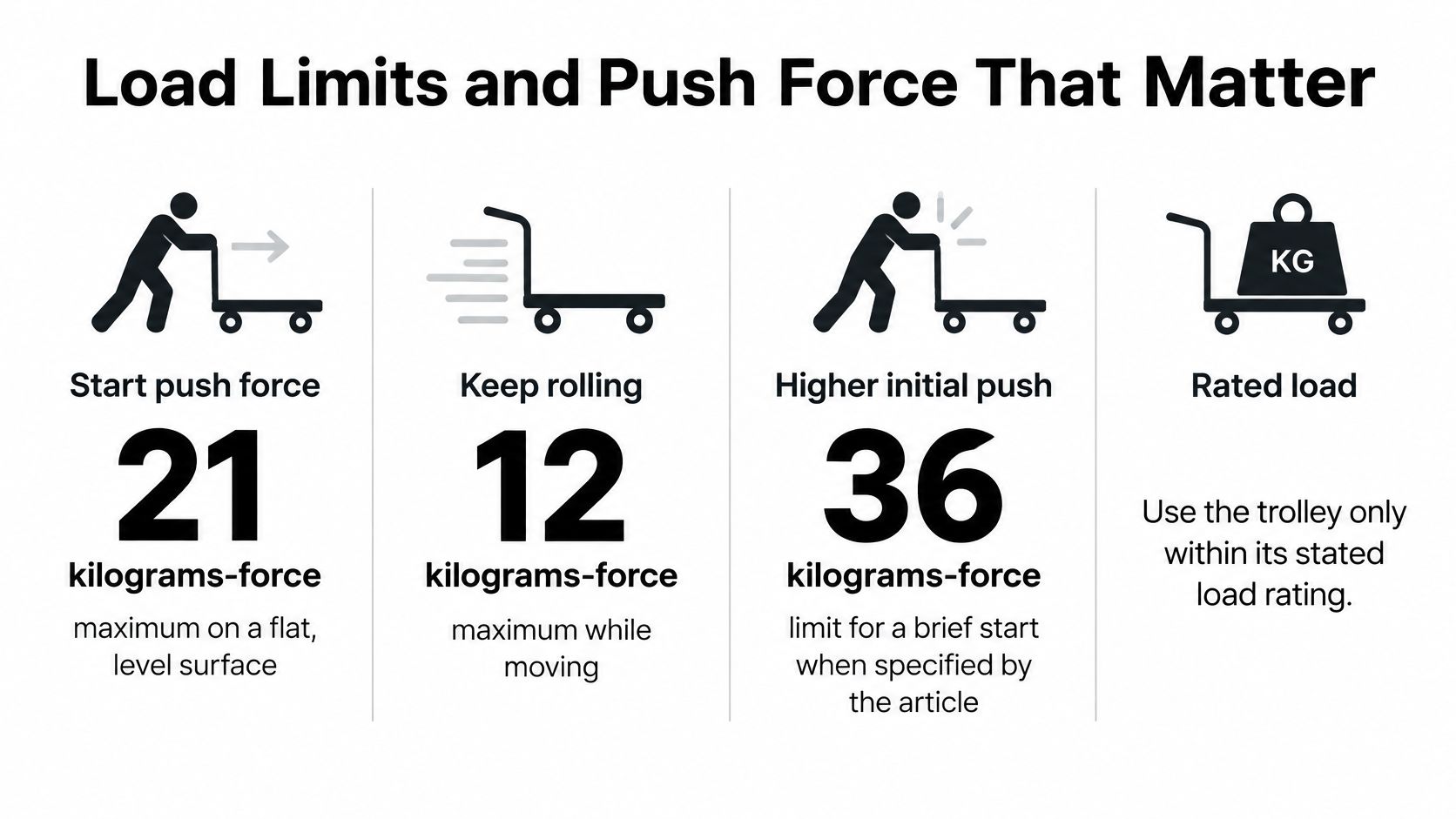
A trolley's safe load depends on how hard it is to move, not just the number printed on its frame. For an ergonomically designed trolley carrying its rated load on a flat, level surface, WorkSafe Victoria's trolley guidance sets benchmarks of 21 kg-force to start, 12 kg-force to keep rolling and 36 kg-force for emergency stopping. These figures describe pushing effort, not furniture weight.
General planning guidance for trolley use
| Measure | Planning guidance | What it means on a move |
|---|---|---|
| Force to start, rated load, flat floor | Up to 21 kg-force | Greater effort may indicate the trolley, load or floor is unsuitable |
| Force to keep rolling | Up to 12 kg-force | High resistance may point to poor castors, bearings or carpet |
| Emergency stopping force | Up to 36 kg-force | A sudden stop requires control of the trolley and load |
| Long pushes | Break up and plan the route | Sustained effort can make a long trip harder to manage |
| Repeated use | Plan breaks and share the work where practical | Frequent pushing can add to physical strain |
Capacity doesn't tell you how hard it rolls
Large, freely rolling castors and sound bearings can reduce resistance on suitable hard floors. Carpet, door tracks and lift lips can make the same load harder to move.
Keep heavy furniture centred over the axle or deck, and secure it against tipping. Divide the load before a ramp, slope or tight turn if the combined weight makes the trolley difficult to control.
Push with your hands just above waist height and elbows close to your body. Stop if you have to lean heavily into the handles, jerk the frame or twist to get it moving. Change the setup or use a trained crew when the route or load remains difficult to control.
The emergency-stopping benchmark is not permission to apply greater force when starting. You cannot reliably judge kg-force by feel, but a trolley that takes a deadlift-like effort to move is a clear signal to stop and reassess.
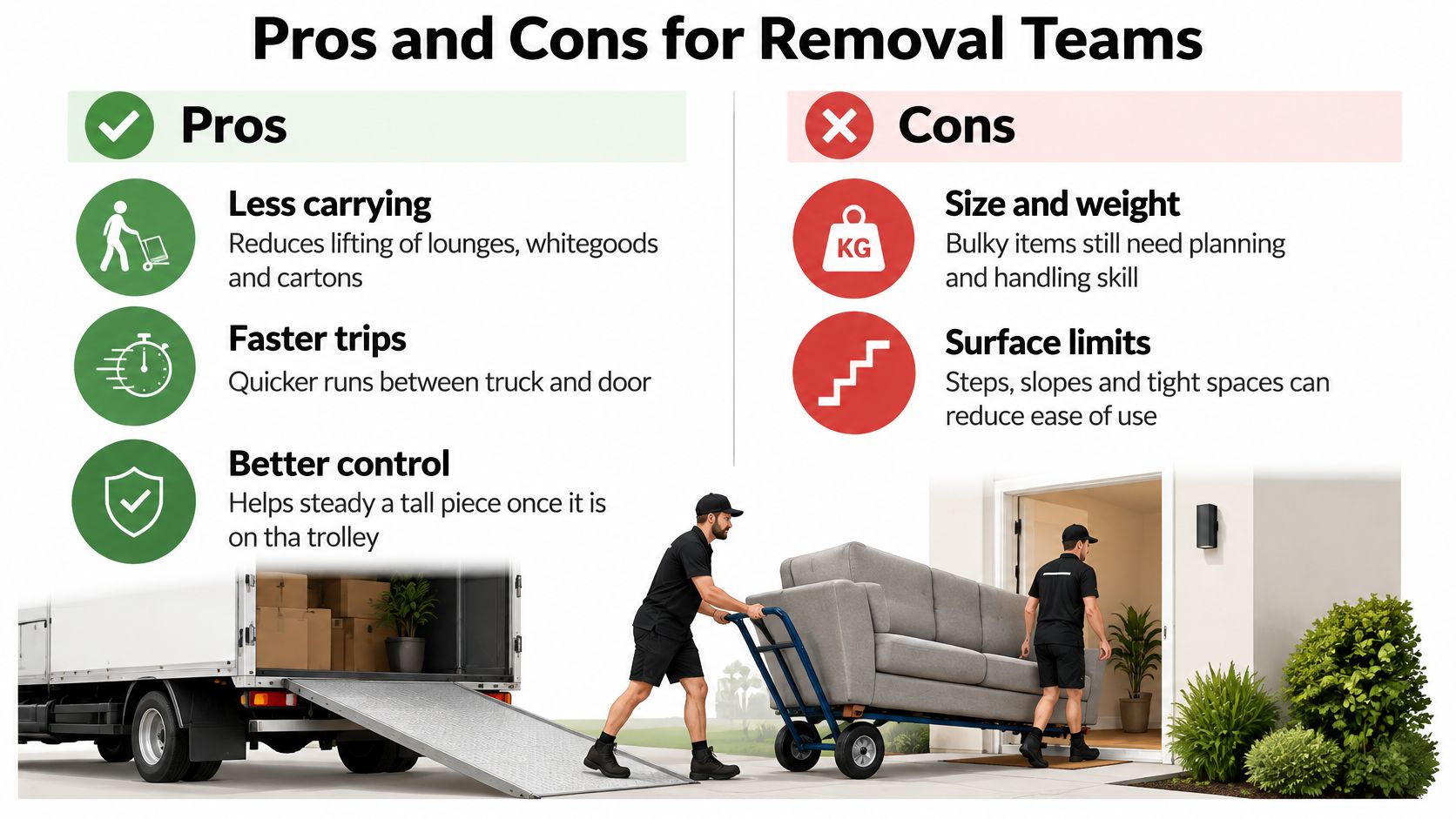
Pros and Cons for Removal Teams
The gain is less carrying, especially when a crew can roll furniture along an uninterrupted level path. That doesn't mean the trolley makes every stage faster or safer.
WorkSafe Victoria's hazardous-manual-handling guide identifies repeated, sustained, high or sudden force and awkward posture as conditions that can make manual handling hazardous. A heavily loaded trolley can meet those conditions even when nobody is carrying the furniture.
What the crew gains
- Less carrying: Lounges, whitegoods and cartons can travel on wheels instead of in workers' arms.
- Quicker transfers: A clear truck-to-door run allows goods to move without repeated set-downs.
- Better load control: A properly strapped tall item stays connected to the equipment.
- Clear crew roles: A handler can steer while a spotter watches clearance and pedestrian traffic.
- Fewer awkward lifts: A suitable deck can avoid repeated lifting and turning along a flat path.
What the crew takes on
- Overbalance: A tall load can tip when the surface or direction changes.
- Crush zones: Fingers, hands, toes and lower legs are exposed if the trolley shifts.
- Restricted sight: A high stack can conceal a person, doorway or floor obstruction.
- Surface damage: Poor castors may drag, collect grit or mark flooring.
- Equipment demands: Powered units require training, suitable access and a charged machine.
The same sofa can need a different method
Say a balcony sofa has to travel through a clear hallway before reaching a spiral stair. A furniture dolly may be appropriate in the hallway, but it isn't an answer to the stair geometry.
The crew should stop at the transition and reassess disassembly, a suitable strap arrangement, or specialist stair equipment. Swapping to a stair trolley does not guarantee the sofa will fit or remain controllable.
Use moving blankets between vulnerable furniture surfaces and contact points, without covering grips or interfering with straps. Protection doesn't compensate for an unstable load.
Wheels cut carrying exposure and add pushing, braking and crush exposure. Remove a damaged frame, bent axle or seized castor from service until it's repaired or replaced. With a mechanical fault, the expected handling benefit can disappear.
Safe Use on Stairs Ramps and Lifts
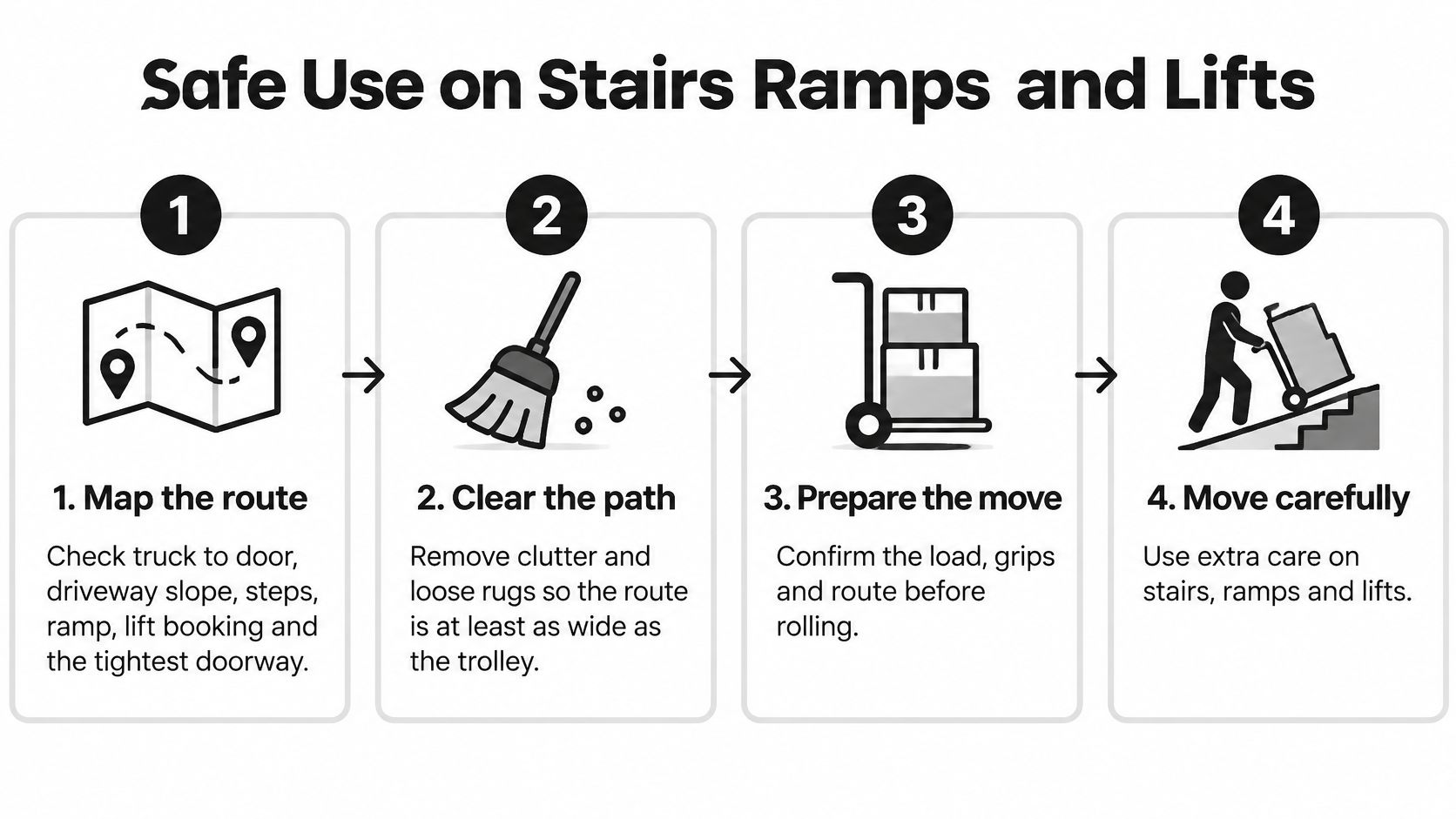
A trolley that rolls easily along a hallway can become hard to control on a ramp. Check the full route from truck to door first, including the tightest doorway, steepest driveway and smallest landing. Allow room for the handlers as well as the trolley.
Run the route drill before loading
Map the route. Check the driveway slope, steps, ramp, lift access and doorway clearances. Include space for handlers to turn and stop.
Clear the path. Remove loose rugs, cables and clutter. Secure doors open where permitted, and keep other people out of the working area.
Inspect the trolley. Check castors, frame, brakes and straps. Make sure the loaded setup leaves a clear line of sight.
Prepare the furniture. Keep the heavy end low and centred. Bring the trolley close before loading, secure the item before releasing support, and use the brakes during loading if fitted.
Set handler positions. Push rather than pull where the trolley and route allow. Safe Work Australia's hazardous-manual-tasks code favours pushing because it generally supports better posture, use of body weight and visibility in the direction of travel.
Reduce the load on slopes. Steeper gradients add considerably to the pushing effort for every 100 kg of loaded trolley weight. A load that feels manageable indoors may be unsuitable on an access ramp.
Use the lift where suitable. Never take a loaded flat-floor trolley onto stairs or improvise stair handling with ordinary equipment. If the item cannot be moved safely by lift, reassess the handling method.
Move deliberately. Slow before corners, agree on stopping commands and pause if fatigue affects control. Treat a stairwell, ramp or uneven driveway as a separate handling task.
Watch the surface beneath the handler
WorkSafe Victoria's slip-prevention guidance warns that pushing and pulling on slopes requires good grip between footwear and the walking surface. Wet loading docks, dusty ramps and sloping drives can undermine footing even when the trolley rolls freely.
In Melbourne apartments, check lift thresholds, balcony-door tracks and lips between floor finishes. Don't ram the trolley into a lip to build momentum. Unload or use an appropriate transition solution.
For short indoor repositioning before loading, protect floors with furniture sliders. Sliders help with repositioning, not transporting furniture down a ramp, and they do not provide braking or restraint.
Use this guide to plan how to move heavy furniture around the item's size and the available route.
Stop point: If the trolley starts to run, don't chase it or stand downhill to catch it. Bring it to a controlled stop only if safe, lower the load where possible, clear people away and replan.
When to Rent a Trolley or Stop DIY
Rent, buy or hire for the trolley job
| Situation | Better option | Why |
|---|---|---|
| One-off house or apartment move | Hire removalists or a short rental | A purchased trolley is idle and still fails on stairs |
| Single fridge or washer, level path, under the solo-load guide | Day rental of an appliance dolly | Capable adults, straps and a clear view can be enough |
| Weekly office, shop or warehouse shifts | Buy and maintain a small set | Ownership makes sense only with spares and tag-out of damaged gear |
| Piano, pool table or spiral stairs | Hire a specialist crew | The wrong board or handling method raises tip and crush risk |
| Long path or highly repetitive trolley trips | Book a crewed move | Repetition and distance require planned handling, not an improvised DIY day |
| Fragile flat-pack furniture | Disassemble, don't roll it whole | Assembled flat-pack frames are easily damaged |
A short rental suits a specific, understood task. It doesn't solve uncertainty about the item's weight, a staircase you haven't measured or a driveway where you can't safely stop.
For an appliance move, the supporting adult needs a defined role. That may mean watching clearance, managing doors or helping with controlled loading, not walking backwards in front of a descending load.
Count the costs beyond the trolley
Buying makes sense when someone will use, inspect and maintain the equipment regularly. A trolley stored in a shed between rare moves can develop stiff bearings, damaged tyres or corrosion without anyone noticing.
Ownership also involves practical extras:
- Storage: Keep the trolley dry and accessible without creating an obstruction.
- Replacement parts: Budget for castors, bearings, grips and straps.
- Protection: Keep suitable blankets and edge protection with the equipment.
- Inspection: Identify who checks it and who can remove faulty gear from use.
- Handling competence: Don't assume owning the tool means knowing how to restrain a load on a ramp.
The injury risk isn't a purchase accessory you can leave out of the comparison. A cheap trolley can become an expensive choice if the operator has no safe way to stop it.
Make the homeowner's stop line clear
Pianos, pool tables, spiral stairs and long stair runs belong with specialist handling. Stop DIY when the item blocks your view, needs uncontrolled tilting, traps a handler against a wall or requires a forceful heave to move.
Flat-pack furniture deserves a separate decision. Disconnect and label components, retain the fittings together and reduce the frame to manageable sections rather than using straps to squeeze an unstable assembled unit.
For a broader comparison of labour, access and handling responsibilities, consider why hiring removal services can be the smarter moving option.
Rent or hire for rare and awkward jobs. Buy for repeated professional use with maintenance. Book a crew when the route fails the force test, stair test or vision test.
How Movers Fit Trolleys into a Full Move
A trolley is one tool in a planned move, not the whole service. The crew needs to know where the truck can stand, whether the lift is booked and how the widest furniture will pass through the building before choosing equipment.
The loading method matters too. Planning access to a moving truck with a lift gate means considering the transfer between ground, platform and truck floor, not just the roll from the front door.
Choose the equipment around the sequence
Our trucks are fitted with heavy duty moving blankets, specialty moving trolleys, dollies and ties. That allows the handling aid to be matched to the item rather than making every item fit whatever trolley happens to be available.
Our piano removalists use specialised equipment such as piano trolleys, with delicate handling by the experienced team. A piano doesn't get treated as a sofa with a different shape.
Heavy duty moving blankets are used on all furniture. They separate vulnerable finishes from decks, straps and neighbouring pieces, while the crew keeps the load's support points and restraint arrangement accessible.
Reduce awkward handling before it starts
Beds, tables and fragile flat-pack pieces may need disassembly so the crew can move smaller components through restricted access. Reassembly belongs in the plan too, with fittings kept together and parts identified before loading.
On an office relocation, our moving manager oversees the move alongside the office furniture removalists. Sequencing work areas helps prevent queues at the lift, crowded corridors and an improvised succession of repetitive trolley runs.
The same equipment logic applies whether you're moving a bulky item or a complete home. The difference is the number of transitions, the mix of furniture and how the crew coordinates the work.
Send access details before moving day. A photo of a tight landing can change the equipment choice more than a description of the furniture.
Provide an item list, stair or lift notes, parking information and access photos from both properties. Include the difficult parts: the turn beside the lift, the driveway incline, the low doorway and any furniture that can't be taken apart.
Get n Go Removals Melbourne can plan that handover for house, apartment and office moves. The aim is to choose the trolley and crew before the furniture reaches a point where there's no safe way forward.
Get n Go Removals Melbourne offers furniture removals, specialist piano and pool-table handling, and packing support, with moving equipment matched to the job. Visit Get n Go Removals Melbourne and send your item list, access photos and stair or lift details so we can plan the right trolley and crew for your move.