

High Rise Apartment Moving Guide: Lifts, Permits and Rules
You've got the keys coming, boxes across the lounge and a sofa you're fairly sure will fit. Then the building manager asks for your lift booking, truck height and common-area protection arrangements, none of which appeared on your moving checklist.
For a high rise apartment move, the lift and building rules set the schedule. The removalist's arrival time has to work around them, not the other way round.
Why High Rise Moves Need More Lead Time
Say a couple is moving a queen bed and a three-seater sofa into a fourteenth-floor apartment. The sofa fits through the apartment doorway, but it won't turn into the service lift. They spend the morning trying orientations that don't work, and the booked access window expires before the furniture reaches the unit.
That's an access-planning problem, not a lifting problem. A house move usually offers more flexibility about where furniture waits and how the crew enters. In a tower, other people control the route.
The access decisions you don't control
- Lift availability: Management decides which lift movers can use and when.
- Truck access: The building controls the dock, while the council controls street parking.
- Moving conditions: The owners corporation or building manager sets working hours, protection requirements and inspections.
The scale of apartment living makes these normal planning considerations, not unusual complications: the Australian Bureau of Statistics Census summary records 368,943 high-rise apartments nationwide in 2021, occupied by 550,592 people, with high-rise defined as apartment buildings of nine or more storeys.
Victoria's construction pipeline reinforces the point: the ABS apartment building heights article reports that combined high-rise and super high-rise commencements increased by 428.8%, equivalent to 5,793 additional dwellings, between 2004–05 and 2018–19.
Practical rule: Confirm the route and access window before committing to a moving date or paying a deposit.
A Timeline for Moving to or from a High Rise
Use this as a working planning schedule, not a promise that every building can accommodate the minimum notice. Start earlier when access requires manager attendance, inspections or coordination between buildings.
Apartment move timeline and lead times
| Timing | Task | Who to contact |
|---|---|---|
| 8 weeks before | Request current building rules and lift specifications | Owners corporation or strata manager |
| 6 weeks before | Book movers and confirm truck size suits the loading zone | Moving company |
| 4 weeks before | Measure large items against lift car and corridors | You, using building plans |
| 10 business days before | Reserve service lift, loading zone and moving hours | Building manager |
| 5 business days before | Confirm parking eligibility and clearway restrictions | City council and building manager |
| 3 days before | Arrange padding, floor protection and any pre-move inspection | Building manager and movers |
| Move day | Photograph common areas before loading | You and movers |
| Within 1 week after | Complete post-move inspection and report common-area damage | Building manager |
Get the access information before the quote is final
Request the actual lift specifications, not just confirmation that the building has a service lift. Provide the moving crew with photographs of the dock entrance, ramps, loading doors, and the route to the lift. A truck can have enough capacity for your belongings and still be unsuitable for the building entrance.
Building plans help with preparation, but check measurements on site. Plans may not show handrails, protective padding, door closers or furniture already narrowing a corridor.
Use the Australian moving house checklist for the broader household tasks, then put building approvals beside those tasks in the same calendar. Keeping separate lists makes it easier to book a truck before access is settled.
Protect the booking from avoidable changes
A compressed timeline leaves little room to correct missing paperwork or arrange disassembly. Treat an unanswered booking request as unconfirmed, even if reception says your preferred day looks quiet.
When moving between apartment buildings, give the crew both access windows. The destination booking must allow for loading, travel, unloading and the actual carry route, rather than assuming the truck can leave immediately after arrival.
- Before arrival: Pack and label everything that can travel in ordinary cartons.
- At handover: Have keys, fobs and the manager's contact details ready.
- After unloading: Keep the inspection appointment, even if the move appears damage-free.
Permits, Parking and Building Rules to Check
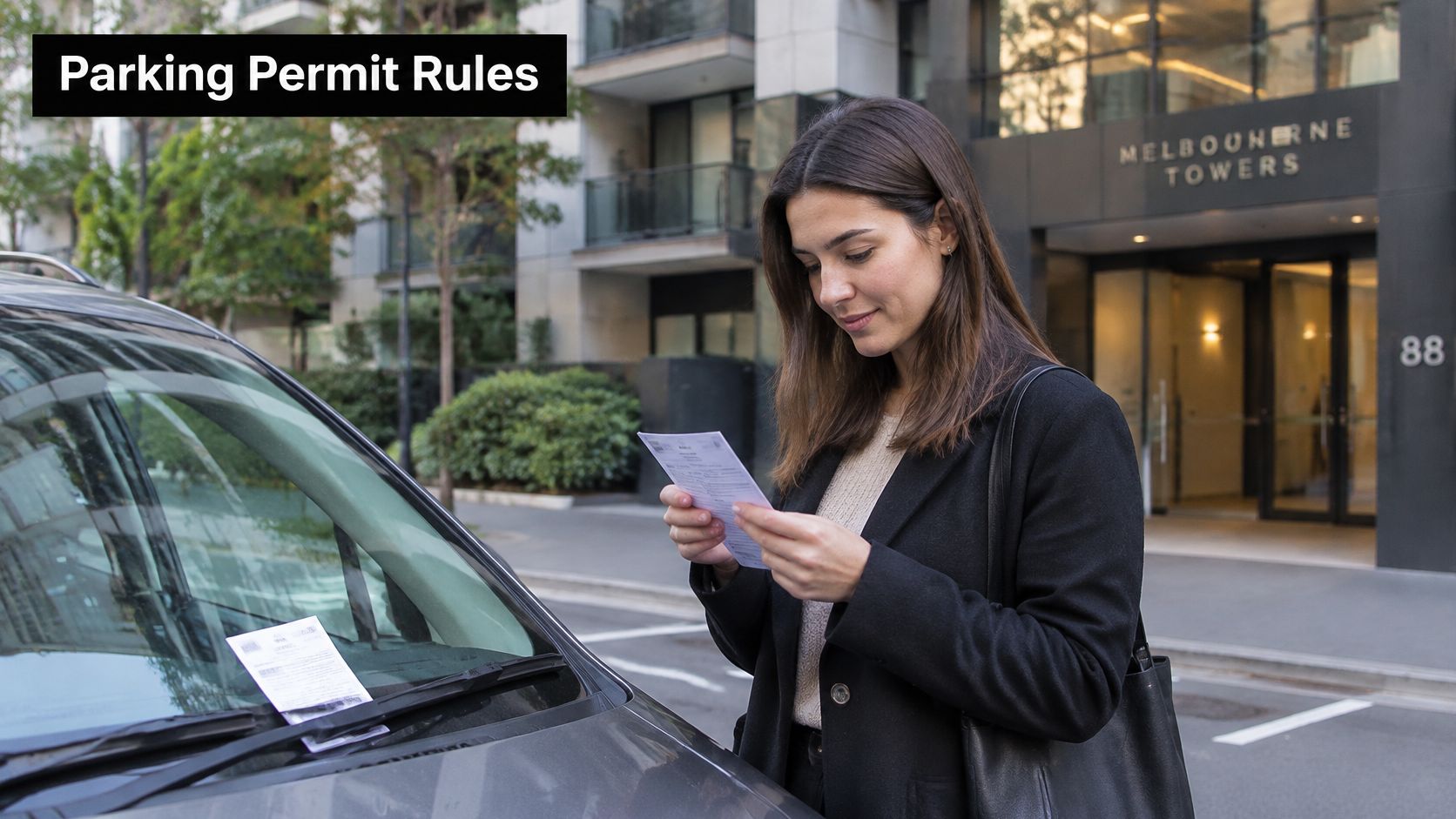
A resident parking permit isn't automatic permission to leave a moving truck outside your apartment. The City of Melbourne residential parking permit guidance limits permits to residents of eligible properties within designated permit areas, and says they can only be used where signs display an exception for residents.
Check the property's eligibility, the permit conditions and the actual street sign before relying on this option. Prepare the supporting documents requested by the council, and confirm whether the proposed vehicle and use meet the conditions.
Parking mistakes can turn an organised arrival into a delayed unload.
Match the street permission to the building booking
Customers must ensure there's parking and easy access to the property. Our drivers can't park in clearways or no-standing zones, but can use loading zones subject to their time restrictions.
Access checks by situation
| Situation | What to confirm | Lead time |
|---|---|---|
| Resident permit for the truck | Property is eligible and the sign shows a resident exception, with the council documents ready | Before the truck is booked |
| Loading zone outside the building | Time limit and whether the booked window fits inside it | With the lift booking, about 10 business days ahead |
| Building rules in force | Current consolidated rules from the owners corporation, strata manager or noticeboard | Before selecting the moving date |
| Lift shutdown or maintenance | Alternative route, dates and the manager's written confirmation | Before the move date is set |
| Clearway or no-standing | Not legal parking; use a loading zone or an agreed bay | Before moving day |
For example, suppose the lawful loading zone has a two-hour limit. Plan for the whole unloading and lift window to fit within those two hours, including equipment removal and departure. A resident permit only helps where the property is eligible, the sign includes the resident exception and the permit conditions cover the proposed use.
Don't confuse a nearby space with usable access
A legal space farther away can be workable, but it adds carrying time and exposes furniture to weather. A closer dock may be more efficient, provided the truck clears the entrance and the booking includes access through internal doors.
Obtain the current building rules rather than relying on the previous tenant's arrangements. For moves across Melbourne's southern suburbs, check the relevant local council rather than assuming City of Melbourne permit conditions apply.
Measuring and Moving Large Items Safely
Measure furniture against the entire service-lift route, not just the apartment doorway. The tight point may be the turn out of the dock, the lift entrance or the landing outside your unit.
Use a tape measure, a notepad and photographs with measurements marked clearly. Record the lift car's internal width, depth and height, then its clear door opening. Measure between obstructions such as handrails and bump rails rather than wall to wall.
Check the turning movement, not just the resting position
Measure each item's width, height and depth, including projecting arms, handles and feet. For sofas and bed bases, check the usable diagonal, but don't treat a favourable diagonal as proof that the item fits. The crew still needs room to introduce it through the doorway and rotate it without striking the ceiling.
A cardboard footprint can help test a difficult corridor turn. For awkward furniture, send photographs of the item and route before moving day rather than expecting the crew to solve the geometry at the lift.
Large item measurement and workaround guide
| Item | Check against | Usual workaround |
|---|---|---|
| Sofa | Lift car diagonal and door clearance | Remove legs and detach backrest or cushions where designed to come off |
| Bed base | Corridor turns and lift door width | Remove slats and split frame into sections |
| Wardrobe | Lift car height, width and rated load | Disassemble into panels and pack hardware separately |
| Upright piano | Lift rated load and door opening | Book specialist piano movers, not merely a standard lift slot |
| Pool table | Slate weight and lift floor capacity | Split slate sections and move with specialist equipment |
| Glass-top dining table | Top size against lift car | Remove top, wrap and move separately |
| Refrigerator | Lift car height and corridor turns | Empty, secure doors and plan an upright move |
Choose disassembly before force
Remove components only where the furniture is designed for disassembly. Photograph connections, label matching panels and bag the hardware with the item. Wardrobe backs and bed fittings can be damaged by levering them apart without identifying the fixings.
Use padded blankets around vulnerable edges and approved protection on the lift walls. Keep protective material clear of door tracks, sensors and ventilation openings. The heavy furniture moving guide provides additional preparation advice for bulky pieces.
Pianos and slate pool tables need specialist handling assessment because weight distribution matters as much as size. Glass tops also need appropriate carrying equipment and secure edge protection.
Furniture that arrives successfully isn't guaranteed an easy exit later.
Before buying a replacement sofa or wardrobe, measure the current route again. A different lift allocation, altered access rules or an unavailable service lift can change what's practical to remove.
How to Book the Service Lift and Loading Zone
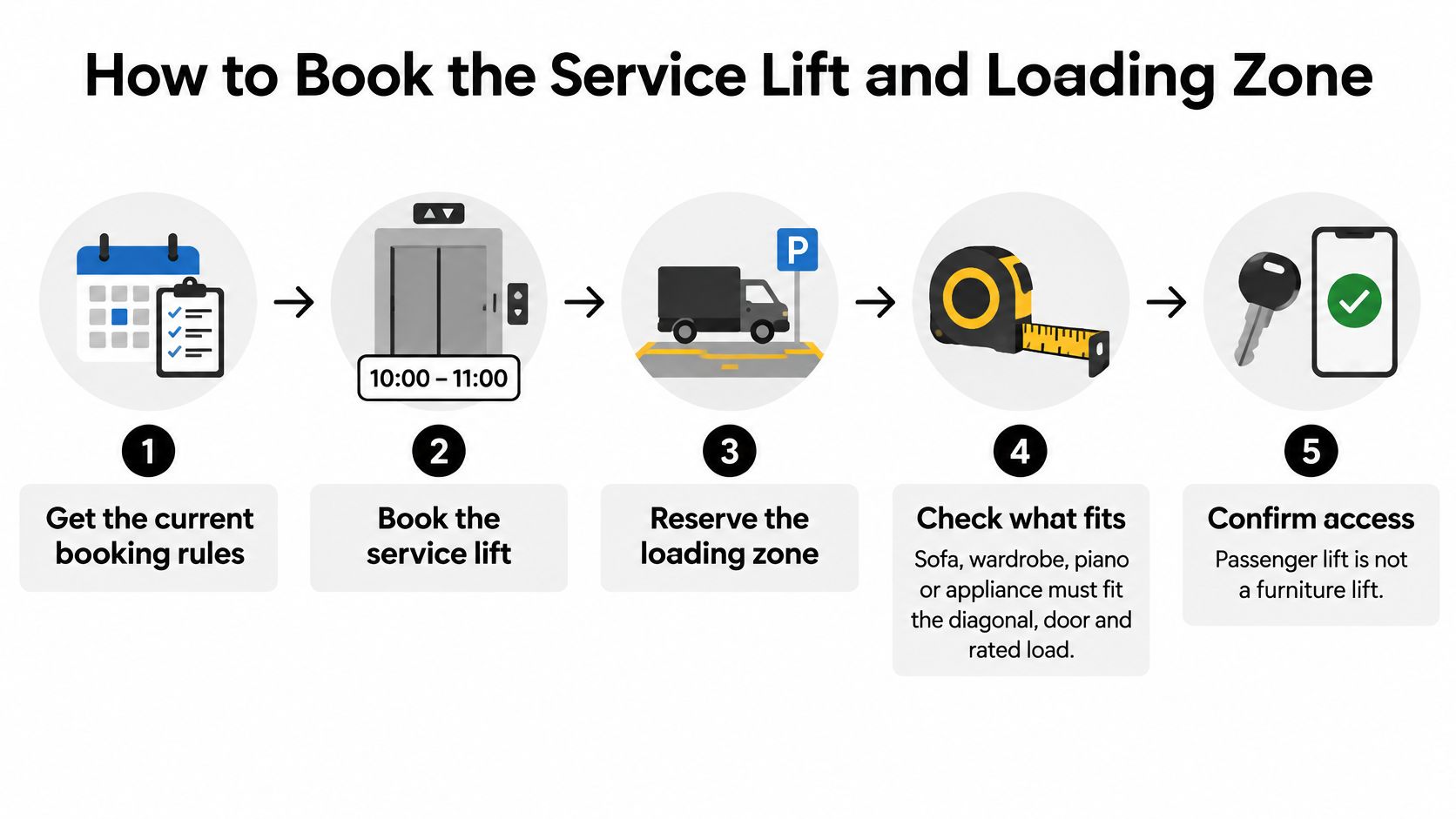
A passenger lift isn't automatically a furniture lift. A reservation controls access; it doesn't establish that the furniture fits or that the lift can carry the proposed load.
Keep the booking process in this order so the manager and moving crew work from the same information.
Secure the permissions and specifications
Get the current rules in writing. Ask the owners corporation, strata manager or building manager for the current version. Consumer Affairs Victoria's owners-corporation rules guidance says newly consolidated rules must be placed on the noticeboard if the building has one.
Reserve both access points. Keep the booking reference for the service lift and loading zone. Aim to secure access at least 5–10 business days ahead, allowing longer for manager attendance or inspections, consistent with the practical booking benchmark in Allied Strata's moving access guidance; that guidance also notes the National Construction Code minimum lift floor dimensions of 1,400 mm wide by 1,600 mm deep where lift travel exceeds 12 metres, which don't establish usable furniture clearance.
Confirm the operating conditions. Ask who supplies lift padding, who installs it, whether an inspection is required and who provides access fobs. Clarify truck height limits, permitted moving hours and responsibility for common-property damage.
Put the physical move into the booking
Submit the measurements. Give management the large-item dimensions and ask for the actual car dimensions, door opening, internal rails and rated load. Include people and moving equipment when assessing the load, not just the furniture.
Confirm the truck against the dock. We offer residential moves including units and apartments, and our 4.5 tonne truck holds 17–19 cubic metres, suitable for studios up to one-bedroom units. Its suitability still requires checking the building approach and loading arrangements; our apartment moves are planned around lift bookings and building manager requirements.
Agree on the fallback and inspection. If an item won't fit, approve disassembly, smaller loads or another authorised route before arrival. Arrange the post-move inspection and identify who signs off the common areas.
Send a final email listing the date, window, designated lift, loading location, truck size, oversized items and onsite contacts. Get written confirmation before the truck arrangements are locked in.
This video provides additional visual context for planning the move.
Common Problems and How to Avoid Them
The cheapest available moving date isn't necessarily the lowest-cost move. If the crew arrives but can't unload, you may pay for waiting, parking, storage and another attendance without getting your furniture upstairs.
Access problems also extend beyond the booking calendar. The NSW Building Commission's strata defects research report found serious defects in 53% of surveyed apartment buildings in New South Wales. That's not a Victorian prevalence estimate, but it highlights why residents should ask about building works and essential-service interruptions before committing.
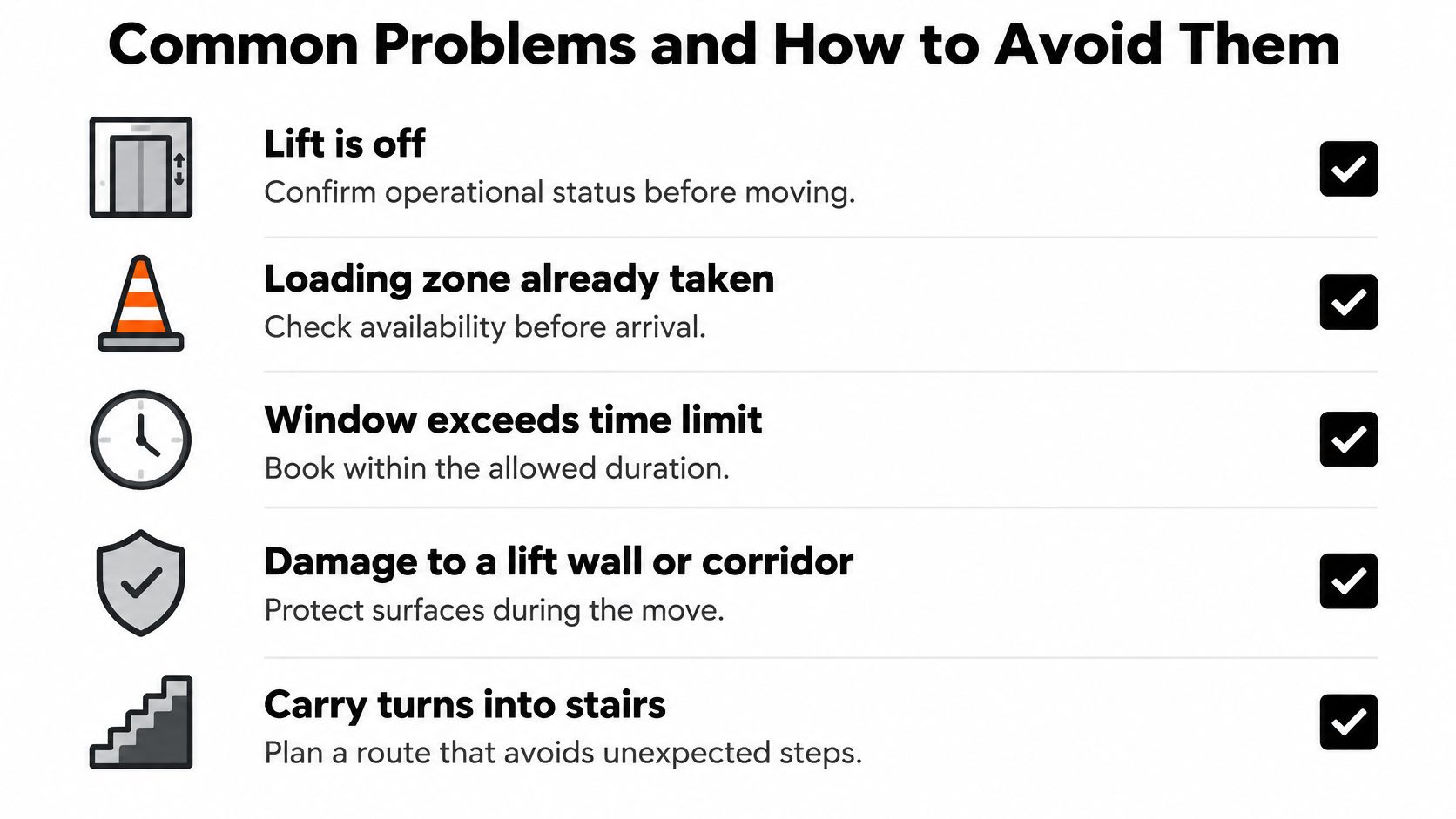
Use these checks to separate manageable interruptions from failed access.
Decide whether to wait or reschedule
A brief wait for another resident to exit the lift can be absorbed if the remaining booking allows it. A non-operational service lift is different, particularly when no approved furniture route remains.
- Lift outage: Stop dispatch until management confirms an operational, suitable alternative.
- Occupied loading area: Contact the manager before the driver arrives. Don't substitute an illegal stopping place.
- Active water ingress or emergency maintenance: Reschedule where the route or apartment isn't safe.
- Unexpected stairs or a long carry: Reassess labour, equipment and timing before proceeding. Stair fees may apply.
- Surface damage: Photograph the affected area, notify management and record what happened rather than leaving it for the final inspection.
Ask about works, not just availability
Get written confirmation of planned lift shutdowns, fire-system works, loading-zone restrictions and any temporary access permits. Ask whether contractors will share the dock or corridor during your window.
Protecting walls doesn't compensate for poorly prepared loads. Loose drawers, open cartons and exposed furniture corners increase handling time and collision risk; avoid the common packing mistakes when moving home before the crew reaches the building.
Cost check: Compare the cost of a workable booking with the total cost of a failed arrival, not just the hourly rate.
Where settlement and lease expiry leave little flexibility, agree on a backup destination for the belongings before loading starts. Don't assume an unusable apartment can safely hold furniture while maintenance continues.
Set Up Power Gas and Mail
Once management confirms access, organise the services you'll need when you get the keys. Aim to complete the administration before the final week, leaving time to resolve an incorrect unit address or connection problem.
Arrange services around your arrival
Transfer electricity and gas without leaving billing loose ends. Victorian Energy Compare's moving-house guidance recommends comparing offers, cancelling or transferring the existing plan, checking exit and connection or disconnection fees, and giving the retailer your move-in date. Confirm the apartment's connection arrangements, since they may differ from your previous home.
Ask for electricity to be available by the start of the moving morning rather than relying on a connection occurring during unloading. Keep the retailer's confirmation accessible; our moving house electricity guide can help organise the changeover. For connection, transfer or billing disputes, the Victorian guidance identifies the Energy and Water Ombudsman Victoria as an independent assistance service.
A retailer transfer doesn't replace physical gas work. If an appliance or gas line needs attention, arrange a licensed gas fitter with building approval where needed; gas fitting services from Total Plumbing, provided by Total Plumbing & Hot Water Systems, are a relevant resource for that separate task.
Redirect mail and update senders. Australia Post's mail-redirection service offers eligible letter and parcel redirection for 1, 3, 6 or 12 months, with a listed starting price of $40.50 and proof of identity required. Use the transition period to update banks, insurers, government agencies, your employer and online shops with the complete unit address.
Don't rely on redirection for urgent deliveries. A parcel already on board for delivery may not be redirectable, so change pending orders directly with the sender and confirm the building's parcel-handling arrangements.
Get n Go Removals Melbourne offers apartment relocations, packing, furniture disassembly and storage support, with moves planned around lift bookings and building manager requirements. Visit Get n Go Removals Melbourne with your building details, preferred access window and large-item measurements to discuss a move plan that fits the property.