Moving Insurance Australia: What Cover You Need
Your cartons are labelled, the lift is booked, and the glass dining table is still waiting to be wrapped. Then someone asks who pays if it's chipped on the stairs. If your answer is “the removalist's insurance, probably”, you've still got an important job to finish before collection.
Moving insurance in Australia isn't one blanket promise. You need to know which policy covers your belongings, when that cover starts and stops, and what happens if the damage falls outside it.
Why Moving Insurance Matters Before Moving Day
The night before a Melbourne move is a poor time to discover that nobody has checked the insurance. You might have organised professional handling for the piano, packed your own kitchen cartons and arranged storage until settlement. Those arrangements don't necessarily sit under the same cover.
The important period starts before the truck leaves. Your belongings may be packed, carried through shared corridors, loaded, transported, stored and delivered before they're settled at the new address.
Local doesn't mean automatically covered
Australian moves are mostly domestic. In 2019–20, 1.14 million households, or 12% of Australian households, had moved during the preceding year, while more than 40% had moved within the previous five years, according to the Australian Bureau of Statistics housing mobility figures.
Among households moving during that five-year period, 65% moved within their state or territory but outside their locality, 25% stayed within their locality, 7% moved interstate and 3% arrived from overseas, according to the same ABS figures.
That makes a Victorian relocation an ordinary situation, not a reason to skip the insurance check. A short drive doesn't answer whether damage while carrying furniture through a stairwell is insured.
Practical rule: Check cover against the work being done, not just the distance the truck travels.
Find the gap before collection
A standard contents policy can have different conditions once belongings leave home or enter storage. Don't confuse having insurance at your address with having suitable insurance throughout removal.
Add an insurance check to your moving house checklist for Australia, alongside access arrangements and key collection. Ask yourself:
- Which stage? Packing, carrying, transport, delivery or storage.
- Which place? Your home, a common area, the truck or a storage facility.
- Which event? Accidental breakage, theft or another specified loss.
An interstate move adds more locations and handovers to confirm. Your aim isn't to buy something called moving insurance. It's to avoid discovering, after damage occurs, that everyone expected another policy to respond.
How Moving Insurance Works in Australia
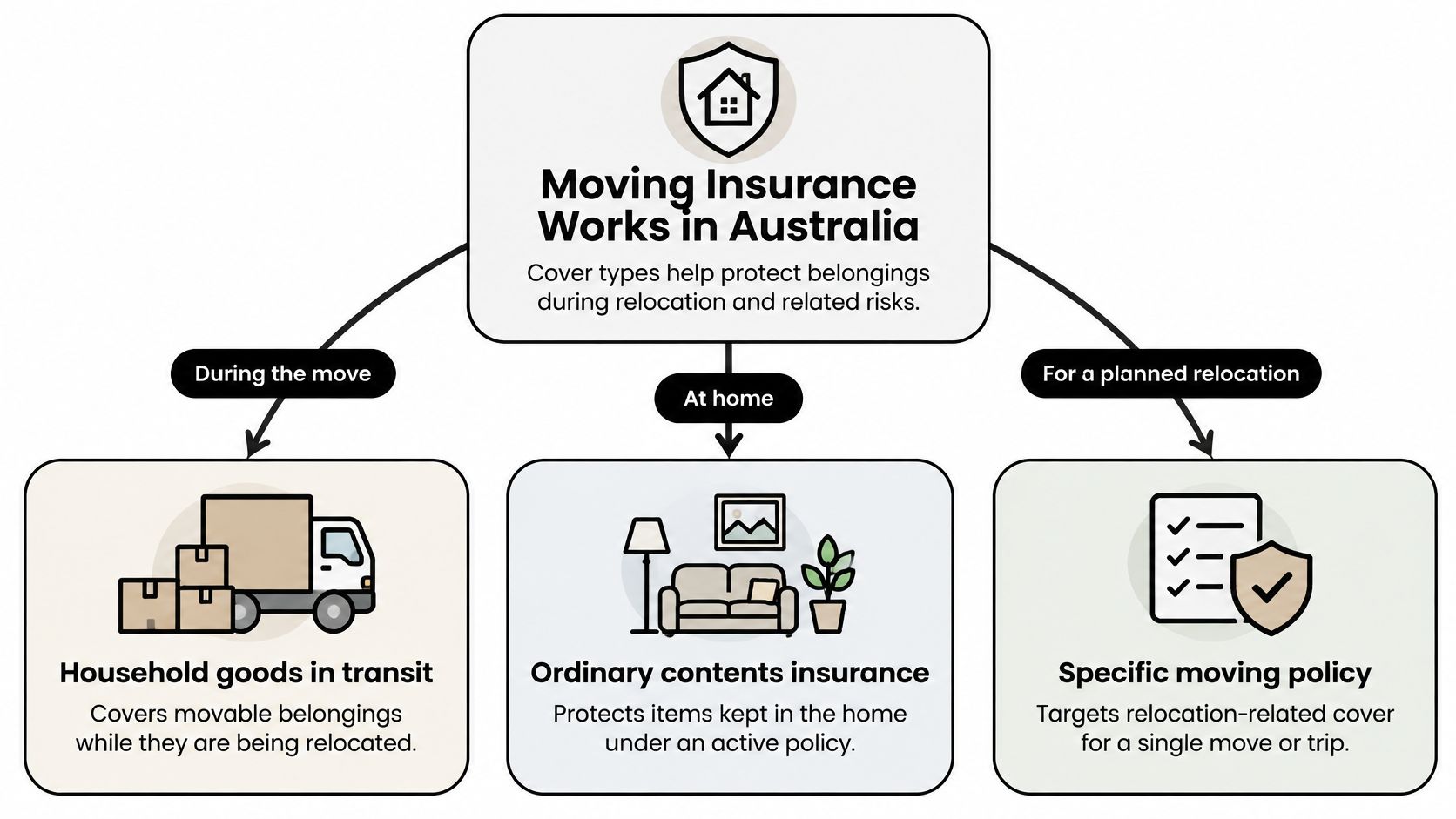
Start by separating the policies. Contents insurance, goods-in-transit insurance and public liability perform different jobs. The Insurance Council expressly recognises household goods in transit as a distinct general-insurance product.
The diagram provides a starting point for understanding the cover types.
Separate the jobs each policy does
Ordinary contents or tenants' contents insurance protects belongings under the conditions of an existing home policy. Check its moving provisions rather than assuming everything follows you.
Household goods-in-transit insurance addresses belongings being relocated. A specific moving policy may provide this protection for a planned journey, but its name alone doesn't establish the insured events or handling stages.
Public liability generally concerns third-party injury or property damage arising from the removal business's work. It isn't automatically a replacement policy for your sofa, computer or piano. Our explanation of public liability insurance helps distinguish damage to premises from cover for the goods being moved.
Build a written coverage map
Ask the insurer or authorised arranger to complete this map for your actual booking.
| Moving stage | Written confirmation needed | Who pays first? |
|---|---|---|
| Packing and loading | Packing, carrying and loading are included | Ask which policy responds to handling damage |
| Road transit | Route and insured events are included | Identify the relevant contents or transit insurer |
| Unloading and placement | Cover continues beyond the truck | Confirm responsibility through final placement |
| Temporary storage | Storage address and dates are accepted | Identify whether transit or separate storage cover applies |
Don't assign payment responsibility from the policy name. Where cover overlaps, ask the insurers how they'll handle the claim and which excess applies.
Check the settlement basis too: new-for-old replacement, depreciated market value, repair cost or an agreed amount can produce different outcomes. Ask about sub-limits for jewellery, artwork, computers, wine, documents and commercial equipment, plus the excess per claim.
For interstate work, confirm every state crossed and each storage address. To understand the questions storage raises, you can compare self-storage contents policies using Admiral's Yard Self Storage's resource, while relying on Australian policy documents for your own cover.
Finally, obtain the insurer's name, policy number, effective dates and policy documents. A payment labelled “insurance” isn't enough evidence that cover has been arranged. Confirm that the insurer has received the premium and paperwork before collection.
Exclusions and What Changes Your Premium
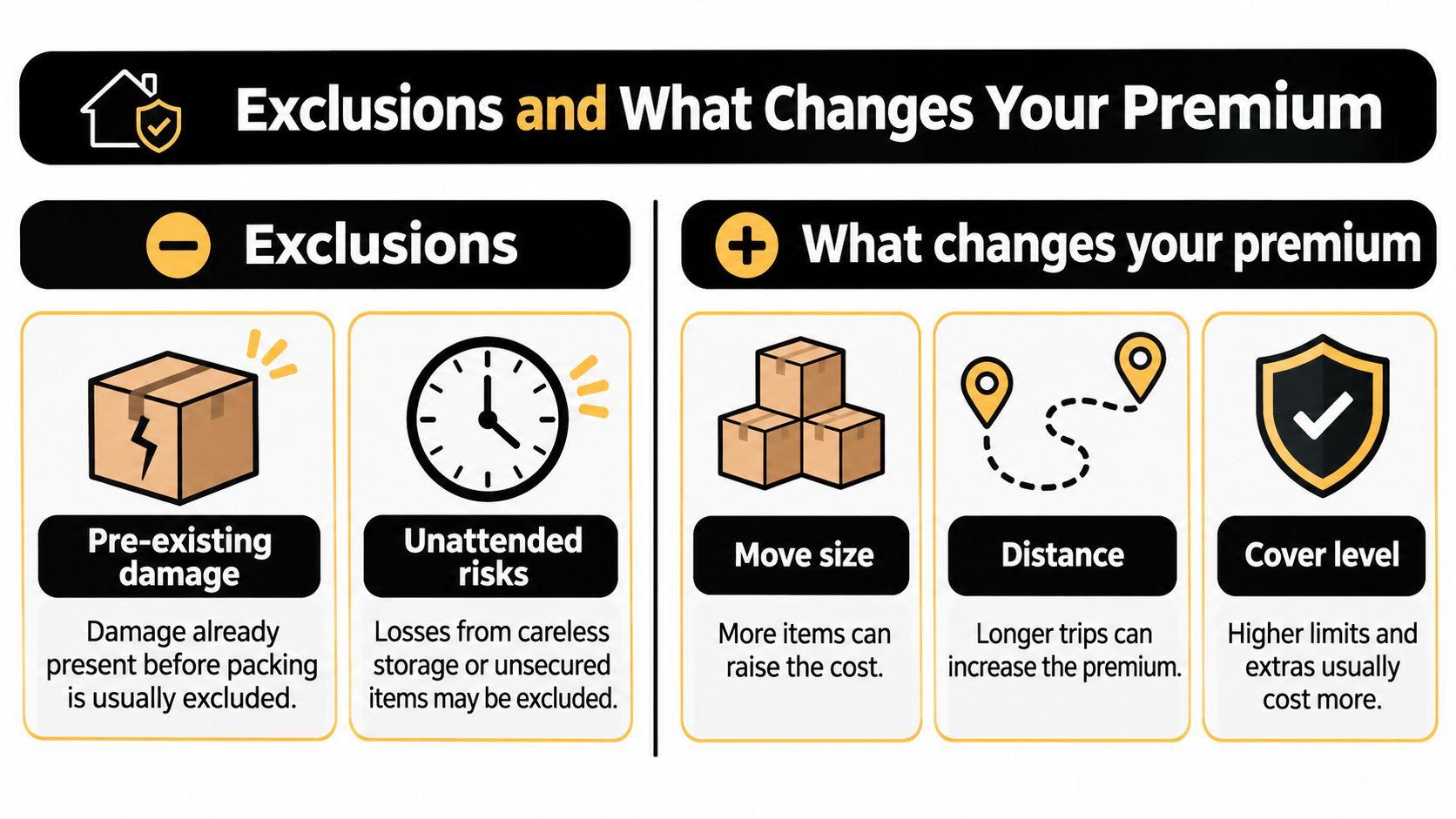
Read the exclusions before comparing prices. A cheaper quote isn't useful if the event you're most concerned about has been left out.
Look for provisions about owner-packed cartons, pre-existing damage, inadequate packaging, unattended vehicles and undeclared valuables. Don't assume these exclusions appear identically in every policy. Ask how each proposed policy treats your arrangements.
The following visual highlights the exclusions and pricing questions to check.
Underinsurance can follow you out the door
Some households start with no contents protection at all. An Insurance Council report using ABS household expenditure data estimated that 30%, approximately 2.7 million of around 9 million potentially eligible households, didn't have contents insurance.
That report also cited a national survey finding that more than 80% of homeowners and renters were likely to be underinsured, while 63% of renters had no contents insurance. These are historical findings, not current estimates, but they explain why checking whether a policy exists is only the beginning.
Check whether the amount insured matches the valuation basis. A household total that looks substantial can still leave an expensive item inadequately covered.
Ask what actually changes the quote
Give the insurer the details and ask which affect acceptance, price or conditions:
- Declared values: Use the requested valuation method, not a convenient low estimate.
- Specialist items: Identify pianos, pool tables, antiques, glass, artwork and office equipment individually.
- Handling arrangements: Explain professional packing, self-packing, stairs, lifts and difficult access.
- Journey and storage: Supply the destination, route requirements and anticipated storage period.
- Policy choices: Compare the excess and settlement basis alongside the premium.
Pair-and-set rules also deserve attention. Ask what happens if damage affects part of a matching suite, rather than assuming the insurer will replace everything.
A useful quote answers what you'll receive after a loss, not just what you'll pay before the move.
Before paying, ask: What event is excluded? What excess applies? Would declaring a particular item solve the gap more effectively than adding another policy?
Don't buy overlapping cover just because it sounds more thorough. Compare the actual improvement you're purchasing.
Cover Examples for Local and Interstate Moves
These hypothetical moves show how the coverage map works. They aren't customer case studies or promises of a claim outcome.
Professional packing and loading are part of the job you need the policy to address.

A Melbourne apartment move
You're moving within Victoria. The removal team packs the furniture, you pack clothing into cartons, and a piano needs specialist handling.
If the piano is scratched in the stairwell, don't assume your home insurer will reimburse you. CHOICE's guidance on finding a removalist warns that moving-related accidental damage and handling can fall outside home or transit cover, and that self-packing can affect protection.
Apply that distinction to each item. The professionally packed furniture and your own cartons may have different conditions, even though they travel together.
If the piano isn't covered by an applicable policy, the next question concerns responsibility under the removal agreement and the circumstances of the damage. Public liability isn't a shortcut to guaranteed reimbursement for the instrument.
Melbourne to Sydney or Brisbane with storage
For an East Coast move, plan the journey with long-distance movers around the handovers as well as the destination.
| Period | Question for this move |
|---|---|
| Packing and loading | Does cover begin before collection? |
| Road transit | Are the full route and relevant events included? |
| Temporary storage | Is the gap between homes expressly insured? |
| Unloading and placement | When does protection end at delivery? |
Some contents policies provide limited moving benefits rather than unrestricted accidental-damage cover. NSW consumer guidance on choosing a removalist discusses checking existing insurance; the NRMA example includes certain transit events and up to 14 days at the new home, subject to that policy's wording.
The video offers additional moving-day context.
For either move, prepare dated photographs, serial numbers, receipts, an inventory and condition notes. Insuring selected risky items can be a rational choice if the insurer offers it and you're prepared to carry the loss on ordinary depreciated goods yourself.
Selective cover is a deliberate trade-off, not a substitute for evidence. A low declared value won't resolve an argument about whether damage already existed.
How to Choose Cover for Your Move
Compare your existing insurance with the proposed moving cover before accepting either. Ask each insurer to explain the remaining gap in writing.
Don't start with “Are you insured?” Start with “What would respond if my belongings were damaged during this particular job?”
Which Policy Responds During a Move
| Cover | Typically responds to | Does not automatically replace |
|---|---|---|
| Existing contents policy | Specified events and any moving benefits in its wording | Every item damaged during removal |
| Customer goods-in-transit policy | Insured loss or damage to declared goods during the accepted journey | Excluded goods, events or handling stages |
| Removalist-provided transit arrangements | Goods and risks falling within that policy's terms | Unrestricted replacement cover for every customer |
| Removalist public liability | Third-party injury or property damage arising from operations | A dedicated policy on your household or office contents |
| Separate storage cover | Accepted risks while goods are at the specified storage location | Transport or handling outside its insured period |
The distinction between contents and storage/transit products also appears in the Insurance Council's insurer product listings. Your decision should follow the policy wording, not the broad category.
My recommendation is straightforward: keep suitable existing protection, then address the uncovered risk. Buying another policy doesn't help if both exclude the same carton or handling event.
Match the provider to the work
Get n Go Removals is a family-owned Melbourne team with police-checked staff, public liability and transit insurance arrangements. Its services include house and apartment moves, office relocations, pianos and pool tables, valet packing, furniture assembly, and short- or long-term storage.
Its company-owned truck fleet and regular East Coast runs connect Melbourne with Sydney and Brisbane. Those services can form part of one moving plan, but service availability isn't proof that every item or activity is insured. Request the documents for your booking.
Use the same checks when choosing a removalist for your move:
- Policy identity: Request the insurer's name, policy number, certificate and applicable wording.
- People covered: Confirm who is insured and whether subcontractors are included.
- Packing terms: Establish how owner-packed goods are treated.
- Storage period: Ask whether storage requires separate acceptance or documentation.
- Financial limits: Obtain the excess, overall limit and relevant item limits in writing.
- Effective dates: Match commencement and expiry to the actual work.
If an answer is vague, pause acceptance until it's clarified. A written limit you understand is more useful than an expansive verbal assurance.
What to Disclose and How to Claim
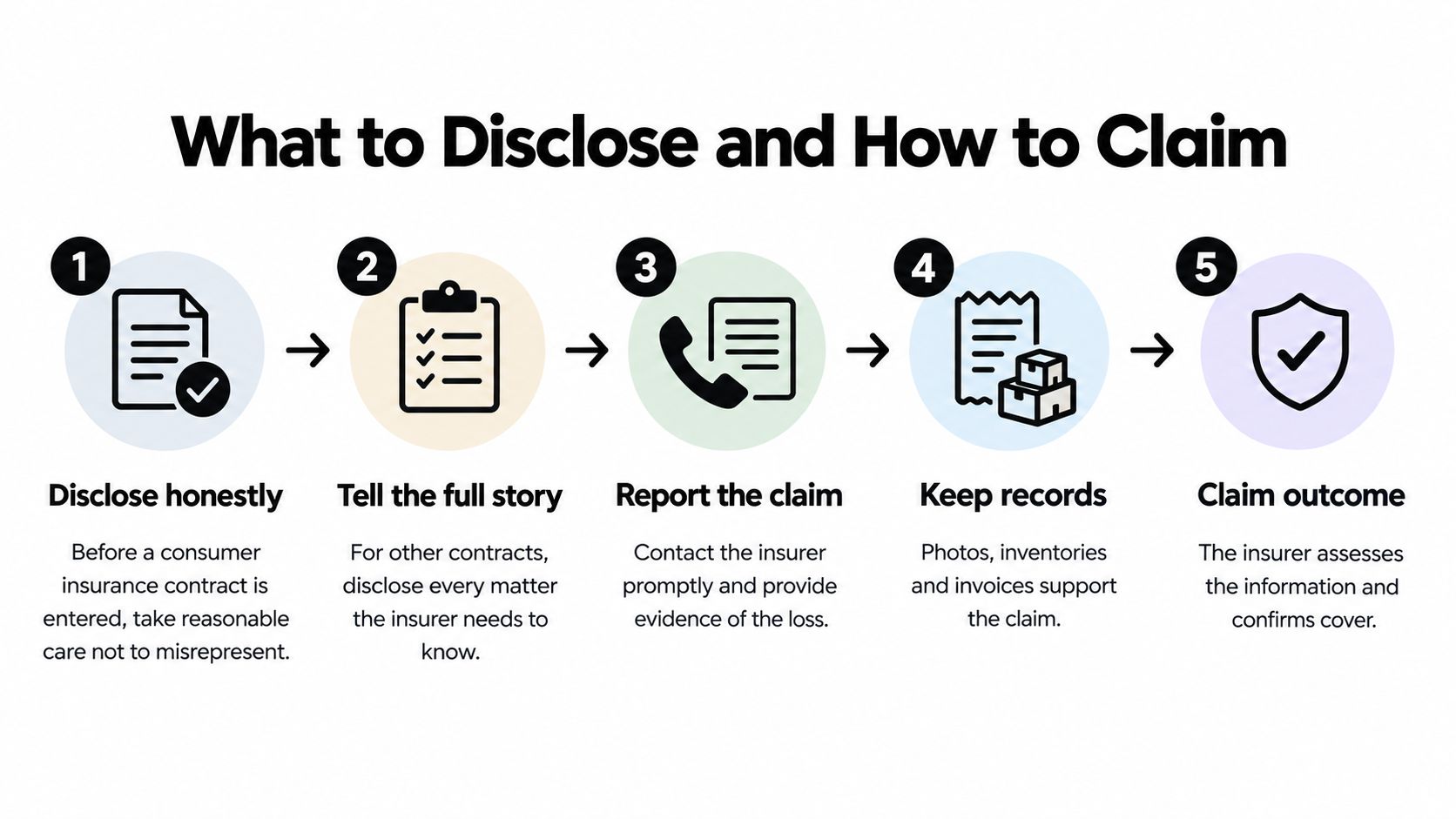
Accurate information matters before the policy begins. Under the Insurance Contracts Act 1984, a consumer must take reasonable care not to make a misrepresentation before entering a consumer insurance contract.
For other insurance contracts, the disclosure obligation concerns known matters relevant to accepting the risk or setting terms, including matters a reasonable person would recognise as relevant. Don't assume the same disclosure framework applies identically to every household and business policy.
Make the application accurate
Provide the requested values, existing damage, destination, access conditions, storage period and packing arrangements. If those details change while cover is being arranged, tell the insurer.
The Act's provisions on written disclosure notices and timing address written notification and the duty continuing until contract entry. A quote or conversation isn't confirmation that your proposed risk has been accepted.
For contracts subject to the disclosure duty, prescribed wording identifies exceptions, including information that reduces risk, is common knowledge, is already known to the insurer or has been waived. It also explains that non-disclosure can lead to cancellation or reduced payment, while fraud can allow refusal and avoidance of the contract, as set out in the prescribed disclosure notice.
Check the insurer's notice when changing existing cover too. The Insurance Contracts Regulations provide notices addressing renewal, extension, variation and reinstatement.
The process below connects accurate disclosure with usable claim records.
Keep evidence through delivery
- Before collection: Photograph goods, list identifying details and record existing marks. Use suitable preparation methods, including this guidance on packing fragile items for moving.
- At handover: Retain the inventory and consignment record identifying what the removalist received.
- At delivery: Record visible damage and keep delivery-condition acknowledgements.
- When claiming: Notify the relevant insurer within its deadline and provide photographs, receipts and the custody records.
- At settlement: Ask whether the proposed outcome is repair, cash or another contractual settlement method.
Evidence check: The consignment record supports that an item was accepted for transport. Collection photographs and an acknowledged condition report support its starting condition.
No single document proves every aspect of a claim. Keep the records together so the insurer can assess both when damage occurred and the amount claimed.
Book a Covered Move with Get n Go Removals
Match the booking to the actual job before asking for an insurance confirmation. A local apartment move needs accurate access information. An office relocation needs an inventory that identifies commercial equipment, while a piano or pool table needs individual attention.
For an interstate booking, include any gap between leaving the old property and receiving access to the new one. Don't leave storage as an assumption to sort out after collection.
Send a usable moving brief
Prepare an email or call with your inventory and dates available. Include:
- Collection and delivery: Addresses, preferred timing, stairs, lifts and access restrictions.
- Specialist belongings: Fragile pieces, valuables, pianos, pool tables and equipment needing particular handling.
- Packing services: What you'll pack yourself and where you need packing or unpacking assistance.
- Storage needs: Anticipated dates and whether the final delivery date is confirmed.
- Insurance request: The documents and written answers you need before accepting the arrangements.
Ask the team to confirm transit and public-liability arrangements alongside the removal plan. If you need flexible scheduling around settlement, lift bookings or office access, raise that during booking and agree on a single point of contact.
Finish the paperwork before collection
Keep the insurer's name, policy or certificate details, effective dates, exclusions, excess and storage confirmation together. Check that the inventory and service plan match what was accepted for insurance.
Don't treat “covered move” as a promise that nothing can go wrong or that every loss will be reimbursed. Treat it as a booking where the work, insured risks and remaining responsibilities have been made clear.
That's the practical outcome to aim for. You should know whom to contact, which documents apply and what risk you're choosing to retain before anyone lifts the first item.
Get n Go Removals Melbourne offers home and office relocations, specialist handling, packing and storage, with insurance arrangements to confirm against your move. Visit Get n Go Removals Melbourne to request a quote, send your inventory and dates, and ask for the applicable transit and public-liability details before collection.