
Packing and Moving Sydney Without the Chaos
You're probably not short on boxes. You're short on certainty. The lease date is fixed, the lift might not be, the truck needs somewhere legal to stop, and half your kitchen is still in cupboards you swore you'd emptied last weekend. That's the shape of Packing and Moving Sydney for many households, and it's why the packing itself is rarely the part that unravels the day.
What Moving Day in Sydney Actually Looks Like
It's a Friday morning outside a strata tower and the truck's already doing a slow lap because the loading dock is occupied. One person is waiting on a lift key from a building manager who hasn't arrived. Another is on the phone asking whether the crew can start carrying through the lobby, and the answer is no. Nothing's broken yet, but the day is already costing money while everyone stands still.
That scene plays out in houses too, just with different blockers. A narrow driveway, a neighbour's car across the access point, settlement running late, keys held at an agent across town. The boxes are packed fine. The problem is that three separate schedules, yours, the building's and the crew's, were never aligned.
Where the friction really sits
Many homeowners prepare for the physical job and underprepare for the coordination job. They know how many boxes they've filled but not whether the sofa clears the turn at the top of the stairs, whether the goods lift needs protective padding fitted before loading, or whether common areas need to be photographed first. When something goes wrong, it's usually an approval, an access measurement or a timing assumption, not a shortage of tape.
There's also the trust question nobody says out loud. You're handing your belongings, your bond and sometimes your only set of keys to people you've just met, on a day when you can't easily reschedule. Clear paperwork calms that down faster than reassurance does. A written brief, an inventory and confirmed access times give everyone the same version of the day.
If you're working through the building side for the first time, this walkthrough on how to plan for an apartment move in a strata building covers the approvals most tenants only discover when the lift key isn't there.
The cheapest quote stops looking cheap the moment a crew is paid to wait for a lift that was never booked.
Once you see a Sydney move as access first and cartons second, the order you do everything else in starts to change.
Building a Sydney-Smart Moving Timeline
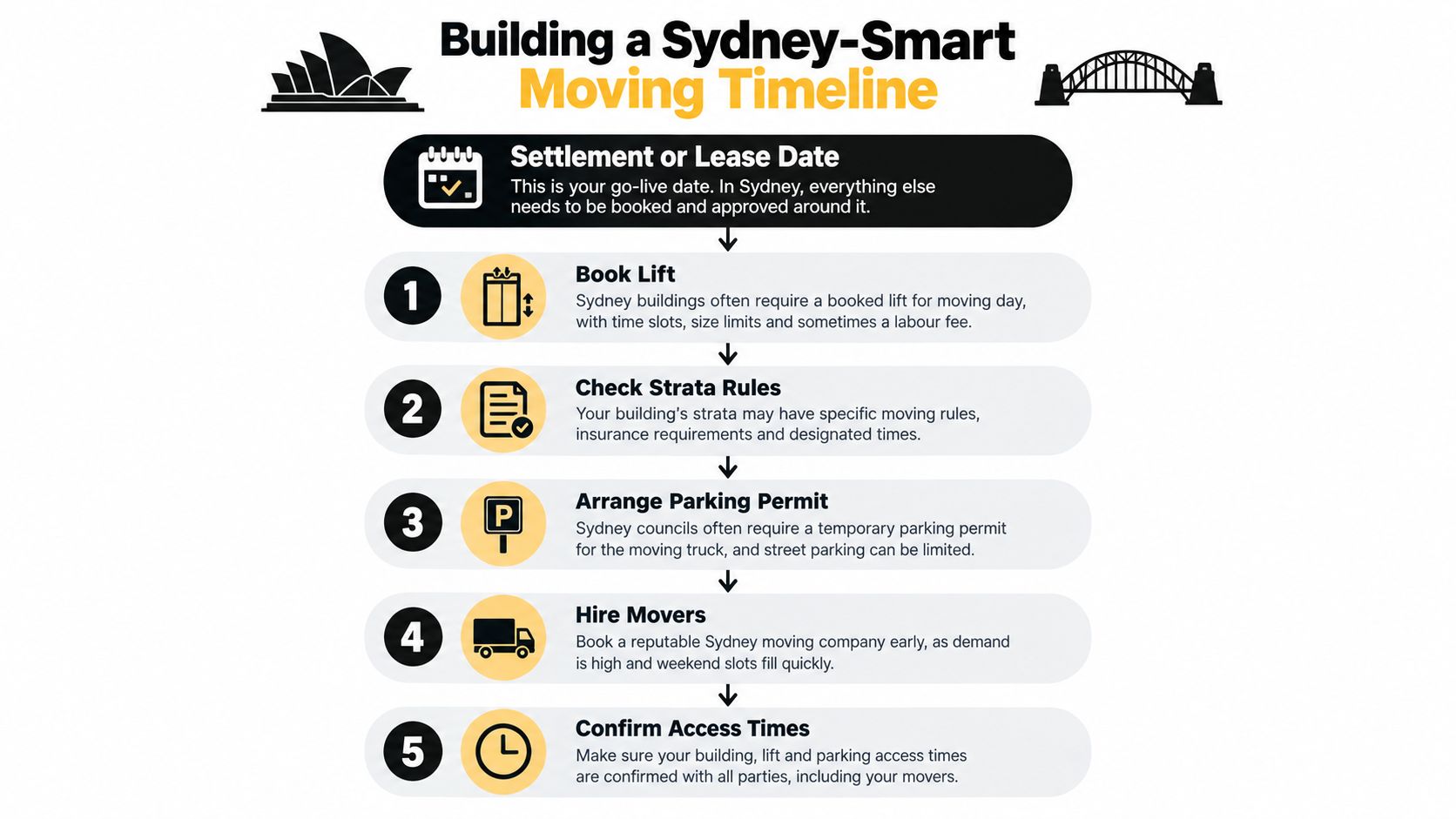
Start from the date you can't move, your settlement or lease handover, and work backwards. Don't start from the truck. Trucks are flexible compared with buildings, and the lift window is almost always the narrowest constraint you'll deal with. If the lift is only available for a set block on a weekday, that block dictates when the crew arrives, when packing must be finished and when cleaning can start.
The demand behind that congestion is real. In the 2021-22 financial year, Greater Sydney's population grew by around 37,300 people, while net internal migration was -51,738, showing large domestic outflows to other states including Victoria and Queensland, according to ABS regional population data for 2021-22. High turnover means lifts, loading docks and popular moving dates get claimed early, especially around lease changeovers.
Book the building before you book the crew
Use a four-stage access-control method and treat it as the spine of your timeline. First, get the building's written moving by-law and confirm the permitted date and hours, service-lift dimensions, loading-dock clearance, protective-padding requirements, insurance certificate and damage-bond process. Lift-notice requirements commonly range from 24 to 72 hours to approximately 14 days, and some Sydney buildings restrict moves to weekday daytime windows, as set out in this strata lift booking checklist for moving day. A phone conversation isn't confirmation. Get it in writing.
Second, reserve the goods lift and loading area before you lock in the crew. Third, run a pre-move fit check for large items against lift doors, corridors, turns, stairwells and truck access, measuring the item and the tightest point it has to pass. Fourth, send a single-page move brief to yourself, the building manager and the crew so nobody's working from memory.
| Stage | What to confirm | Evidence to keep |
|---|---|---|
| By-law check | Permitted hours, padding, insurance, bond | Written by-law or email approval |
| Lift and dock booking | Date, time block, key or fob access | Booking confirmation |
| Fit check | Lift doors, corridors, turns, truck approach | Measurements and photos |
| Move brief | Contacts, access times, parking position | One-page brief shared with all parties |
Parking sits alongside the lift booking, not after it. Burwood Council's moving checklist advises apartment residents to book the building lift in advance because strata commonly requires notice, and to check whether a council parking exemption is needed for the moving truck. That's two separate approvals from two separate bodies, and missing either one stalls the day.
Timing your date matters for the same reason. This guide to the best time to move house around peak demand is worth reading before you commit, because end-of-month and weekend pressure compounds every access problem above. Photograph pre-existing damage in common areas before loading starts, too. It takes minutes and settles arguments that would otherwise drag on for weeks.
Practical rule: plan the move around the lift window, not the truck's availability. Everything else can flex around a fixed access block. The access block can't flex around you.
Packing Methods That Survive a Sydney Truck
Packing fails in a predictable way. It isn't usually weak cardboard. It's unrestrained internal movement, small voids inside a carton that let contents shift, gain momentum under braking and vibration, and hit each other. A box can arrive with the cardboard intact and the contents damaged. So the goal isn't just cushioning, it's immobilisation. If you shake a sealed carton gently and something moves, it isn't packed yet.
This matters at scale because moving is constant. ABS housing mobility figures for 2019-20 show 12% of Australian households moved at least once in the previous year, with 7% of five-year movers relocating from another state or territory. Crews handle enormous volumes of cartons, and the ones that survive are the ones packed to a system rather than filled to the brim.
Classify before you wrap anything
Work room by room and sort goods into fragile, dense, bulky, hazardous and temperature-sensitive before a single carton is taped. Classification decides everything downstream. Dense items like books go in small, rigid cartons so the box stays liftable and stackable. Bulky light items can fill larger cartons. Hazardous goods come out of the consignment entirely until you've confirmed what can legally travel.
- Plates and glassware: wrap each piece, stand plates on edge rather than flat, and fill every gap so nothing rattles
- Books and files: small cartons only, packed flat or spine-down, never mixed with breakables to top up space
- Filing cabinets: empty the drawers or secure them shut, because a loaded drawer that slides open mid-carry is dangerous
- Wall-mounted TVs: photograph the cable setup first, remove the stand or bracket, and keep screws in a labelled sealed bag taped to the unit
- Dismantled furniture: bag the hardware, label it with the item name, and record it on your inventory so reassembly doesn't stall
For the fragile end of that list, the detailed steps in this guide on how to pack fragile items for moving without breakage go deeper on wrapping patterns and carton layering. If you want a broader room-by-room system to work from, this guide to organised relocation packing lays out a sensible sequence for tackling one space at a time without living among half-filled boxes for weeks.
Load engineering in plain language
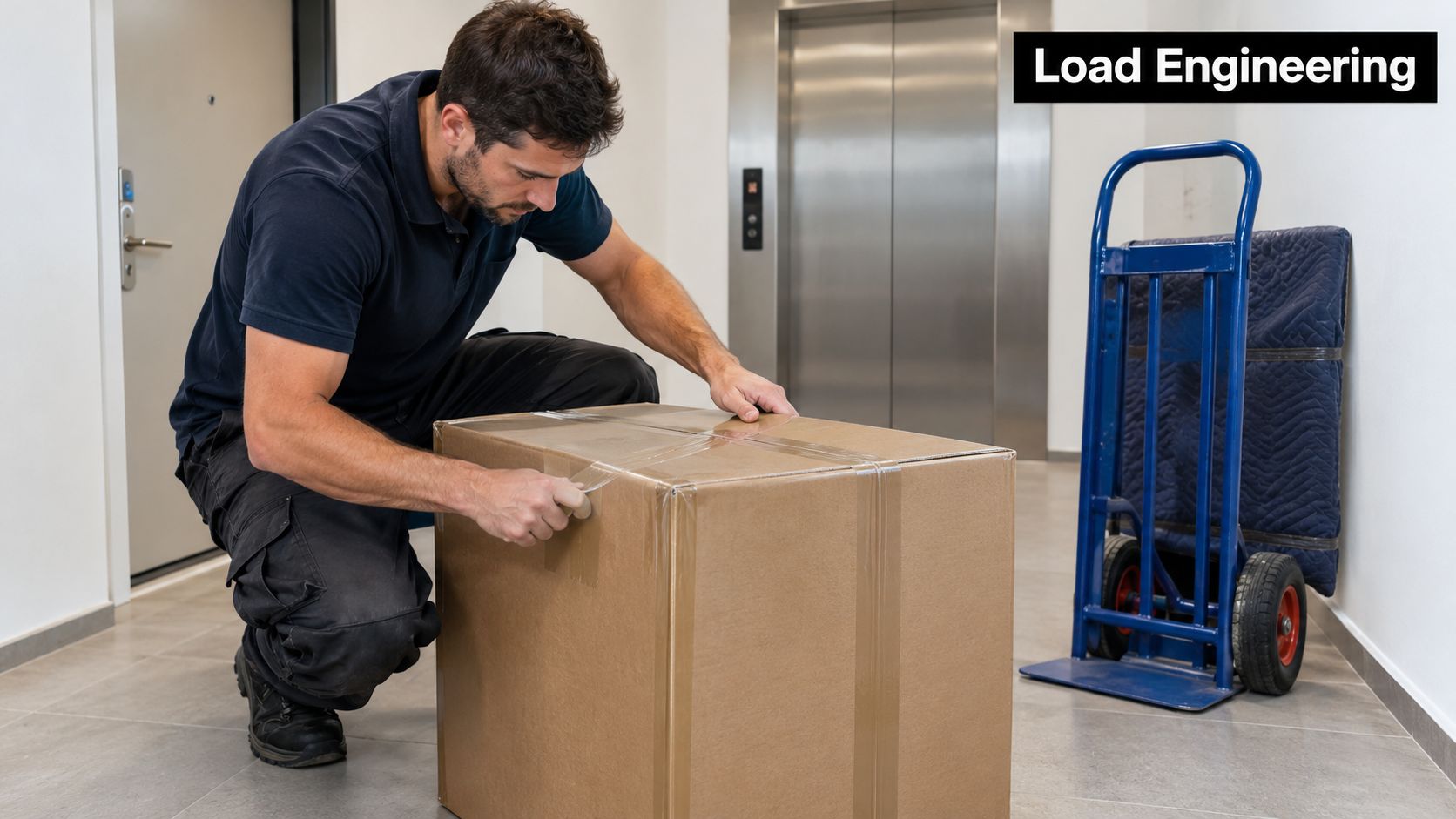
Heavy goods go low and close to the truck's centreline, with weight spread across the floor rather than stacked against one wall. Rigid, uniform cartons stack into a stable block. Odd shapes, soft bags and half-empty boxes create voids, and voids permit movement. Edge protection on furniture corners matters more than extra layers of wrap on flat surfaces, because corners take the knocks against door frames and lift walls.
Label every carton with destination room, handling orientation, weight class and an inventory number. That sounds fussy until unloading, when it means the crew can place boxes correctly without asking you about each one while you're trying to supervise the dock. Photograph high-value or already-marked items before sealing. Keep aerosols, fuels, gas cylinders and corrosives out unless you've confirmed the applicable Australian transport rules. And keep documents, medication, chargers, valuables and an overnight kit with you, not on the truck. That separation is what turns Packing and Moving Sydney from a hopeful load into a traceable chain of custody.
DIY, Full-Service, or Hybrid
The honest answer depends less on your budget than on your building, your furniture and your margin for error. Each option works in Sydney conditions up to a point. Each one also has a specific way it falls apart, and knowing that failure mode in advance is worth more than a generic list of pros and cons.
DIY truck or ute hire suits a small load, ground-floor access and flexible timing. Where it breaks down is strata and parking. A hired ute still needs somewhere legal to stop, and a building that requires lift bookings, padding and an insurance certificate doesn't waive those rules because you're doing it yourself. You're also the labour. Heavy items through corridors and stairwells, without trolleys, blankets or a second experienced pair of hands, is where injuries and wall damage happen. The hire cost looks low until you add a second day because the first load took longer than planned.
What full-service actually buys you
A full-service removalist handles packing, disassembly, loading, transport, unloading and reassembly. What you're really paying for in Sydney is coordination and accountability. One team works to your lift window, brings protective equipment for common areas, and knows how to sequence a load so the truck doesn't need repacking at the dock. The trade-off is cost and control. You need to brief them properly, and you still own the building approvals unless you've explicitly agreed otherwise in writing.
Get n Go Removals Melbourne is one example of how this model is typically structured, offering house and apartment moves, packing and unpacking, furniture disassembly and reassembly, and storage, with weekly direct runs between Melbourne and Sydney. Whichever provider you consider, the useful questions are the same. Who supplies the insurance certificate for strata? Who fits the lift padding? What's the process if the lift window is missed?
If you're weighing up whether packing help is worth it on its own, this overview of movers that will pack for you and what that service includes breaks down what pack-only arrangements usually cover.
The hybrid middle ground
Hybrid moves split the work. You pack the straightforward rooms, linen, books, clothes, and pay professionals for the kitchen, fragile items and the heavy furniture. Or you pack everything and hire a crew purely to load and unload within your access window. For many apartment moves this is the sensible middle. Your time goes on tasks that are slow but low-risk, and paid expertise goes where breakage and injury occur.
The hybrid failure mode is the handover. If your packed cartons aren't sealed, labelled and staged when the crew arrives, you've paid professionals to wait while you finish taping boxes. Hybrid only saves money when your part is finished before the booked start time.
Match the service level to your tightest constraint. A tight lift window, heavy furniture or a same-day settlement pushes you toward professional help faster than the size of your home does.
Think about office moves the same way. The cost driver isn't desks, it's downtime, after-hours building access and IT equipment that needs careful handling and reconnection. A cheap move that leaves a team unable to work on Monday wasn't cheap.
Interstate Runs Between Sydney and Melbourne
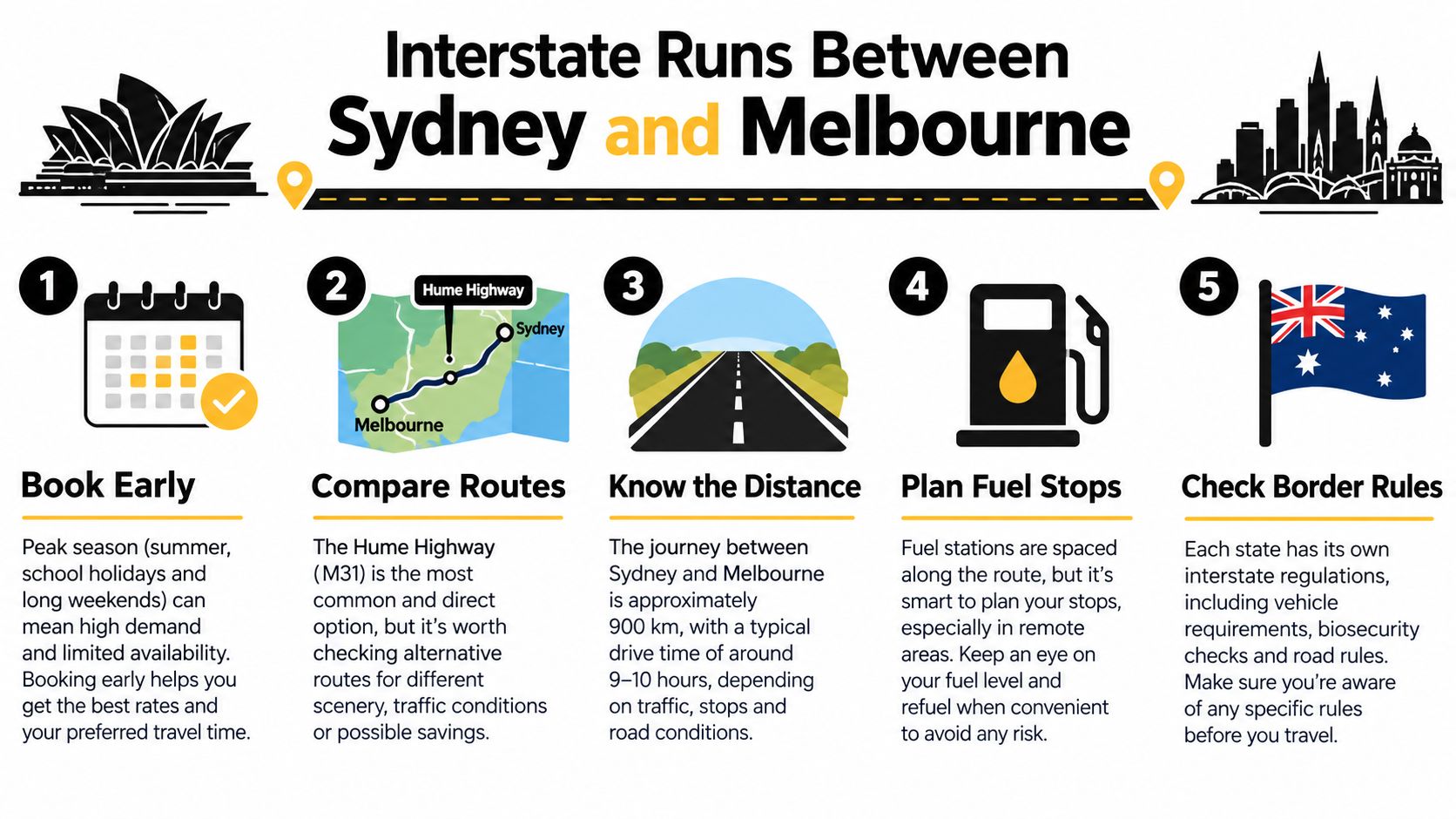
The Sydney to Melbourne corridor isn't an occasional favour between mates with a truck. Sydney's population pattern combines strong overseas inflow with a large domestic outflow to other states, including Victoria, and that outflow keeps this lane busy and well serviced. For you, that means scheduled direct runs exist alongside cheaper shared options, and choosing between them is a real decision with real consequences for timing.
A dedicated run puts only your goods on the truck, loaded once and unloaded once, with tighter control over departure and arrival. A backload fills spare space on a truck already travelling the route, which usually costs less but ties your dates to someone else's schedule and may involve additional handling. Neither is automatically better. If your Melbourne lease starts on a fixed date and you're sleeping on the floor until the truck arrives, scheduling certainty is worth paying for.
Packing for distance, not just for loading
Interstate packing uses the same classification system as a local move, but the consequences of a void inside a carton multiply over a long highway run with repeated vibration and braking. Record carton count, unusual dimensions and item condition in a written inventory, and photograph high-value pieces before sealing. That record is what lets you identify whether damage happened during packing, transit, unloading or assembly, rather than arguing from memory at the other end.
Ask about transit insurance explicitly and get the answer in writing. Ask what's excluded. Dangerous goods rules apply regardless of distance, so aerosols, fuels, gas cylinders and corrosives stay out unless confirmed otherwise. Keep essential documents, medication, chargers and valuables in your own vehicle or luggage. Build contingency around Sydney loading congestion at one end and Melbourne receiving access at the other, because a delay at either end shifts the whole run. This interstate moving checklist for long-distance relocations sequences those tasks so the paperwork doesn't get left until loading day.
The Victorian end of the move
Access planning doesn't stop at the border. Victoria's heavy vehicle rules apply to trucks over 4.5 tonnes GVM, with long vehicles that display a Do Not Overtake Turning Vehicle sign permitted to use more than one lane when turning, which affects access planning at inner-city destinations, per Transport Victoria's truck and heavy vehicle road rules. In practice, that means checking the approach route, turning space and kerbside position at your Melbourne address before the truck is dispatched, not while it's circling the block.
If you're renting in Victoria, two deadlines deserve a spot in your moving folder. Your rental provider or agent must give you the condition report before move-in, and you return one completed, signed copy within five business days of moving in, having inspected every room and photographed existing marks and faults, as explained in Consumer Affairs Victoria's guide to condition reports before moving in. That time-stamped record helps separate pre-existing damage from anything blamed on the move.
Budget for the bond alongside transport and cleaning. In Victoria the maximum bond is generally one month's rent, except where weekly rent exceeds $900, and it must be lodged with the Residential Tenancies Bond Authority within 10 business days of the rental provider receiving it, according to the Consumer Affairs Victoria renters guide on bonds and the RTBA. Keep the RTBA receipt and bond number with your moving paperwork. You'll want both when this tenancy ends.
Your Sydney Move-Out Checklist
Everything above collapses into one sequence. Print it, screenshot it, work down it in order. The order matters because each item leads to the next, and doing them out of sequence is how people end up with a booked truck and no lift.
- Written by-law first: confirm permitted hours, padding, insurance certificate and bond process with strata
- Lift and loading area reserved: in writing, before the crew is booked, with key or fob arrangements clear
- Parking sorted: loading dock confirmed or council exemption arranged where your building requires it
- Fit check done: largest items measured against lift doors, corridors, turns and stairwells at both addresses
- Cartons labelled properly: destination room, orientation, weight class and inventory number on every box
- Overnight kit separated: documents, medication, chargers, valuables and essentials travelling with you
- Common areas photographed: pre-existing damage recorded before loading starts
- Moving folder complete: condition report, bond receipt, inventory and booking confirmations in one place
Waste is part of the move, not an afterthought
Decluttering before you pack reduces volume and cost, but disposal rules in Sydney vary by address and rushed dumping creates its own problems. The City of Sydney's moving in or out waste and recycling guide notes that bin colours and food-scraps services vary by property, bulky-waste collections must be booked in advance, and apartment residents should check with the building manager first because one booking may cover the whole building. It also identifies free drop-off options for some electronics, batteries, polystyrene and textiles. Those are City of Sydney arrangements. A neighbouring council may run things differently, so check your actual address rather than assuming one Sydney-wide answer.
Build a simple decision for every unwanted item. Sell it, donate it, book it for collection, take it to a drop-off site, or store it temporarily. Don't leave furniture on the kerb hoping for the best, and don't leave goods on common property after you go. Strata can treat items left behind as abandoned, and sorting that out from interstate is nobody's idea of a good week. If some belongings aren't travelling straight to the new place, short-term storage gives you a buffer between settlement dates, lease gaps and delivery windows without forcing rushed decisions.
Cleaning sits at the end of the sequence for renters, once the rooms are empty and you can see what needs doing. If your bond is on the line, working through Steps to protect your security deposit room by room gives you a structured way to check the details agents typically inspect, rather than relying on a final walk-through when you're already exhausted.
Questions that come up on nearly every job
Do I book the movers or the lift first? The lift. Crew availability flexes, building access usually doesn't, and a confirmed access window makes every quote you request more accurate.
What should never go on the truck? Documents, medication, valuables, chargers and anything you'll need the first night. Add dangerous goods like fuels and gas cylinders unless you've confirmed they can legally travel.
How do I prove damage wasn't mine? Photographs, taken before loading, of common areas, high-value items and existing marks, kept with your condition report and inventory. Evidence gathered calmly in advance beats recollection argued afterwards.
Handled in that order, Packing and Moving Sydney stops being a scramble and becomes a sequence of confirmed bookings, labelled cartons and known access windows. Boring, ideally. Boring is what a good moving day feels like.
If you'd rather hand the coordination, packing and heavy lifting to a crew that runs weekly direct services between Melbourne and Sydney, Get n Go Removals Melbourne offers house and apartment moves, office relocations, professional packing and unpacking, furniture disassembly and reassembly, and secure storage with a single point of contact from first box to last. Tell them your lift window, your access constraints and your destination date, and get a plan built around the narrowest constraint rather than around hope.