
Interstate Moving Insurance: A Practical Guide for Melbourne
You've just unloaded a Melbourne home in Sydney. The dining table has a fresh gouge, the television screen is cracked, and a carton that looked dry at collection is damp inside. The removalist says the load was insured. The insurer asks for the policy schedule, declared values, photographs, and proof of damage. Suddenly, “insured” sounds less like protection and more like an unanswered question.
Interstate moving insurance matters because responsibility changes during a long relocation. The truck, removal crew, depot, subcontracted carrier, temporary storage facility, and customer may each sit at a different point in the custody chain. A successful claim depends on matching the loss to the policy wording, not on relying on a reassuring sentence made over the phone.
Why Melbourne Families Get Caught Out on Interstate Insurance
A Melbourne family moving to Sydney may assume their household contents are covered from the moment the first chair leaves the house. That assumption often survives packing, loading, the Victorian departure, and the arrival at the new property. It usually disappears when the family finds water damage inside a bookcase or a cracked television after delivery.
The problem is simple. A removalist's public-liability policy isn't automatically transit insurance for your belongings. Public liability generally deals with injury or property damage suffered by a third party because of the operator's activities. Transit insurance is designed around the customer's declared goods while they're being moved. ASIC's insurance guidance distinguishes land-transit cover from ordinary home-contents insurance, which primarily protects possessions at the insured home. ASIC's insurance-data guidance explains the distinction between land transit and home contents cover.

The three checks before the truck is loaded
Before collection, get written answers to three questions:
- Who underwrites the cover? Ask for the insurer's legal name, policy number, certificate or schedule, and Product Disclosure Statement.
- What event does it cover? Confirm whether the policy responds to accidental loss or damage, or only where the removalist is legally negligent.
- Which handling stages are included? Check loading, line-haul transport, unloading, depot transfers, overnight stops, and any storage period.
The Australian Government advises consumers to obtain insurance, compare quotes, read the policy wording, and confirm the excess. You also don't have to buy insurance from the provider recommended by the removalist. That makes independent comparison sensible, especially for high-value furniture, electronics, antiques, artwork, and pianos. You can also review the practical distinction between a mover's policy and customer protection in this guide to moving company insurance coverage.
Practical rule: A verbal assurance that your goods are “insured” proves nothing. Ask for the documents before collection, not after damage occurs.
The Four Cover Types Customers Actually Choose Between
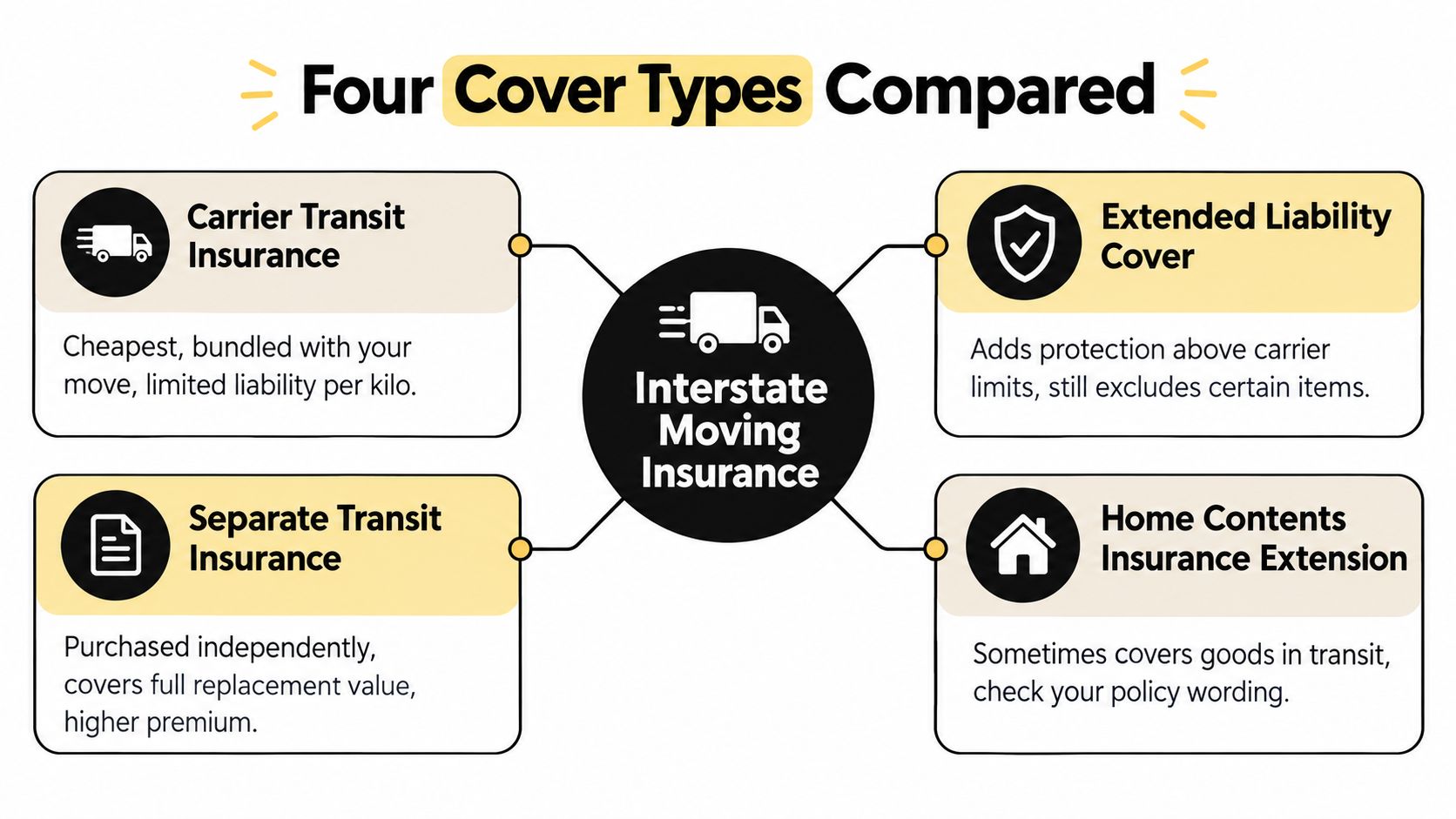
Customers often use “moving insurance” to describe several different arrangements. They don't respond in the same way, and choosing the cheapest option without understanding its limits can leave a valuable item effectively uninsured.
Carrier transit cover
This is the protection arranged through the removalist for goods while they're being moved. Think of it as cover attached to the carrier's service, with limits, exclusions, and liability conditions set by the relevant policy or contract.
For example, a Melbourne consignment travelling to Brisbane may be covered during the truck journey but treated differently during depot storage or a subcontracted leg. Ask whether the policy covers the full route and every party handling the goods.
Declared-value protection
Declared value protection lets you identify the value of the shipment or particular items before the move. Its mental model is a higher payout ceiling in exchange for more accurate disclosure.
A family moving a dining set, television, piano, and home-office equipment should list those items specifically rather than allowing them to disappear into a generic “household contents” description. The insurer or removalist can then apply the stated valuation method and any sub-limits.
Third-party transit insurance
A standalone policy bought directly from an Australian insurer can be useful when you're self-packing, combining professional transport with your own vehicle, or arranging several providers. It may offer broader control over the insured events and valuation basis, but it still depends on the PDS.
For a plain-English discussion of whether additional shipping protection is worthwhile, Aeros Couriers' guide to shipping protection is a useful comparison point. It shouldn't replace reading your own policy.
Storage cover
Storage cover deals with the gap between collection and final delivery. That gap might arise because settlement dates don't align, the Sydney property isn't ready, or the customer wants a warehouse period before moving in.
A Melbourne family sending furniture into storage should confirm whether transit cover continues automatically, switches to a storage section, or stops when the goods enter the facility. The policy may also require a separate premium or impose different exclusions. Before accepting any quotation, compare it with the provider's explanation of goods in transit insurance.
Side-by-Side Cover Comparison for Melbourne Interstate Moves
The table below is a decision aid, not a substitute for the policy wording. The two columns that deserve the most attention are payout basis and exclusions. A policy may sound broad but still value an item at market value, exclude customer-packed goods, or stop responding once the shipment enters storage.
| Cover type | Who arranges it | Typical payout basis | Best for |
|---|---|---|---|
| Carrier transit cover | The removalist or its insurer | The policy's stated liability or insured-value method, subject to limits and excess | A straightforward move where the customer has checked the carrier's documents |
| Declared-value protection | The customer and removalist together | Declared values for the shipment or specified goods, subject to valuation rules | Households with identifiable high-value furniture, electronics, or musical instruments |
| Third-party transit policy | The customer directly with an insurer | The selected policy's replacement, market-value, or indemnity basis | Self-packed, hybrid, or unusually valuable moves needing independent cover |
| Storage cover | The customer, removalist, storage provider, or insurer, depending on the arrangement | The storage section's valuation and event limits | Moves where delivery dates don't align or goods remain in a warehouse |
Carrier cover is usually quick to arrange but narrow in response when its liability terms are restrictive. Declared-value protection can produce a more suitable limit, but only if you list the right goods and understand how settlement is calculated. A standalone policy gives you more control, yet it requires more effort before moving day.
Many Melbourne customers combine cover types. For example, they may use a removalist's transit arrangement for the road journey and arrange separate storage protection for a Sydney warehouse period. That combination can work, but only if the start and end points meet without an uninsured gap.
A public-liability policy should remain a separate question. It may respond when the removalist causes third-party damage or injury, but it doesn't automatically promise replacement of your furniture. Read the explanation of public liability insurance for removals before treating it as household protection.
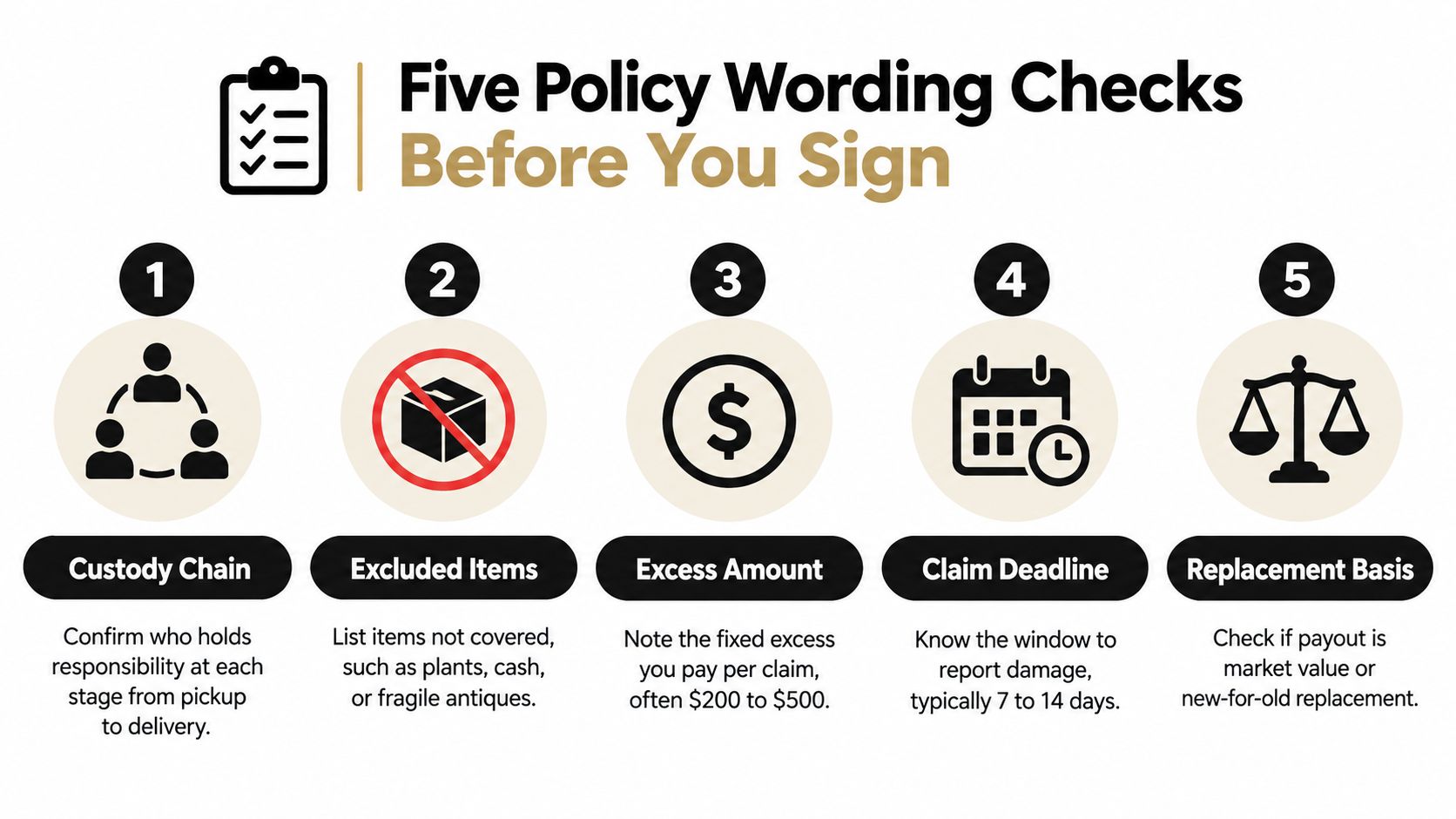
What to Check in the Policy Wording Before You Sign
A policy is only as useful as its weakest clause. Don't accept “full cover” as an answer until the documents show exactly what the insurer means.
Confirm the custody chain
Write down every stage from Melbourne pickup to final placement. A Melbourne-to-Brisbane move might involve loading, a depot transfer, line-haul transport, unloading, an overnight stop, or a subcontracted carrier. Ask who carries responsibility at each stage and whether the same policy follows the goods.
Identify the valuation method
Replacement value, market value, and indemnity valuation can produce very different outcomes. Replacement wording may focus on obtaining a comparable new item, while market-value wording may consider the item's condition and age. Indemnity wording generally aims to place you in a financial position similar to the one before the loss, not provide an unrestricted new purchase.
List high-value items separately
A piano, dining suite, antique cabinet, artwork, camera, computer, or television shouldn't be hidden inside a broad contents estimate. Ask for written confirmation of item limits, category sub-limits, and any special requirements for fragile or irreplaceable goods.
Set the packing responsibility
NTI's domestic-removal wording shows why packing matters. The cover can apply during insured transit, but the policy's events, exclusions, and packing conditions still control the claim. If you self-pack cartons, ask whether poor packing can exclude damage. If the mover packs, confirm that professional packing is included and record the condition before loading.
Record the excess
The excess is the amount you pay toward an accepted claim. Ask whether it applies per incident, per item, or per consignment, and whether different excesses apply to storage, accidental damage, or high-value goods. The Australian Government specifically advises consumers to confirm the excess before choosing a removal insurance arrangement. Government consumer guidance for choosing a removalist explains the importance of comparing cover and checking the excess.
How to File a Claim Without Getting Knocked Back
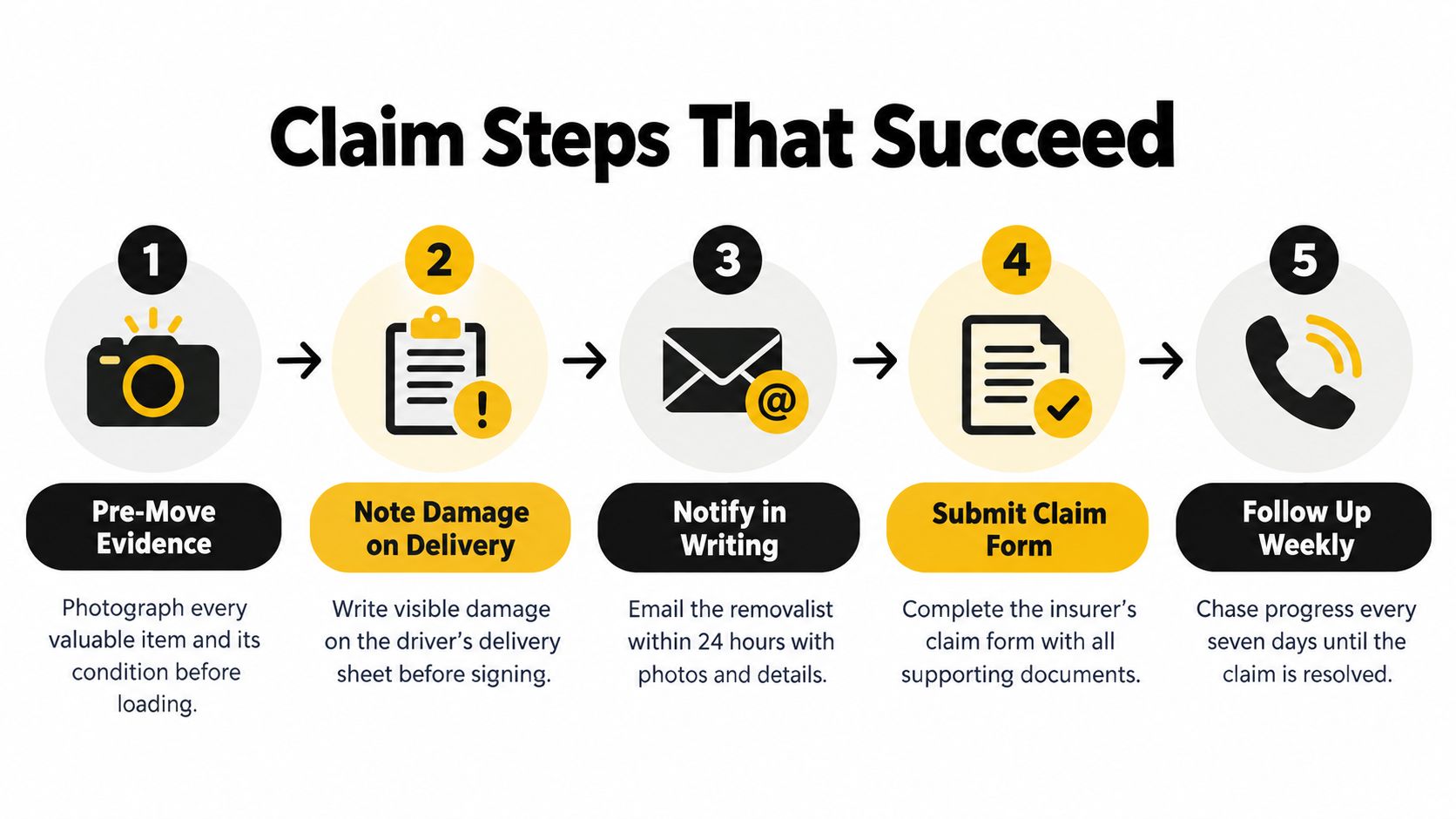
Claims are won with evidence. Begin before the removalist arrives, because the strongest proof of condition exists before the item enters the truck.
Build the evidence before collection
Photograph high-value goods from several angles. Capture scratches, dents, existing marks, model numbers, and serial numbers. Keep receipts, replacement estimates, and purchase records where you have them, and create an inventory showing the item description, carton count, and declared value.
At collection, review the condition report with the crew. Don't allow a pre-existing mark to become confused with transit damage, but don't let a genuine defect go unrecorded either.
Inspect at delivery
Walk through the delivery as the crew unloads. Photograph torn cartons, wet packaging, crushed corners, broken furniture, and damaged screens. Write visible damage on the delivery document before signing, then keep a copy.
Concealed damage needs prompt action. Stop unpacking the affected carton if practical, preserve the packaging, photograph the interior and exterior, and contact the removalist and insurer in writing. Notification windows vary by policy. Some guidance highlights a 7 to 14 day reporting window, so check your own documents rather than assuming you have unlimited time. NT consumer guidance explains inventory, condition records, and removalist service obligations.
Claims evidence is a timeline: condition before loading, condition at handover, discovery of damage, written notification, and supporting valuation.
A prepared customer might photograph a television before loading, note a clean screen on the collection record, record a cracked screen at delivery, preserve the carton, and submit the insurer's form with the photographs. A customer relying only on a verbal promise may discover damage after unpacking, discard the packaging, and have no reliable evidence of when the crack occurred.
Send one organised evidence pack. Include the inventory, photographs, delivery notes, receipts or estimates, policy details, claim form, and a short factual description of what happened. Keep copies of every email and attachment.
The following video provides another visual explanation of the claim process:
Where Removalist Liability Stops and Your Cover Starts
Australian Consumer Law gives customers important service rights, but those rights aren't the same as automatic replacement-value insurance. A removalist service must generally be provided with due care and skill, be fit for a specified purpose, and be supplied within a reasonable time when no timeframe has been agreed. That doesn't mean every accidental loss becomes the removalist's bill.
Scenario one, the crew causes the damage
The crew drops a cabinet while carrying it down the stairs. The customer can point to the handling event, the condition report, and the service obligation. The removalist's liability arrangements or the customer's policy may respond, depending on the facts and wording.
Scenario two, damage occurs without proven negligence
A third-party vehicle collision, road event, weather exposure, or another incident may damage goods even when nobody can prove the removalist acted negligently. Treasury's analysis of removalist add-on insurance gives examples of accidental losses where consumer guarantees may not compensate the customer, including a train derailment, maritime loss, or collision involving a third-party vehicle where the removalist wasn't at fault. Treasury's paper on removalist add-on insurance distinguishes consumer guarantees from broader accidental-damage cover.
In that situation, the customer's transit policy may be the protection that responds. Without it, the customer may have a damaged item and no automatic entitlement to replacement value.
Scenario three, a subcontractor handles the load
The original removalist accepts the booking, but another carrier handles part of the route. Ask whether the original policy extends to subcontractors, depot transfers, and storage. If the paperwork is silent, the customer can face an argument about which company had custody when the damage occurred.
Removalist liability and insurance are complementary. One deals with legal responsibility and service performance. The other can close the gap for accidental loss where negligence is difficult or impossible to prove. Use a written guide to choosing the right removals firm as part of your broader due diligence, but still request the actual insurance documents.
Building Your Pre-Move Insurance Checklist
Run this checklist during the week before collection. Don't leave it until the crew is already carrying furniture through the front door.
Start with the quote
Identify the cover offered, the insured or declared limit, the excess, the route, and any storage period. Check whether the quotation separates transport, packing, unloading, and storage. If the quote uses “insured” without naming the insurer or explaining the basis of settlement, treat that as incomplete.
Request the documents
Use direct wording:
- Insurer: “Please provide the underwriting insurer's legal name.”
- Policy proof: “Please send the policy number, certificate or schedule, and Product Disclosure Statement.”
- Coverage period: “Please confirm when cover starts and ends.”
- Custody: “Please confirm whether subcontracted transport, depot transfers, overnight stops, and storage are included.”
- Valuation: “Please explain whether settlement uses replacement value, market value, or indemnity valuation.”
The need for proof is not theoretical. In 2000, ASIC announced Federal Court action involving a Western Australian removal business. ASIC alleged that the operator accepted premiums for promised transit insurance and, in many cases, retained the money without arranging the cover. The regulator advised consumers to check that the premium and insurance paperwork had been sent to the insurer. ASIC's announcement records the warning about verifying insurance paperwork and forwarded premiums.
Finish the practical checks
Before loading:
- Photograph electronics: Use original boxes where available and record serial numbers.
- Separate irreplaceable goods: Keep jewellery, passports, cash, and essential documents with you.
- Describe valuable furniture: List pianos, antiques, artwork, dining sets, and specialist equipment individually.
- Confirm packing: Record who packs each carton and what standards apply to self-packed boxes.
- Confirm storage: Get the facility, dates, cover period, access rules, and insurance treatment in writing.
A useful companion is the interstate moving checklist from Get n Go Removals Melbourne. Use it to organise the move, then verify every insurance statement against the policy itself.
Common Questions Melbourne Customers Ask Before Signing
How much does interstate moving insurance cost for a typical three-bedroom Melbourne home?
There isn't a responsible flat fee. Pricing usually relates to the declared value of the goods, the selected events, the valuation basis, the route, the packing arrangement, any storage, and the excess. A higher declared value can increase the premium, while a higher excess can reduce the upfront cost but leave you paying more after a claim.
Ask for the premium and excess as separate figures. Then compare what the policy pays, not just the price. A cheap arrangement that excludes accidental damage, self-packed cartons, or storage may offer little practical value for a full household move.
Who is responsible if a self-packed carton is damaged?
Responsibility depends on the policy and the evidence. Self-packed cartons often receive closer scrutiny because the insurer may need to decide whether poor packing caused the damage. A crushed carton, inadequate internal protection, or an item that was already damaged before collection can affect the outcome.
Reduce the dispute by photographing the empty carton, packing fragile goods carefully, recording the contents, sealing the box, and photographing it before loading. At delivery, retain damaged packaging and report the issue promptly. If the removalist packs the carton, keep written confirmation that packing formed part of the service.
What's the difference between replacement value, market value, and indemnity valuation?
Use one example: a television moving from Melbourne to Sydney.
Replacement value generally aims to fund a comparable replacement under the policy's conditions. Market value considers what the television was worth in its pre-loss condition, which can reflect age and depreciation. Indemnity valuation generally focuses on the financial position you held immediately before the loss rather than promising a new equivalent without adjustment.
Don't choose based on the label alone. Read how the policy treats depreciation, matching items, repair, obsolete electronics, pairs and sets, and high-value goods.
Does storage in Sydney need separate cover?
It can. A move involving storage creates another custody stage, and transit cover may not continue automatically once the goods enter a warehouse. Ask whether the policy includes storage, whether a separate section or premium applies, and when the transport cover stops.
For a family waiting to move into a Sydney property, written confirmation should identify the storage location, the covered dates, the insured events, the valuation basis, and the process for reporting damage discovered during release. A complete custody chain prevents the familiar answer of “that part wasn't covered”.
If you're planning a Melbourne interstate move, Get n Go Removals Melbourne offers residential and commercial relocations, professional packing, furniture handling, interstate transport, storage, and transit insurance on request. Ask the team for the insurer details, policy wording, declared-value process, and storage terms before booking so your paperwork is ready before the truck arrives.