
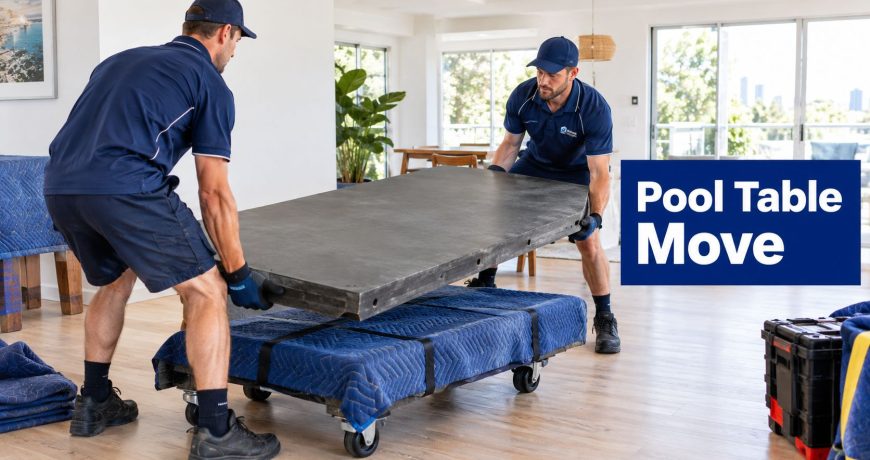
Pool Table Removals Brisbane: A Practical Guide
You're standing in a Brisbane games room with a buyer waiting, a new floor booked, or a moving truck due at the kerb. The pool table looks solid enough to carry out intact, until you measure the doorway, find the narrow turn in the hallway, and realise the table was designed to stay level, not travel.
That's why pool table removals Brisbane jobs need access planning before anyone touches a bolt. The price, crew size, equipment, protection, transport method, and reassembly time all depend on the table's construction and the route between properties. A careful removal is a dismantle-and-carry project, not a standard furniture lift.
When the Table Will Not Fit Through the Door
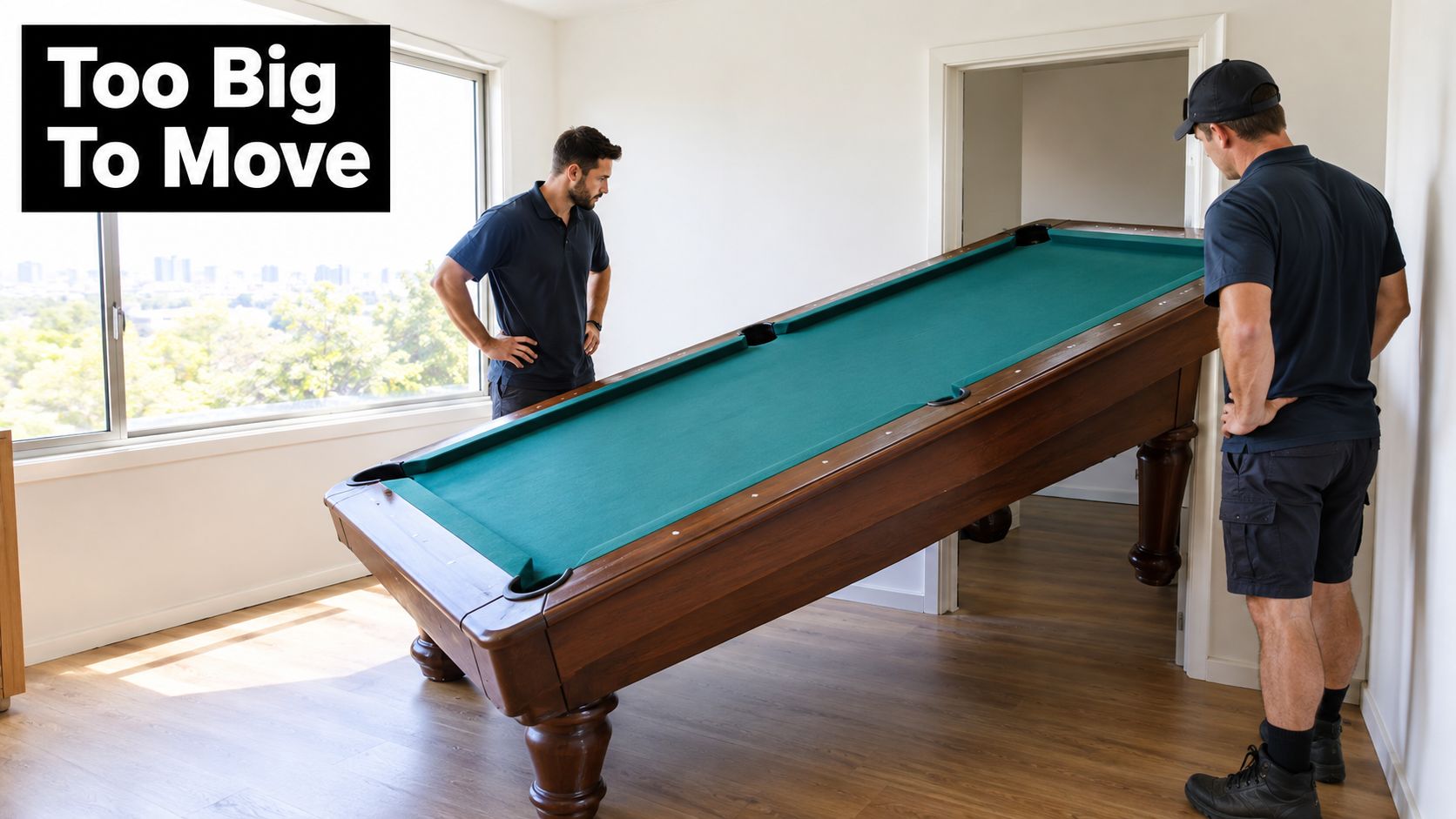
The problem usually becomes obvious at the worst possible moment. A Brisbane household has cleared the games room, the truck is nearly ready, and the table appears to have only one obstacle left, the front door. The legs are fixed to the frame, the rails surround the playing surface, and the slate bed sits beneath the cloth. A one-piece carry-out may look quicker, but a doorway can turn that plan into a dangerous tilt, scrape, or impact.
Slate is the reason. An Australian delivery source says the slate alone typically weighs 200 to 300 kilograms and commonly arrives in three or four pieces, which is why professional movers normally dismantle the table at pickup and reassemble it at delivery. The same source places many Australian pool-table moves at about A$400 to A$1,200, reflecting dismantling, transport, setup, table variation, and possible cloth or cushion work. See this practical guide to moving heavy furniture safely before deciding whether a general furniture crew is suitable.
The Brisbane situations that force a dismantle
A Queenslander with narrow hallways creates a different challenge from a modern ground-floor home. A unit move may involve a high-rise lobby, a lift interior, loading restrictions, and a booked access window. A property sale can add another complication if the table is included as a fixture and must arrive without damage or missing hardware.
The route needs checking from the table to the vehicle, not just from the room to the front door. Measure door clearances, stair widths, landing space, sharp turns, driveway gradients, gate openings, parking distance, and lift dimensions. Also confirm whether doors can be removed from hinges and whether building management requires floor or lift protection.
Practical rule: If the table cannot leave the room without twisting the frame or forcing the slate through a turn, it shouldn't leave assembled.
The questions are straightforward. Who will dismantle it? What access conditions affect the quote? How will the slate be protected? Who will re-level the playing surface? A reliable Brisbane removal plan answers those questions before moving day, when there's still time to change the crew, reserve equipment, or arrange building approval.
Why a Pool Table Is a Specialist Move
A pool table combines a heavy, fragile playing bed with a frame that must return to a precise position. That combination makes it unlike a wardrobe, dining table, or sofa. A general mover may be able to carry the timber components, but the slate, felt, rail alignment, and final level require a more controlled process.
Australian specifications show the physical scale clearly. An 8-foot table has a playing surface of 2.34 metres by 1.17 metres, while a 9-foot table measures 2.54 metres by 1.27 metres, according to Australian table-size information from All Tables Sports. The same Australian market data lists many family billiard tables at around 260 to 300 kilograms for 8-foot models and 315 to 355 kilograms for 9-foot models, depending on construction.
Room geometry matters at the destination as much as it does at pickup. Recommended minimum room sizes are 5.20 metres by 4.00 metres for an 8-foot table and 5.50 metres by 4.30 metres for a 9-foot table, using the same Australian table-size reference. A room that accepts the table physically may still leave too little cue clearance for normal play.
Pool table sizes and weights at a glance
The figures below use the verified Australian specifications available for slate tables. They're planning references, not substitutes for identifying the exact model.
| Table Size | Total Weight | Slate Weight | Typical Use |
|---|---|---|---|
| 8-foot | Around 260 to 300 kg, depending on model | Slate is commonly supplied in multiple sections | Home games rooms and family use |
| 9-foot | Around 315 to 355 kg, depending on model | Slate is commonly supplied in multiple sections | Larger home rooms, clubs, and serious play |
Queensland manual-handling guidance doesn't set one universal safe weight limit for every worker. Risk changes with grip, shape, posture, twisting, travel distance, and available assistance. Brisbane guidance describes slate tables as commonly weighing about 300 to over 500 kilograms, with individual slabs sometimes weighing 70 to 120 kilograms, so the safer method is to move controlled components with enough hands, spotters, and protected routes rather than attempt an assembled lift. Read the Queensland pool-table removal guidance for the handling risks that make under-resourced DIY work a poor trade-off.
The equipment makes the difference
A specialist crew should be able to explain how it will handle the slate, not just say that it has a truck. Useful equipment can include a slate-lifting dolly, padded board carts, suction handles, furniture blankets, edge protection, and a re-levelling kit with suitable precision tools.
The reassembly stage is where many amateur moves fail. A table can arrive with an intact frame and still play badly if the slate order is wrong, the joins aren't aligned, the rails are returned to the wrong positions, or the bed settles without a proper level check. The carry-out is only half the job.
The Dismantle, Label, and Pack Sequence
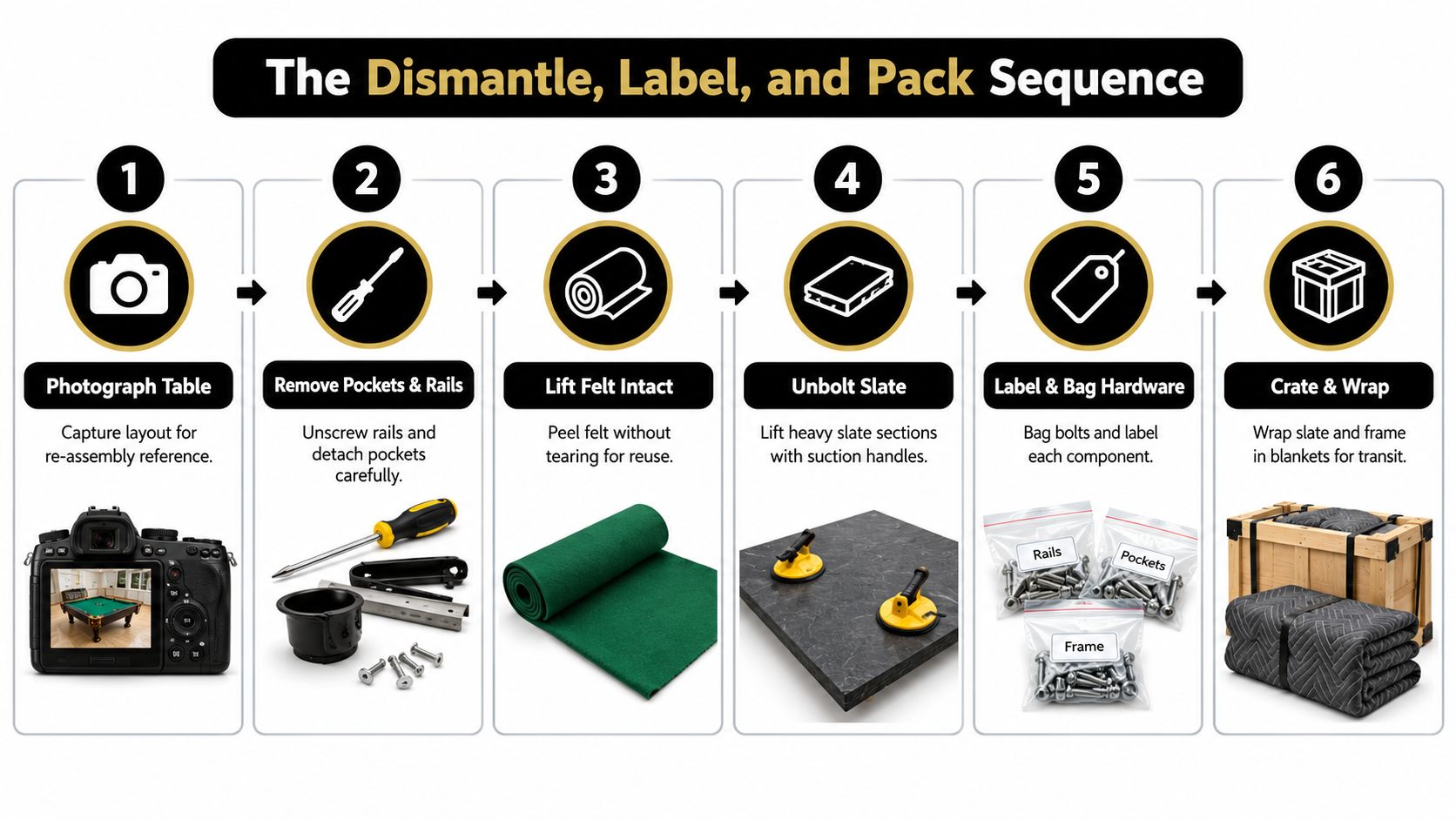
A well-run removal follows an order. The crew should be able to tell you what happens next while you watch from the kitchen, because every stage protects a later stage of the job.
Photograph first, then remove accessories
Before disassembly, photograph the table from above and from each corner. Capture rail positions, pocket locations, leg connections, hardware placement, and any existing marks or damage. Those photographs become a reassembly reference instead of relying on memory after transport.
Remove cues, balls, racks, lights, scoreboards, and other accessories before the heavy work begins. Pockets, rails, bolts, and fittings should be separated, bagged, and tagged by position. A labelled bag for each corner is more useful than one container marked “pool table parts”.
Protect the felt and support the frame
Rails and pockets come off before the slate is disturbed. Felt needs protection from dust, moisture, foot traffic, and sharp hardware. If the cloth is being reused, it should be handled as a separate fabric component, not dragged across the floor or wrapped tightly in material that can mark or trap condensation.
The frame must be supported on both sides before the slate is lifted. Slabs should be handled with appropriate grips and enough people, then placed on edge on a padded A-frame or equivalent supported surface. They shouldn't be left loose, balanced against a wall, or laid directly on a truck floor where vibration and impact can transfer into the stone.
A useful preparation resource is this guide to tools for pulling up hardwood, particularly when flooring work and pool-table removal happen in the same room. Floor protection still needs to be installed before any lifting begins.
Label every part for the return trip
Frame pieces and legs should be wrapped in furniture blankets. Stretch wrap can trap condensation against timber and may leave marks, so it's not the only protection a careful crew should rely on. Rubber pockets, bolts, rail fittings, and small hardware belong in separate labelled containers.
The vehicle load plan should keep the slate vertical against a properly protected bulkhead, with the frame secured on its side and the legs and hardware in a labelled bin. Components shouldn't shift during braking, cornering, or loading. The pool-table moving equipment used for controlled handling should match the table's weight and the access route.
The following video provides a visual reference for the dismantling and moving process:
Choosing Between Specialist and Generalist Crews
Brisbane households usually choose among three paths, and the sensible option depends on the table, access, distance, and how much reassembly uncertainty the budget can absorb.
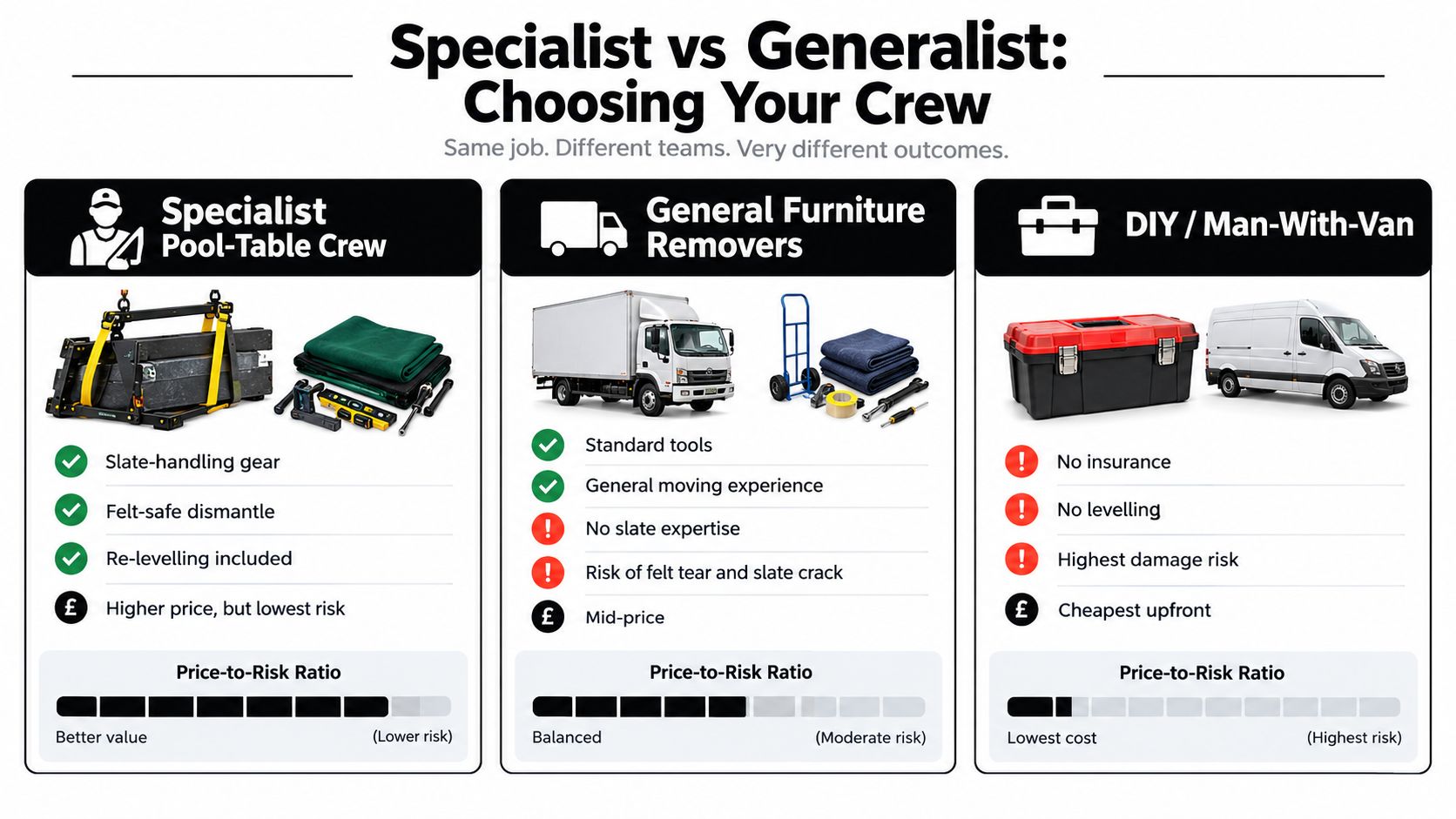
A specialist pool-table crew is equipped for slate handling, component labelling, felt protection, and re-levelling. This normally costs more than treating the table as oversize furniture, but it targets the points where expensive damage occurs. Ask whether re-levelling is included, whether the cloth is being removed or protected in place, and who performs the final setup.
A generalist removalist may be practical for a table that has already been professionally dismantled, or for a simple relocation where the specialist handles the slate separately. The risk rises when the crew treats rails and slate like ordinary furniture, particularly if it lacks the right dolly, padding, grips, or reassembly experience. A lower initial quote can become less attractive if the table needs a second visit for alignment or levelling.
Match the method to the table
Self-hire with a ute and a mate is only sensible for a single-piece coin-operated table under about 180 kilograms, and even then the vehicle, blankets, tools, route, and driver experience matter. That approach doesn't suit a multi-slate domestic table. It also usually leaves the owner responsible for damage, reassembly, and levelling.
| Option | Upfront position | Main strength | Main weakness |
|---|---|---|---|
| Specialist crew | Higher | Controlled slate handling and re-levelling | Requires specialist availability |
| Generalist removalist | Mid-range | Useful for ordinary furniture and prepared components | Slate and reassembly expertise may be limited |
| Self-hire or man-with-van | Cheapest upfront | Flexible timing and direct control | Highest handling, damage, and levelling risk |
The broader removal industry also shows why service labels matter. A general guide to removals services in Exeter can help clarify the difference between ordinary household moving and specialist handling, but Brisbane customers still need to ask specifically about slate, felt, rails, and re-levelling.
The deciding questions are practical: how many slate sections does the table have, how far is the destination, are there stairs or lifts, and will the table be used immediately after delivery? If play quality matters, the cheapest carry usually isn't the cheapest complete move.
Brisbane Access Factors That Change the Quote
Access often decides the price before the table's brand or finish does. Brisbane listings show a broad pool-table removal range of roughly A$200 to A$585, reflecting variation in access, disassembly time, crew size, and handling requirements, as described by Brisbane pool-table removal guidance. A separate Brisbane pricing guide lists local removalist rates of about A$130 to A$260 per hour, with access-related surcharges of A$60 to A$300 for stairs, no-lift access, or body-corporate-controlled buildings. See the pool-table movers price guide for the questions that should sit behind any estimate.
A ground-floor move between two accessible homes is simpler than a Queenslander with stump access, a tight side gate, or a long path from the kerb. Inner-city apartments can add lift bookings, loading-zone restrictions, protective sheeting requirements, and approval from building management. These aren't administrative details. They determine how long the crew is committed and whether the slate can travel through the building without obstructing common areas.
Brisbane access variables and typical price impact
| Access Factor | Typical Price Impact | Lead-Time Effect |
|---|---|---|
| Stairs or no-lift access | Often adds A$60 to A$300 in access-related charges, depending on the building and job | May require additional planning and crew allocation |
| Body-corporate-controlled building | Often adds access-related charges within the same A$60 to A$300 guide range | Lift and loading approvals may need advance booking |
| Tight Queenslander access | Quote can rise within the broad A$200 to A$585 market range | On-site route inspection becomes more important |
| Parking distance or loading restrictions | May increase labour time and access charges | Permits or loading windows may affect scheduling |
| Lift booking | Can add building coordination costs within the access-related guide range | Booking windows can determine the arrival time |
The price figures are planning markers, not promises. A crew can't quote accurately from “it's upstairs” alone. Report the number of stairs, landing widths, lift dimensions, parking distance, driveway slope, narrowest doorway, and whether doors or gates can be opened fully.
Access information to send with photos
Send photographs of the table, room, doorway, stairs, lift, driveway, gate, and kerbside parking. Include the table size and any visible manufacturer plate or model information. If the building has a loading bay or body corporate, share the rules before booking.
Personal safety also deserves attention during heavy handling. A practical health plan for movers can help households think through fatigue, hydration, access hazards, and who should remain clear of the work zone. Customers shouldn't carry slate to save time. Their role is to provide accurate information and keep the route clear.
Insurance, Transit Cover, and Re-levelling
A pool-table removal contract should answer three insurance questions in writing. First, what public liability cover does the crew hold, and can it provide a current certificate of currency? Second, does transit cover apply to slate cracking, rail damage, felt tearing, drops, and handling impact, or only damage caused by the vehicle? Third, is re-levelling included in the quoted job or treated as a separate appointment?
Queensland logistics guidance notes that standard Goods in Transit insurance commonly carries per-consignment limits from A$5,000 to A$50,000, depending on the operator, while higher-value items may require declared-value Marine Cargo Insurance. The relevant Queensland transit-cover guidance explains why customers should ask about the actual item and packing method, not assume that a general policy covers every type of slate impact.
The written checks that matter
A certificate of insurance doesn't automatically confirm that your pool table is covered in every circumstance. Ask the mover to state whether the crew must perform the packing and dismantling for the cover to apply, and whether exclusions affect slate, felt, timber frames, or pre-existing damage.
Use this checklist before the booking becomes final:
- Public liability: Request the current certificate and confirm the insured business name.
- Transit damage: Ask whether slate, felt, rails, frame, and accessories are individually covered.
- Handling exclusions: Confirm whether customer-packed or customer-dismantled components are excluded.
- Declared value: Discuss additional cover if the table's value exceeds the standard consignment limit.
- Damage process: Ask who photographs damage, who receives the claim, and what documentation is required.
- Re-levelling: Get the included work and any follow-up charge stated on the quote.
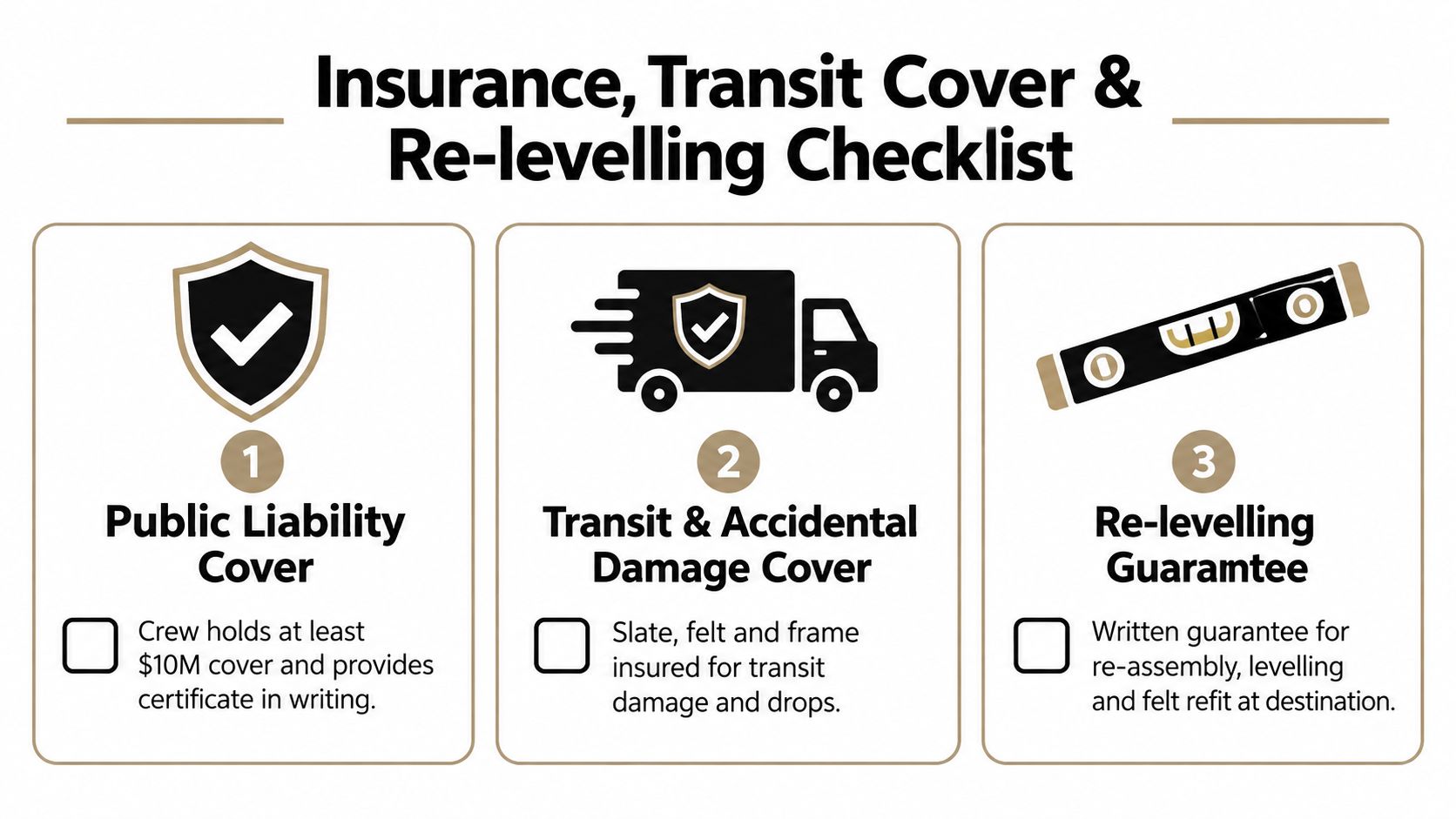
Re-levelling should involve a precision wedge or equivalent calibrated system, careful checking of slate joins, rail alignment, cushion response, and pocket position. A table can look assembled and still need adjustment before play. The moving-company insurance coverage information is useful when comparing what a mover says it carries with what the contract promises.
A Calm Day-Of Plan and Final Checklist
The calmest move is organised before the truck arrives. The crew confirms the route, protects the floor, photographs the table, removes accessories and rails, carries slate in controlled stages, secures the load, and reassembles the table at the destination. The final work includes levelling, checking the cloth and rails, confirming pocket alignment, and brushing the playing surface before anyone starts a game.
A realistic Brisbane day may include an arrival window, preparation in the games room, a staged carry to the vehicle, loading and securing, travel, destination access, reassembly, levelling, and inspection. The exact duration depends on table construction and access, so avoid scheduling play, settlement handover, or another contractor immediately after the estimated finish.
The morning checklist
- Clear the route: Remove boxes, ornaments, rugs, and breakables from hallways, stairs, landings, and doorways.
- Confirm the building: Check lift bookings, loading zones, protective-sheeting rules, permits, and body-corporate approval.
- Prepare the table: Remove accessories and keep them together, but leave technical dismantling to the agreed crew.
- Protect people and pets: Keep children and pets out of the work area and nominate one adult as the on-site contact.
- Check the vehicle plan: Confirm parking, driveway access, stairs, tight turns, and the destination route.
- Hold the re-levelling window: Don't schedule immediate play until the bed, rails, cushions, and pockets have been inspected.
- Confirm payment and paperwork: Check the accepted payment method, quote inclusions, insurance details, and contact number.
At the destination, inspect the table rather than accepting a quick visual finish. Check that the playing surface is level, slate joins feel consistent, cushions respond evenly, and pockets sit correctly in relation to the rails. Photograph the completed table and report any concern before the crew leaves.
Use the pool-table setup service information when comparing what the reassembly stage should include. Any mover can shift separated pieces. The difference is whether someone planned the access, labelled the accessories, protected the slate, and allowed enough time to make the table playable again.
Get n Go Removals Melbourne handles specialist pool-table transport, careful handling, furniture disassembly and reassembly, and interstate moves connecting Melbourne with Brisbane. For a move where slate protection, access planning, insurance, and final setup need to be discussed together, visit Get n Go Removals Melbourne and request a detailed quote based on your table, route, stairs, lift, and parking conditions.