
Office Moving Plan That Keeps Your Business Running
You've booked the new premises, told the leadership team, and chosen a moving date. Then someone asks whether the internet will be live, whether the lift is reserved, and who's responsible for the old office keys. That's when a simple move starts looking like a business continuity project.
A practical office moving plan protects more than desks and filing cabinets. It keeps people safe, gives IT time to make the new workplace functional, supports lease compliance, and gives staff, clients and suppliers enough notice to adjust. In Melbourne, market conditions and formal notice requirements also affect whether moving now is sensible, whether you can negotiate better premises, and how much time you really have.
Why Your Office Moving Plan Matters More Than Boxes
A Monday morning move can fail before the first truck arrives. Staff reach the new office and find unlabelled boxes blocking walkways, workstations without power, phones that haven't been activated and a reception area with no clear instructions. The removal itself may have been completed, but the business still isn't ready to operate.
A complete plan treats relocation as a controlled operational change. It connects the lease, building access, people, furniture, technology, records, communications and reopening checks. Packing is one workstream, not the entire project.
Practical rule: The move isn't finished when the last item leaves the truck. It's finished when each department can work safely and the business can serve customers.
What the plan must protect
Start with four outcomes:
- Continuity: Critical teams know where to work, what systems they need and who resolves problems.
- Safety: Employees and contractors aren't exposed to avoidable lifting, trip or access hazards.
- Compliance: Lease notices, building requirements, consultation and handover records are assigned and documented.
- Control: A named person can make decisions when the schedule changes.
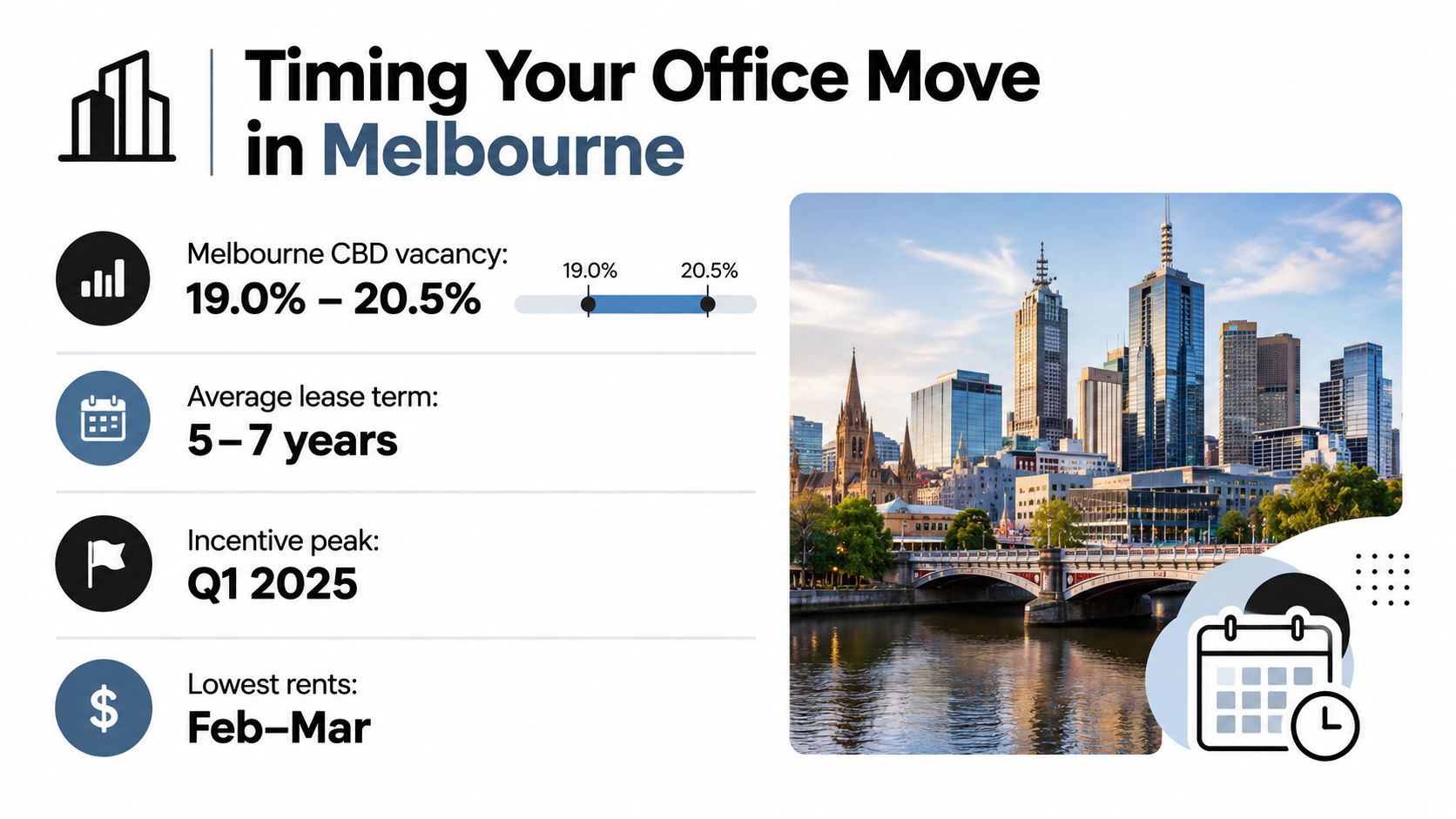
A Melbourne move also needs commercial judgement. The Property Council of Australia reported Melbourne CBD vacancy at 18.0% in January 2025, 17.9% in July 2025 and 19.0% in January 2026, with the January 2026 level described as the highest since 1997. Melbourne's sublease vacancy was 1.6%, while St Kilda Road reached 29.1% in July 2025 and 31.8% in 2026, showing that availability differs sharply between submarkets. The Melbourne office market data supports a useful planning question: should the business relocate, or use the move to renegotiate space, timing or fitout obligations?

Change needs ownership, not just announcements
Employees often worry about commuting, desk allocation, equipment and disruption. Supervisors need a clear message sequence, feedback route and escalation process. Practical change management tips for supervisors can help managers support staff while the project team handles the physical work.
Your plan should therefore name owners for the timeline, lease, employee consultation, inventory, IT, packing, transport, communications and final approval. That structure prevents the common failure where everybody is informed but nobody is accountable.
Build Your Timeline and Assign Clear Ownership
A relocation can lose weeks before anyone packs a box. Set the move date only after checking the lease position, building access, IT dependencies, compliance lead times and the condition of the new premises. That sequence protects the business from paying for space it cannot use or discovering that a carrier, lift or internet connection is unavailable.
Australian office-moving guidance recommends starting IT and site planning 3–6 months ahead. The work includes mapping the floor plan, checking outlets, booking the internet service provider, testing data connections and scheduling a Day 1 walkthrough. The office moving timeline guidance provides a useful sequence, so urgent tasks receive attention before move day rather than competing with routine packing.
A working relocation schedule
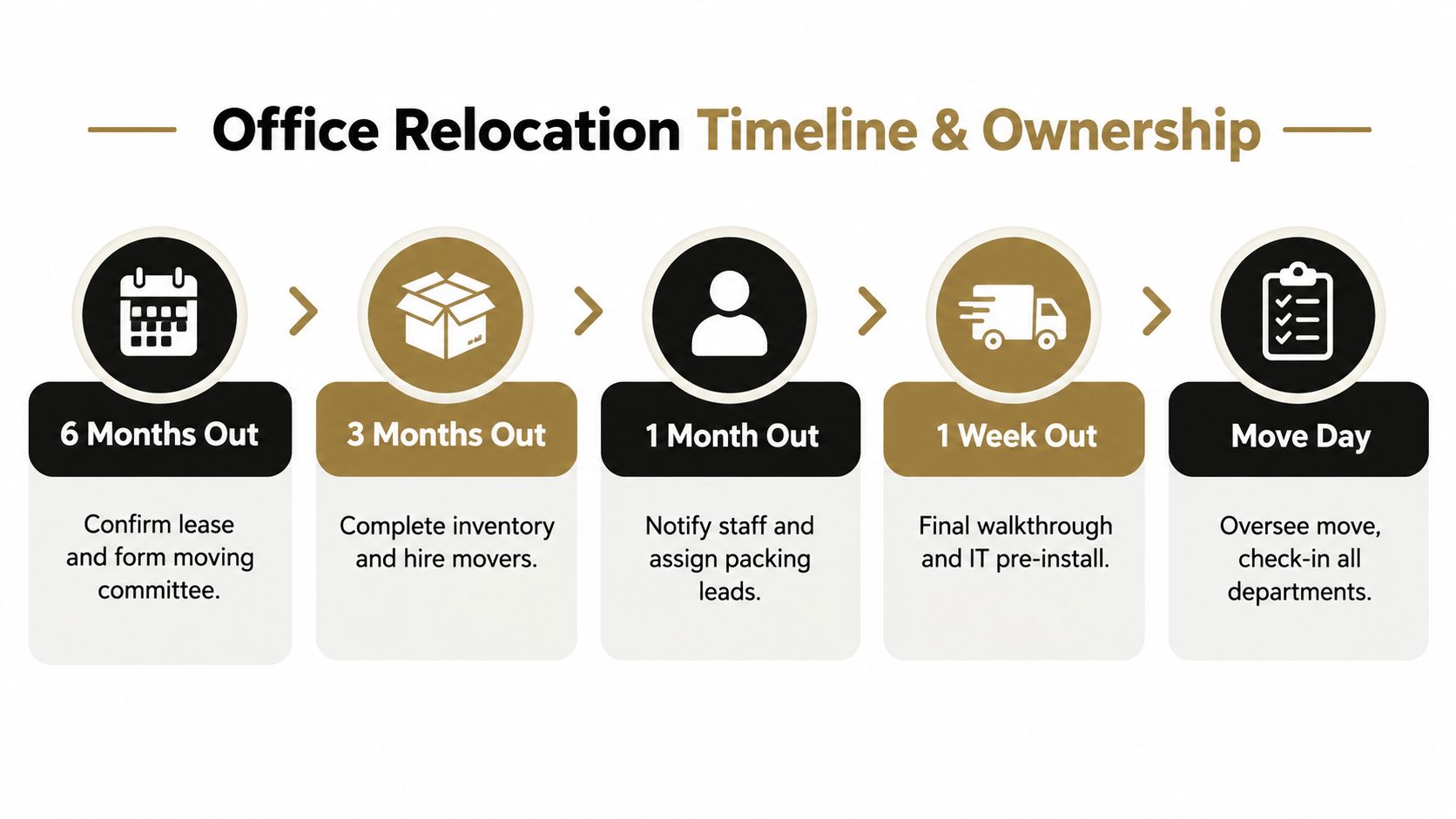
Six months out, confirm the lease, inspect the new premises, form the moving committee and appoint one move coordinator. The coordinator owns the master schedule, records decisions and remains the main contact for the mover, building managers, IT and department leads. Give the coordinator authority to escalate blocked decisions, not just maintain a spreadsheet.
Three months out, complete the inventory and decide what will move, be disposed of or stored. Approve the floor plan and book the moving crew. Check access routes, loading areas, lift requirements and building rules that may limit delivery times. Raise WHS consultation early, especially where staff will pack, lift or work around contractors.
One month out, notify staff and external stakeholders, assign packing leads and begin with archived files and items that are not needed for daily work. Set one labelling convention, document each department's responsibilities and confirm how confidential records will be secured.
One week out, complete the final walkthrough, reconfirm lift and loading arrangements, test installed IT and issue staff instructions. Hold brief status checks to close open decisions. Keep the schedule visible in a shared location, while the coordinator maintains the decision log and action list.
Move day requires a supervisor at each site, or one appointed lead who can move between locations. Supervisors check inventory, direct items to labelled rooms, keep access paths clear and record damage or missing items immediately.
Use a simple ownership matrix
| Workstream | Accountable owner | People consulted |
|---|---|---|
| Lease and exit | Business owner or facilities lead | Property manager, solicitor |
| Employee consultation | Move coordinator and department leads | Employees and HSRs |
| IT readiness | IT lead | Internet and phone suppliers |
| Inventory and packing | Department packing leads | Staff using each area |
| Transport and access | Move coordinator | Removal crew and building manager |
| Reopening approval | Business owner | IT, facilities and health and safety representatives |
Consult employees and health and safety representatives early. Identify manual-handling risks, then provide suitable trolleys, ladders, boxes and personal protective equipment. WorkSafe Victoria warns that “safe techniques” alone do not adequately control hazardous manual handling. Change the task, equipment or load instead of asking people to lift more carefully.
IT planning needs its own workstream. IT project planning with CloudOrbis Inc. can help structure dependencies, testing and ownership before technical tasks become urgent.
Give staff enough notice to clear personal items, label equipment and confirm what they must pack themselves. Suppliers need a delivery window, contact number and access procedure. One coordinator should issue final instructions, so the mover, building teams and departments are working from the same information.
Use Melbourne Market Conditions and Lease Rules to Time Your Move
A move planned around truck availability alone can leave a business paying for the wrong footprint or waiting on a lease decision. Melbourne's office market gives relocation teams room to separate the commercial decision from the physical move. In Q2 2026, Melbourne CBD office vacancy reached 20.5%, with about 1.1 million square metres of vacant stock. Quarterly net absorption was -6,300 square metres, while the preceding 12 months recorded 23,900 square metres, below the 10-year annual average of 28,300 square metres. JLL's Melbourne office market coverage records these conditions and shows Melbourne CBD vacancy above Sydney's 13.3% and Brisbane's 10.2% in the same reporting cycle.
The figures do not guarantee a particular rent or incentive. They do give a tenant useful bargaining context. Ask about commencement dates, fitout support, make-good flexibility, a smaller footprint or a sublease arrangement, especially where landlords are competing for occupiers. The timing of your physical move should follow the commercial outcome, not determine it.
Decide whether moving everything is still the right move
High vacancy can reveal options a standard moving checklist misses:
- Reduce area: Review attendance patterns and storage needs before committing to the same footprint.
- Improve quality: A smaller, better-configured premises may support operations more effectively than a larger outdated office.
- Delay expansion: If hiring or growth plans have softened, avoid paying for space that will not be used.
- Split locations: Some teams may work from a central office while operational functions use a fringe site.
- Use a sublease: Existing surplus space may have value if the lease permits assignment or subletting.
Melbourne metropolitan office vacancy was 14.2% in September 2025, down from 15.2% at the start of that year, according to earlier PCA-linked reporting covered by the same JLL market coverage. CBD and metropolitan figures describe different submarkets. Check the specific conditions for St Kilda Road, Southbank or another fringe location before applying a CBD assumption to the premises you are considering.
Put formal notice dates before truck dates
Review the lease before booking transport. In Victoria, a renter ending a fixed-term rental agreement must give 28 days' notice, and notice can be delivered by post, email or by hand to the rental provider. Consumer Affairs Victoria's renter notice guidance explains the regulated process.
Commercial arrangements may follow different rules. A Victorian commercial-lease relocation clause may require a landlord to give at least 3 months' notice when relocating a tenant's business premises for renovations or alterations. The tenant may have a right to terminate within 1 month of receiving that notice. The landlord may also need to provide the work details, evidence that vacant premises are required, alternative premises on the same term and reasonable relocation costs. Review The AustLII clause description alongside the actual lease.
Government tenancy arrangements can set other thresholds. Victorian government tenancy materials refer to a 120-day Notice to Vacate in a departmental relocation policy, and at least 90 days' notice before the end of certain private-landlord tenancy agreements lasting more than six months. The Victorian tenancy management manual shows why the contract and occupancy type must be confirmed before scheduling.
Compliance planning may need 6–12 months, employee consultation may begin 3–6 months ahead, and safety inspections may be scheduled at least 30 days before occupancy, as outlined in the Australian compliance-focused material supplied for relocation planning. Use those windows to start legal, facilities and WHS reviews early. They are planning prompts, not a substitute for professional advice.
For broader local planning considerations, use this guide to moving to Melbourne alongside the lease review and site assessment.
Inventory IT and Site Readiness Without Day One Surprises
The new office should be operational before employees arrive. A clean floor plan won't help if the internet is pending, a server cabinet has no suitable capacity or a meeting room has no usable connection point.
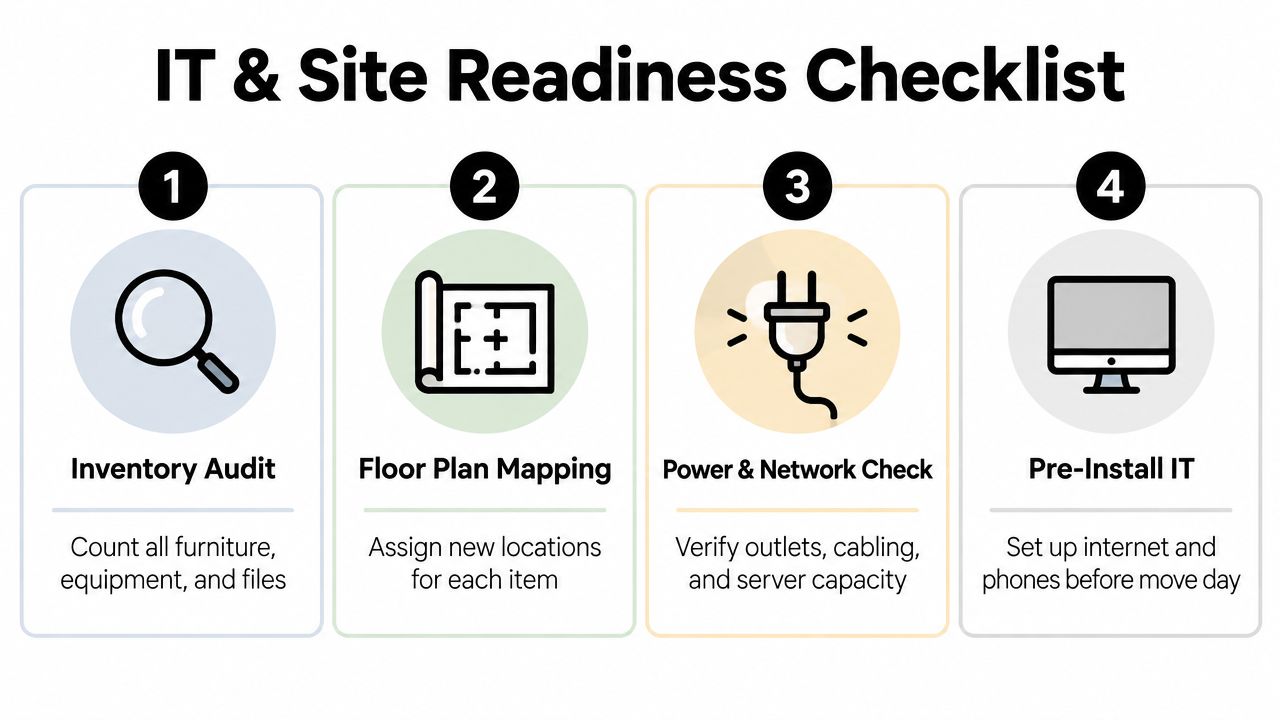
Start with an inventory that records furniture, equipment, files and specialist items. Mark each item as move, dispose, store, replace or review. This avoids paying to transport broken furniture or carrying unnecessary archive material into a smaller workplace.
Build the destination before packing the origin
Map each item to a destination room or workstation. Use room names that appear on the floor plan, box labels and mover instructions. “Marketing” is useful. “Box 14” isn't.
Check the route as well as the room. Measure large furniture against doors, corridors, lifts and turning points. Confirm loading zones, building access, protective requirements, lift bookings and the hours when contractors can work. A final walkthrough should identify surfaces that need protection and areas that must remain clear for staff or visitors.
Treat telecommunications as a critical path
Australian office-moving guidance recommends starting technical and site-planning tasks 3–6 months ahead, including floor-plan mapping, power and network outlet checks, ISP booking, data backup and testing, and a Day 1 walkthrough. NBN or telecommunications installation can require 4–6 weeks of lead time, making activation one of the most common causes of an otherwise complete office reopening being delayed. JLL's office moving checklist provides the relevant benchmark.
The IT lead should document:
- Connectivity: Confirm the service order, installation access, demarcation point and testing responsibility.
- Power: Check workstation outlets, dedicated circuits, server-room requirements and charging locations.
- Network: Map outlets, switches, wireless coverage and equipment locations.
- Phones: Confirm number porting, handsets, reception routing and fallback contact methods.
- Data: Back up systems, test restoration and record who approves the result.
- Security: Check access cards, alarms, cameras and visitor procedures.
Don't disconnect everything at once. Stage the transition so essential systems remain available until the agreed cutover. Keep a tested backup and a written escalation list rather than relying on one person remembering every supplier number.
Specialist equipment needs its own handling instruction. Label fragile technology separately, photograph cabling before disconnection and use protective materials suited to the item. For servers or sensitive infrastructure, server relocation specialists may be considered alongside the internal IT plan, with responsibility for shutdown, transport, recommissioning and testing clearly divided.
On the first morning, walk the site with facilities, IT and department leads. Check access, lighting, temperature, internet, phones, printers, meeting rooms, kitchen facilities and emergency paths before staff settle in.
Packing Transport and Communication That Minimise Downtime
Packing works best when it follows the destination layout. Give each room or department a label, colour or code that appears on boxes, furniture tags and the floor plan. A box marked “Finance, records, open first” is easier to place than one marked only with a person's name.
Begin with items the business can live without, such as archived files, spare stationery and decorative material. Keep essential documents, chargers, access information and first-day supplies in a controlled kit that travels with the move coordinator rather than disappearing into a general load.
Protect the load and the route
Use strong cartons for files, protective wrap for screens and padding for furniture edges. Don't overfill boxes, particularly with paper. Staff should pack personal desk contents only if the project rules make that safe and clear, while movers or trained leads handle awkward furniture, heavy equipment and disassembly.
Photograph complex workstation and cable arrangements before dismantling. Place screws and fittings in labelled bags attached to the relevant item. Keep walkways and fire routes clear, and separate items that need special handling from standard office furniture.
A staged loading order can reduce confusion. Load non-essential items first, keep critical equipment visible and direct unloading by room rather than dumping everything in one central area. The receiving lead should check labels against the inventory as items enter.
Plan the working hours around the business
After-hours or weekend transport can reduce disruption, but it isn't automatically the right choice. It may increase coordination pressure, affect staff availability and require specific building approvals. Compare the operational value of an out-of-hours move with the access, labour and supervision requirements before committing.
Keep an essential team operational where possible. That might mean preserving a temporary workstation area, moving customer-service equipment first, or arranging a controlled remote-work period. Clients and suppliers should receive the new address, effective date and temporary contact method through a planned communication sequence.
Use one source of truth for updates. The move coordinator can issue:
- Early notice: Explain the reason, broad timing and staff responsibilities.
- Preparation notice: Share packing rules, labels, access details and personal-item instructions.
- Final notice: Confirm the move window, reopening plan, contacts and what staff should bring.
- Day 1 update: Report what is operational and where unresolved issues should go.
Building managers need vehicle details, access times, lift bookings, loading instructions and insurance documentation where required. Suppliers need delivery directions and the date from which the new address applies. Update invoices, websites, online listings and client communications once the move is confirmed.
For a coordinated service covering packing, furniture disassembly, transport and related office relocation tasks, review office relocation services against your inventory and access requirements rather than comparing transport alone.
Final Checks and Your Office Moving Plan Template in Action
The final walkthrough should close the move with evidence, not memory. At the old office, inspect cupboards, meeting rooms, storage, service areas and secure records. Record keys, access devices, damage, cleaning, repairs, waste removal and anything left behind.
Consumer Affairs Victoria separates guidance on notice, breaking a rental agreement and goods left behind. Its moving-out and eviction framework reinforces that vacating involves lease and handover responsibilities, not only furniture removal.
At the new office, test department access, IT, assembled furniture and clear safety paths. Give staff a short orientation covering exits, amenities, meeting rooms, first aid, access controls and defect reporting. A Melbourne coordinator should also confirm that WHS actions and building sign-offs are complete before the first full operating day.
Keep the plan reusable
Use a template that records decisions, owners and exceptions:
- Project details: Addresses, move date, lease milestones and building contacts.
- Owners: Move coordinator, facilities, IT, WHS, department leads and final approver.
- Inventory: Item, destination, handling requirement, status and exception.
- Readiness: Floor plan, power, network, telecommunications, access and inspection sign-off.
- Packing and transport: Materials, labels, priority items, secure records, vehicle access, loading sequence, lift booking, crew contact and receiving lead.
- Communications and close-out: Staff, clients, suppliers, property managers, Day 1 updates, keys, leftover goods, damage records and lessons learned.
A filled row makes the format usable: Inventory: Boardroom table. Destination: Level 3 Meeting Room 3.02. Handling: Disassemble legs, wrap glass. Status: Move.
Use this office move project plan template as a starting structure, then adapt it to lease dates, building rules, workplace risks, systems and operating hours.
Review the first week while details remain fresh. Record access problems, label confusion, IT faults and floor-plan changes. That record supports the next expansion or space reduction.
Get n Go Removals Melbourne can coordinate packing, furniture disassembly and reassembly, protective equipment, transport and storage. Visit Get n Go Removals Melbourne early to discuss inventory, access requirements and the move window before lease deadlines and building bookings restrict your options.