Packing Cases for Moving: Types, Sizes, and Smart Choices
You're standing in a half-packed Melbourne lounge room, surrounded by cartons that came from three different shops. One is sagging at the base, another is too large to lift safely, and the “heavy duty” label on the third means very little once it's filled with books. The removalist booking is fixed, the lift window is closing, and you're starting to realise that packing cases for moving aren't just containers. They control how quickly the job runs, how safely belongings travel, and how much the move finally costs.
Australia sees around 1.14 million household moves each year, and about 84% of people use Australia Post's Mail Redirection service, according to Australian moving-box guidance. Melbourne's share of that activity creates a familiar supply problem: people buy cases too late, choose by appearance rather than load, and then pay for the consequences through broken items, re-packing and wasted truck space.
This guide takes the removalist's view. It explains which cartons earn their place, when plastic crates make sense, how many cases a home usually needs, and when professional packing is worth the labour cost.
Why the Right Packing Cases Make or Break Your Move
A weak carton rarely fails at the moment you expect. It holds together while you carry it across the room, then buckles when a heavier case sits on top in the truck. A large box seems efficient until someone fills it with crockery, struggles to lift it, and leaves it half-packed because it has become unsafe.
That creates double-handling. Someone repacks the contents into smaller cases, the crew shifts boxes to find a stable stack, and fragile belongings lose the protection they had at the start. The original carton might have been cheap, but the extra labour and damaged contents aren't.
The three costs hidden inside a carton
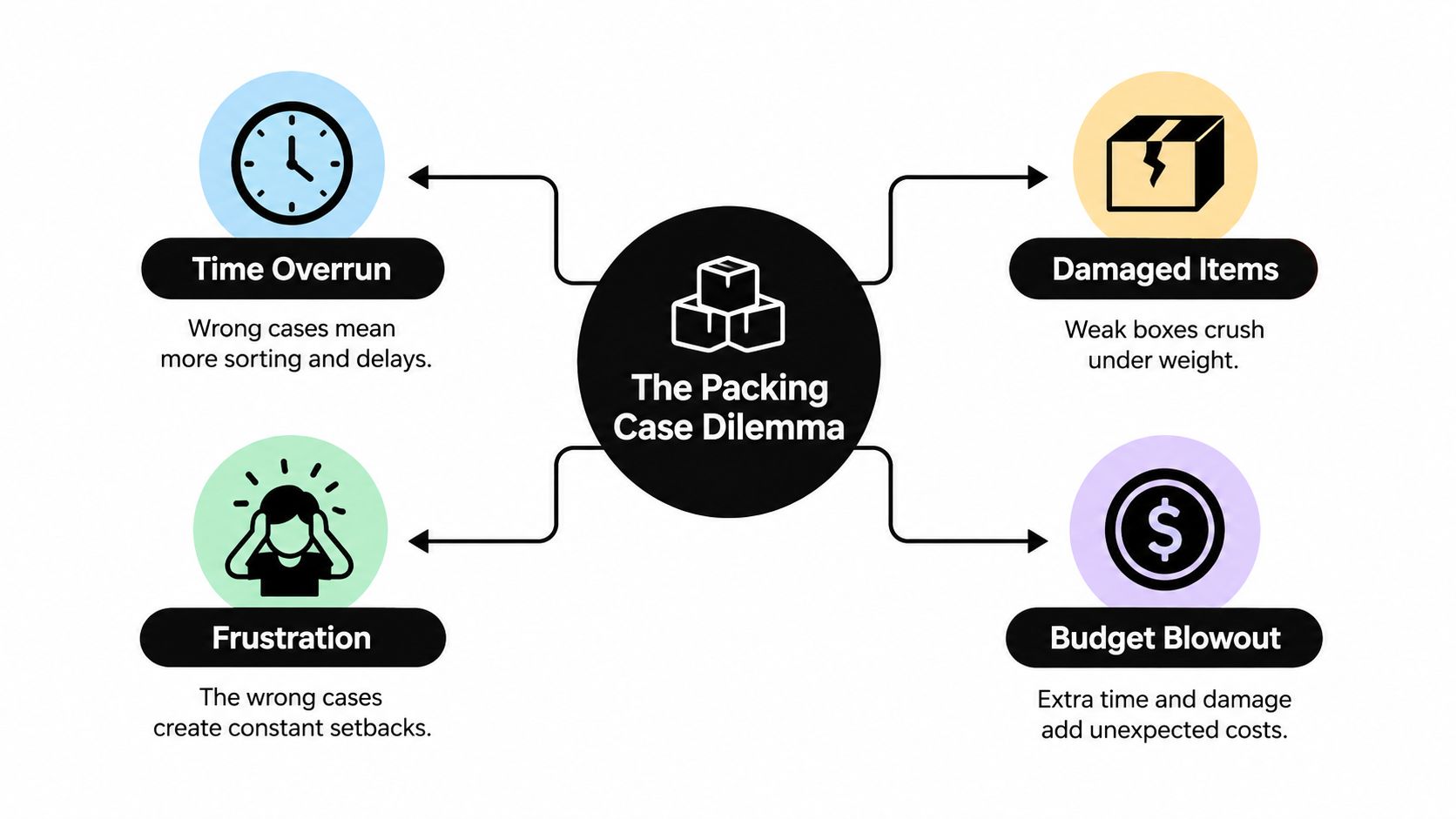
The right case affects three parts of the move at once:
- Protection: A rigid, correctly sized carton supports its contents and resists crushing during stacking.
- Speed: Consistent sizes make the packing area easier to organise and let movers build tighter, more stable loads.
- Total cost: The purchase price is only one part of the calculation. Replacements, additional packing materials, disposal and extra labour can cost more than the original cartons.
People often focus on the number of boxes, but the shape and strength of each box matter just as much. Dense items belong in compact cases. Light, bulky items need volume without excessive weight. Fragile goods need partitions, cushioning and enough internal support to stop movement.
Removalist rule: If you can't comfortably lift a packed case, it isn't ready for the truck.
A sensible packing system also separates the job into zones. Keep empty cartons, tape, markers and paper together. Pack one room at a time, label at least two sides, and keep an open-first case with medication, chargers, toiletries and basic bedding. For practical guidance on avoiding the errors that lead to re-packing, use this moving-home packing mistakes guide.
For breakables, don't rely on newspaper alone. Clean packing paper, tight wrapping and correctly filled voids give glassware and ceramics a better chance of arriving intact. This guide to a damage-free move with packing paper is useful when you're preparing fragile items without professional assistance.
The Main Types of Packing Cases and When to Use Them
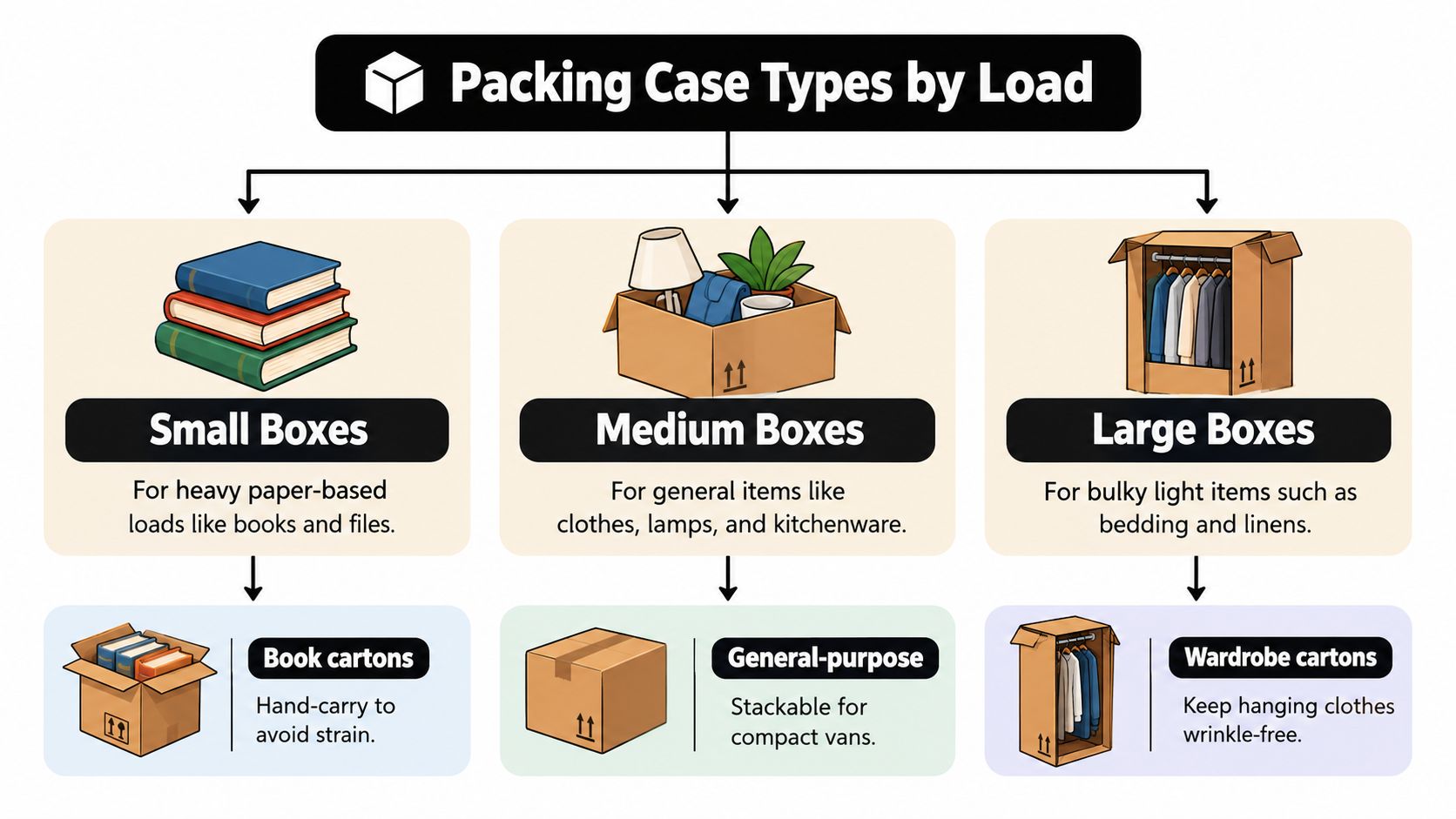
Start with the load, not the carton name. Books, bedding, hanging clothes and framed artwork all need different shapes because their weight, bulk and vulnerability differ.
Small cartons for dense loads
Small book cartons are the workhorses for books, files, tools and compact kitchen equipment. Their limited capacity stops you from turning a manageable case into an unsafe block of weight. Put the heaviest items at the base, fill remaining gaps so the contents can't shift, and seal the top with strong packing tape.
Medium cartons suit mixed household contents. Use them for pots, toys, lamps, folded clothing and smaller appliances, but don't treat “medium” as permission to combine everything from a room. A carton containing cookware should be labelled differently from one containing linen, even if both cases are the same size.
Large cartons for light, bulky items
Large cases are best for bedding, towels, cushions, doonas and linen. They give soft goods room without creating an unreasonable lifting load. They're a poor choice for books, crockery or tools because the finished carton becomes difficult to carry and unstable when stacked.
Purpose-built cases solve awkward problems
A wardrobe carton has a hanging bar, allowing suits, dresses and coats to travel upright rather than folded into creases. Keep the rail evenly loaded and don't overfill the case, or the garments will compress and the box will become awkward to move.
Picture and mirror boxes use telescoping sections to accommodate flat, delicate surfaces. Wrap the frame or glass separately, protect the corners, and mark the case clearly. A television carton should match the screen's dimensions and have cushioning around the panel, while a dish pack with double-walled construction and dividers gives plates and glasses individual support.
Plastic stackable cases suit moves involving storage, moisture exposure or repeated handling. They're particularly useful when cartons need to remain sealed for a while. For a broader look at reusable storage formats, browse the Pacific Mobile Structures storage lineup.
Match the case to the household scenario:
- Book-heavy study: Small reinforced cartons.
- Standard apartment: Medium cartons, with selected large cases for linen.
- Family wardrobe: Wardrobe cartons for hanging garments.
- Fragile kitchen: Dish packs with dividers.
- Long-haul or delayed storage: Stackable plastic cases for vulnerable contents.
For room-by-room preparation, this packing tips resource for moving house provides a useful checklist without replacing good judgement about load weight.
Cardboard vs Plastic Cases and Specialty Boxes Compared
You are halfway through a Melbourne move when a cheap carton splits under a load of books. The replacement case costs time, the contents need repacking, and the removal crew still has to handle the extra mess. Choose cases by weight, moisture risk and how often they will be handled, not by appearance alone.
Cardboard is the sensible default for most household goods. Single-wall cartons suit light items and short moves. Use double-wall or reinforced cases for books, crockery, tools and interstate transport, where crushing and repeated handling are more likely. Cardboard keeps upfront spending low and is easy to label, recycle or dispose of after delivery.
Plastic crates earn their cost when you will reuse them, require uniform stacking, or expect storage and changing weather. They resist moisture and keep their shape through repeated trips. Account for collection, storage and any deposit. A rental can cost more than cardboard if the relocation stretches out.
Specialty cartons are protective equipment. A wardrobe box keeps hanging garments upright without forcing them into creases. A dish pack separates plates and glasses. A purpose-sized screen carton protects an expensive television more reliably than a makeshift cardboard-and-blanket arrangement.
| Material | Avg Cost per Case | Max Load | Reusability | Best For |
|---|---|---|---|---|
| Standard cardboard | A$2–A$6 | Light to moderate loads | Limited | General household packing |
| Value-pack cardboard | Roughly A$2–A$4 | Light to moderate loads | Limited | Larger carton orders |
| Double-wall cardboard | Varies by supplier | Moderate to heavier loads | Some reuse | Books, crockery and longer moves |
| Plastic crate | About A$5.40 for the first week in Victoria, plus A$1.25 per additional week | Moderate, depending on crate | High | Storage, staged moves and moisture exposure |
| Specialty carton | A$7–A$19 | Purpose-specific | Usually limited | Wardrobes, mirrors and artwork |
The cardboard and specialty ranges above come from Australia-focused moving-box cost guidance. Use plastic when repeated handling, storage or wet conditions justify the hire cost. Choose cardboard when low upfront spending and simple disposal matter more.
Order a mix, not a single carton type. Use compact reinforced cases for dense goods, medium cartons for everyday contents, larger cases for linen, and specialty protection for items that cannot tolerate improvisation. For practical sourcing options, read this guide on where to find moving boxes.
How Many Cases You Need and the Right Sizes to Order
A medium moving carton holds about 0.06 cubic metres, or roughly 40 to 50 litres, according to Australian moving-box volume guidance. That equals approximately 16 to 17 medium cartons per cubic metre, giving you a practical way to check whether your order fits the truck or storage space.
Use the household estimate as a starting point. A studio or one-bedroom move often needs 25 to 30 boxes, while a three-bedroom home may require 70 to 80, based on Australian relocation guidance. The estimate excludes the contents hidden in cupboards, garages, sheds and storage areas. Homes occupied for longer than five years also tend to need about 20% more packing capacity.
| Home size | Small cases | Medium cases | Large cases | Wardrobe boxes | Estimated volume |
|---|---|---|---|---|---|
| Studio or one bedroom | 6–8 | 12–16 | 4–6 | 1–2 | Approximately 1.5–2 cubic metres |
| Two-bedroom apartment | 8–12 | 18–24 | 6–8 | 2–4 | Approximately 2.5–3 cubic metres |
| Three-bedroom house | 15–20 | 40–48 | 12–16 | 4–6 | Approximately 4.5–5 cubic metres |
Treat these figures as an ordering framework, not a fixed quota. Add capacity for a full garage, a substantial book collection or long-term storage. Reduce it after a serious declutter. For a more precise load estimate, use this cubic metre calculator for moving.
A practical Melbourne apartment example
For a two-bedroom Melbourne apartment, order medium cartons for general contents, small cases for books and cookware, and large cases for linen. Add wardrobe cartons only where clothing needs to stay hanging. The right mix prevents dense items from turning large cartons into unsafe loads.
Leave room for proper lifting. A carton filled to the top is not automatically efficient, and overloaded cases slow stairs, lifts and narrow-street loading. Compare the estimated cubic metres with the vehicle booked before ordering, particularly when Melbourne parking restrictions or limited lift access can shorten the loading window.
Buying Versus Renting Cases Versus Hiring a Valet Pack
On a tight Melbourne moving schedule, the cheapest case can create the most expensive delay. Compare the case price with packing time, storage space, disposal, and the risk of cartons sitting around after settlement.
Buy cardboard for a straightforward move when you can pack gradually and store empty cases. Standard cartons usually cost about A$2–A$6 each, while value packs bring them to roughly A$2–A$4. Specialty cases, including port-a-robes and picture or mirror boxes, can reach A$7–A$19. Use these as planning ranges, then check current Melbourne retailer prices before ordering.
Renting plastic crates suits a short, organised move. One Victorian rental model charges about A$5.40 per box for the first week and A$1.25 for every additional week. Uniform crates save disposal work and keep a temporary move orderly, particularly when you are moving between properties on a tight schedule. Confirm delivery, collection, deposit, cleaning, and late-return terms. A low weekly rate is not a low total cost if access or timing adds fees.
The labour equation
Professional packing changes the calculation. Melbourne packing-service guidance places assistance at around A$125–A$300 per service hour, with full-house estimates around A$390–A$1,950, depending on home size and crew size, as outlined in Melbourne packing-service pricing guidance. A separate Melbourne estimate puts a three-bedroom pack at approximately A$1,170–A$1,560 with a three-person crew.
Choose a valet pack when settlement, lift bookings, interstate timing, or fragile contents leave little time for mistakes. Skip it for a small move with uncomplicated belongings and enough days to pack yourself. Paying for labour makes sense when a missed loading window or damaged item costs more than the service.
The supplied comparison visual uses a different illustrative benchmark for a three-bedroom move, including approximately 40 boxes and two hours of valet work. Treat it as a scenario, not a quote. The final total depends on case types, packing scope, access conditions, crew, and rental terms.
Budget test: Buy when you can pack steadily. Rent when reuse and convenience matter. Hire a valet pack when your schedule or fragile inventory is worth more than the labour saving.
For a staged move, renting keeps spare cartons from filling the new property before unpacking. For a family home with preparation time, buying gives you control over sizes and packing pace. For offices, high-value collections, and interstate relocations, professional packing reduces delays caused by inexperienced loading decisions.
Packing Techniques for Fragile and High Value Items
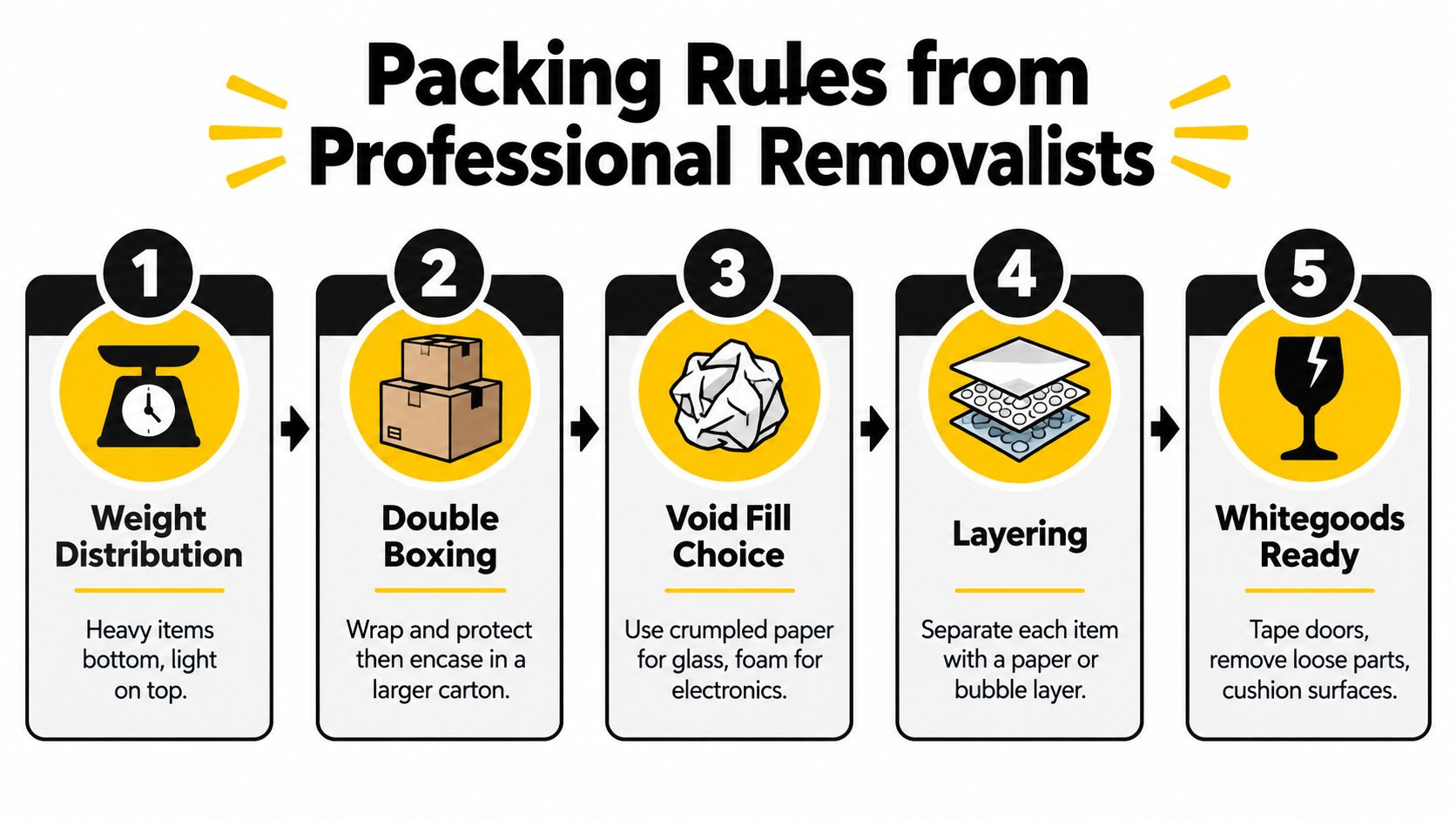
The truck is booked, the lift window is short, and a carton of glasses is rattling before it reaches the hallway. Fix that risk with weight distribution first. Put dense items at the bottom, lighter pieces above, and fill every void so contents cannot shift. Use small cartons for heavy goods and larger ones for light, bulky contents, following Australian packing advice for removalists.
A carton must remain rigid when lifted. Keep ordinary cases to around 15–20 kilograms, using the lower end for fragile contents and long-distance transport. Double-corrugated or reinforced cartons provide better protection, as recommended by Allied's Australian packing tips. For step-by-step wrapping and void-fill methods, see how to pack fragile items for moving.
Build protection in layers
Wrap glasses and ceramics separately in clean packing paper. Place rolled corrugated cardboard between flat items, and pack plates vertically instead of creating a tall stack that can crush at the base. Linen can fill small gaps, but it should not be the only barrier around valuable glass or sharp edges.
Electronics need foam or shaped cushioning around screens and hard corners. Bag and label cables separately. Double-box vulnerable equipment by placing a cushioned inner carton inside a larger case, with protection between both walls.
Assess artwork and antiques individually. Protect corners, keep pressure away from painted or polished surfaces, and use acid-free tissue where contact could mark a delicate finish. Packing peanuts suit broad voids, while tightly crumpled paper usually supports household items more securely because it can be positioned around each piece.
Prepare large appliances properly
Tape washing-machine and refrigerator doors closed, keeping adhesive off finished surfaces. Remove loose shelves, trays and fittings, wrap them separately, and cushion exposed edges. Mark fragile faces and keep cases upright where the contents require it.
Keep passports, jewellery, laptops, medication and important documents out of ordinary moving cases. Carry them in a personal essentials bag or secure vehicle. A labelled carton can still enter storage or sit beneath heavier items, so valuable and irreplaceable belongings need their own chain of control.
Your Moving Day Packing Case Checklist
Treat this as the job sheet you'll use when the lounge room is busy and everyone is asking what goes where.
The night before
- Create staging zones: Keep sealed cases together by room, with a clear path to the exit.
- Label visible faces: Write the destination room, contents and fragile status on at least two sides.
- Separate essentials: Keep medication, documents, chargers, toiletries, basic food and a change of clothes with you.
- Check carton condition: Reject damp, crushed or soft cases before loading.
- Prepare the kit: Put tape, markers, scissors, spare paper and a small tool kit in one accessible container.
On moving morning
- Load by stability: Put heavier cases low and light linen cartons higher in the stack.
- Protect the awkward items: Secure wardrobe cartons so their doors can't swing, and pad picture, mirror and screen cases.
- Redistribute weight: If one carton is too heavy, open it and move contents into a smaller case.
- Keep valuables separate: Carry important documents, jewellery, medication and personal electronics yourself.
- Load the open-first case last: It should be the first case available at the new property.
At the destination
- Place cases by room: Don't create a second sorting job in the hallway.
- Open priority rooms: Set up the bathroom, bedroom and basic kitchen items before decorative contents.
- Inspect specialty cases: Check artwork, glassware and electronics before disposing of packaging.
- Return hired crates: Confirm the rental collection date and any additional-week charges.
- Flatten cardboard: Break down usable cartons for future packing and place unwanted cardboard into the appropriate recycling stream.
Get n Go Removals Melbourne can supply packing materials and handle packing, unpacking and valet white-glove services for homes, apartments, offices and interstate relocations. If you want the cases chosen, packed and loaded around your Melbourne access and timing requirements, visit Get n Go Removals Melbourne to discuss the move.