Pool Table Moving Equipment: Complete Reference Guide
You're halfway through a Melbourne move when the pool table becomes the problem nobody planned for. The front door looks wide enough, but the slate won't turn through the hallway. The apartment lift has a weight limit and a booking window. A furniture trolley that handled the sofa now flexes under the table frame, while an unprotected corner threatens the wall, felt and timber rail.
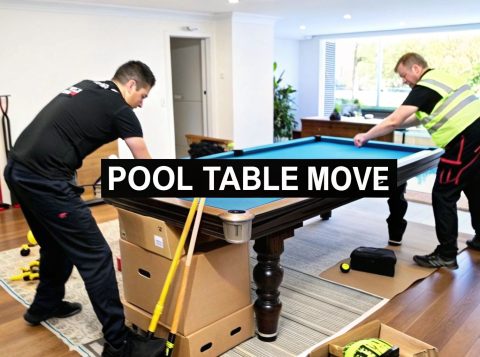
Pool tables aren't ordinary bulky furniture. They combine concentrated weight, rigid slate, fragile playing surfaces and awkward footprints, so the right pool table moving equipment must match both the load and the route. The safest setup usually includes mechanical aids, protective padding, restraints and tools for controlled disassembly, not a group of people trying to lift the table in one piece.
Why Pool Table Moving Equipment Matters
A pool table can look stable because it's designed to remain still. That stability becomes a liability during a move. The frame distributes weight through its legs, the slate needs to remain supported, and the rails and felt can suffer damage from twisting, dragging or careless stacking.
A common failure starts with an apparently simple plan. Someone slides a dolly beneath the assembled table, another person lifts the opposite end, and the group tries to guide it through a doorway. The dolly may be suitable for a cabinet, but not for a long, uneven load with a high centre of gravity. As the table turns, the frame can shift, a leg can take excessive force, or the slate can flex against the cabinet.
The better approach is to treat the table as several different loads. Remove the pockets, rails, felt and slate where the construction allows it. Wrap each component separately, protect corners, label the hardware and move the slate with equipment designed for heavy, rigid panels. Australian moving guidance also recommends separate wrapping and labelled bags for bolts and brackets, helping protect the felt and timber rails during reassembly (Australian pool table moving guidance).
The damage equipment prevents
Inadequate equipment causes predictable problems:
- Cracked slate: A dropped edge or unsupported panel can damage the playing surface.
- Torn felt: Dragging rails or lifting felt from the wrong point can make the cloth unusable.
- Scratched timber: Bare frames and legs rub against truck floors, walls and other furniture.
- Strained movers: Awkward lifting encourages twisting and uncontrolled lowering.
- Misaligned reassembly: Unlabelled bolts and brackets make it harder to return every component to its original position.
Access makes the job more difficult than the weight alone suggests. Stairs, narrow corridors, lift entrances, sharp turns and short loading zones all affect the equipment choice. A trolley that works across a garage floor may be unsuitable on steps, while a large dolly may not fit inside an apartment lift.
Practical rule: Choose equipment after inspecting the route, not just after looking at the table.
A professional removalist becomes the sensible option when the table has slate, access includes stairs or lifts, the route requires a hydraulic tail lift, or the available equipment doesn't have clearly suitable capacity and dimensions. For broader planning around the value of specialist help, see this guide to why hiring removal services is the smart way to move.
Understanding Pool Table Weight and Dimensions
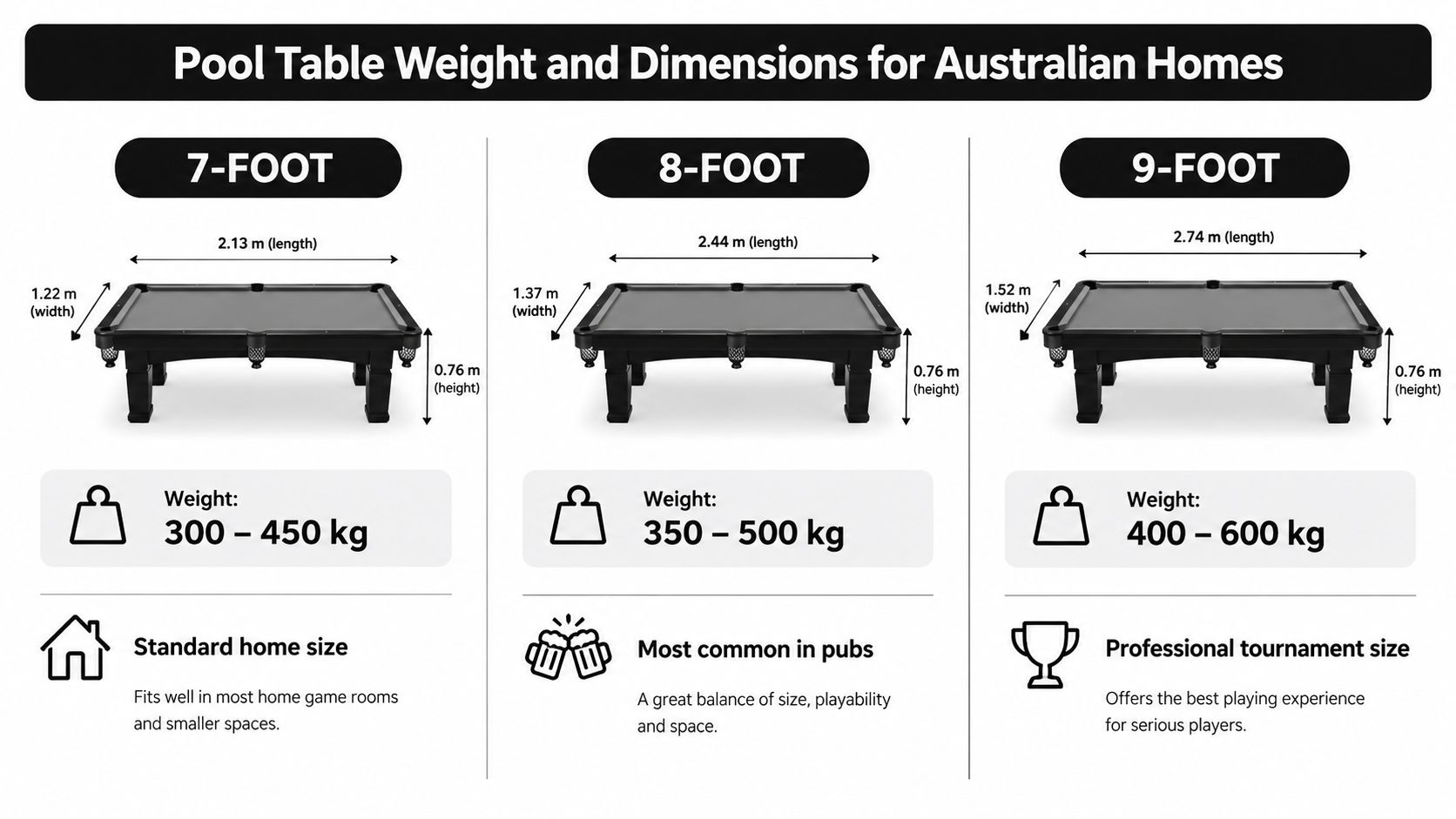
A table's advertised size does not determine the moving setup. Total mass, slate construction, component dimensions and available clearance decide whether ordinary removal equipment is suitable. A family table that separates into manageable parts may suit a properly rated dolly. A full-size traditional table can require specialist separation, crating and mechanical support, particularly when stairs, narrow doorways or an apartment lift limit how the load can be positioned.
In Australia, a standard slate pool table commonly weighs about 220 kg to 454 kg. Some locally sold 7-foot slate tables weigh around 260 kg, while 8-foot models weigh around 280 kg (Australian pool table moving weight guidance). A single-person lift is not realistic at those loads. Movers need equipment that spreads the weight, keeps the load controlled and fits the route.
Traditional Australian Alcocks full-size tables have listed weight ranges of roughly 590 kg to 1,010 kg, depending on size and model. Family tables commonly range from about 180 kg to 355 kg. A 10-foot model can exceed 700 kg, while a 12-foot table can approach 1,000 kg (Australian billiard-table specifications). The difference affects more than truck capacity. It determines whether the table can pass through a doorway, be positioned in a lift, or needs dismantling before it reaches the loading area.
Slate construction changes the job
Modern tables often use a three-piece slate system, with each slab weighing about 80 kg to 120 kg (Australian slate handling guidance). Each panel needs even support during removal, carrying and transport. A one-piece slate has a different handling profile, requiring a larger support surface, more movers and a route with fewer difficult turns.
Slate thickness also affects rigidity and load. Australian information identifies 19 mm one-piece slate, while product listings specify 20 mm three-piece slate (Australian slate construction information). Point impacts and unsupported edges can crack a panel, so protective padding alone is not enough.
Footprint affects the trolley and truck
The playing surface of a 9-foot table is 2.54 m by 1.27 m, while an 8-foot table is 2.34 m by 1.17 m (Australian billiards and pool dimensions). Rails, wrapping and handling space make the complete component larger. Measure doorways, stair landings, lift entrances and truck access before booking equipment. Use this guide to how to measure furniture and check the load volume with a cubic metre calculator using the disassembled parts.
Essential Lifting and Transport Equipment
A Melbourne pool table may clear the front door but still fail at the first stair turn or lift entrance. Choose equipment around the access route, not just the table's weight. The setup must support the load, control movement, protect surfaces and keep the route manageable. A trolley with a high capacity is still unsuitable if its deck is too narrow, its wheels catch on thresholds or the load sits off-centre.
Dollies and piano trolleys
A furniture dolly suits a cleared frame, wrapped slate on a properly supported platform or grouped components that remain low and stable. Choose a broad, solid deck, non-marking wheels and a frame that keeps the load centred. Small hard casters can roll well on smooth concrete, then catch on door thresholds, damaged paving or uneven apartment driveways.
A piano trolley helps control a tall, balanced component through a straight route. Check its load rating, upright support and wheel locks before loading. It does not make stairs safe by itself. Stair flights, landings and tight turns need enough people, a clear movement plan and equipment suited to the route. In an apartment, confirm the lift booking, door width and platform dimensions before the trolley arrives.
WorkSafe Victoria recommends mechanical aids and wheeled equipment for heavy or awkward objects, with the trolley matched to the object's weight and dimensions (WorkSafe Victoria manual-handling guidance).
Straps, pads and load control
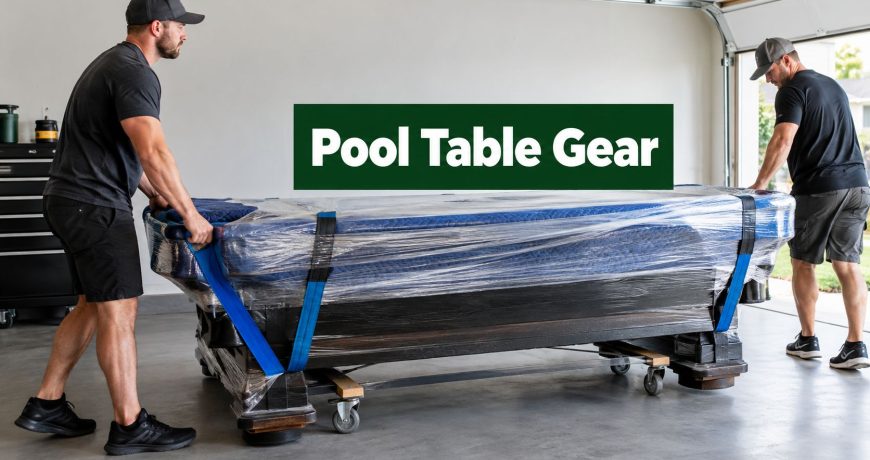
Use lifting straps when the component and attachment points allow the load to be shared between movers. Keep the arrangement symmetrical. Do not run straps across exposed felt, cushion noses or delicate corners.
Ratchet straps hold wrapped components in place during loading, transport and unloading. Tighten them enough to stop movement without crushing the frame or rails. Place padding between the strap and finished timber, then add corner protection wherever webbing could cut into blankets or packaging.
Moving blankets protect cabinets, rails and legs from scuffs. Wrap parts separately and secure each blanket so it cannot slide or bunch beneath a panel. Slate must remain separated from hard surfaces. Padding only works when it stays positioned.
Load-control rule: Straps hold the load still. They do not replace level support or correct an overloaded trolley.
Hydraulic equipment and small essentials
A truck-mounted hydraulic lift can reduce the height difference between the ground and vehicle, particularly when a long slate section is already secured on a trolley. Confirm the platform size, approach angle and overhead or side clearance before moving day. A lift that cannot accept the trolley width creates another manual lift at the kerb.
Keep a screwdriver, socket wrench, power drill, staple remover, lifting straps, blankets and carts together. Marker pens, labels, bags and tape keep hardware matched to each rail, pocket and frame section. If a hydraulic trolley or pump is involved, check these hand hydraulic pump maintenance tips before loading.
For large household items, this guide to how to move heavy furniture reinforces the same rule: select mechanical assistance for the object and route, rather than using whatever equipment happens to be available.
Specialized Tools for Slate Handling
Slate deserves its own handling plan. It's dense, rigid and vulnerable at the edges, yet it must often travel through routes that weren't designed for large stone panels. The right equipment controls the panel without forcing movers to grip thin edges or carry the entire load with their hands.
Clamps and carrying handles
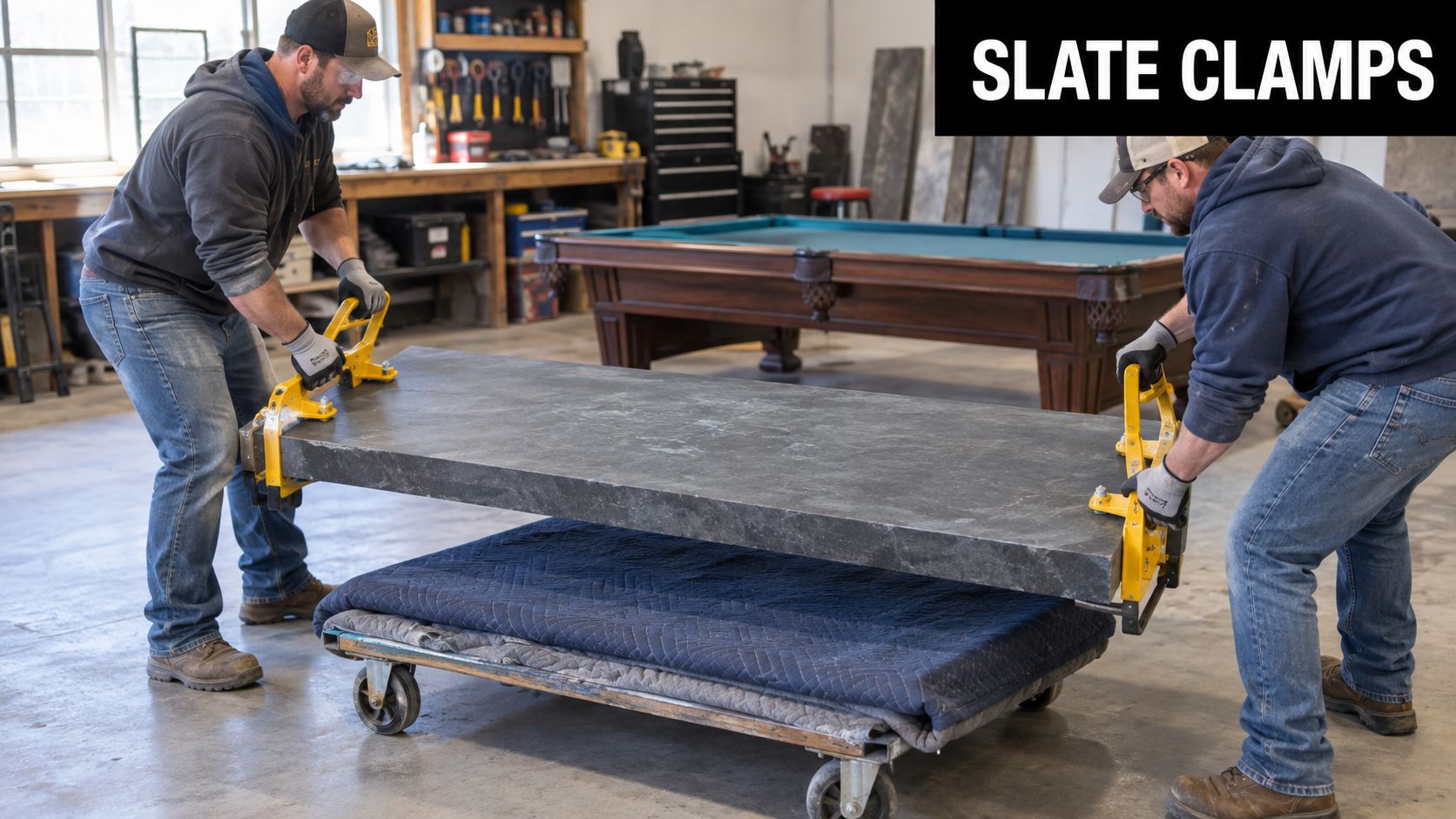
Slate clamps or purpose-built carrying handles distribute pressure across a controlled section of the panel. They give movers a more secure grip and reduce the temptation to lift from a corner. Inspect the clamp jaws, padding and locking action before use. A clamp that slips under load is more dangerous than no clamp at all because it creates false confidence.
Move one slab at a time unless the equipment and crew are specifically designed for a different arrangement. Keep the panel supported from multiple points, communicate every lift and lower it onto a flat, padded surface. Never place slate directly onto concrete, a steel truck floor or an uneven dolly deck.
Disassembly tools that protect the table
The usual dismantling kit includes a socket wrench, screwdriver, power drill and staple remover. Remove pockets and rails first, then release the felt carefully and expose the slate screws. Keep a separate labelled bag for each component's bolts and brackets. A photograph of each connection can prevent forced reassembly later.
Avoid using a power drill at high speed when a screw is resisting. Stripped heads, damaged timber and sudden tool movement are common results. A hand tool gives better feedback around delicate fittings.
Crating and panel protection
Wrap slate separately and protect the corners before securing it in a crate or on a reinforced platform. Crating becomes increasingly important for larger Australian tables, where the frame, slate and accessories may need separate heavy-duty handling. A specialist Australian crate-maker identifies a finished packed crate height of about 200 mm to 250 mm after wrapping and crating (Australian pool table crating guidance). That height can affect truck loading, trolley stability and apartment lift clearance.
A crate should prevent sideways movement without pressing directly against the playing surface. Use padding that fills voids, but don't wedge material so tightly that it transfers impact into the slate.
Coordinating the lift
Before lifting, nominate one person to give commands. That person calls the lift, stop, turn and lower, while the others maintain their position and watch corners. Clear the route first, keep hands away from pinch points and stop immediately if the panel begins to tilt.
If the route involves stairs, a specialist crew with appropriate equipment is safer than improvising with straps and household tools. For specialist handling, piano movers in Melbourne work with similar principles of controlled movement, equipment matching and access planning.
Rental Versus Purchase Decisions
Renting makes sense when the move is a one-off and the required equipment is specialised. Purchasing can be practical for a removalist, billiards retailer, venue operator or property manager who expects repeated handling. The decision shouldn't be based only on the hire price. Transporting the rental item, checking its condition and returning it within the agreed window also matter.
The table below gives a decision framework without inventing prices. Suppliers vary widely, and a reputable hire provider should confirm the equipment's capacity, dimensions and suitability for the route before accepting the booking.
Equipment Cost Comparison
| Equipment Type | Purchase Cost | Rental Cost (per day) | Recommendation |
|---|---|---|---|
| Furniture dolly | Varies by load rating and build quality | Varies by supplier and availability | Rent for a single move, purchase for regular relocation work |
| Piano trolley | Varies by trolley design and restraint system | Varies by supplier and availability | Rent when the route requires it, inspect brakes and wheels first |
| Ratchet straps | Varies by length, rating and hardware | Often supplied or hired with equipment | Purchase a suitable set for repeat use |
| Moving blankets | Varies by thickness and condition | Varies by quantity and hire period | Purchase if you move regularly, rent for a carefully planned one-off |
| Slate clamps | Varies by design and padding | Specialist availability varies | Rent or engage a specialist unless you handle slate often |
| Protective crate | Varies with size and construction | Custom hire availability varies | Arrange through a specialist when the table needs crating |
What to inspect before accepting a rental
Check that the wheels rotate freely, the platform is flat, the brakes hold and the straps have no cuts, fraying or damaged buckles. Ask whether the rated capacity applies to the complete trolley configuration, not just an individual component.
Measure the equipment against the route. A trolley that fits the table may not fit the lift doorway, stair landing or truck tail lift. Confirm the booking period allows time for disassembly, access delays and reassembly rather than planning around an unrealistically narrow window.
A hybrid setup often works best. Buy labels, tape, basic tools and straps, then rent the larger trolley or slate clamps for the move. If you're comparing a specialist crew with a general removal option, this guide to choosing the right removals firm for your move can help you assess equipment, experience and scope of service.
Safety Protocols and Common Mistakes
Pool table moving equipment controls risk only when the crew uses it properly. WorkSafe Victoria guidance supports mechanical aids and wheeled containers for heavy or awkward objects, with equipment matched to the load's weight and dimensions.
A controlled lifting sequence
Begin with a route check. Remove rugs, boxes and, where appropriate, doors that restrict the turning area. Protect walls, flooring and lift interiors before moving any component. In Melbourne apartments, confirm the lift booking and loading access before the table is dismantled. A delayed booking can leave heavy slate blocking a hallway.
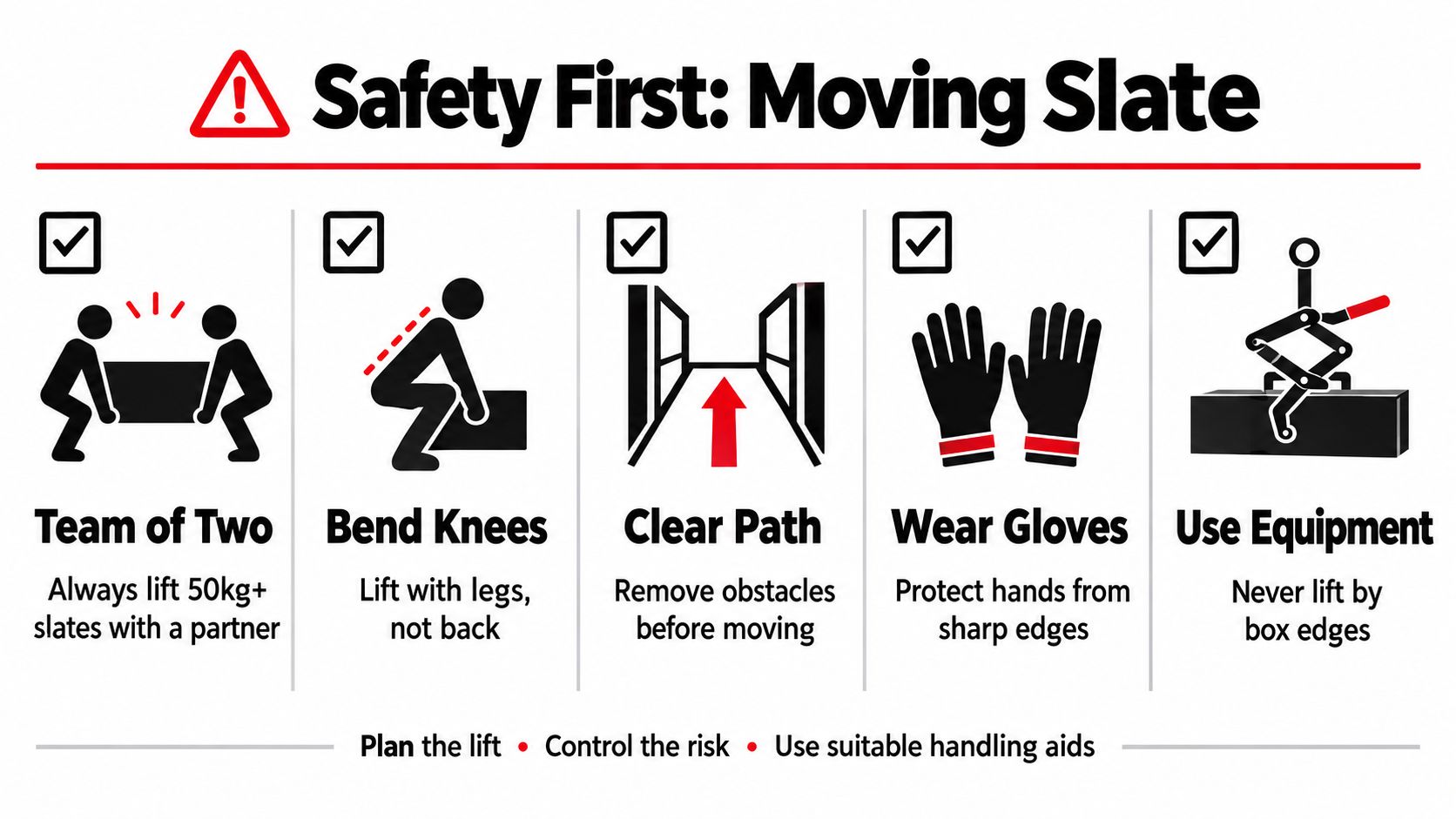
Use one clear command system. One person directs the move, everyone stops on that command, and nobody changes grip without warning the team. Keep the panel close to the body where possible, maintain a stable stance and avoid twisting while carrying.
Gloves protect hands from sharp edges, but they cannot stabilise a poor grip. Use slate clamps or handles where suitable, keep fingers away from gaps, and lower each panel onto prepared support instead of dropping it onto a trolley.
Stop the move if equipment bends, a wheel catches, a strap slips or the route no longer gives the crew room to work.
Mistakes that cause avoidable damage
- Moving the assembled table through a tight route: The frame can twist, legs can shift, and the table may strike walls or door frames.
- Using an undersized dolly: Small wheels and narrow platforms become unstable at thresholds, on ramps or during turns.
- Pulling by the felt or rail: These surfaces are not safe lifting points and can tear or loosen.
- Leaving hardware unlabelled: Reassembly takes longer and increases the chance of incorrect fitting.
- Stacking slate without separation: Direct contact between panels can damage edges.
- Relying on straps alone: Restraints cannot correct poor support, an overloaded trolley or an unsafe ramp.
- Skipping the lift booking: Apartment access can fail before the equipment reaches the table.
Stairs, ramps and vehicles
Stairs require a dedicated plan and controlled handling. Confirm that the trolley suits the stair width and landings, protect the nosings, and keep people above and below the load clear of pinch zones. On narrow landings, reposition the load only when every person has stable footing and the route is clear.
A ramp must be secured, correctly positioned and free of obstacles. Do not substitute extra helpers for equipment that cannot hold or control the load.
For vehicle loading, a hydraulic lift provides a controlled transition from ground level to the truck deck. Inside the vehicle, place wrapped slate on a stable, protected base and restrain it so braking, cornering and road vibration cannot shift it. If stairs, difficult turns or a fragile high-value table exceed the crew's equipment or access, use a specialist removalist rather than improvised gear.
Access Planning and Clearance Requirements
Access should be checked before hiring equipment, not after the table is partly dismantled. Measure the narrowest doorway, hallway width, stair width, landing depth, lift entrance, lift interior and truck loading area. Measure the disassembled slate with its wrapping, clamps and trolley, because a panel that fits alone may not fit as a supported load.
A 9-foot playing surface measures 2.54 m by 1.27 m, while an 8-foot playing surface measures 2.34 m by 1.17 m. The slate is only part of the moving envelope. Blankets, trolley rails and the movers' hands need room to work, particularly where the route turns.
Measure the route, not just the room
Measure each narrow point, rather than trusting the apparent width of an open hallway. Check door hinges, handles, skirting boards, handrails, light fittings and ceiling changes. A sharp corner can restrict movement more than a doorway, since the panel may need diagonal clearance to rotate.
For practical room and furniture measurement methods, use this resource on measuring for furniture and mattresses as a starting point. Apply the same method from the table room to the truck, including every turn and staging area.
Photograph awkward corners and record the measurements. A removalist can then choose equipment that suits the property instead of arriving with a trolley that cannot turn.
Apartment and workplace planning
Apartment moves require early confirmation of lift dimensions, lift capacity, booking rules, protection requirements and loading-zone access. The wrapped component and trolley must fit through the lift entrance and inside the car together. If they cannot, decide where the component will wait and how lift doors and common areas will stay clear.
Book the lift for the actual moving window, and confirm whether building staff require padding, certificates or a loading-zone reservation. A short booking can leave a crew holding a slate panel in a corridor while access expires.
Workplaces bring different restrictions. Check loading docks, security access, freight-lift rules, evacuation paths and the time available for the move. On Melbourne streets with limited stopping space, position the truck close enough for a short, protected transfer without blocking pedestrians or building access.
Solve the route before moving day
If measurements fail, options include removing a door, changing the trolley, using another entrance, staging smaller loads or arranging a hydraulic lift. Do not find the problem while slate is suspended in a hallway. If stairs, tight turns or lift limits exceed the crew's equipment, use a specialist removalist rather than improvised gear.
Quick Reference Equipment Checklist
Use this checklist during the site inspection and before loading:
Before disassembly
- Route measurements: Check doorways, stairs, landings, lifts and the truck loading area.
- Hand tools: Prepare a screwdriver, socket wrench, power drill and staple remover.
- Labels and bags: Keep bolts and brackets organised by rail, pocket and frame section.
- Protection: Have moving blankets, corner padding and floor protection ready.
During disassembly
- Component order: Remove pockets, rails, felt and slate carefully.
- Slate support: Use slate clamps or suitable carrying handles, with multiple movers.
- Mechanical aid: Use a furniture dolly or piano trolley matched to the load and route.
- Separate wrapping: Wrap slate, rails, frame, legs and accessories individually.
Loading and reassembly
- Hydraulic access: Use a suitable truck lift where ground-level loading is difficult.
- Stable placement: Keep slate on a flat, padded support surface.
- Restraints: Secure components with heavy-duty ratchet straps without crushing padding.
- Final check: Reassemble methodically and inspect the playing surface before use.
If the trolley doesn't fit, the wheels don't lock or the route includes stairs you can't control, stop and change the plan. Get n Go Removals Melbourne can disassemble, transport and reassemble pool tables with equipment suited to Melbourne homes, apartments and office access constraints. Visit Get n Go Removals Melbourne to discuss the table, route and required moving support before moving day.