4 Tonne Truck Guide for Melbourne Moves Made Easy
You've booked the lift, measured the hallway and found a loading spot near the apartment. Then one question appears: will a 4 tonne truck fit the furniture, the street and the legal requirements for your Melbourne move?
Truck size isn't about how much space you can see inside the body. The important questions are the truck's Gross Vehicle Mass (GVM), its actual payload, its dimensions and the access conditions at both addresses. A smaller rigid truck can be a practical choice for apartments, narrow inner-city streets and compact house moves because manoeuvrability may matter more than maximum box volume.
This guide explains what “4 tonne” means in Australia, how payload differs from capacity, which licence rules apply, and how to load the vehicle safely. It also shows when a larger truck makes more sense, so you can choose equipment based on the conditions of your move rather than a label on a rental listing.
Introduction to the 4 Tonne Truck for Melbourne Moves
A one-bedroom apartment in Brunswick might have a lift at one end, a narrow driveway at the other and furniture that needs to travel through a busy loading zone. A larger truck may offer more internal room, but if it can't park close to the entrance or turn comfortably in the street, your removal team may spend more time carrying items by hand.
That's why a 4 tonne truck can suit urban Melbourne moves particularly well. It offers useful moving capacity while remaining within the light-vehicle category when its rated GVM stays at or below the relevant legal limit. Its compact format can also make access easier around apartment buildings, residential streets and older properties with restricted driveways.
The phrase “4 tonne” can confuse people. It usually refers to the vehicle's GVM rating, not the weight of furniture it can automatically carry. GVM includes the truck, fuel, passengers, equipment and belongings. The legal payload is whatever remains after the truck's tare weight is accounted for.
The practical question isn't “How big is the box?” It's “What can this specific truck legally carry, and can it reach both properties?”
Throughout this guide, you'll find the key measurements used for rigid trucks, an explanation of tare and payload, Victorian licence considerations, and loading techniques that protect furniture without wasting space. You'll also see why an apparently larger truck isn't always the quickest option for a Melbourne apartment or inner-city relocation.
What a 4 Tonne Truck Really Means in Australia
Start with the term Gross Vehicle Mass. GVM is the maximum legal mass of the fully loaded vehicle. It includes the truck itself, the body, fuel, driver, passengers, removal equipment and the customer's goods. It isn't a measurement of the furniture load alone.
Think of the truck as a backpack with a fixed weight limit. The backpack already weighs something before you put anything inside it. The remaining allowance is what you can use for your belongings. A truck with a higher-looking body can still have less usable payload if its chassis and body are heavier.
GVM, tare and payload
The basic relationship is:
Payload = GVM minus tare
Tare is the unladen weight of the truck in its working configuration. For a removal vehicle, that can include the cab, chassis, box body, tail lift, tools and other fitted equipment. Two vehicles carrying the “4 tonne truck” label may therefore have different legal payloads.
A vehicle marketed as a 4 tonne truck may have a GVM close to 4 tonnes, but the body volume doesn't change that legal ceiling. Sofas, bookcases and cartons still count toward the total, even when the truck appears to have unused room above them.
Australian fleet information notes that payload is calculated from GVM minus tare, and that typical 4 tonne rigs can carry about 2,000 to 4,000 kg after the chassis, cab and body are included. See the Australian fleet explanation of 4 tonne truck payload for the distinction between the advertised class and actual carrying capacity.
Where the truck sits in the Australian framework
The key dividing line is 4.5 tonnes GVM. NSW Government guidance treats vehicles at 4.5 tonnes GVM or less as light vehicles, while vehicles above that threshold are treated as heavy vehicles. National heavy-vehicle standards also use the over-4.5-tonne boundary. You can review the NSW road access guidance for oversize light vehicles for how the threshold affects access rules.
That makes a compliant 4 tonne truck a useful option for removals. It sits below the boundary that generally triggers heavy-vehicle classification, although the operator still has to follow the truck's actual GVM, axle and loading requirements.
For a service that combines a truck with experienced movers, a 2 man with a van moving option can also be relevant for smaller jobs. The right choice depends on the inventory, access and handling requirements, not just the number printed in the vehicle description.
Dimensions Payload and Real World Capacity Explained
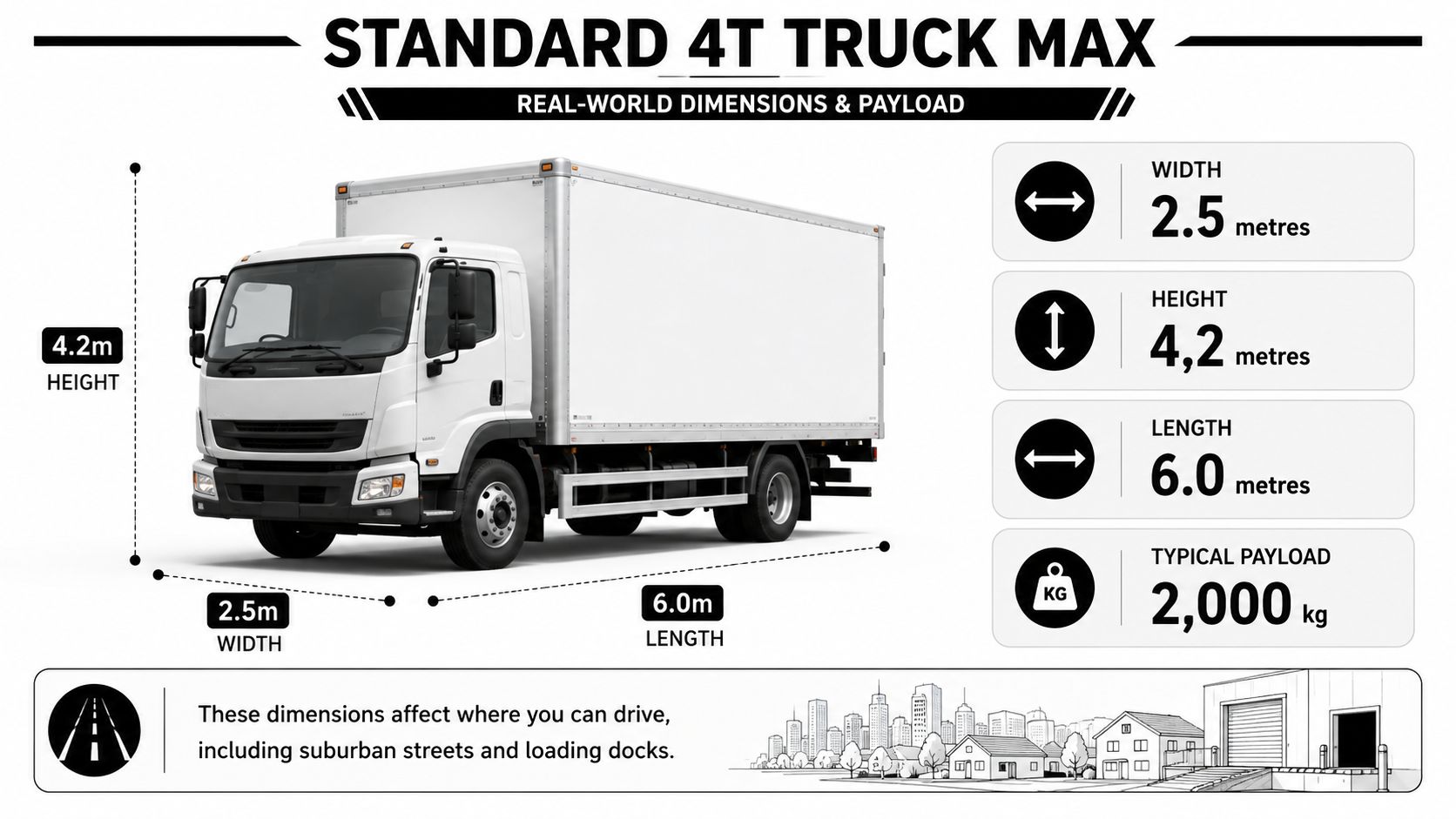
A rigid truck in Australia is commonly subject to maximum standard dimensions of 2.5 m width, 12.5 m length and 4.3 m height under Victorian road guidance. These are overall vehicle limits, not necessarily the dimensions of every 4 tonne removal body. The Victorian bus and truck drivers handbook provides the relevant road guidance.
For a Melbourne move, width and height often matter before the furniture does. A truck that fits the main road may still face trouble at a narrow driveway, a low awning, a tight laneway or an underground apartment entrance. The driver needs to assess turning space, overhead clearance and the position of parked vehicles before committing to the approach.
Volume is not the same as weight
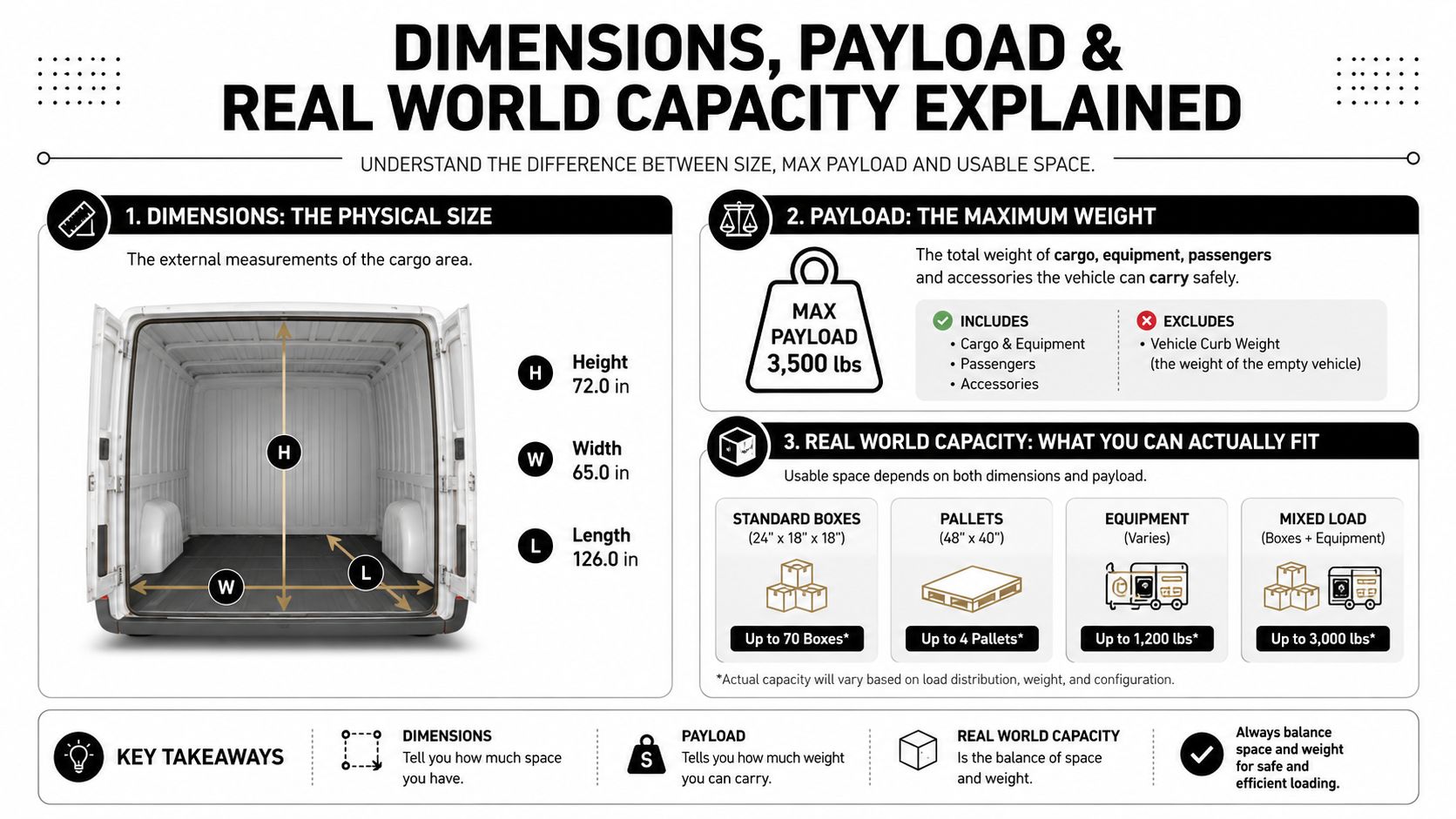
A truck can be full by volume without being full by mass. A load of books, dense appliances or stone furniture may reach the payload limit while empty gaps remain above or between items. Lightweight cartons, bedding and lamps may fill the body without approaching the same mass.
The reverse can also happen. A smaller household may have a heavy piano, commercial equipment or substantial solid-wood furniture that requires more attention than its apparent volume suggests. The removal team should identify unusually heavy items before selecting the truck and should place them in a way that keeps axle loads within limits.
Australian fleet guidance places typical 4 tonne rig payloads at about 2,000 to 4,000 kg, depending on tare and body configuration. That range is why a truck's compliance plate and actual specification matter more than a generic online description.
A practical capacity check
Use a room-by-room inventory rather than guessing from the number of boxes:
- Furniture first: List beds, lounges, wardrobes, dining tables, whitegoods and outdoor items.
- Dense items next: Identify books, tools, gym equipment, filing cabinets and stone or metal pieces.
- Access separately: Record stairs, lifts, laneways, loading bays and parking restrictions.
- Loose goods last: Estimate cartons, bags, plants and fragile items after the main furniture is listed.
A cubic metre calculator for moving can help estimate space, but it can't replace a weight assessment. Treat cubic volume as one planning measure and GVM compliance as the hard legal limit.
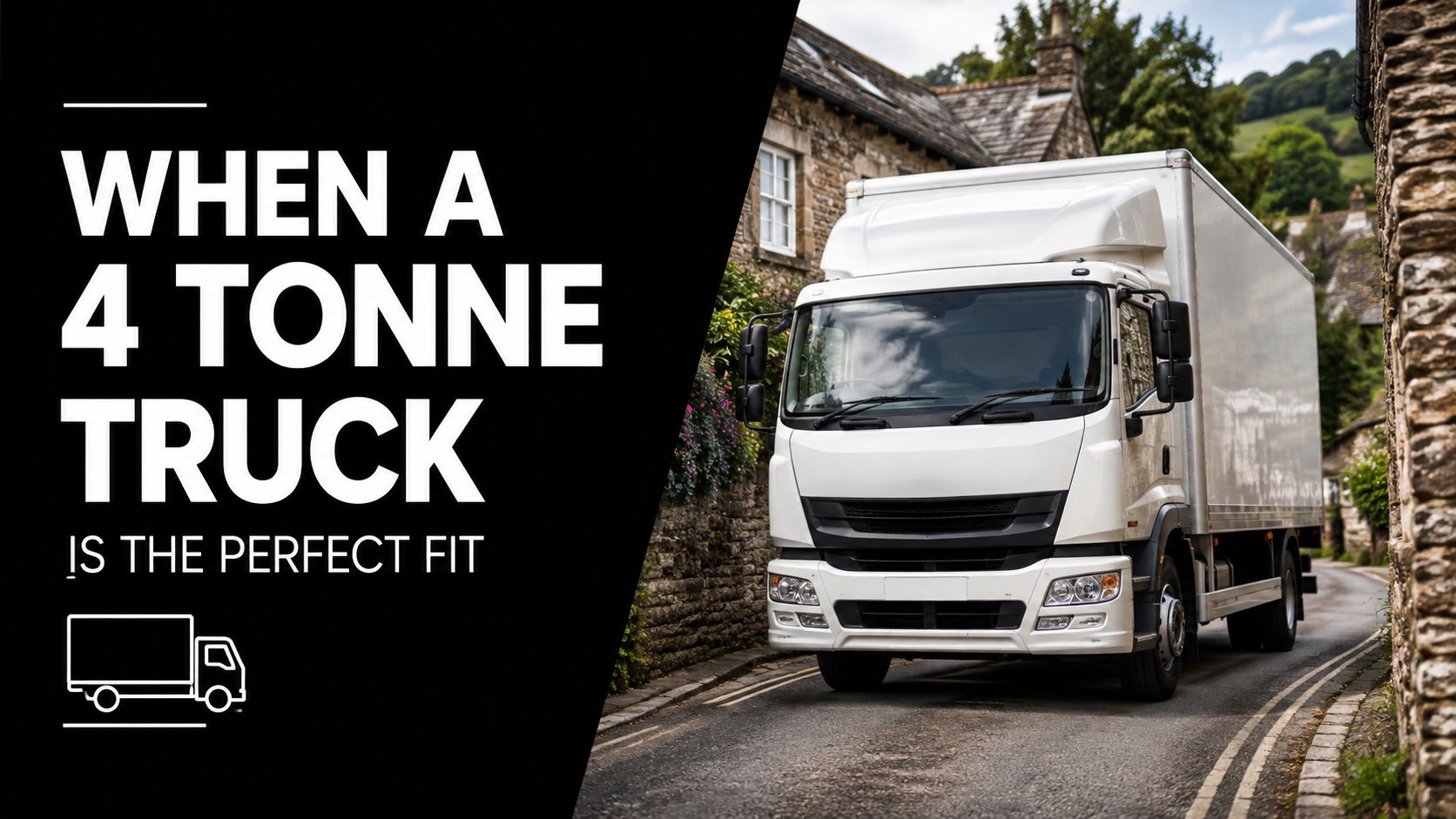
When a 4 Tonne Truck Is the Perfect Fit
A 4 tonne truck often earns its place on jobs where access and handling time matter as much as total capacity. A studio or one-bedroom apartment may not need a large body, especially when the building has a loading bay, a lift booking and a short travel distance between the truck and the front door.
A compact two-bedroom move can also work well when the inventory is moderate and the larger furniture has been measured. Disassembled bed frames, tables and shelving can stack more efficiently, while blankets and straps help the team build stable layers. The truck becomes less suitable when the property contains unusually heavy pieces or a large amount of dense storage.
Melbourne situations where smaller helps
- Inner-city apartments: A shorter vehicle may be easier to position near a building entrance or loading zone.
- Older suburban streets: Narrow roads and parked cars can make a large truck difficult to turn or stop.
- Student relocations: A modest inventory often benefits from a truck that doesn't require unnecessary road space.
- Small offices: Desks, chairs, monitors and cartons can be moved efficiently when the team plans the loading order.
- Event transport: Stands, display equipment and packed materials may need careful protection and convenient venue access.
The comparison with a larger truck is straightforward. A bigger vehicle can provide more volume and may reduce the chance of a second trip for a substantial household, but it can create longer carry distances when parking is restricted. A 4 tonne truck may offer less spare room, yet its manoeuvrability can simplify the actual loading process.
For an apartment move, the closest legal parking position can be more valuable than unused space inside a larger truck.
Get n Go Removals Melbourne uses truck sizes across the removal market, so the recommendation should follow the property details and inventory. Give the mover measurements for lifts, driveways and bulky items before booking, rather than assuming a standard apartment package will fit every building.
Licence Requirements and Access Rules in Victoria
The licence question starts with the truck's GVM, not its advertised name. In Australia, a standard Class C car licence covers a vehicle up to 4.5 tonnes GVM, inclusive. That means 4,500 kg is within the stated limit, while 4,501 kg is over it.
Transport for NSW's licensing information confirms the Class C limit, and Access Canberra states that a heavy-vehicle licence is required above 4.5 tonnes GVM. The Australian licensing and registration glossary is useful when checking the terminology before hiring or driving a truck.
Where LR licensing begins
A Light Rigid licence applies to a rigid vehicle above 4.5 tonnes GVM and up to 8 tonnes GVM. Guidance also refers to a trailer limit of 9 tonnes GVM for that class. CarsGuide explains the Light Rigid vehicle definition in plain language.
A truck described as 4 tonnes will generally sit below the LR boundary, provided its compliance information confirms the GVM. Don't rely only on the body size or a rental category. Check the vehicle's rating and confirm that the driver's licence matches it.
Access is a separate question
A car licence doesn't guarantee that every street or loading area is suitable. NSW guidance states that, where detailed road sign information isn't shown, a truck with GVM greater than 4.5 tonnes may not pass. Local signs, clearance restrictions, council controls and building requirements can still affect the route.
For Victorian moves, check the vehicle's dimensions and planned approach. The car requirements for VicRoads test can help readers understand broader Victorian vehicle and driving expectations, although a removal truck's GVM and road access should be confirmed separately.
A house relocation service in Victoria can help coordinate access details, but the customer should still provide accurate information about underground entries, low structures, narrow laneways and lift bookings.
Packing and Loading Tips to Get the Most From Your Truck
Good loading doesn't mean filling every gap at any cost. It means creating a stable load that stays within the truck's legal mass and protects furniture during braking, cornering and unloading.
Start with the heaviest items. Place dense furniture low and as close to the appropriate axle area as the loading plan allows. Don't concentrate all the weight at the rear, and don't build a tall stack of heavy boxes that can fall when the doors open.
A safer loading sequence
- Prepare the furniture: Disassemble bed frames, tables and shelving where practical. Keep screws, brackets and tools in labelled bags attached to the relevant item.
- Protect surfaces: Wrap timber, glass and polished finishes with moving blankets. Use corner protection on wardrobes, fridges and cabinets.
- Build a stable base: Load heavy, strong items first, with lighter cartons above them. Keep fragile goods away from compression and impact points.
- Use the walls carefully: Secure tall pieces so they can't lean into doors or shift across the body.
- Fill controlled gaps: Use linen, cushions and small cartons to reduce movement, but don't wedge items so tightly that unpacking causes damage.
- Strap before closing: Tie sections of the load progressively instead of waiting until the truck is full.
Courier bags can protect small soft goods, documents and loose accessories during a move. The MSP Packaging courier bag guide for businesses offers useful background on choosing protective packaging for different items.
Melbourne moving-day details
Reserve or arrange the closest lawful parking position available, especially for apartment buildings. Confirm the lift booking, protect common areas and keep a clear path from the entrance to the truck. These steps can save more effort than squeezing additional cartons into the body.
For more preparation ideas, use these packing tips for moving house. Label boxes by room, mark fragile cartons clearly and keep essentials such as medication, chargers and documents separate from the main load.
A well-distributed load protects your belongings and gives the driver a more predictable vehicle to control.
Choosing Between a 4 Tonne Truck and Larger Options
Choosing a truck is a balance between capacity, access, licensing and total handling effort. A 4 tonne truck is a sensible starting point for a studio, apartment or compact household when the inventory is moderate and the addresses have restricted access. A larger option becomes more appropriate when the home contains substantial furniture, dense storage or bulky items that may exceed the smaller truck's practical payload.
Here's a simple decision guide:
| Moving situation | More suitable direction |
|---|---|
| Studio or modest apartment with straightforward inventory | 4 tonne truck |
| Apartment with narrow access but a carefully measured household | 4 tonne truck, subject to payload |
| Larger home with extensive furniture and cartons | Larger rigid truck |
| Heavy commercial equipment or dense storage | Larger truck, with GVM and axle review |
| Difficult CBD access with limited parking | Smaller suitable truck, if capacity allows |
Get n Go Removals Melbourne operates a company-owned fleet from 4.5 to 12 tonne trucks, so a quotation can account for both the inventory and the streets involved. A larger truck may reduce trips, but a smaller suitable truck can reduce carrying distance and simplify parking. The right answer depends on the complete move plan, not a truck-size comparison in isolation.
Drop trailers and alternative transport formats involve different access and loading considerations. Readers comparing those arrangements can compare drop trailer options before deciding what fits their property and schedule.
For pricing context, review the cost of movers in Melbourne and ask for a quote based on the number of rooms, bulky items, stairs, lift access, travel route and packing requirements. Share photographs or measurements where possible, especially for CBD buildings and tight residential streets.
Get n Go Removals Melbourne can assess your inventory, access points and GVM needs before recommending a suitable truck for your local or interstate move. Visit Get n Go Removals Melbourne to discuss truck selection, careful loading, packing, storage and a clear moving plan.