Expert Removals Inner West: Your Top Local Movers
You can feel an Inner West move before the truck even arrives. The street is narrow, the terrace stairs are steep, the lift booking is tight, and the parking spot disappears just as the crew turns the corner. That's why removals Inner West isn't a generic moving job, it's a local access problem wrapped inside a household move.
The Inner West sees constant churn, and the numbers explain why local expertise matters. Between 2016 and 2021, 39.0% of residents moved from elsewhere in Australia and 7.0% moved from overseas, compared with 35.3% and 5.4% nationally, which means the area keeps drawing people who need a move planned properly, not guessed at. Inner West migration profile The smart move is to work with a team that understands compact streets, apartment access, and council rules from the start, not after the truck is already parked.
The Unique Challenges of Inner West Removals
A Balmain resident booking a Saturday move for a two-bedroom terrace learns the same lesson quickly. The truck can be on time, the crew can be ready, and the job can still stall if the street offers no clean loading space, the stairs are tight, or the sofa needs to be carried in pieces just to clear the hallway. That is the Inner West. Access decides the pace of the move, and council rules shape what the crew can do once they arrive.
The area stays busy for a reason. People move in, move out, and move within the same pockets of the Inner West all the time, so local removalists deal with short notice, repeat apartment shifts, and the kind of timing pressure that comes with rental handovers and settlement days. The right team does not just bring muscle. It knows which suburbs are easy to service, which streets punish oversized trucks, and which jobs need extra coordination from the start. A clear Get n Go Removals service areas page should tell you straight away whether a mover covers the parts of the Inner West you live in.
Why the built form changes everything
Inner West housing is dense, expensive, and often awkward to access. That matters because every scratch, delay, or missed booking has a real cost attached to it. In this part of Sydney, a move is usually tied to a lease, a settlement, or a strict handover window, so crews have to protect floors, wrap furniture properly, and avoid wasting time at the kerb. The margin for error is thin.
The dwelling mix makes the job harder. The Inner West is full of compact homes, apartments, terraces, and tight entry points, which means a removalist has to plan the carry route before lifting anything. Stairs, narrow halls, shared driveways, and building access rules all affect how the move runs. If a mover talks only about the truck and ignores the access details, they are not prepared for this area.
Council expectations add another layer. Parking, loading, and building access all need to be checked early, because a poor setup on move day slows everything down and puts pressure on the whole schedule. The smart approach is simple, measure the access, confirm the parking, and make sure the crew knows where the difficult points are before the first box leaves the house.
Practical rule: In the Inner West, the route into the property matters as much as the route between suburbs. If the carry is awkward, the whole move takes longer.
Overview of Inner West Services
A strong Inner West mover should do more than move boxes. The service has to fit the way people live here, in terraces, apartments, split-level units, small offices, and storage-heavy homes where stairwells, landings, and building rules shape the whole job. If a company only talks about “truck and two men”, it is not set up for this area.
Residential moves, apartments, and terraces
Inner West house moves start with access, not the truck. Apartment jobs need lift bookings, common-area protection, and a clear plan for tight door frames. Terrace moves often require furniture to be taken apart before the crew starts carrying, because narrow stairs and sharp turns waste time and increase the risk of scuffs. In a Newtown walk-up, a dining table may need to be disassembled at pickup and put back together at delivery just to keep the move moving and avoid damage.
Renters need speed and control. Owners need damage prevention and careful timing around settlement. A dependable team should protect floors, wrap soft furnishings, and load in the right order so heavy items do not crush fragile ones.
Office relocations, specialist items, and storage
Inner West businesses move differently. Small offices in Marrickville, Leichhardt, or Balmain need equipment protection, labelled cartons, and a loading sequence that gets staff back to work without chaos. A capable crew plans around computer gear, files, meeting tables, and reception furniture instead of treating the job like a house move with desks added in.
Specialist items need their own plan. Pianos, pool tables, and fine art call for proper wrapping, the right lifting technique, and the correct team size. Valet packing and unpacking helps when you want the move finished cleanly in one day instead of dragging into two. For people who need temporary holding space, movers should offer secure, short- or long-term storage planning before moving day arrives. If you want a full run-through of what should be organised before the truck arrives, use this moving house checklist for Australia and build from there.
The right service is not the fanciest one, it is the one that matches your access, your contents, and your deadline.
A few practical examples make the difference obvious:
- Terrace move in Balmain: use disassembly, heavy-item protection, and careful carry routing.
- Apartment shift in Marrickville: book the lift, protect common areas, and load in the correct order.
- Small office relocation: label everything before the truck arrives and move IT gear separately.
- Storage-led move: split the job into what is needed now and what can go into secure storage.
Breaking Down Inner West Moving Costs
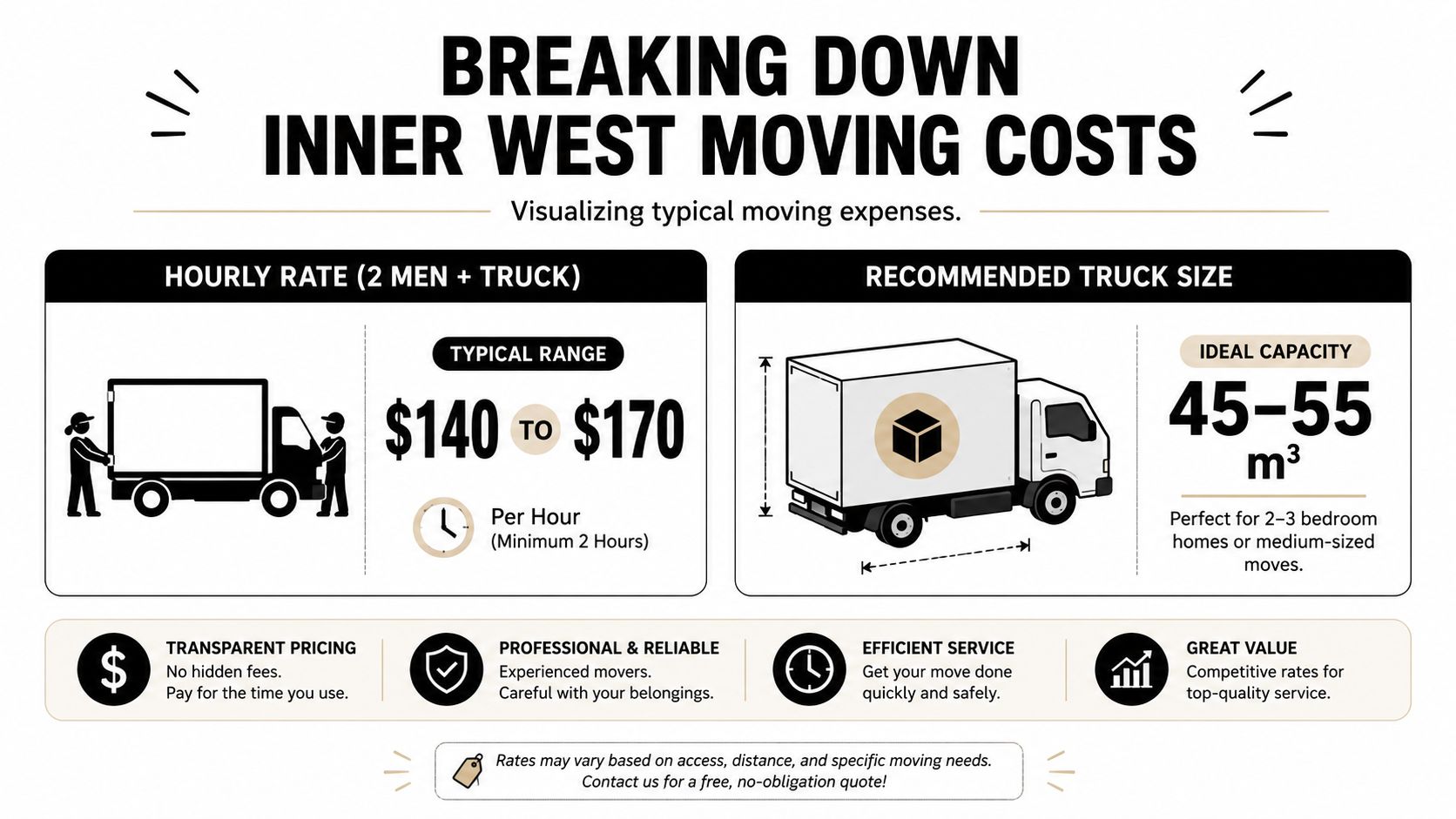
The Inner West is a market where the quote can change fast if the access is bad or the job is poorly scoped. Local industry guidance places two-man team rates around $140 to $170 per hour and recommends 45–55 m³ trucks for 3 to 5 room households. Local Inner West moving guide If you're comparing removalists, those two figures tell you a lot about whether the company is pricing sensibly or just guessing.
What actually drives the quote
Hourly pricing makes sense when the move is straightforward and access is clean. It gets less friendly when the crew has to carry furniture a long way, wait for a lift, or hunt for parking. That's why matching truck capacity to the job matters, and why a move that looks small on paper can still run long in real life.
The local market also shows how wide the pricing spread can be. One service marketplace lists 567 best-rated removalists in the Inner West, with average prices of $130 to $262 for a removalist service, $140 to $280 for a mover, and $150 to $300 for a truck removal service. Airtasker Inner West removals market That tells me two things. First, competition is strong. Second, shoppers need to compare what's included, not just the headline number.
When fixed pricing beats hourly pricing
Hourly billing is fair when the scope is clear and access is easy. Fixed pricing can be smarter when the job has obvious complications, such as multiple stair flights, a tight loading zone, or a lot of bulky furniture. If you've got a compact apartment with a lift booking and short carry distances, hourly might work well. If you've got a terrace full of awkward furniture and no parking, a fixed or minimum-charge model can protect you from runaway time.
Use Get n Go Removals pricing guidance as a benchmark against any quote you receive, then compare the service details line by line. The useful question isn't “What's the cheapest?” It's “What will this cost once the crew is standing in front of my building with the clock running?”
Hidden cost triggers to watch
- Long carry distances: more walking time, more labour time.
- Lift delays: crews wait, and waiting affects the clock.
- Parking pressure: a bad parking setup can stall the whole move.
- Oversized items: disassembly or extra hands may be needed.
- Weekend timing: some jobs are priced differently because demand is higher.
If you want control, ask for the truck size, the crew size, the expected duration, and the access assumptions before you book. That one conversation prevents most disputes later.
Building Your Moving Timeline and Checklist
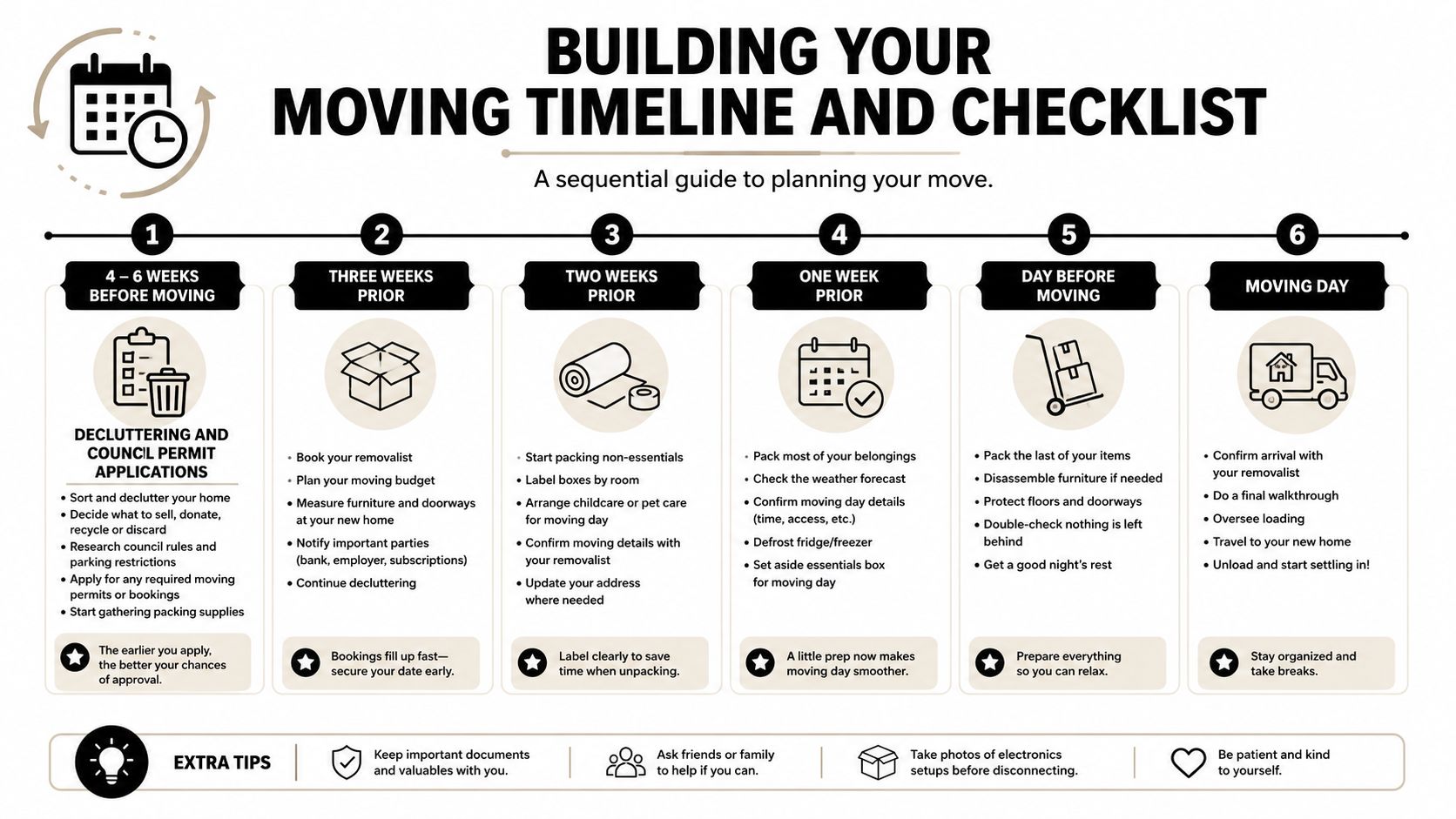
The easiest Inner West move is the one that starts early. Rushing in this area is expensive because access issues, lift bookings, and parking arrangements don't fix themselves on moving day. If you want the day to run cleanly, build the job backwards from the handover time.
Four to six weeks out
Start with decluttering and sorting. Anything you don't want in the new place should be separated now, not packed by default and dealt with later. This is also the time to line up building access, check whether your new place needs lift access coordination, and decide whether bulky items should go to storage instead of straight onto the truck.
Use Get n Go Removals moving house checklist as a working reference while you plan your own list. A strong checklist keeps everyone aligned, especially if more than one person is organising the move.
Three weeks out
This is packing time. Start with books, seasonal clothes, spare linen, and anything you won't need before moving day. Transfer or confirm utilities, then label boxes by room and priority so the unloading sequence makes sense later. If you're moving a business, sort files, hardware, and shared equipment into separate groups so the team can load them in the right order.
Job duration gives you a practical planning guide. Average Inner West moves run 2 to 5 hours for 1 to 2 bedroom homes, 5 to 9 hours for three-bedroom houses, and 7 to 10+ hours for larger properties. Inner West job duration guide That doesn't guarantee your exact timing, but it's a sane baseline for booking help, elevator access, and key handovers.
Practical rule: Pack by access, not by category. The boxes you'll need first should be the last ones loaded.
One week out and moving day
Confirm the booking, the address, parking details, and any building rules. On moving day, keep valuables, keys, chargers, and essential documents in one hand-carry bag. Take meter readings if needed, hand over access items cleanly, and walk the crew through any fragile furniture or awkward stair turns before they start.
A practical checklist should include:
- Lift bookings confirmed: check the time slot and building access rules.
- Parking arranged: confirm where the truck can legally stop.
- Boxes labelled: room, contents, and priority marked clearly.
- Furniture disassembly planned: remove legs, shelves, and loose fittings early.
- Valuables separated: passports, jewellery, laptops, and keys stay with you.
- Final walk-through done: check cupboards, balconies, and storage spaces.
That's the difference between a move that feels controlled and one that becomes a scramble at the front door.
Packing, Unpacking, Storage, Insurance and Permits
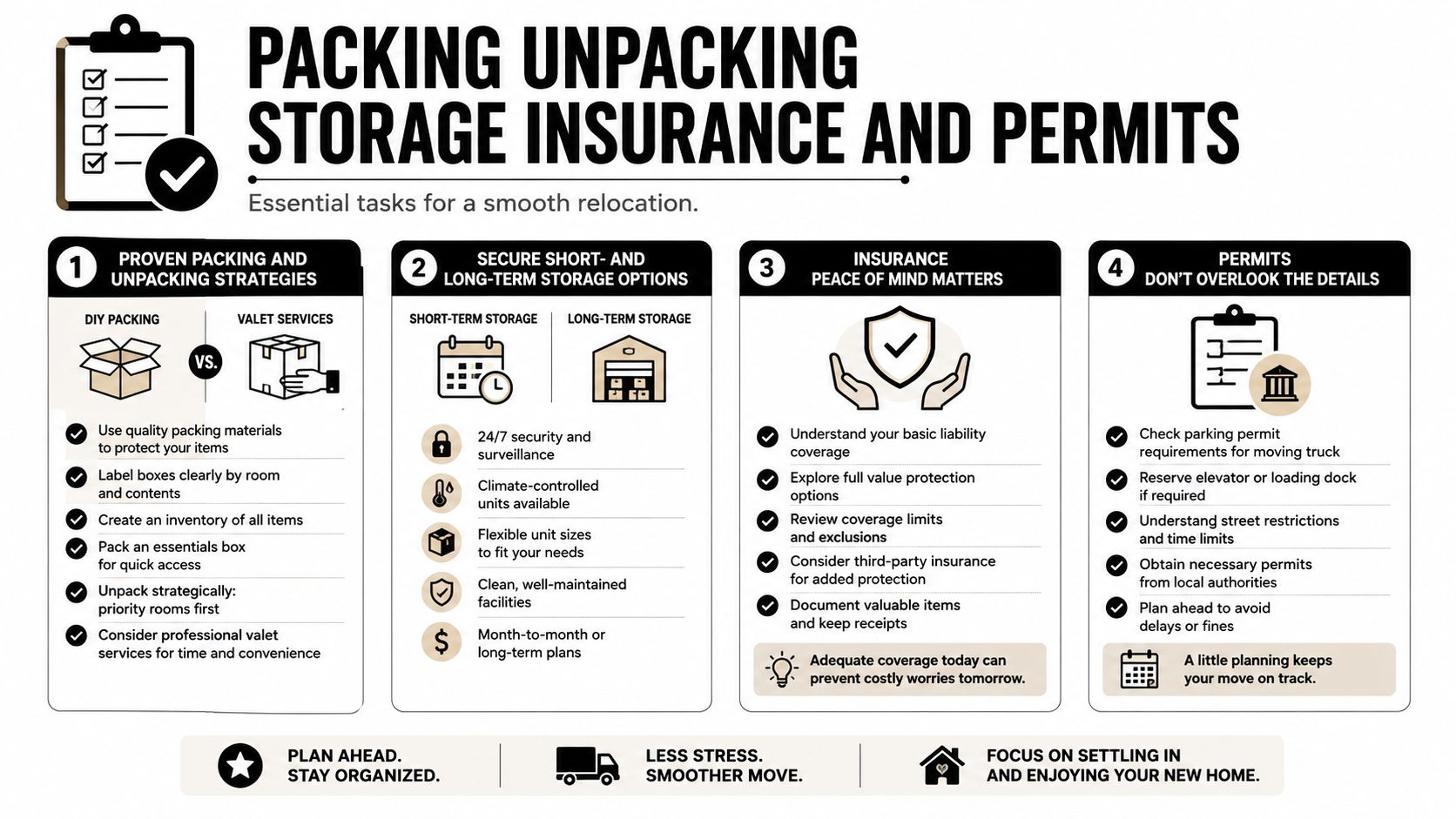
Packing in the Inner West should be built around access, not just protection. A careful pack saves time on the other end because the crew can lift, stack, and unload without stopping to rework every box. If you want the move to stay calm, treat packing, storage, insurance, and permits as one system.
Packing and unpacking choices
DIY packing gives you control, but it only works if the cartons are strong, the contents are labelled properly, and breakables are wrapped with enough padding. Valet packing and unpacking is the better call when you're short on time, have a large household, or want fragile items packed by people who do it every day. The right choice depends on your schedule, not on pride.
Storage should be used as a tool, not a dumping ground. Short-term storage helps when settlement dates don't line up, while long-term storage makes sense for items you won't need in the new space. If you're comparing options, storage units and prices near me is a useful starting point, but the primary decision is whether the storage is secure, accessible, and sized properly for what you're keeping.
Insurance and permit basics
Before any truck rolls in, confirm what cover applies to your move. Transit and public liability are not the same thing, and you need to know what happens if an item is damaged during loading or if a common area is affected. If you're sorting out cover for a bigger relocation, a practical guide like prepare your insurance with My Policy Quote can help you think through the right questions before you sign anything.
Council waste rules matter just as much. Inner West Council caps bulky clean-up piles at 2 cubic metres and says no single item can be longer than 2 metres. It also requires source-separated recycling streams to avoid rejected loads. Inner West Council waste guidance That means the pre-move clear-out should be staged properly, with materials separated and oversized items handled through the right channel.
A simple pre-move decision stack
- What's moving now? Pack those items first.
- What needs storage? Remove it from the main load.
- What's fragile or high value? Prioritise protection and insurance.
- What must be separated for disposal? Keep waste compliant.
- What access needs booking? Confirm lifts, loading, and entry points.
Poor planning can quickly become expensive. A mixed pile, a badly packed box, or a permit you forgot to request can all turn a straightforward move into an avoidable delay.
How to Choose a Reputable Inner West Mover
Pick the mover before you need them, not the night before. In the Inner West, the wrong operator costs time through poor access handling, weak communication, and vague pricing. A serious mover should be able to explain exactly how they'll deal with stairs, lifts, parking, and breakables without talking in slogans.
What to verify first
Ask whether the crew is full-time, what insurance is in place, and how the company handles damage claims. Check whether the truck is maintained properly, whether packing materials are supplied, and whether the quote includes the access conditions you've described. A transparent mover answers those questions directly.
If you're comparing providers, read through how to choose the right removals firm for your move and use it as a checklist against each quote. Don't accept a broad price without understanding what the mover is promising.
Red flags that should end the conversation
- Vague quotes: if the company won't explain the assumptions, walk away.
- No access questions: a mover that ignores stairs, lifts, and parking is guessing.
- Weak insurance answers: if cover isn't clear, the risk is yours.
- Pushy cancellation terms: tight penalties often favour the operator, not you.
- No mention of protection gear: blankets, straps, trolley equipment, and wrapping matter.
Questions worth asking on the phone
Ask how they handle lift bookings, whether they disassemble and reassemble furniture, and what happens if parking is unavailable on arrival. Ask how the crew protects walls and floors in apartments and terraces. Then ask who your point of contact is on moving day, because clear communication prevents most problems before they start.
A reputable mover makes the job easier to scope before the booking is confirmed. If the answers are slippery, the move will probably be slippery too.
For Inner West homes and businesses, I'd rather pay for clarity than gamble on a cheap quote that grows teeth on moving day. That's the practical rule, and it saves money more often than bargain hunting does.
Navigating Inner West Access and Compliance
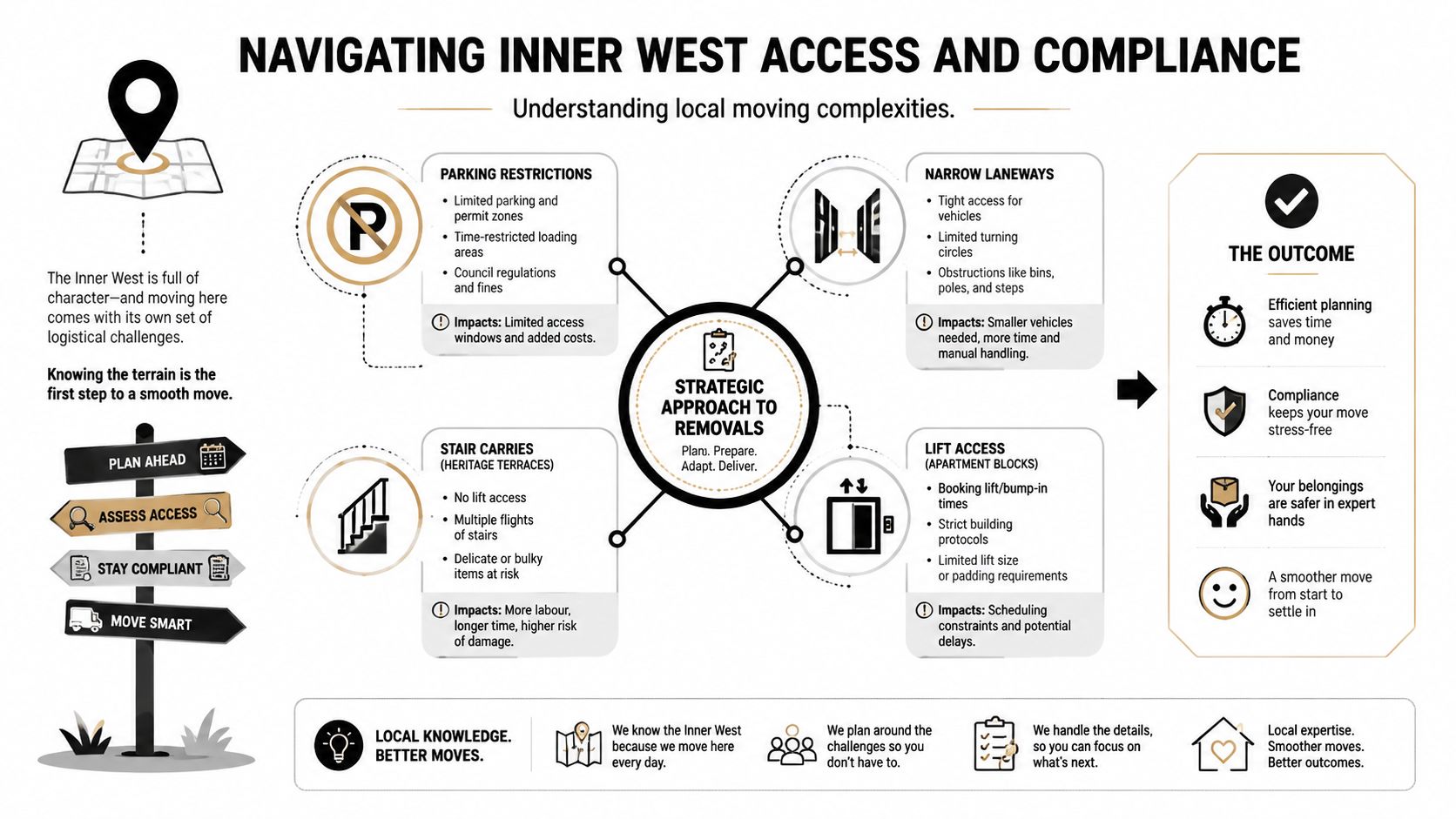
The Inner West is not a suburb where you can assume the truck will find space and everything will work out. Streets are tight, heritage terraces create awkward stair carries, and apartment blocks often depend on precise lift timing. That's why access planning belongs at the centre of the booking, not as an afterthought.
Parking and loading space
Parking is the biggest silent cost on many Sydney moves. An AFRA survey cited in local Inner West guidance found 28% of Sydney moves were delayed by parking issues, with average fines of $250. Parking and access guide That's not a minor inconvenience, it's a direct hit to time and budget.
The fix is simple. Pre-book what can be pre-booked, confirm where the truck is allowed to stop, and tell the removalist exactly how far the carry will be. If the building manager or council has specific loading rules, deal with them before the crew arrives. Waiting until move day is how time gets burned and quotes blow out.
Terraces, laneways, and lift access
Heritage terraces need different handling from modern apartments. Terraces often mean tight internal stairs and narrow front entries, which is why carry paths need to be measured mentally before the first item moves. Apartments add another layer, because lift bookings, loading bays, and building keys can become the bottleneck if nobody has checked them.
A sensible compliance checklist should include:
- Building rules: confirm move times, lift use, and padding requirements.
- Parking permissions: know where the truck can legally load.
- Carry route: check for stairs, turns, and gate widths.
- Access keys or fobs: collect them before moving day.
- Waste staging: keep clear-outs separate from the main load.
The Inner West Council's online services and planning environment also matter because the area is actively managed under heritage and local-area constraints. Inner West Council online services You don't need to become a council expert, but you do need to ask the right questions about what can be placed where, for how long, and under which rules.
Practical rule: if access is uncertain, assume the job will take longer than the listing says and book accordingly.
The best Inner West moves are the ones where the access plan is boring. No one remembers a boring move, and that's the point.
Frequently Asked Questions
What's the best time to move a small apartment in the Inner West
Early in the day is usually the cleanest option because parking, lifts, and building traffic are easier to manage. For a small apartment, the timing issue is less about distance and more about how many people share the same access points. If the lift is booked and the truck has a legal spot, the move becomes far more predictable.
Are short-distance Inner West moves cheaper
They should be, but only if access is easy and the crew doesn't lose time on parking or stairs. A short move within the Inner West can still run long if the loading zone is poor or the apartment entry is awkward. The right quote reflects access, not just kilometres.
Do weekend moves cost more
They often do in practice because demand is tighter and the schedule is less forgiving. If you need a weekend move, book early and make sure the quote clearly explains what's included. Don't assume the cheapest weekend price is the lowest final cost.
How should I handle high-value artwork or fragile items
Separate them from the general load and tell the mover before the booking is locked in. Fragile items deserve custom packing, careful loading, and a delivery sequence that puts them out of harm's way first. If the company can't talk clearly about that process, use someone else.
What if access isn't confirmed until moving day
Don't wait for moving day to discover a problem. If the building manager hasn't confirmed lift access or parking, you need to escalate that immediately and have a backup plan ready. A good mover will help you adjust the sequence, but they can't invent legal parking or lift access on the spot.
Should I ask for a site inspection
Yes, if the move is large, the access is awkward, or the furniture list is full of bulky pieces. An onsite view removes guesswork and reduces quote disputes later. For Inner West homes, that's often the difference between an accurate booking and a messy one.
If you want an Inner West move handled with proper planning, clear communication, and the right equipment for tight access, contact Get n Go Removals Melbourne and ask for a quote that reflects your building, your parking, and your timeline. They handle residential and commercial moves, packing, storage, and specialist items, so you can book a service that fits your move instead of forcing your move to fit the service.