
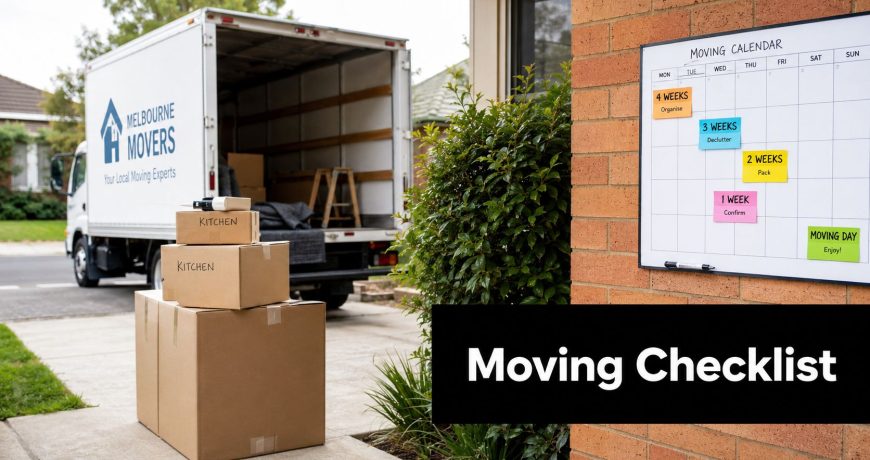
Interstate Moving Checklist: Your 2026 Guide
Moving Interstate? Your Timeline-Based Plan Starts Now
Relocating from Melbourne to Sydney, Brisbane, or Canberra can feel like a pile of separate jobs that all need to happen at once. One day you're deciding what to keep, the next you're chasing lift bookings, utility dates, and box labels while trying not to lose track of the essentials. A good interstate moving checklist turns that pressure into a sequence you can manage, especially when the first 90 days after arrival matter for licence and registration changes in Australia, as noted in interstate-moving guidance from Allied's checklist timeline for ACT, NSW, and Queensland residents (Allied Australia moving checklist timeline).
The strongest moves start early, not on moving day. Australian moving guidance consistently points to an 8-week planning window, and practical interstate checklists also build around a 6 to 8 week lead time so the high-risk tasks land first, including quotes, access checks, utility coordination, and packing preparation (InstaMove interstate moving checklist, RelocationsWA moving interstate checklist). That timing matters because a Melbourne-to-East Coast move usually involves a tighter handover, more admin, and fewer chances to fix mistakes after the truck leaves.
If you're moving house or office, the fastest way to stay in control is to work from a timeline, not a vague to-do list. Get the big decisions made first, then lock in the items that create delay risk, then finish with the details that protect your deposit, your insurance, and your sanity.
1. Assess Your Inventory and Create a Detailed Moving List
The first task is blunt but necessary, know exactly what's going. A proper inventory saves time later because it tells you what needs packing, what needs special handling, and what shouldn't be carried interstate at all. It also gives your removalist a realistic view of volume, access, and protective equipment needs.

Build the list room by room
Start with one room and work through the property methodically. Write down furniture, electronics, artwork, boxed items, garage goods, and anything awkward to lift, such as a piano, pool table, or oversized sofa. If you're moving from Melbourne to Brisbane, that list might include delicate glassware, a grand piano, and a couple of bulky pieces that need disassembly and reassembly before loading.
Use your phone or a spreadsheet, not loose notes. Add photos, measurements, and condition notes for valuable items so you can compare the original state with what arrives at the destination. That's especially useful for office relocations, where servers, filing systems, monitors, and ergonomic furniture all need to be tracked without slowing down business operations. Share the inventory with your mover early, because it helps them plan the truck, the crew, and the protection materials.
Practical rule: If you can't describe an item clearly, your mover can't plan for it properly.
Separate what stays, what goes, and what needs attention
Create three categories, essentials, valuables, and everyday belongings. Then add a fourth pass for items that should be sold, donated, or stored instead of hauled interstate. That sort of upfront declutter keeps the move lighter and makes unpacking less chaotic at the other end. If you want a practical decluttering guide that fits this stage, use the declutter before you move checklist to trim the load before packing begins.
For larger furniture, record dimensions and note doorways or stairwells at the new property. A Sydney-bound move with a leather sofa and pool table can become a problem fast if the dimensions were never checked. Detailed inventory work doesn't feel exciting, but it's the part that prevents the expensive surprises.
2. Obtain Multiple Quotes from Licensed, Insured Interstate Moving Providers
A quote should tell you more than the price. It should show whether the company understands interstate work, whether the services match your move, and whether the booking can handle access, packing, and storage without surprise extras. Get at least three written quotes from providers that can show licensing and insurance coverage clearly, then compare them line by line.
Compare the service, not just the headline price
An interstate move should be judged on the full scope, not the cheapest figure. Ask what is included, truck type, crew size, labour, disassembly, reassembly, packing, and whether secure storage is available if the dates do not line up. A Melbourne homeowner comparing providers may choose the company that includes moving and storage in one package, because that can reduce handover pressure when settlement dates shift.
Route experience matters for Melbourne-to-East Coast moves. Regular direct runs to Sydney or Brisbane usually mean better scheduling discipline and fewer timing surprises, especially when lift access, settlement timing, and delivery windows all need to align. Ask whether the mover runs your corridor on a direct schedule, and how they handle delays if traffic, weather, or building access changes the plan. For guidance on vetting providers, see our guide on how to choose the best interstate removalists.
The U.S. FMCSA guidance is still useful as a consumer-safety benchmark even if you are moving in Australia, because it shows the sort of checks serious customers should make before booking. Its consumer advice says to get estimates from at least three movers or brokers, confirm interstate registration, and review the booklet Your Rights and Responsibilities When You Move before booking, while also checking complaint history and on-road safety performance records (FMCSA Ready to Move brochure, FMCSA moving company checklist).
Ask the quote questions that prevent disputes
- Truck and crew details: Confirm truck size, number of movers, and estimated time on site.
- Packing scope: Ask whether valet packing, unpacking, and materials are included.
- Access conditions: State lift access, parking restrictions, stairs, and narrow hallways in writing.
- Special handling: Identify artwork, antiques, electronics, or specialty items that need extra care.
- Storage terms: Ask how storage is priced and how retrieval works if dates change.
For insurance wording, keep your records clear and consistent. If you want to compare a separate policy option while you review provider coverage, the term shipping insurance is worth checking in context.
A strong quote should make the move feel organised, not vague. It should also give you enough detail to compare direct-run schedules, valet packing options, and secure storage without relying on verbal promises.
3. Book Moving Services and Confirm All Appointment Details in Writing
Once you've chosen a mover, lock the booking in as early as you can. Interstate jobs during summer months and end-of-quarter periods are often harder to secure, so the best slots usually disappear before the move feels urgent. Written confirmation protects both sides and removes confusion when moving day gets close.
Put the booking on paper, not in memory
Your confirmation should list the moving date, arrival window, services included, final cost, insurance details, and the name of the person managing your booking. Ask for a single point of contact so you're not relaying questions through different staff members every time something changes. That matters even more if you're balancing school calendars, settlement dates, or business handover deadlines.
For a Melbourne family moving to Sydney, booking six weeks ahead can be the difference between getting a preferred weekend slot and settling for a less practical window. For an office relocation, early booking gives the scheduler time to coordinate lift access, parking, and after-hours timing so staff disruption stays low. When a mover already runs the route regularly, early confirmation can also improve availability.
Get every material commitment in writing, including access instructions, delivery window, and any packing or storage add-ons.
Use a timeline that fits the reality of interstate work
A 4 to 8 week booking window is a solid practical benchmark for most interstate moves, and it gives you enough room to confirm the details without rushing. Ask the company to email the confirmation so you have a record you can forward to landlords, building managers, or internal office stakeholders. If the company has a contingency plan for truck replacement, late access, or route changes, get that in writing too.
This is also the moment to clarify any special requests, such as valet packing, furniture disassembly, or a direct-run service between Melbourne and an East Coast city. If the move is complex, a clear appointment note now is far cheaper than a fix later.
4. Arrange Storage Solutions if Timing Between Moves Doesn't Align
Interstate moves rarely line up perfectly. One property may be ready before the other, or settlement dates may shift after you've already committed to the move. Storage becomes the bridge that keeps your belongings safe instead of leaving you to improvise with temporary garages, borrowed rooms, or rushed decisions.
Treat storage as part of the move, not an afterthought
If you know the dates don't align, arrange storage at the same time as your moving quote. That's often the cleanest way to control cost, because the mover can plan the pickup, holding period, and final delivery in one workflow. It also gives you a single inventory trail from Melbourne to the storage facility and then onto the new property.
For family moves, storage is often the difference between a smooth transition and a stressful scramble. A Melbourne family waiting for a new Sydney home to settle might keep furniture in secure storage while the final paperwork clears. Office relocations use the same principle when a renovation or fit-out delays access to the new space. In both cases, the goal is the same, protect the items and keep the timetable from breaking.
Check the conditions before you hand anything over
Make sure the storage terms are in writing. You need to know how long the items will stay in storage, how access works, whether the facility is climate-controlled, what insurance applies, and how retrieval is booked. Electronics, furniture, and household goods all behave better in a controlled facility than in a temporary arrangement that wasn't designed for long-term holding.
If you want a storage option that sits naturally within an interstate move, the short-term storage guide is a sensible reference point for working out what to ask before you book. A good storage plan should reduce pressure, not add another layer of uncertainty.
5. Manage Utilities, Address Changes, and Administrative Transitions
An interstate move can look organised on moving day and still fall apart on the admin side. If your power is still live at the old place, your internet install is delayed, or your mail keeps going to the wrong suburb, the move feels unfinished long after the truck has gone. The physical job gets the attention. The admin keeps the handover functional.
Handle the time-sensitive items first
Start with the services that affect daily living. Contact electricity, gas, water, internet, and phone providers before moving day so disconnections, final meter reads, and reconnections are set around your handover date. Keep your own record as well. Photograph the meters before you leave, then store the images with your paperwork so any bill dispute has a clear starting point.
Address changes need the same early attention. Update Australia Post, banks, insurance providers, employers, subscription services, and government agencies as soon as you have the new details. That includes the ATO, Medicare, and the relevant state authorities. Driver licence and vehicle registration updates also need timing checked against your new state's requirements, because different states handle compliance differently after arrival.
Keep one master list and work it in stages
A moving spreadsheet is the simplest way to keep admin under control. List every organisation, account number, contact name, and completion status in one place, then update it as each task is finished. Set reminders for four weeks, two weeks, and one week before moving day so the work starts before packing and travel take over your attention.
Use the list to separate tasks that can be done online from those that need appointments or proof of address. That distinction matters because some providers will update records quickly, while others need supporting documents or a follow-up call. The Allied Australia moving checklist timeline is a useful reference for spacing these admin jobs across the move, rather than trying to finish them all at once.
- Mail forwarding: Set it up through Australia Post early enough that the first redirected mail is not missed.
- Utility connections: Confirm reconnection times the day before the move so you are not left waiting at the new property.
- Insurance updates: Tell your insurer the new address so your policy details stay accurate.
- Vehicle and licence admin: Leave enough time to update records after arrival, especially if you are crossing state lines.
- Billing clarity: Keep disconnection notices and final meter photos in the same folder so your records are easy to check.
For a practical reminder of how easily utility details build up, you can browse utility bills by Ring Hot Water. It is a simple way to keep the admin side visible while everything else is moving at once.
6. Pack Strategically with Proper Materials and Organization Systems
Packing is not just about getting things into boxes. For an interstate move, it's about protecting items through longer transit, making the truck easier to load, and setting up a faster unpack at the destination. Good packing also reduces damage claims because items are separated, labelled, and cushioned properly from the start.

Use the right materials and the right box sizes
Sturdy boxes, tape, bubble wrap, foam padding, and protective blankets are basic gear, not extras. Heavy items belong in smaller boxes, lighter items in larger ones, because oversized heavy boxes are harder to lift and more likely to split. Fragile pieces should be wrapped individually before they go into a box, and any empty space should be filled so things don't move around during transit.
Colour coding works well because it removes confusion when boxes land in the new property. A Melbourne family moving to Brisbane might use blue for kitchen, red for bedroom, and green for living room, then match each box to a numbered inventory list. That gives the crew a simple visual system and gives you a faster unpack later.
Use valet packing when the move needs more protection
Professional valet packing is worth considering for delicate or high-value loads. It's especially useful when you're dealing with glassware, artwork, electronics, or a mix of household and office items that need to arrive intact and in order. A good packing team also knows how to place furniture and boxes in the truck so the weight distribution makes sense.
Packing rule: Pack essentials last, but keep them separate and clearly marked so they don't disappear into the truck load.
For extra packing guidance, the packing tips for moving house resource fits well here because it reinforces the habits that prevent damage and confusion. If you want a practical visual reminder for storing accessories after the move, store spare mattress protectors correctly is a useful reminder that not everything needs to be handled the same way. Packing well is less about speed and more about control.
7. Confirm Access Arrangements at Both Properties Including Lift Bookings
A lot of interstate delays happen at the building entrance, not on the highway. Lift bookings, loading bays, parking permits, and strata rules can all stop the job if they aren't confirmed early. If you're moving into an apartment or a commercial building, access is a major part of the checklist.
Lock in the building details before moving day
Contact both property managers or strata teams well before the move and get the access arrangements in writing. Share the moving date, the time window, truck size, and any restrictions on hours, parking, or lift use. If the building has a lift booking system or a loading zone permit, make sure it's reserved and documented.
A Melbourne apartment resident moving to a Brisbane high-rise might need lift bookings at both ends, plus parking confirmation in a limited-access building. A Victorian office relocation may also require after-hours access so staff can finish setup without disrupting the work week. These details are easy to ignore when you're focused on packing, but they're the difference between a smooth load and a long, expensive wait.
Give the mover the exact access picture
Tell your moving coordinator about stairs, lift capacity, narrow hallways, concierge hours, and any protection requirements for walls or floors. If a deposit is needed for lift use or a permit is needed for the street, include that in your preparation notes. The goal is to remove guesswork before the truck arrives, not while the crew is standing outside with furniture in their hands.
- Write down the contact person: Have the building manager's phone number ready on moving day.
- Confirm parking early: Don't assume the loading zone will still be available.
- Check access hours: Some buildings won't allow moves outside specific windows.
- Ask about lift protection: Know who is responsible for coverings and supervision.
- Keep approval documents handy: You may need them if security asks at the door.
If a building blocks access after the truck is booked, the schedule can unravel quickly. That's why this step is one of the most important parts of any interstate moving checklist.
8. Prepare Essential Items Box and Plan Your First Night at the New Property
A good first night depends on the box you keep with you, not the boxes on the truck. Your essentials box should travel in the car or with the person who's arriving first, because it gives you immediate access to the things that make the new place usable. This is one of the simplest ways to reduce stress after a long travel day.

Pack for the first 24 hours, not the whole week
Your essentials box should hold toiletries, medications, phone chargers, important documents, bed linens, a basic change of clothes, and some kitchen basics. If you're moving with children or working from the new property quickly, add medication prescriptions, small snacks, and any immediate-use electronics. Keep this box separate, clearly marked, and out of the moving truck.
A Melbourne family relocating to Sydney might have bedding, chargers, and toiletries in the essentials box so they can sleep comfortably even if the main truck arrives later. An office move can use the same idea by packing a priority box with laptops, chargers, and basic phone system equipment to get staff operational the next morning. The logic is simple, if the essentials are with you, the delay feels manageable.
Make the first night simple on purpose
Check that electricity, water, and internet are connected or scheduled for activation. Know where the main switch and water shut-off are before the movers leave, because those are the questions that surface when something stops working. Keep cleaning supplies, toilet paper, and paper towels easy to reach so you can handle minor messes without unpacking half the house.
Keep the essentials box with you, not on the truck, and treat it like carry-on luggage for the move.
For a broader practical reference, the moving into a new house checklist sits neatly beside this step because the first night is where organisation either pays off or falls apart. Plan the evening, and the whole move feels less overwhelming.
9. Conduct a Final Walkthrough and Document Property Condition at Both Locations
Final walkthroughs protect you from arguments later. They also make sure nothing has been left behind, no damage is missed, and the property handover is properly documented. That matters at both ends of an interstate move, especially when different landlords, agents, or building managers are involved.
Document the old property before you hand it over
Check every room, cupboard, laundry, storage area, and garage space. Photograph the condition of walls, corners, floors, appliances, and anything that may be questioned later in a bond discussion. Confirm that the property is clean, note that utilities have been disconnected, and make sure nothing has been left behind.
If you're a renter, this is also the point where written evidence matters most. Take timestamped photos and a short video so you can show the condition exactly as it was when you left. If the landlord or property manager is available, ask them to sign off on the condition notes. That small step can save a lot of back-and-forth later.
Check the new property before furniture goes in
Before the first box is placed, photograph the new place as it stands. You want a baseline record of existing damage, appliance condition, and room layout before your belongings cover anything up. Then confirm that utilities are working, doors and windows lock properly, and that the mover has delivered items to the right rooms.
An office relocation benefits from the same discipline. Staff can verify that IT systems are connected, furniture is in the correct areas, and the building is ready for use before the workday begins. That reduces disputes and helps the site settle faster.
- Use photos and video: Capture both detail and overall room condition.
- Write down meter readings: Keep final and opening readings together.
- Note pre-existing damage: Be specific about dents, marks, and appliance faults.
- Check locks and safety: Confirm doors, windows, and alarms work as expected.
- Match the delivery list: Make sure the mover placed items in the right rooms.
This is the stage that proves the move was completed properly. If there's a dispute later, you'll be glad you documented it.
10. Unpack Strategically and Reassemble Furniture for Full Property Setup
Unpacking should be sequenced, not rushed. The fastest way to make a new property feel functional is to start with the rooms you need every day, then work outward into storage and secondary spaces. If furniture was disassembled for the move, get reassembly underway early so you're not living around dismantled pieces and unopened cartons.
Prioritise the rooms that support daily life
Start with the bedroom, bathroom, and kitchen. Those three areas control sleep, hygiene, and meals, which is why they should be functional before the decorative or low-use rooms. After that, move into the living area, storage spaces, and anything that can safely wait a few days.
A Melbourne family moving to Sydney may choose to unpack for three weeks rather than trying to finish everything in one weekend. That approach makes it easier to spot damaged goods, organise room by room, and reassemble furniture in the right order. Office relocations benefit from the same method because desks, cubicles, and conference tables need proper setup before staff can settle into their work rhythm.
Use the unpacking process to catch problems early
Check visible damage before you fully unpack fragile items or assemble furniture. If something is broken, contact the moving company straight away and keep the photos with your inventory notes. Don't bury the evidence under half a house of boxes and forget where the damage was first noticed.
Professional disassembly and reassembly services are useful here because they keep furniture safe and make it usable again faster. A coordinated team can handle the bed frames, tables, and larger items while you focus on the essentials. That keeps the new home from becoming a storage shed for parts.
Spread unpacking over weeks, not hours, and finish one room before opening the next.
Keep empty boxes stacked in one area so disposal is easier later. The move is not really finished when the truck leaves, it's finished when the house works again. That's the standard worth aiming for.
10-Item Interstate Moving Checklist Comparison
| Task | Implementation Complexity 🔄 | Resource Requirements ⚡ | Expected Outcomes 📊 | Ideal Use Cases | Key Advantages ⭐ | Quick Tip 💡 |
|---|---|---|---|---|---|---|
| Assess Your Inventory and Create a Detailed Moving List | Medium, systematic, time‑intensive 🔄 | Time, smartphone/apps, tape measure, photos ⚡ | Accurate quotes; fewer surprises; insurance-ready 📊 | Large households, specialty items, office moves | Improves cost accuracy and planning ⭐ | Use apps + photos; share list with movers 💡 |
| Obtain Multiple Quotes from Licensed, Insured Interstate Moving Providers | Medium, requires outreach and verification 🔄 | Time, internet, documentation of items; phone/email ⚡ | Competitive pricing; verified insurance and services 📊 | Any interstate move where cost/insurance matter | Protects belongings and reduces disputes ⭐ | Request itemized written quotes and insurer details 💡 |
| Book Moving Services and Confirm All Appointment Details in Writing | Low–Medium, clerical but time‑sensitive 🔄 | Deposit funds, email confirmations, contact info ⚡ | Secured date; single point of contact; contractual clarity 📊 | Peak‑season interstate moves; time‑sensitive schedules | Locks availability and clarifies responsibilities ⭐ | Book 4–8 weeks ahead in peak times; get email confirmation 💡 |
| Arrange Storage Solutions if Timing Between Moves Doesn't Align | Low–Medium, straightforward but adds coordination 🔄 | Storage fees, insurance, inventory list, transport logistics ⚡ | Safe interim storage; flexible retrieval; protection from weather/theft 📊 | Gap between move-out and move‑in; renovation periods | Prevents rushed placement and protects items ⭐ | Include storage in move quote for better rates; confirm climate control 💡 |
| Manage Utilities, Address Changes, and Administrative Transitions | Medium, multi‑party coordination with deadlines 🔄 | Time, account details, forms; Australia Post, utilities, banks ⚡ | Continuous services; correct mail forwarding; fewer billing issues 📊 | All interstate relocations needing account continuity | Prevents service disruption and billing errors ⭐ | Use a master spreadsheet and set calendar reminders ≥2 weeks out 💡 |
| Pack Strategically with Proper Materials and Organization Systems | Medium, labour‑intensive; methodical process 🔄 | Packing materials, labels, time or professional packers ⚡ | Reduced damage; faster unpacking; optimized truck space 📊 | Fragile items, long-distance moves, decluttered moves | Protects goods and simplifies unpacking ⭐ | Color-code + number boxes; keep master inventory 💡 |
| Confirm Access Arrangements at Both Properties Including Lift Bookings | Low–Medium, requires early coordination with management 🔄 | Communication with strata/managers, possible deposit/permits ⚡ | Smooth loading/unloading; avoids delays and fines 📊 | High‑rise apartments, restricted access buildings | Prevents costly schedule disruptions on moving day ⭐ | Book lifts 4–6 weeks ahead and get written confirmation 💡 |
| Prepare Essential Items Box and Plan Your First Night at the New Property | Low, simple but essential preparation 🔄 | A single box/bag with chargers, meds, documents, linens ⚡ | Immediate functionality on arrival; reduced stress 📊 | All moves, especially long interstate trips and families | Ensures comfort and basic needs without unpacking ⭐ | Keep this box with you, label clearly, pack last 💡 |
| Conduct a Final Walkthrough and Document Property Condition at Both Locations | Medium, detailed and evidence‑based process 🔄 | Camera/video, timestamps, written notes; possible witness/signature ⚡ | Bond protection; evidence for claims; utility verification 📊 | Rentals, leased commercial spaces, bond returns | Protects deposit and documents pre‑existing damage ⭐ | Take timestamped photos/video and get landlord sign‑off if possible 💡 |
| Unpack Strategically and Reassemble Furniture for Full Property Setup | Medium, phased effort over 2–4 weeks 🔄 | Time, tools, possible reassembly service, storage for boxes ⚡ | Functional home progressively; documented damage for claims 📊 | New homes, large moves, when furniture was disassembled | Systematic setup reduces clutter and stress ⭐ | Unpack room‑by‑room; schedule reassembly early; save empties for disposal 💡 |
Settle In Smoothly with Your Melbourne to East Coast Move
You've made it. With a structured interstate moving checklist, the move from Melbourne to an East Coast home stops feeling like a dozen separate problems and starts looking like a clear sequence of decisions. The inventory comes first, then the quotes, then the booking, storage if you need it, admin, packing, access confirmation, essentials, walkthroughs, and unpacking in the right order.
The first 90 days matter for state-specific obligations, so keep your records close and your admin list handy even after the truck is unloaded. The practical advantage of working this way is simple, you don't rely on memory when the move gets busy. You rely on the plan.
If you're moving a house, apartment, office, or specialty item, the right mover should make the process easier, not more confusing. Get n Go Removals Melbourne works across residential, commercial, packing, storage, and interstate jobs, so it fits naturally into a move where timing, access, and careful handling all matter. The useful part is having one team manage the moving day details while you focus on settling into the new place.
Keep this guide for your next relocation or pass it on to someone who's preparing for their own move. When you're ready to turn the checklist into a booked job, contact a mover that understands Melbourne-to-East Coast timelines and the admin that comes with them.
If you want a move that's planned around timing, access, packing, storage, and interstate delivery, Get n Go Removals Melbourne can help you organise it properly. Their team handles house moves, office relocations, valet packing, disassembly, reassembly, and secure storage, which makes them a practical fit for this kind of checklist-driven move.