Moving Your Home: A Comprehensive Guide to the Cost of Moving House and How to Save
Trying to nail down the cost of moving house can feel a bit like catching smoke. Prices seem all over the place, but there’s a method to the madness. On average, you can expect the moving houses cost in Australia to be anywhere from $300 for a small local apartment move to over $6,000 for a bigger interstate relocation.
The final number on your invoice really boils down to a few key things: the size of your home, how far you're going, and any extra services you need. This guide is designed to provide you with all the customer information you need to confidently budget for your move, whether it's for your house or office.
Demystifying Your Moving Quote
Getting your head around a moving quote is the first step to creating a realistic budget and avoiding any nasty surprises on moving day. The good news is that the pricing structure is quite logical once you break it down.
For local moves—those just across town or to a nearby suburb—pricing is almost always by the hour. That hourly rate covers the professional movers, the truck, and the time it takes to get from your old place to the new one.
For interstate moves, however, the game changes. The cost is calculated based on the total volume of your belongings (measured in cubic metres) and the distance between your two homes.
A Snapshot Of Average Moving Costs
Let's look at some real-world numbers to give you a clearer picture. Data from across the industry shows that local removalist hourly rates typically land between A$35 and A$50 per mover. To see how this adds up for a full job, you can find detailed breakdowns of moving company costs.
This chart provides a great visual representation of what you might expect to pay for a local move based on your home's size, making it easier to read and understand.
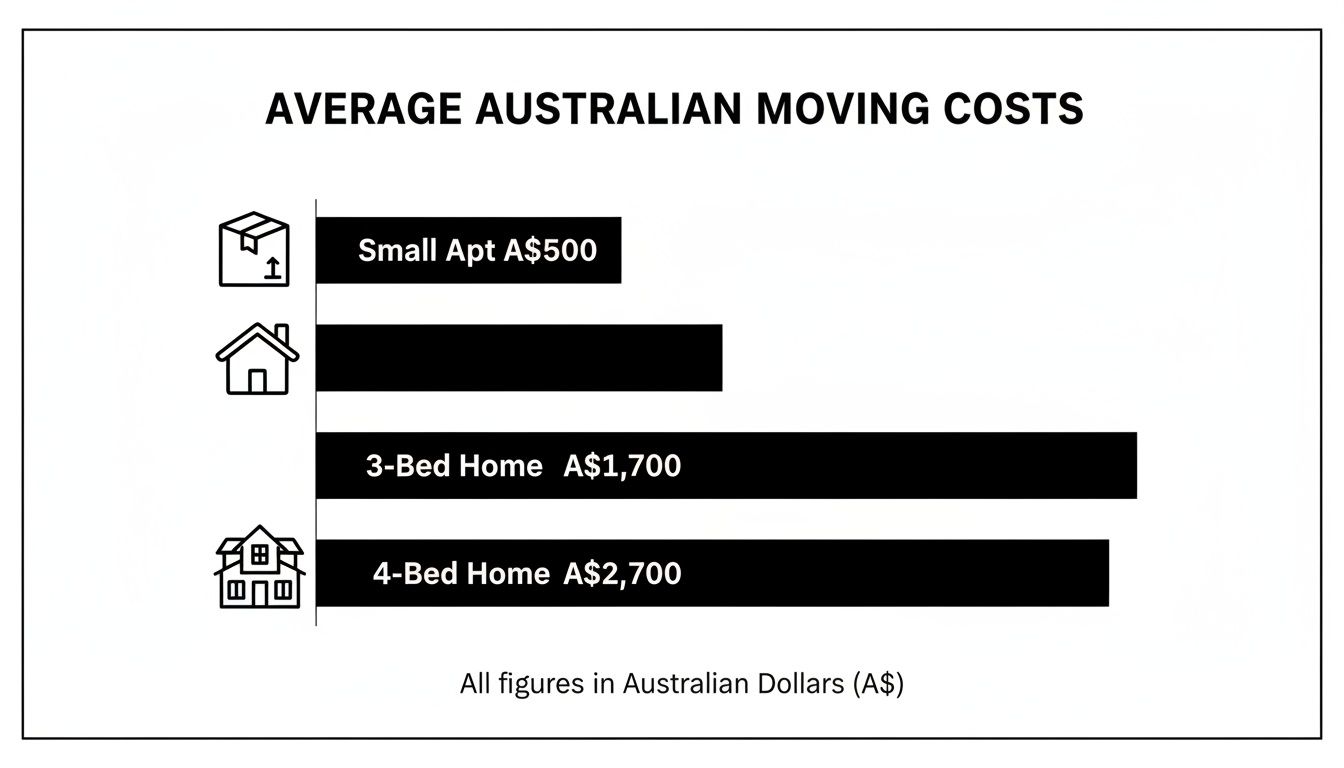
As you can see, the bigger the home, the more time and crew members are needed, which is directly reflected in the final cost.
To put it into perspective, here’s a quick table outlining what you might expect for a local move.
Estimated Local Moving Costs By Home Size
| Home Size | Typical Crew Size | Estimated Hourly Rate (AUD) | Estimated Total Cost (AUD) |
|---|---|---|---|
| Studio/1-Bedroom Apt | 2 Movers | $120 – $150 | $360 – $750 |
| 2-Bedroom Home | 2-3 Movers | $150 – $180 | $750 – $1,440 |
| 3-Bedroom Home | 3 Movers | $180 – $210 | $1,260 – $2,100 |
| 4-Bedroom Home | 4 Movers | $220 – $260 | $1,760 – $2,860+ |
| 5+ Bedroom Home | 4-5 Movers | $260 – $300+ | $2,340 – $3,900+ |
These figures are a solid starting point, but remember they can shift based on things like property access (stairs, lifts) and travel time.
Recent analysis backs this up, showing a standard three-bedroom house move often takes six to eight hours. For a local job, that puts the total cost somewhere between A$1,470 and A$1,960. Knowing these benchmarks is the best way to start planning your move without breaking the bank.
The Key Factors That Shape Your Moving Quote
Ever wondered why two moving quotes for what seems like a similar job can be wildly different? The final moving houses cost isn't a number plucked from thin air; it’s a careful calculation based on a handful of key variables. Understanding these factors is the best way to interpret any quote like a pro and see exactly where your money is going.
Think of it this way: the more work, time, and resources your move demands, the higher the price tag will be. Every detail adds up, from the sheer volume of your possessions to how tricky your old and new properties are to access.
When you break it down, you can see how your specific situation translates into the final estimate. This knowledge is invaluable, helping you make smart decisions and even spot ways to trim your budget.
Volume and Size of Your Move
The single biggest factor that drives up the cost is, quite simply, how much stuff you have. For removalists, the world is measured in cubic metres (m³). A small one-bedroom apartment might only take up 10-15 m³ of truck space, but a four-bedroom family home can easily push past 40 m³.
More items mean you'll need a bigger truck, and it’s going to take the crew longer to load and unload everything. This has a direct impact on both the hourly rate for local jobs and the volume-based pricing you see for interstate relocations.
Distance and Travel Time
This one’s a no-brainer: how far you’re going plays a massive role. A quick hop across the suburb will always be more affordable than relocating to an entirely new city.
For local moves, the clock is always ticking. The bill includes the time it takes to get from the depot to your old house, then to your new one, and finally back to base. Unexpected peak-hour traffic can add more time—and cost—than you'd think. On long-distance moves, the kilometres travelled become a primary multiplier in the final invoice.
Access and Difficulty
So, how easy is it to actually get your furniture from the house to the truck? This is a critical question that can seriously affect your quote.
Navigating multiple flights of stairs, dealing with a long driveway where the truck can’t park close, or manoeuvring through tight corridors all add considerable time and labour to the job. These access challenges are often overlooked but can quickly inflate your moving costs.
Movers have to factor in the extra effort and time needed to work around these logistical hurdles safely. A tricky access point means a longer, more challenging day for the crew.
Additional Services Required
A standard move is pretty straightforward: load, transport, unload. But plenty of people need a bit of extra help, and these services will show up on the final bill. When you're budgeting, think about whether you'll need professional furniture assembly and disassembly services, as this can definitely change the final number.
Other common add-ons include:
- Professional Packing: Getting the team to pack your boxes is a huge time-saver, but it's a premium service.
- Packing Materials: The cost of boxes, tape, and bubble wrap if you get them from the moving company.
- Specialty Items: Moving things like pianos, pool tables, or fragile antiques requires special gear and expertise.
Each of these services adds real value, but they also contribute to the total price. It’s worth deciding which jobs you can tackle yourself and where professional help is a smart investment. Being upfront about what you need from the get-go is the key to an accurate quote, and of course, choosing the right removals firm for your move is a huge part of the puzzle.
Navigating Interstate Moving Costs

Moving across state lines is a whole different ball game compared to shifting a few suburbs over. When it comes to the moving houses cost for an interstate move, removalists ditch the hourly rates. Instead, your quote is built on two key pillars: the total volume of your belongings (measured in cubic metres) and the sheer distance they need to travel.
This makes perfect sense when you think about it. A move from Sydney to Melbourne is a fundamentally different logistical operation than Perth to Brisbane, with huge variations in fuel, time, and labour. Your budget needs to be ready for these much bigger variables right from the start.
Dedicated Trucks vs Backloading
When you start getting quotes for an interstate move, you'll generally come across two main options, and they sit at very different price points. Understanding the difference is key to managing your budget effectively.
- Dedicated Truck: Think of this as the premium, express service. You hire the entire truck just for your belongings. It gives you total flexibility on dates and guarantees the fastest possible delivery because the truck goes straight from your old place to your new one, no detours.
- Backloading: This is the smart, budget-friendly choice. Backloading means your items share truck space with another customer's things, or they fill up an empty truck on its return journey. It’s a fantastic way to save a significant amount of money, but you need to be more flexible with your pickup and delivery dates.
Ultimately, the choice comes down to a trade-off between cost and convenience.
A dedicated truck gives you speed and certainty, which is perfect if you’re on a tight schedule. Backloading, on the other hand, is a savvy financial decision that can slash your costs if your timeline has some wiggle room.
Understanding Interstate Price Ranges
The financial jump from a local move to an interstate one is pretty significant. A local job might stay under $2,000, but relocating a standard three-bedroom house (around 25–35 m³) across state lines typically lands somewhere between A$3,600 and A$6,200 for a full-service move.
The good news? Opting for a backloading service can often cut that figure by up to 50%. You can get more details on these cost-saving strategies in our guide to finding the best interstate removalists in Australia.
Industry-wide, the numbers show that per-cubic-metre rates for standard moves kick off around A$145/m³. With backloading, that can drop to closer to A$95/m³. These figures really drive home why a detailed, volume-based quote is non-negotiable for an accurate interstate budget.
How Moving Costs Vary Across Australian Cities
It’s a surprising fact, but the city you’re moving to has a huge say in your final moving houses cost. Just like a flat white costs more in one capital than another, the price of relocation changes from state to state. Understanding these regional quirks is vital, especially if you're planning an interstate move and trying to nail down a realistic budget.
So, what causes these price gaps? It boils down to local economic factors. The cost of running a removalist business—things like wages, fuel prices, and depot storage—can be wildly different between cities. Local demand for movers also plays a big part. Cities with lots of people moving in often have more competitive, and sometimes higher, pricing.
City to City Cost Comparisons
Recent data really shines a light on the stark differences in what people are paying to move into Australia’s major hubs. While a typical long-distance interstate move might fall somewhere in the A$6,000 to A$12,000 range, your specific destination can easily push that quote to one end of the scale or the other.
For example, figures from 2025 show Perth is currently the priciest capital city to relocate to, with an average inbound cost of around A$11,968. That's a fair bit higher than other major cities like Adelaide (A$8,956), Canberra (A$7,649), and Melbourne (A$7,017). These numbers prove just how much your destination can sway the final bill, and it’s worth exploring these moving price trends to understand the impact on your household budget.
Think of your destination as more than just a spot on the map—it’s a major line item in your moving budget. Getting your head around these city-specific costs means you can plan your finances with far more accuracy.
Why Your Destination Matters
Knowing about these regional price differences gives you a real advantage when you’re budgeting. If you’re tossing up between a couple of different cities, having a clear idea of the potential moving costs for each can help you make a much smarter decision.
To make this easier, we’ve put together a table that gives you a quick, at-a-glance comparison of average costs for major cities.
Average Inbound Moving Costs By Major Australian City
This table breaks down the average cost of moving into Australia's capital cities, highlighting the significant price variations you can expect depending on where you're headed.
| Destination City | Average Moving Cost (AUD) |
|---|---|
| Perth | A$11,968 |
| Adelaide | A$8,956 |
| Canberra | A$7,649 |
| Brisbane | A$7,341 |
| Melbourne | A$7,017 |
Having this data is essential for setting realistic financial expectations and helps you dodge any nasty surprises as moving day gets closer.
Actionable Tips to Lower Your Moving Houses Cost
Knowing what goes into your moving quote is the first step, but the real power comes from actively finding ways to shrink that final moving houses cost. With a bit of forward planning and some smart moves, you can seriously trim the bill without making the whole process a chaotic mess.
Think of it like this: the more organised you are before moving day, the smoother and cheaper the actual move will be. Being proactive puts you back in control of the budget and helps you sidestep those sneaky extra expenses.
Declutter Before You Pack a Single Box
Honestly, one of the most effective ways to lower your moving bill is to simply have less stuff to move. Before you even think about calling for quotes, it's time for a proper clear-out of your whole home. Get into every room, every cupboard, and that forgotten corner of the garage, and be ruthless.
Why is this such a game-changer? Because every single item you get rid of is one less thing the movers have to pack, lift, carry, and load onto the truck. This directly shrinks the total volume (measured in cubic metres) of your belongings, which is a massive factor in what you pay, especially for interstate jobs. For local moves, it can slash the number of hours you're billed for.
Here's a solid rule to live by: if you haven't touched it in a year and it doesn’t hold any real sentimental value, it’s time for it to go. Sell what you can, donate the rest, and you'll lighten both your load and your final invoice.
Master the Art of Smart Packing
While getting the pros to pack for you is a fantastic time-saver, doing it yourself is a surefire way to cut costs. Taking the DIY route gives you total control over the packing process and how much you spend on materials.
- Source Free Materials: Don't rush out and buy brand-new boxes. Start collecting them a few weeks in advance. Supermarkets, local community pages online, and bottle shops are usually more than happy to give away sturdy boxes they're just going to throw out.
- Use What You Already Have: Get creative! Your towels, blankets, and even clothes make perfect padding for fragile items, saving you a fortune on bubble wrap. Big suitcases and laundry baskets are also great for moving bulky, non-breakable stuff.
By tackling the packing yourself, you completely remove a major labour cost from the equation. For even more ideas, check out our full list of tips to keep your moving costs down.
Be Strategic with Your Scheduling
When you book your removalist really matters. Demand for movers goes through the roof on weekends, around the start and end of the month, and during school holidays. Naturally, when demand is high, prices follow.
If you can, try to book your move for the middle of the week and the middle of the month. You’ll often find that a Tuesday or Wednesday move is significantly cheaper than a Saturday. For interstate moves, having some flexibility with your dates can also open the door to backloading deals, where you share truck space and split the cost. A little bit of wiggle room in your calendar can lead to some pretty big savings.
Uncovering the Hidden Costs of Moving
To budget for a move successfully, you need to look beyond just the cost of the truck and the crew. The final moving houses cost often has a few extra expenses that can really catch you by surprise if you're not ready for them.
These aren't shady fees slipped in at the last minute. They're genuine costs for extra services or tricky situations that fall outside of a standard, straightforward job. Knowing what these potential charges are ahead of time lets you build a much more realistic budget and helps you avoid that last-minute financial panic.
Beyond the Basics: What Else to Budget For
One of the most important—and most often overlooked—costs is moving insurance. While any reputable removalist will have basic transit cover, this usually only protects your things against a major disaster like a fire or a traffic accident while on the road. For real peace of mind, you’ll want to look at comprehensive protection.
Comprehensive insurance covers accidental damage that can happen during the packing, loading, or unloading process. It's the difference between being covered for a catastrophe and being covered for a dropped box of fragile glassware.
Another classic "hidden" cost is temporary storage. If there’s a gap between your move-out and move-in dates, you’ll need a secure spot to keep all your belongings. Naturally, that comes with its own rental fee.
Other costs can pop up on your final bill, too. Keep an eye out for things like:
- Special Handling Fees: Pianos, massive artworks, or pool tables aren't your average bit of furniture. They need special equipment and know-how to move safely, which comes at an extra cost.
- Difficult Access Surcharges: If the movers have to navigate multiple flights of stairs, deal with a long walk from the truck to your front door, or coordinate a tricky lift booking, expect a surcharge for that extra time and effort.
- Cleaning Costs: This one hits renters hard. Beyond the move itself, you need to factor in the full end of lease clean cost to make sure you get your bond back.
When you plan for these possibilities, they stop being unexpected shocks and become calculated parts of your budget. For a deeper dive into what to watch out for, check out our guide on the most common hidden costs in moving house. It'll help you create a budget with no nasty surprises.
Your Moving Cost Questions Answered
Working out the budget for your move can bring up a lot of questions. To help you plan with a bit more confidence, we've put together some clear, straight-to-the-point answers to the questions we hear the most.
Is It Cheaper to Move on a Weekday?
Yes, absolutely. You'll almost always save money by moving on a weekday, especially between Tuesday and Thursday. Weekends and the days around the end of the month are peak times for removalists, so demand is high and so are the prices.
Booking your move for the middle of the week in the middle of the month can often land you a better hourly rate and give you more choice with scheduling. It's a simple switch that can directly lower your overall moving houses cost.
How Is the Volume of My Belongings Calculated?
Professional removalists work out the space your items will take up in cubic metres (m³). There are a couple of ways they do this: either by visiting your home for a physical assessment or by using a detailed inventory list you’ve put together.
An experienced assessor can often size up the volume just by looking, but online calculators can also give you a pretty good estimate by using the standard dimensions of common furniture items.
If there’s one thing to get right for an accurate quote, it’s your inventory. The more detailed and honest you are about what needs to be moved, the more reliable your estimate will be, saving you from nasty surprises on the big day.
What Does Moving Insurance Typically Cover?
This is something you really need to check directly with your chosen removalist, as policies can vary quite a bit. Most reputable companies will include basic transit insurance as part of their service. This usually covers your goods against major events like a fire or a traffic accident while they're on the truck.
What this basic cover often doesn't include is accidental damage that might happen while your things are being packed, carried, or handled. For complete peace of mind, it’s worth looking into comprehensive moving insurance. Your removalist can often help you arrange it, or you can go through a third-party provider. Always take the time to read the policy so you know exactly what is and isn’t covered.
How Does Backloading Actually Save Me Money?
Backloading is a seriously smart way to cut costs on interstate moves. The whole idea is that your belongings share truck space with other jobs on a truck that's already heading in your direction.
Instead of paying to hire the entire truck for yourself, you only pay for the portion of space your items use up. This simple change can result in savings of up to 50% compared to a standard, dedicated booking. It might require you to be a bit flexible with your moving dates, but it’s hands-down one of the best ways to bring down the cost of a long-distance move.
Ready to get a clear, transparent quote for your move? The team at Get n Go Removals Melbourne offers reliable, professional moving services with no hidden fees. Plan your seamless relocation by visiting us at https://www.getngoremovals.com.au.