Storage Rates Melbourne: An Expert Guide to 2024 Pricing
When you start exploring storage rates in Melbourne, the costs can vary significantly, typically ranging from $90 to over $500 per month. This wide spectrum is primarily determined by the size of the unit you need and any specialised features it includes.
To put it into perspective, a compact locker ideal for a few boxes might cost you less than $100 monthly. However, if your goal is to store the entire contents of a three-bedroom family home, you should budget for something closer to $450 or more. Understanding these figures is the first step toward finding the perfect balance between cost and convenience.
Understanding Typical Storage Rates in Melbourne
Decoding storage prices in Melbourne requires a clear understanding of what you’re paying for. While unit size is the most significant cost driver, factors such as location and premium features like climate control also play a crucial role in shaping the final monthly fee.
Whether you're moving house and need temporary storage for furniture, or you're a business owner managing inventory, grasping the typical price brackets is essential for securing a solution that fits your budget and operational needs.
The Melbourne self-storage market is experiencing high demand, which naturally supports firm pricing. A recent market analysis pegged the average storage fee at approximately AUD 388 per square metre per year. Even more telling is the fact that revenue per available metre (RevPAM) grew by 3.2% over just six months, highlighting the dynamic and active nature of the current market.
A Snapshot of Melbourne Storage Costs
To provide a clear and actionable overview, we've compiled a quick guide to what you can expect to pay for the most common self-storage unit sizes in Melbourne. This table is designed to help you accurately budget for your personal or business storage requirements.
For a more in-depth exploration of all available options, we recommend reviewing our comprehensive guide to storage solutions in Melbourne.
Estimated Monthly Self-Storage Rates in Melbourne
This table breaks down the typical monthly price ranges for common self-storage unit sizes in Melbourne, serving as a practical reference for anyone needing personal or small business storage.
| Unit Size (Approx.) | Suitable For | Estimated Monthly Rate (AUD) |
|---|---|---|
| Small (1.5m x 3m) | Boxes, small furniture, contents of a studio apartment | $90 – $180 |
| Medium (3m x 3m) | Contents of a one or two-bedroom apartment | $180 – $320 |
| Large (3m x 6m) | Furnishings from a three-bedroom family home | $320 – $480 |
| Extra Large (3m x 9m) | Contents of a four-bedroom home or business inventory | $450 – $600+ |
These figures offer an excellent starting point, but remember that prices can fluctuate based on several other key factors, which we will explore next.
Key Factors That Drive Your Storage Costs
To accurately forecast your final storage bill, it's crucial to understand what truly influences the price. The advertised rate is rarely the full story, as several key variables can significantly adjust the monthly cost up or down.
By breaking down these cost drivers, you can make more informed choices that align with both your budget and your specific needs. It all begins with the most obvious factor, but the subsequent details are where the real opportunities for savings lie.
Unit Size and Location
The most significant factor determining your base rate is, without a doubt, the unit size. As demonstrated in the price table, a large unit capable of holding the contents of a three-bedroom house will naturally cost more than a small locker for just a few boxes. It's a simple principle: you pay for the space you occupy.
Location is the next major influencer. A storage facility situated in a prime area like South Melbourne or Richmond will invariably have higher rates due to premium real estate costs and greater convenience. Conversely, facilities located in the outer suburbs often provide much more competitive pricing for the same amount of space. For those looking to save, the short drive can translate into substantial long-term savings.
To better understand these price dynamics, it's helpful to consider the perspective of a facility owner. Factors such as property costs, operational expenses, and market demand, as outlined in guides on the economics of starting a self-storage business, play a massive role in the final price you pay.
Rental Duration and Access Needs
The length of time you plan to store your items also has a significant impact on the total cost. Most storage providers offer better rates for longer commitments.
- Short-Term Rentals: A month-to-month arrangement provides maximum flexibility but almost always comes at the highest standard rate.
- Long-Term Agreements: Committing to a 6 or 12-month rental can often unlock attractive discounts, sometimes reducing the monthly bill by 15% or more.
Furthermore, the type of access you require can affect the price. While most facilities offer standard business-hour access, some provide 24/7 access for an additional fee. This premium is typically for those who need to retrieve items outside of the usual 9-to-5, such as a business owner managing inventory after hours.
Premium Features and Amenities
Finally, any special features or amenities will contribute to your monthly bill. The most common premium feature is climate control, which maintains a stable temperature and humidity level. This is essential for protecting sensitive items like wooden furniture, electronics, artwork, and important documents from Melbourne’s fluctuating weather. Expect this feature to add 20-30% to the standard unit price.
Other features, such as enhanced security measures, drive-up access for easy loading, or inclusive insurance coverage, are also factored into the final storage rate. When you're in the midst of a move, bundling services can be a highly effective strategy. Our integrated approach to furniture removal and storage in Melbourne helps streamline the entire process, ensuring both your move and storage are handled with professional care.
Personal Self-Storage vs Business Warehousing Rates
When it comes to storage, the needs of a family moving house are fundamentally different from those of an e-commerce business managing its inventory. Consequently, their pricing models are worlds apart. Understanding the distinction between personal self-storage and commercial warehousing is the first step toward finding a solution that fits your budget and meets your specific requirements.
For individuals and families, personal self-storage is defined by simplicity and flexibility. You'll typically find a straightforward month-to-month payment structure, which is perfect for temporary needs like a house move or a major decluttering project. Many facilities also offer introductory promotions, such as the first month free or a discount, to attract new customers.
This model is designed for easy access and convenience. You rent a private, secure unit and can access it as needed. The storage rates in Melbourne are generally transparent, making it simple to budget for each month.
The Business-Focused Warehousing Model
In contrast, commercial warehousing is engineered for business operations, and its pricing structure is more complex. Instead of renting a single unit, businesses are usually leasing much larger spaces or paying based on the actual volume of goods being stored.
The primary difference lies in the unit of measurement. Personal storage is priced per unit, whereas warehousing often operates on a per-pallet price or charges by the square metre. It is designed to integrate seamlessly into a broader supply chain.
For example, a business might pay a fixed rate for each pallet of stock it holds per week or month. This allows their storage costs to scale dynamically with inventory levels—a variable cost that aligns with the natural ebbs and flows of business.
Analysing Long-Term Commercial Leases
Long-term leases are standard in the commercial sector. These agreements, which can span a year or more, provide businesses with the operational stability they need. This is where Melbourne’s industrial storage rates become particularly relevant.
The main factors driving storage costs apply to both personal and commercial scenarios, as illustrated below.
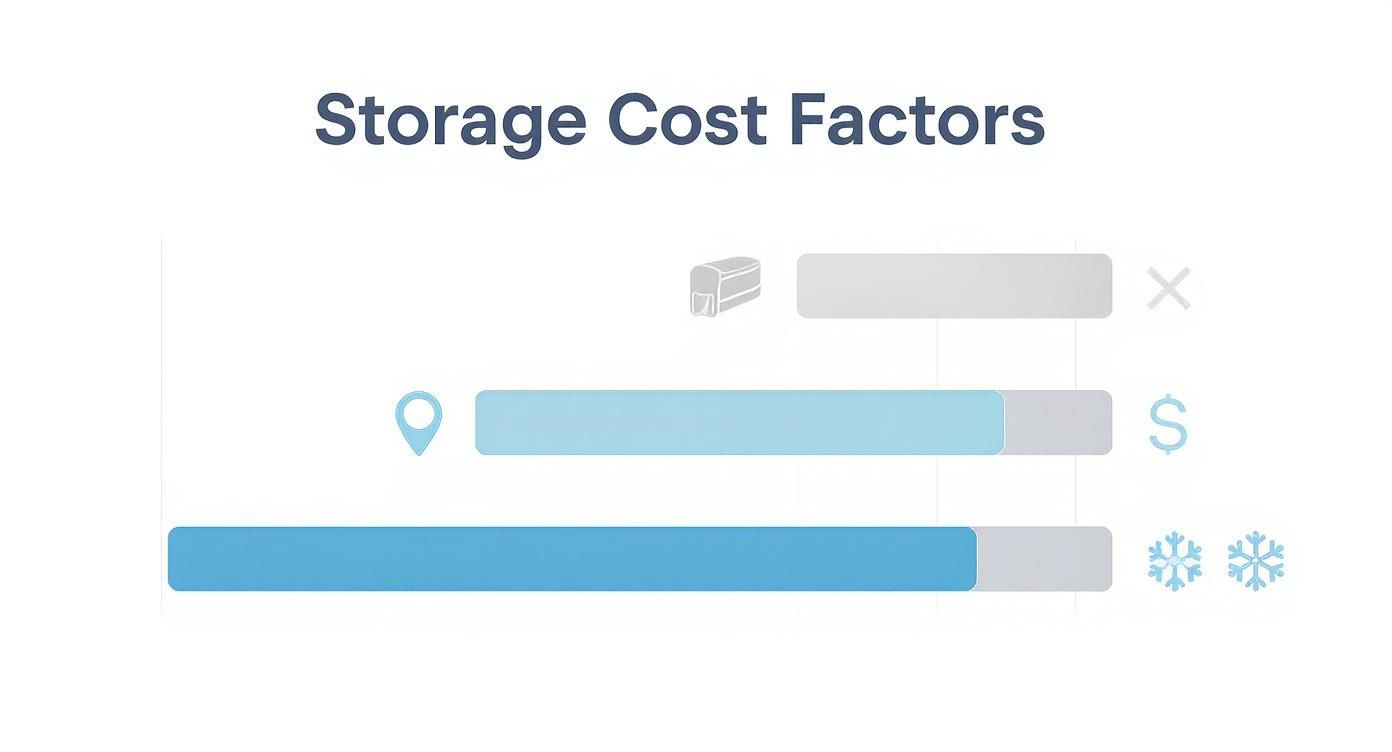
This demonstrates how factors like size, location, and premium features are universal cost drivers, even if the final price structure differs greatly between a self-storage unit and a full-scale warehouse.
Recent data shows that warehouse and industrial storage rates in Melbourne have remained relatively stable. The national median for pallet storage is approximately AUD 4.53 per pallet per week. For leasing, industrial rates in Greater Melbourne typically fall between AUD 200 to 500 per square metre annually. This level of consistency is invaluable for businesses attempting to budget for their long-term logistics. For a more detailed analysis, you can consult a market report on Melbourne's 3PL and warehousing rate trends.
To help you see the differences at a glance, here’s a quick breakdown of the two main storage types.
Storage Type and Rate Comparison
| Feature | Personal Self-Storage | Commercial Warehouse Storage |
|---|---|---|
| Typical User | Individuals, families, small businesses | E-commerce, logistics, larger businesses |
| Pricing Model | Per unit, per month | Per pallet, per square metre, or volume-based |
| Lease Term | Flexible, month-to-month | Long-term leases (1+ years are common) |
| Common Use | Moving house, decluttering, storing personal items | Inventory management, order fulfillment, distribution |
| Access | Frequent, often 24/7 access to a private unit | Scheduled access, often integrated with logistics services |
| Services | Basic security, trolleys, packing supplies for sale | Forklift services, inventory tracking, pick-and-pack |
| Cost Structure | Simple, fixed monthly rate | More complex, often includes service fees and variable costs |
Ultimately, the right choice depends entirely on your specific use case. A homeowner requires the simple, accessible model of personal self-storage, while a growing business will derive far more value from the scalable, integrated services offered by commercial warehousing.
Choosing the Right Storage Unit Size to Avoid Overpaying
One of the most common ways to inflate your storage bill is by selecting the wrong unit size. Many people overestimate the space they need, leading them to pay for empty air month after month. The goal is to find a unit that perfectly accommodates your belongings, ensuring you don’t waste a single dollar on unused space.
Getting this right isn't about guesswork; it's about smart planning. By taking a moment to catalogue what you're storing and familiarising yourself with common unit dimensions, you can accurately determine your needs and control your costs from the outset.
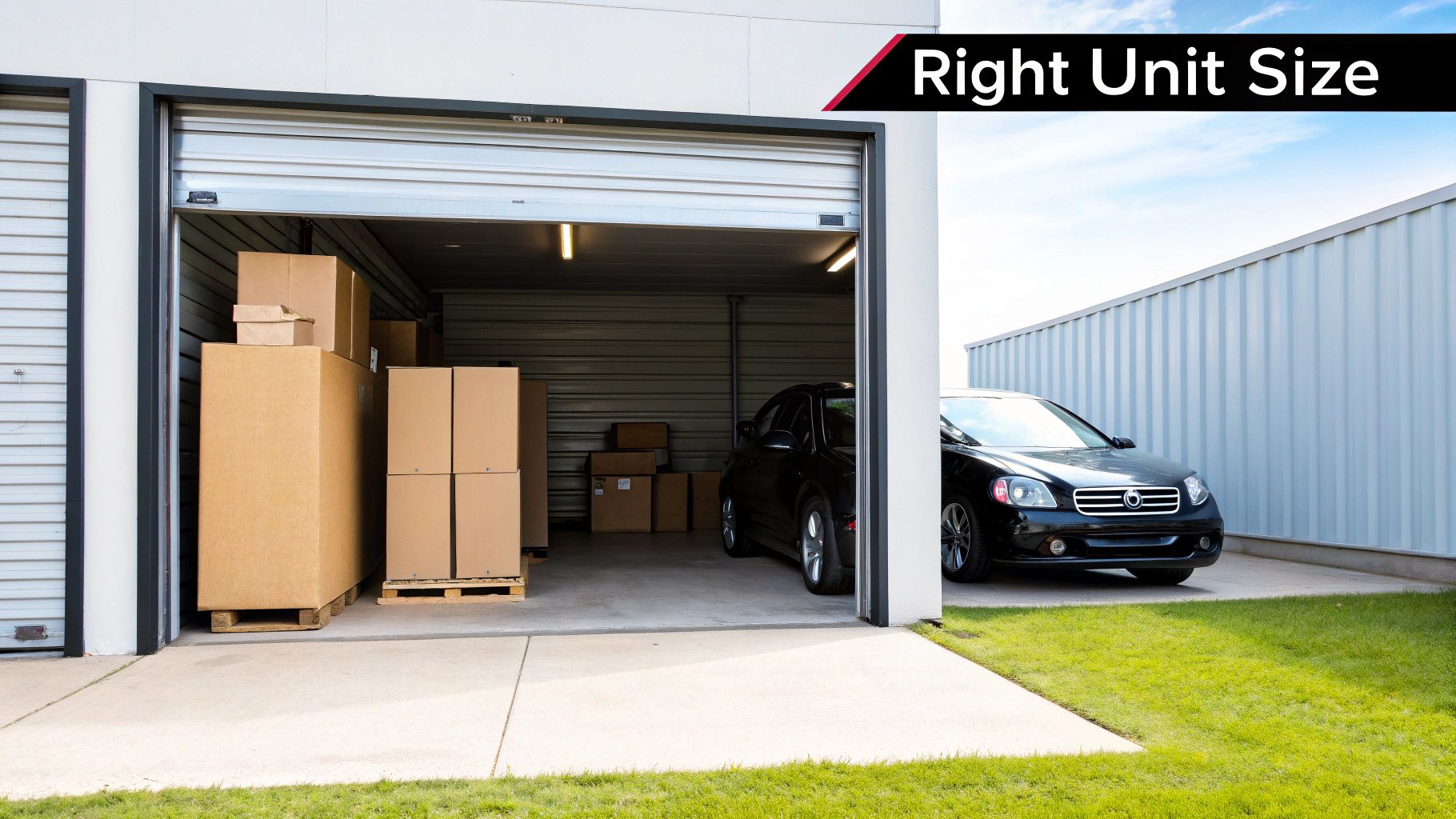
This simple step ensures the storage rates Melbourne facilities offer align with what you actually require, saving you from unnecessary expenses before you even lock the door.
Visualising Common Storage Unit Sizes
To make an informed decision, it's helpful to visualise what can realistically fit into standard storage units. Instead of just thinking in metres, try comparing them to familiar spaces in your home.
- Small Unit (e.g., 1.5m x 3m): This is roughly the size of a large walk-in wardrobe. It’s perfect for storing seasonal items, numerous boxes, small furniture like a desk or chest of drawers, or the contents of a studio apartment.
- Medium Unit (e.g., 3m x 3m): Think of this as the size of an average bedroom. It can comfortably hold the furniture from a one or two-bedroom apartment, including larger items like a queen-sized bed, sofa, and a dining set.
- Large Unit (e.g., 3m x 6m): This is comparable in size to a standard single-car garage. It’s the ideal choice for storing the contents of a two or three-bedroom house, including major appliances, multiple large furniture sets, and dozens of boxes.
A critical mistake is underestimating the vertical space available. Most storage units have high ceilings, allowing you to stack boxes and arrange furniture strategically to maximise capacity.
How to Accurately Estimate Your Needs
The most effective way to avoid paying for excess space is to create a quick inventory before you begin your search for a unit. Simply listing all your larger items—sofas, beds, tables, whitegoods—is an excellent starting point.
Once you have your list, you can be more precise. For a highly accurate calculation of the total volume your belongings will occupy, use a tool like our handy cubic metre calculator to get a reliable estimate. This removes the guesswork and points you directly to the most cost-effective unit size for your needs.
Finally, remember that strategic packing makes a significant difference. By dismantling furniture like bed frames and tables, you can substantially reduce the required floor space. Using uniformly sized boxes also allows for safe and stable stacking, ensuring you make the most of every square metre you're paying for.
Actionable Tips for Reducing Your Storage Expenses
Securing the most competitive storage rates Melbourne has to offer is much simpler when you know a few industry strategies. With a smart approach, you can significantly reduce your monthly costs without compromising on the quality or security you need. These practical steps will help you find an excellent unit that fits your budget.
Optimise Your Space and Possessions
One of the easiest ways to save money is to simply store fewer items. Before you start packing, dedicate time to thoroughly sort through your belongings. This is the perfect opportunity to sell, donate, or discard items you no longer use, which directly reduces the storage volume you require. For practical advice to get you started, check out this guide on how to declutter before you move.
Once you've decided what to keep, the next step is to pack efficiently. Disassemble bulky furniture like bed frames and dining tables to make them as flat as possible. Using sturdy, uniformly sized boxes is a game-changer, as it allows you to stack them securely to the ceiling, maximising every inch of vertical space. You might find this strategy allows you to rent a smaller, and therefore cheaper, unit.
Choose Your Location and Timing Wisely
The location of your storage facility has a massive impact on the price. Unsurprisingly, facilities in prime, inner-city locations will always cost more due to high real estate values. If you're willing to consider options in suburbs a short drive from the city centre, you can often find much lower rates for the exact same size unit.
When you rent can also lead to significant savings. The moving industry has its peak seasons, typically during summer and school holidays. If your timeline is flexible, try to book your storage unit during the off-season, such as winter. Demand is lower then, and facilities are often more willing to offer promotions to fill their units.
For businesses, this logic can be applied on a larger scale. When storing inventory, exploring broader supply chain cost reduction strategies can help you identify ways to minimise stock levels, which in turn lowers your overall storage costs.
Lock in Long-Term Deals and Promotions
Never underestimate the value of commitment and special offers. Many storage companies provide significant discounts to customers willing to sign a longer-term lease. Pre-paying for six or twelve months upfront can often reduce your monthly rate by 15-20%.
Finally, always be on the lookout for move-in promotions. It’s common for facilities to offer deals like "first month free" or "50% off for three months" to attract new customers. These introductory offers can provide substantial upfront savings, making the initial cost much more manageable. By combining a few of these tips, you'll be in a great position to secure a fantastic rate.
Understanding Rates for Specialised Storage Solutions
Sometimes, a standard storage unit just isn't sufficient. For items that require specialised care, Melbourne's storage market offers a range of tailored solutions. These are premium options designed for belongings that need specific environmental conditions or enhanced security, and they naturally come with a higher price tag. Understanding these costs is key to properly protecting your most valuable assets.
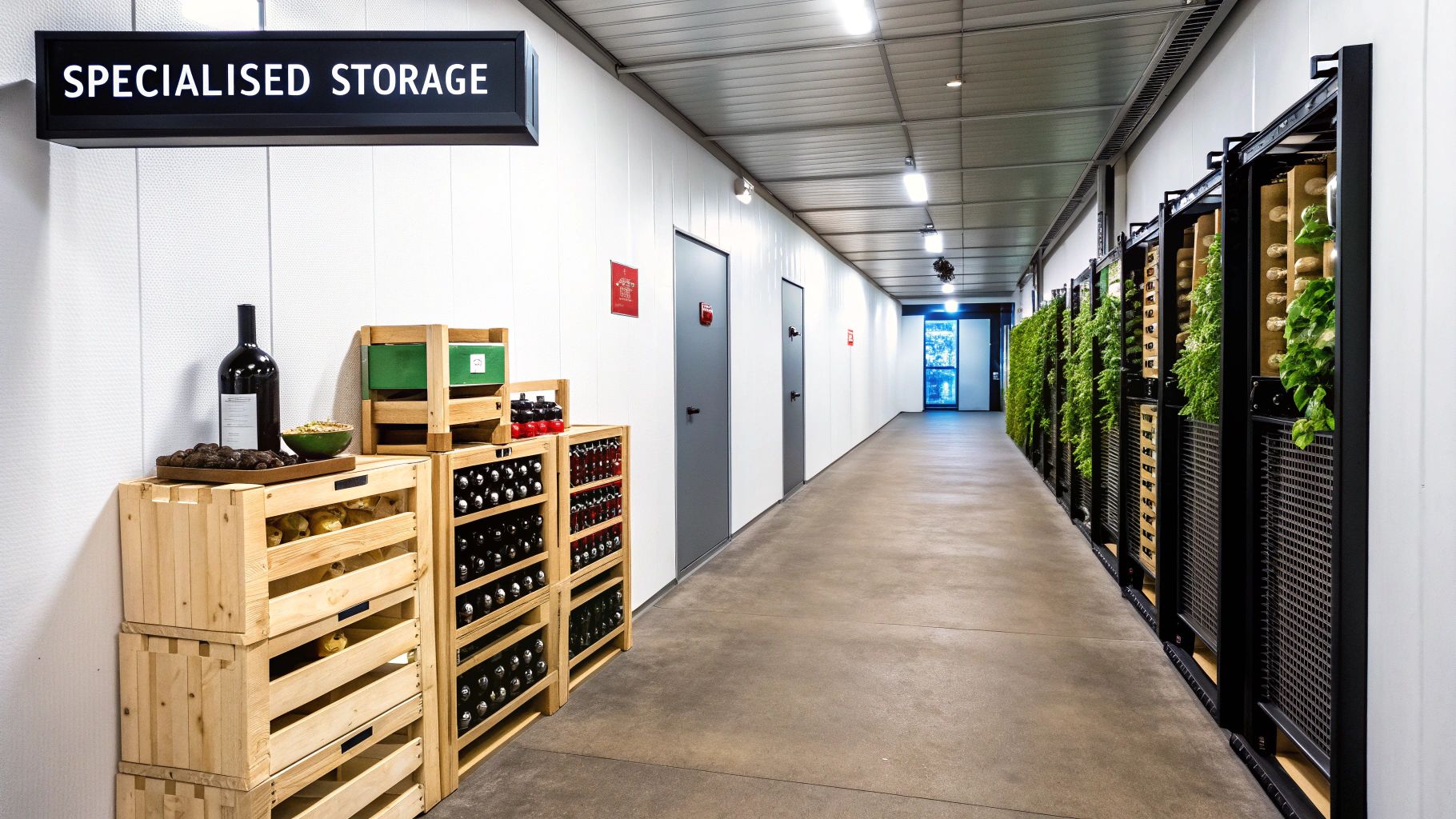
The most common specialised option is climate-controlled storage. These units maintain a consistent temperature and humidity, which is vital for preserving delicate items like fine art, antiques, wine collections, and sensitive electronics, especially given Melbourne's unpredictable weather. You can expect to pay approximately 20-30% more for a climate-controlled unit compared to a standard one of the same size. Consider this extra cost an insurance policy against warping, mould, and rust.
High-Security and Business-Focused Storage
Beyond climate control, you'll find high-security storage facilities. These locations offer advanced surveillance, individual unit alarms, and stringent access controls, making them perfect for storing high-value collections or critical business documents. The price for this level of security varies depending on the specific measures in place.
For businesses, specialised storage can become highly technical, such as data centres. Melbourne’s data centre storage market is a significant component of Australia's storage industry, known for efficient designs that leverage renewable energy and cool ambient temperatures for over 1,800 hours of free air cooling annually. This Victorian market segment is projected to reach USD 820 million by 2030, highlighting its importance. You can explore the Australian data centre storage market and its growth on mordorintelligence.com for more details.
Ultimately, when considering specialised storage, the higher rate is a direct reflection of the advanced protection you receive. It’s a wise investment to safeguard assets that are difficult, or even impossible, to replace.
Frequently Asked Questions About Melbourne Storage
When researching storage options, numerous questions can arise, particularly regarding costs and contract details. To help you make an informed decision with confidence, we've compiled answers to the most common queries about storage in Melbourne.
Clarifying these details upfront ensures there are no unwelcome surprises down the line.
Is It Cheaper to Book Storage Online or in Person?
Booking your storage unit online is almost always the more cost-effective option. Storage facilities frequently run web-only promotions and offer better rates on their websites that are not available to walk-in customers. It's a smart strategy to compare online prices before visiting a facility in person.
Do I Need to Pay a Security Deposit?
This varies from one facility to another. Many modern storage providers in Melbourne have eliminated security deposits. However, some may still require a small, refundable deposit, while others might charge a one-time administration fee upon signing the agreement.
Always request a full breakdown of all initial costs before signing any contract. A reputable provider will be completely transparent about every potential fee—including deposits, insurance, and lock purchases—so you know exactly what you’re paying for from day one.
Are There Hidden Fees I Should Be Aware Of?
It is crucial to inquire about any potential extra charges beyond the monthly rent. Common "hidden" fees can include mandatory insurance coverage, the requirement to purchase a specific type of lock from the facility, late payment penalties, and even cleaning fees if the unit is not left in pristine condition.
Can I Get a Discount for Long-Term Storage?
Yes, absolutely. Most storage facilities in Melbourne are happy to offer attractive discounts for longer-term rental commitments. If you can pre-pay for six or twelve months, you can often secure the best possible monthly rate, saving a significant amount of money over time.
For more general queries, our comprehensive list of frequently asked questions provides even more insights.
Planning a move and need a seamless storage solution? Get n Go Removals Melbourne integrates secure, affordable storage with our expert removalist services, giving you a single point of contact for a stress-free experience. Visit us at https://www.getngoremovals.com.au to get a transparent quote today.