House Moving Equipment: Essential Gear Guide
You're standing in the hallway with a solid timber dresser, a narrow stairwell behind you and a rented truck waiting outside. The boxes are packed, but the move has already slowed because nobody can get a safe grip on the furniture. A basic trolley rattles over the threshold, a corner catches the wall and the load shifts just as someone reaches the front step.
That's the point many Melbourne households discover too late. House moving equipment isn't just a convenience purchase. It controls how much force the crew uses, how the load behaves and whether floors, walls, furniture and people make it through the day without damage. The right system includes transport tools, protective materials, access equipment and a plan for matching each item to its actual weight.
The Reality of Moving Day and Equipment Needs
Moving day rarely fails because someone forgot a marker pen. It fails when a heavy appliance must cross a soft lawn, a tall cabinet has to turn through a tight landing or a packed carton gives way at the bottom of a staircase. Those moments expose the difference between carrying an object and controlling it.
A household move contains awkward loads rather than neat gym weights. Fridges have poor handholds, sofas flex as they're lifted and bookcases become unstable when their contents aren't removed. Even a modest distance from the living room to the truck can become exhausting if people carry everything by hand.
Australia's removal industry has been adapting to this problem for more than 130 years. John George Nuss began moving people in Sydney by horse and cart in 1892, and the equipment supporting modern removalists has since developed into specialised trucks, dollies, straps, lift systems and protective gear. The historical shift described by this account of operating truck-mounted EWPs safely reflects a broader principle, mechanical assistance should replace unnecessary manual effort wherever the task allows it.
Practical rule: If an item can roll, slide or be lifted mechanically, don't make the crew carry it.
Treat gear as a risk-control system
A dolly reduces repeated lifting. A strap keeps a tall load aligned. A ramp controls the change in height between the ground and the truck deck. Moving blankets prevent contact damage, while floor protection creates a controlled path through the property.
The wrong tool creates hidden costs. A crew may need more breaks, more people or more time. A scratched floor or crushed cabinet can cost far more than the equipment hire, and an injury can disrupt the move well beyond the day itself.
Before buying anything, walk the complete route. Note steps, gradients, door widths, lift access, soft ground, overhead obstructions and the position where the truck can legally park. The equipment decision should follow that route, not a generic checklist.
Essential Lifting and Transport Gear
The core kit usually consists of a furniture dolly, hand truck, lifting straps, tie-downs, sliders and protective blankets. Each tool solves a different movement problem. A flat dolly rolls bulky items across level ground, an upright hand truck handles cartons and appliances, while straps give the crew control during tilting, stairs and loading transitions.
Size the dolly for the real load
Australian suppliers list common furniture-dolly capacities from 150 kg to 500 kg, with heavy-duty models above 1,000 kg. Those ranges are outlined by AU dolly supplier guidance, which also supports selecting a rating above the heaviest load and allowing a 20 to 30 per cent buffer.
That buffer matters because the label weight isn't the whole loading event. A dense cabinet can place extra force on a small wheel when it tips onto the dolly, crosses a threshold or turns sharply. Measure the heaviest item, add the buffer and consider how the load will transfer during the route.
Wheel choice changes the result. Pneumatic tyres absorb thresholds and uneven outdoor surfaces more comfortably, while solid tyres resist deformation and can carry sustained loads with less maintenance. Pneumatic wheels can be harder to control indoors if they're underinflated, whereas solid wheels can transmit more vibration into timber floors and fragile furniture.
Use hand trucks and straps deliberately
An upright hand truck works well for cartons, dishwashers and tall appliances when the load can sit close to the frame. Keep the centre of gravity low, secure the item with a strap and never rely on one person to catch a load that starts tipping.
Lifting straps can increase mechanical advantage, but they don't remove the need for coordination. Before lifting, agree on commands, keep fingers away from pinch points and make sure every person knows whether the next movement is a tilt, roll, lift or pause. Furniture sliders are useful on clean, level timber floors, but they're not a substitute for a dolly on ramps or uneven surfaces.
For dense furniture, appliances and pianos, point loading is the deciding issue. A tool that looks strong enough in a catalogue can behave poorly when one castor takes most of the force during a turn. If the route includes stairs, use equipment designed for stair work rather than improvising with a standard trolley.
For a practical walkthrough of techniques for controlling oversized furniture, see how to move heavy furniture. The useful lesson is simple, equipment should keep the load close, supported and predictable throughout the route.
Protective Packing Materials and Quantities
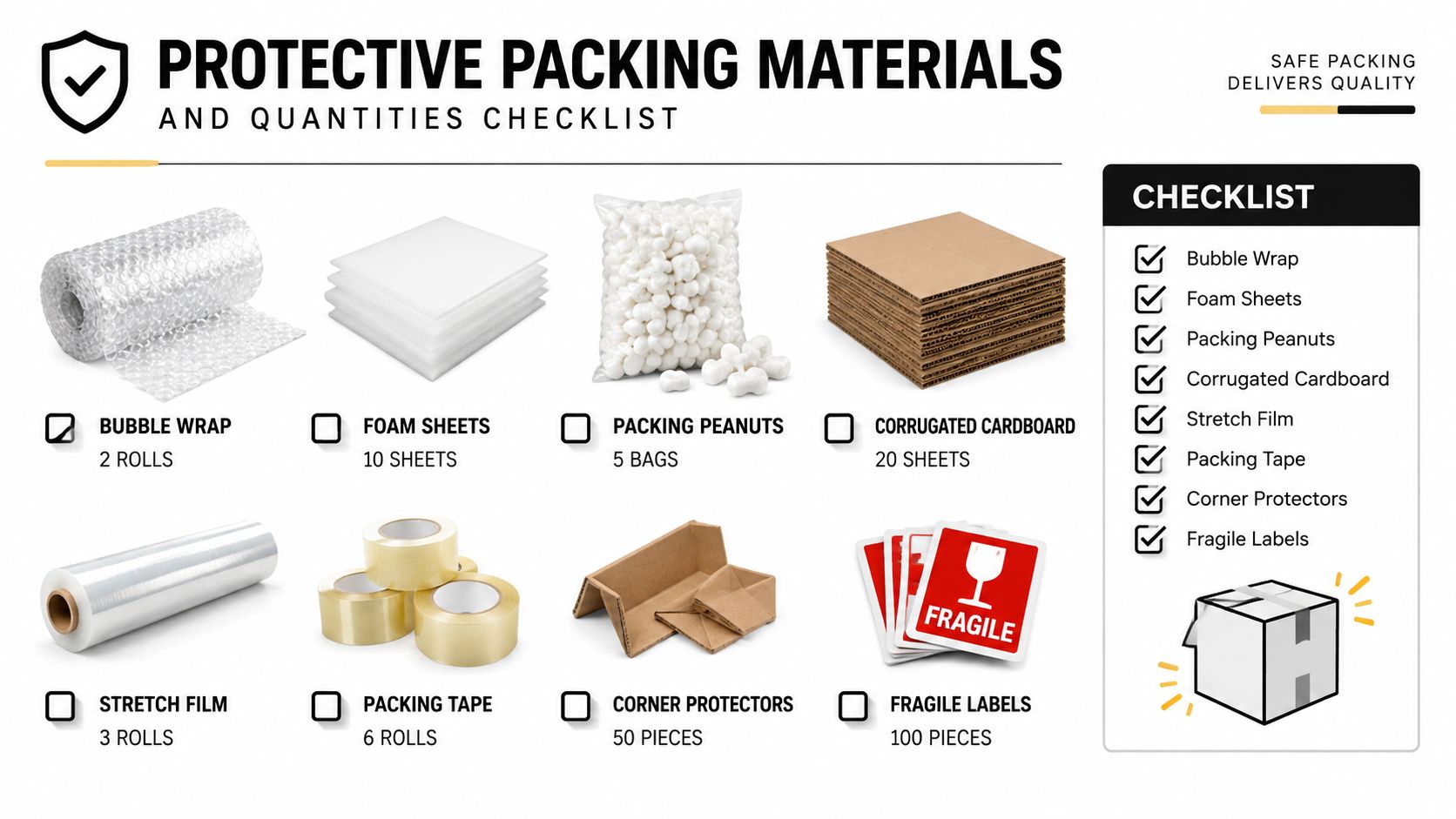
Generic packing lists often tell you to buy boxes, tape and bubble wrap, then leave you to guess the quantities. That approach causes two common problems. You either buy excess materials that occupy space and money, or you run out of tape and protective wrap while half the kitchen is still unpacked.
Australia Post's moving-house packing guidance identifies the practical foundation: packing tape, a tape dispenser, bubble wrap or honeycomb wrap, packing paper, sturdy recyclable boxes and a flat packing surface such as a dining table.
Build a usable inventory
Start with an item count by room rather than a vague estimate based on property size. Count books, kitchenware, clothing, ornaments, framed pieces and electronics separately. A small apartment with a large library may need more strong cartons than a larger home with minimal storage.
Use ordinary cartons for linen, clothing and light household goods. Choose heavy-duty double-walled boxes for books, tools, crockery, small appliances and dense objects. Don't fill a large carton with one heavy category. A carton that can't be lifted without twisting is already too heavy for a safe move.
A practical purchasing model should include:
- Small cartons: books, tins, tools and dense kitchen items.
- Medium cartons: folded clothing, toys, pantry goods and everyday household contents.
- Large cartons: doonas, cushions, lampshades and lightweight bulky items.
- Specialist cartons: wardrobes, artwork, televisions and fragile glassware.
- Tape and labels: enough for continuous packing, sealing and room identification, with spare rolls kept at the packing station.
The right quantity depends on inventory, not bedrooms alone. Buy materials in stages if you can, starting with the rooms you'll pack first. Keep a small reserve for last-minute drawers, cleaning supplies and items discovered in sheds or cupboards.
Match protection to the surface and object
Honeycomb wrap works well where you want paper-based cushioning around glassware and ceramics. Bubble wrap provides more impact absorption for delicate objects, but it should be combined with a rigid carton and void fill rather than used as the only protection.
Wrap furniture corners, not just broad faces. Secure drawers so they don't slide open, but don't tape directly to polished timber or painted finishes. For timber floors, use clean furniture pads and a protected travel path. Guidance on how to prevent scratches on hardwood floors is useful because grit under a slider or dolly wheel can mark a surface quickly.
A flat packing surface keeps cartons square and reduces rushed sealing. Packing materials for moving should be selected around the objects you own, the route they'll travel and the handling equipment available, not just the number of rooms.
Specialty Equipment for Pianos and Pool Tables
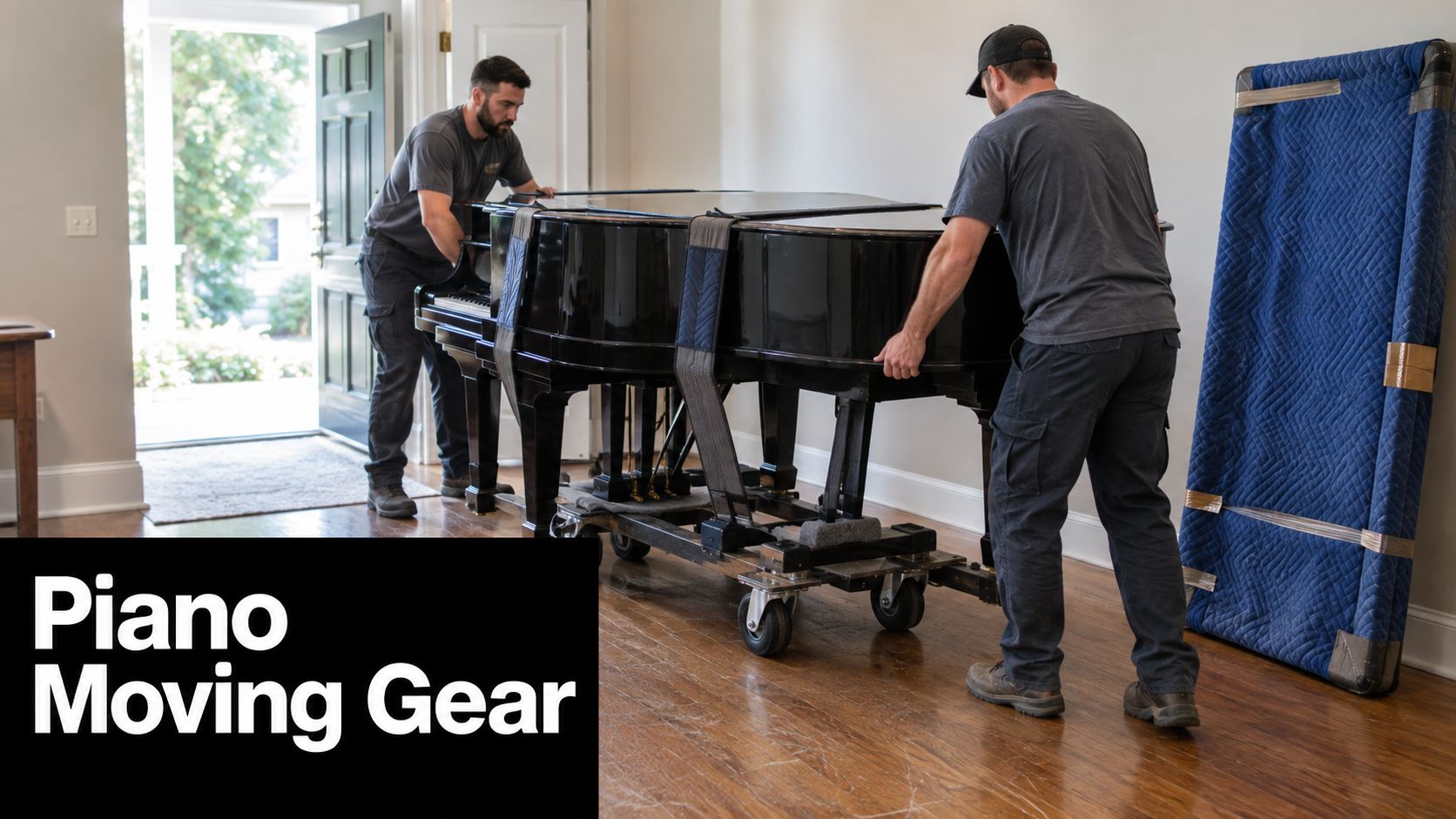
A piano or slate-bed pool table changes the risk profile of a move. The weight is concentrated, the shape is awkward and the finish can be damaged by a small contact point. Standard household dollies are designed for general loads, not for managing a high centre of gravity through narrow hallways or over stairs.
Why specialist skates behave differently
An Australian industrial catalogue lists piano and furniture dollies at 400 kg for both puncture-proof and pneumatic-wheel versions, and 600 kg for solid-tyre versions. It lists skates at 600 kg total, or 150 kg per castor, as shown in this trolley and hand-truck catalogue.
Those figures don't make every heavy-duty skate suitable for every piano. Castor placement, wheel material, floor condition and the shape of the load all affect stability. Pneumatic tyres absorb thresholds more effectively, while solid tyres provide greater resistance to deformation under sustained load. The wrong combination can increase rolling effort, mark flooring or allow the load to shift during a tight turn.
Pianos also need piano boards, rated straps, corner protection and enough moving blankets to prevent contact with walls and door frames. A pool table usually needs careful preparation, controlled disassembly and protection for the slate, rails and cabinet. Improvised lifting can twist the frame or transfer force into parts that were never designed to carry it.
The important distinction: Specialist equipment controls load transfer. It isn't simply a stronger version of a household trolley.
The same principle applies to access. A reinforced stair-climbing system may be appropriate for a particular route, but only after the stairs, landings and load dimensions have been assessed. Pool table moving equipment should be selected with the table construction and access conditions in mind.
This video provides useful visual context for the controlled handling required by oversized instruments and furniture.
A professional crew should also protect the route before the item moves. Cover hard corners, remove doors where necessary and keep bystanders away from the turning area. If the team can't control the object at every point, the route or method needs to change.
Choosing the Right Truck Size and Ramps
The truck must suit both the volume of the household and the physical dimensions of its largest objects. A vehicle can have enough floor space but still be unsuitable if a wardrobe can't be loaded safely, or if the available payload is consumed before the truck is full.
Start by listing the largest furniture items and measuring their packed dimensions. Then consider the cartons, disassembled parts, protective blankets and clearance needed to stack safely. A tight load can waste space if objects can't be placed without crushing or leaning.
Truck Size and Capacity Guide
| Truck Size | Ideal For | Key Features |
|---|---|---|
| 4.5-tonne truck | Compact apartments and smaller household moves | Agile access, loading ramp and urban-friendly footprint |
| Medium truck | Standard homes with a moderate furniture inventory | More cubic space, tie rails and improved loading access |
| 12-tonne truck | Large family homes, offices and bulky inventories | High payload, generous cargo volume and hydraulic loading support |
The table is a planning guide, not a substitute for an inventory assessment. A compact apartment filled with solid timber furniture may require more capacity than a lightly furnished house. A truck that's too small creates extra handling, additional travel and more opportunities for damage.
Use ramps and lifters to remove the vertical struggle
A loading ramp gives wheels a controlled path into the cargo area. A tailgate lifter raises heavy appliances and dense furniture without forcing the crew to lift the entire weight from ground level. Hydraulic shutters and internal tie points add control when the load must be secured for travel.
Check the ramp angle, surface grip and available landing space before the truck arrives. Keep the path straight where possible, clear loose gravel and assign a spotter to watch wheel placement. Don't let a person stand below a load that could roll backwards.
Small mobility devices need the same care as household furniture. Anyone planning to safely move a mobility scooter should account for its weight, battery, securing points and ramp gradient instead of treating it like ordinary luggage.
For Melbourne moves, what size moving truck you need depends on inventory, access and whether the move includes specialty items. The best choice is the smallest vehicle that carries the load with safe clearance, stable stacking and a sensible payload margin.
Renting Versus Buying Moving Equipment
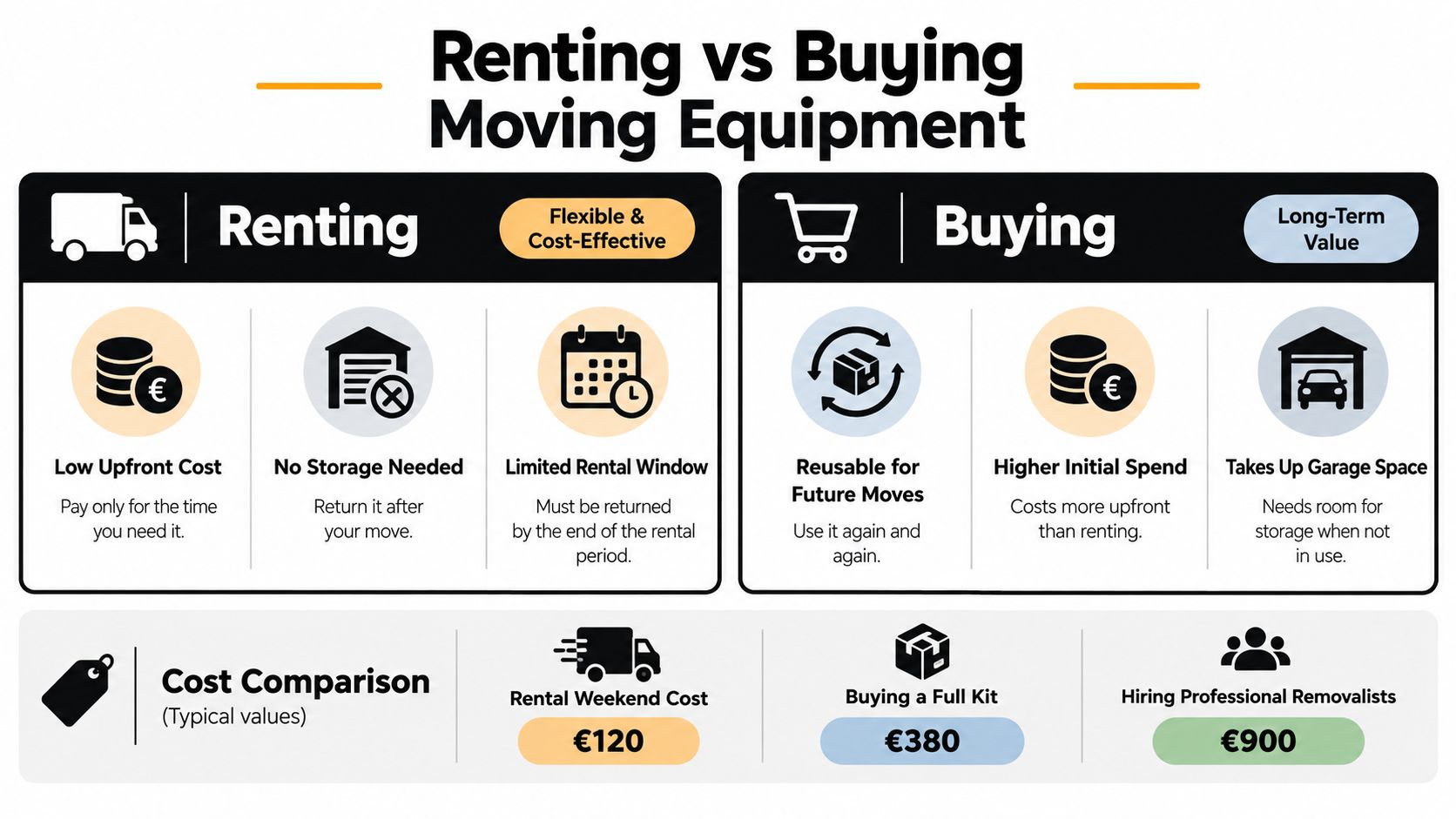
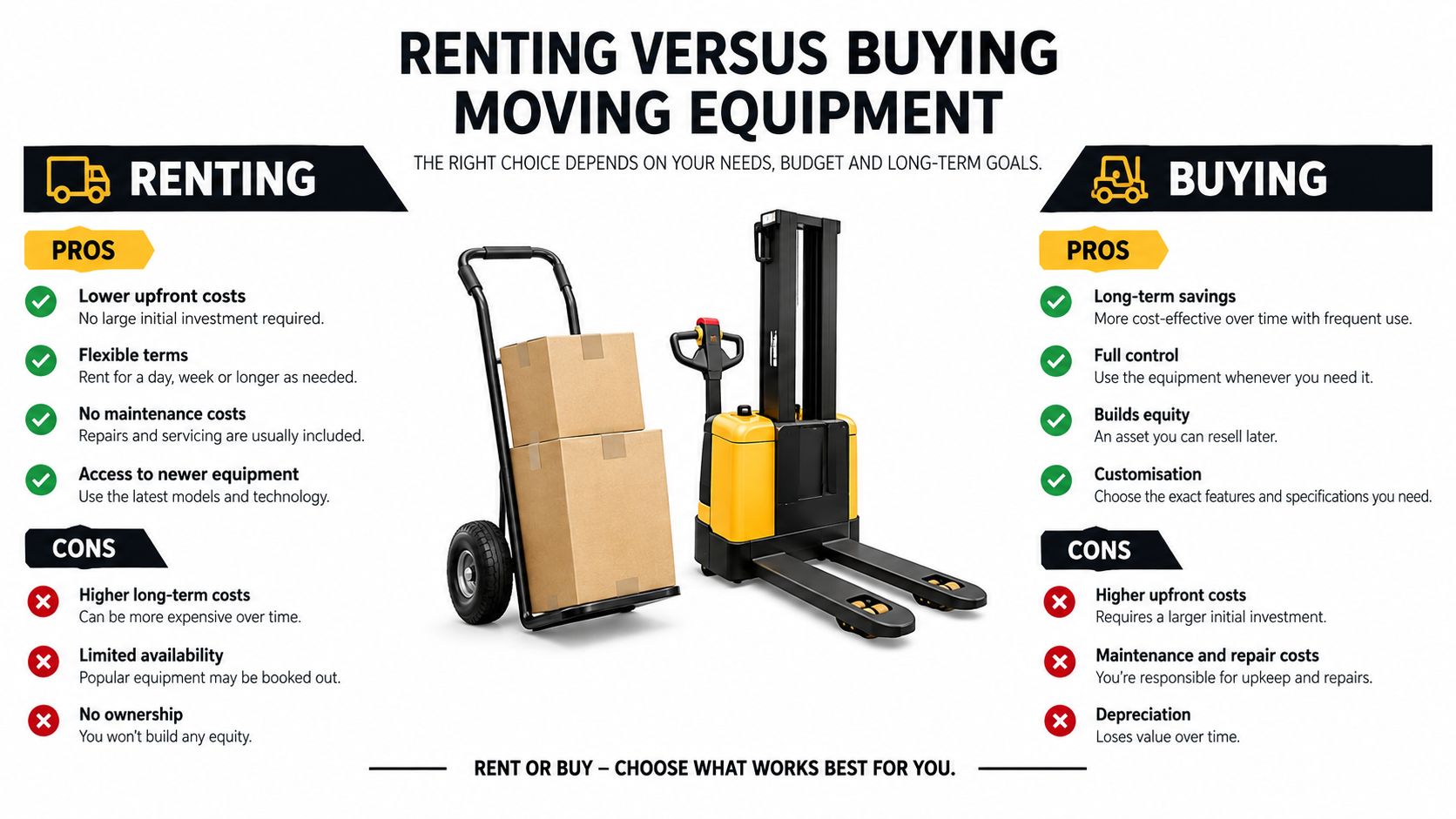
The decision usually comes down to three options: rent the equipment, buy a reusable kit or hire removalists who bring and operate their own gear. Each option can work, but the cheapest line item isn't always the lowest total cost.
Renting makes sense for a straightforward move where you understand the route and only need basic equipment briefly. You avoid storage and maintenance, but you're working within the rental window. Delays, late returns or a tool that doesn't suit the heaviest item can quickly undermine the saving.
Buying is more practical for landlords, renovators, businesses and households likely to move again. A good dolly, hand truck, straps and blankets can serve future projects, but the initial outlay is higher and the equipment takes up garage or storage space. You also carry responsibility for inspection, cleaning and correct use.
Compare the real trade-offs
Professional removalists bring labour, transport and equipment together. That can be valuable when the move involves stairs, long carries, pianos, pool tables, tight parking or fragile finishes. The price reflects more than a trolley. It includes planning, handling, vehicle operation and the ability to manage problems as they appear.
Ask these questions before choosing:
- Physical capacity: Can everyone involved control the heaviest item without rushing?
- Route complexity: Are there stairs, lifts, narrow turns, slopes or soft surfaces?
- Equipment knowledge: Can the team inspect ratings, straps, wheels and tie-down points?
- Time pressure: Would a delay affect settlement, lift bookings, work or storage?
- Protection requirements: Do you need blankets, floor covering, specialist skates or packing support?
The infographic below captures the broad decision, but the right answer still depends on the job rather than the purchase price alone.
For a single apartment move with uncomplicated access, a rented dolly and protective materials may be enough. For a large relocation or a move containing specialist furniture, the labour and equipment system supplied by professionals can reduce the number of decisions you must make under pressure. Quality moving blankets in Melbourne are particularly useful for protecting painted walls, polished furniture and appliances during loading.
Safety Protocols and Ergonomic Best Practices
Equipment only works when the crew uses it within a controlled process. Start with a pre-start inspection of wheels, handles, straps, ramps, brakes, blankets and tie-down points. Remove damaged gear from service, check the route and decide who will lead each movement.
WorkSafe Victoria recommends storing frequently moved, large, bulky or awkward objects above knee height and below shoulder height. Its guidance also supports smaller containers, lightweight stackable containers with wheels and handles, adjustable-height trolleys, firm non-slip surfaces and maintaining three points of contact when using ladders. Those recommendations are set out in WorkSafe Victoria's manual-handling guidance.
Keep people outside the danger zone
Separate pedestrians from moving plant, ramps and loaded trolleys. SafeWork NSW says the risk from moving plant should be eliminated where reasonably practicable and that workers shouldn't enter the hazardous zone. Use barriers, spotters and a clear traffic plan when the truck is near a footpath, driveway or narrow street.
Operators should complete a pre-start checklist, wear seat belts where fitted, avoid mobile phones and music devices while equipment is moving and never exceed rated limits. The Australian Steel Institute's mobile-equipment safety guidance also states that pedestrians must never walk under suspended loads or pass beneath equipment carrying them.
Use a three-part command system for large items: one person gives instructions, everyone pauses on command and nobody changes direction without warning. Keep hands clear of door jambs and castors, push rather than pull where the route allows and stop immediately if the load begins to lean.
Before loading, identify overhead services, uneven surfaces, wet areas and loose mats. Good house moving equipment reduces force, but route control and communication prevent the injuries that tools alone can't stop.
Get n Go Removals Melbourne supplies moving blankets, specialty trolleys, dollies, ties and company-owned trucks ranging from 4.5 to 12 tonnes for residential, apartment, office, piano and pool-table relocations. Visit Get n Go Removals Melbourne to arrange equipment-backed moving support, professional packing, storage or a customized quote for your Melbourne or interstate move.