
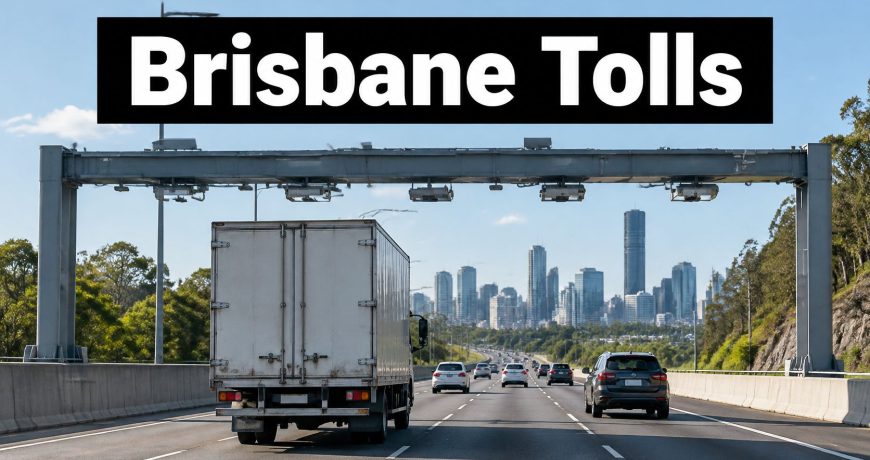
Brisbane Toll Charges Explained for Interstate Movers
You've booked the truck, packed the Melbourne house, and planned the drive north. Brisbane toll charges probably aren't on your checklist. They should be. I've run Melbourne to Brisbane jobs for a decade, and the toll bill is where tidy quotes unravel, not because the road charge is huge, but because a moving truck isn't charged like a car and an unlinked registration triggers admin fees you didn't budget for. Fix that before you cross the border and it's a non-event.
The Brisbane Toll Surprise That Catches Interstate Movers
A Melbourne family lands in Brisbane on a Friday morning. The crew unloads by lunch, the kids claim bedrooms, and everyone exhales. Three weeks later a toll invoice turns up addressed to the truck's registered operator. The road charge itself is modest. The administration charge stacked on top is what stings, and nobody mentioned it before the truck left Victoria.
That's the pattern I see repeatedly. Families research packing, settlement times, and lift bookings in detail. Tolls get treated as loose change the driver will sort out somewhere near the border. In Brisbane there's nowhere to sort it out at the roadside, because there's no booth, no cash option, and no attendant to wave you through.
Why Timing Beats Intentions
Queensland motorists must arrange payment through a toll provider within 3 days of travel, otherwise the registered operator receives an unpaid toll notice that may include additional fees, as Queensland's official toll guidance for motorists sets out. Three days sounds generous until you're mid-move. You're sleeping on a mattress on the floor, chasing the internet connection, and fielding calls from the agent. A toll deadline loses to all of that.
The invoice also doesn't chase the person who was driving. It chases the registered operator of the vehicle. If you've hired a truck yourself, that trail can lead back through the hire company to you, weeks after you've returned the keys and forgotten which motorways you used.
Don't treat Brisbane tolls as something you'll tidy up after you've unpacked. By then the cheap version of the charge may already be gone.
What Good Operators Do Differently
A professional crew running interstate removals to Brisbane has already linked every truck in the fleet to an active toll account. The gantry reads the tag, the charge lands on the account, and the customer sees a clean line item. There's no invoice, no admin fee, and no argument about who was driving.
Ask your removalist one blunt question before you book. Who holds the toll account for the truck allocated to my move, and how will the charges appear on my invoice? If the answer is vague, you're looking at an operator who hasn't thought about Brisbane's system, and that vagueness usually shows up elsewhere in the job too.
If you're driving a hired truck yourself, the responsibility flips to you. Confirm before you leave the depot whether the vehicle is already covered by a fleet account or whether you need your own arrangement. Write down the registration and your travel dates. That two-minute conversation at the counter is worth more than any phone call you'll make three weeks later.
The rest of this guide is the pre-trip playbook I give my own dispatchers. It covers how the network works, why your truck pays more than the family car, and how to set up payment so the first you hear about tolls is a predictable line on a quote you already approved.
How Brisbane's Toll Roads Actually Work
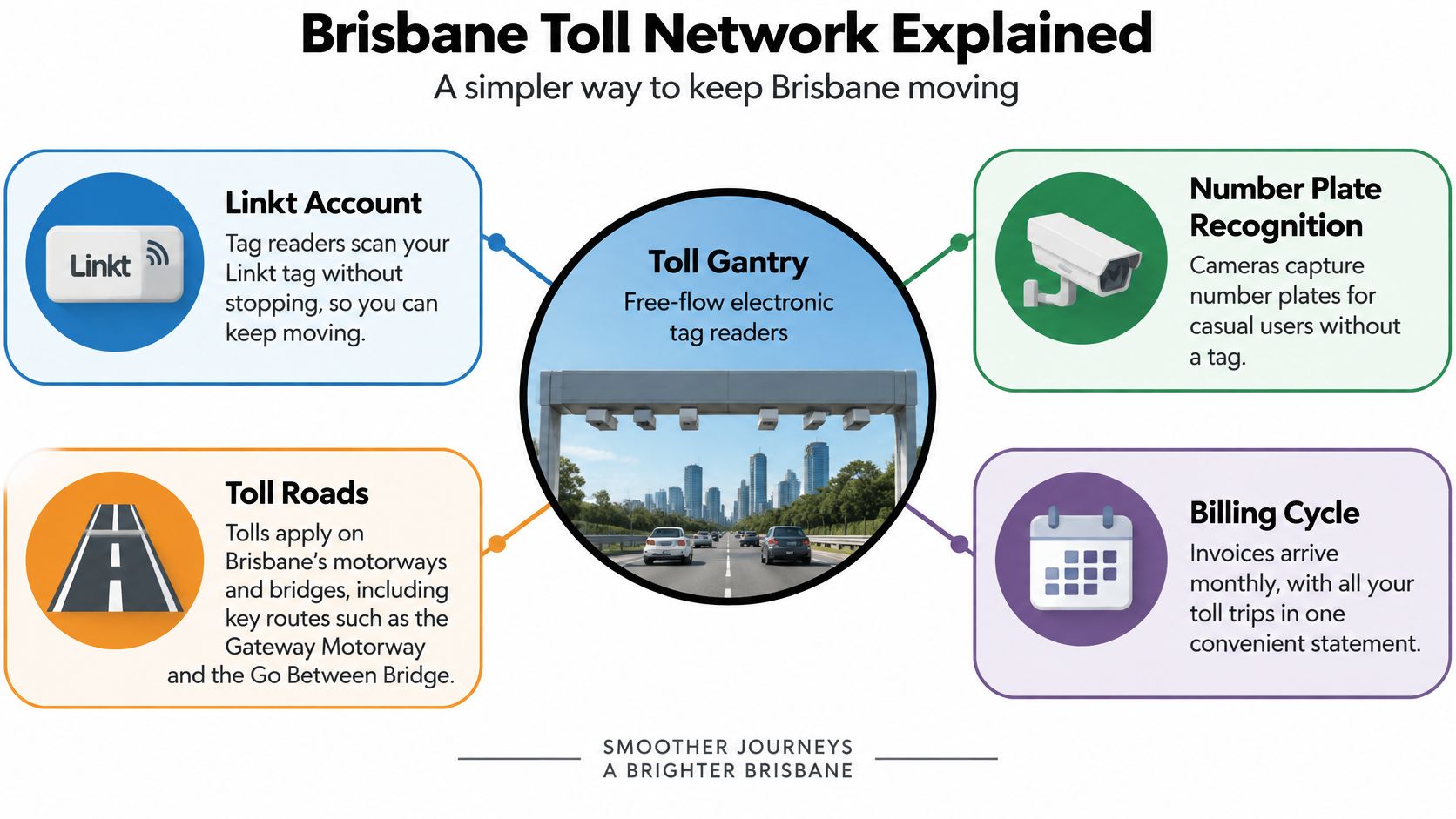
Brisbane runs free-flow electronic tolling. Your truck passes under a gantry at highway speed, the system reads an electronic tag or photographs the number plate, and the charge is recorded without anyone slowing down. There's no booth to stop at and no cash price displayed at the roadside, which is exactly why interstate drivers can rack up several charges before they realise they've used a toll road at all.
The network is bigger than most visitors expect. Queensland's Department of Transport and Main Roads identifies seven toll roads or facilities across Brisbane and wider South East Queensland, and drivers must arrange payment through Linkt within the window covered earlier, according to the department's toll roads overview for industry.
The map below shows how a gantry read becomes a bill, whether the system finds a tag or falls back to plate recognition.
The Seven Facilities You'll Hear Named
For a removal truck entering Brisbane, these are the names that matter:
- Gateway Motorway: The eastern bypass and river crossing most interstate trucks use to skirt the city.
- Logan Motorway: The southern link between the Ipswich side and the Pacific Motorway corridor.
- Clem Jones Tunnel, known as CLEM7: The north to south tunnel under the river.
- AirportLinkM7: The airport and northern suburbs tunnel connection.
- Legacy Way: The western tunnel feeding into the inner north.
- Go Between Bridge: A short inner-city river crossing.
- Toowoomba Bypass: Part of the wider South East Queensland toll network west of the city.
You won't use all seven on one move. A typical delivery might cross the Gateway, use one tunnel, and finish on untolled suburban streets. But route choices made by a driver following a navigation app can add a tunnel you never discussed, which is why the planned route belongs in the job sheet, not just in the driver's head.
Prices Move Every Year
Toll amounts are set by the infrastructure owner within approved limits, and Queensland's framework adjusts charges on 1 July each year in line with the annual Brisbane Consumer Price Index increase, as the department page linked above states. That means any figure quoted in a guide, including this one, is a snapshot. A removalist who priced your route from memory two financial years ago is working with stale numbers.
Dispatch rule: Rebuild your Brisbane toll allowance every July. A route constant that never changes is a costing error waiting for the next indexation.
The practical takeaway is simple. Gantries charge automatically, the network covers most fast routes into and around the city, and the prices step up annually. Once you accept those three facts, the only question left is what your specific vehicle pays, and that's where car-based assumptions fall apart.
Why a Moving Truck Does Not Pay the Same as a Car
Most online explanations of Brisbane toll charges quote the car price and stop there. That's useless for a house move. Brisbane pricing depends on road segment and vehicle classification, and a removal truck sits in a higher class than the family hatchback, so budgeting a move at car rates understates the bill on every single gantry.
Start with how much car tolls already vary by facility. Published Brisbane data puts car-class tolls at approximately $2.28 to $3.76 on the Logan Motorway, $3.55 to $6.02 on the Gateway Motorway, and $5.36 to $7.16 on Airportlink M7, with flat charges of about $6.77 on Clem7 and $7.30 on Legacy Way, and some journeys incur multiple gantry charges on the same road, according to Queensland's published tolling information and vehicle definitions. There's no single Brisbane toll. There's a price per facility, per toll point, per vehicle class.
Where Your Truck Sits in the Classes
Queensland sorts commercial vehicles using gross vehicle mass, axle configuration, and commercial registration. A two-axle commercial vehicle above 1.5 tonnes but no more than 4.5 tonnes is generally Class 3, while a two-axle rigid truck above 4.5 tonnes is Class 4, based on the classification detail in Linkt's Brisbane payment and vehicle class guidance. A typical interstate removal fleet running 4.5 to 12 tonne trucks straddles that boundary, so the allocated truck's weight decides the toll, not the size of your load.
That boundary matters in dollars. In the 2025 schedule example for Clem7, a Class 3 light commercial vehicle was charged $9.75 while a Class 4 heavy commercial vehicle was charged $19.49 in peak periods and $17.21 off-peak, against a $6.50 car charge in the same example, per the Linkt guidance linked above. Same tunnel, same trip, roughly triple the car price once you're in a heavy truck.
If you're comparing vehicles for a move, check where a 6 tonne truck option sits against that 4.5 tonne line before anyone quotes your tolls. Choosing a bigger truck to finish in one load can be the right call, but it moves you into Class 4 pricing on every Brisbane gantry, and your quote should say so.
Brisbane Toll Prices by Road and Vehicle Class
Linkt's pricing table lists the Murarrie toll point at $6.02 for a Class 2 car, $9.04 for a Class 3 light commercial vehicle, and $20.74 for a Class 4 heavy commercial vehicle, with Kuraby and Compton Road at $3.55, $5.33, and $12.24 respectively, including GST but excluding additional fees, according to Linkt's Brisbane toll pricing table.
| Toll road or point | Class 2 car | Class 3 light commercial | Class 4 heavy commercial |
|---|---|---|---|
| Murarrie | $6.02 | $9.04 | $20.74 |
| Kuraby and Compton Road | $3.55 | $5.33 | $12.24 |
| Clem7, 2025 example | $6.50 | $9.75 | $19.49 peak, $17.21 off-peak |
Read that Murarrie row again. The heavy truck pays well over three times the car toll at one toll point. Cross two or three points on a delivery run, then send the truck back out the same way, and the gap between a car-based estimate and the actual charge stops being rounding error.
Quote tolls from the truck's class and the actual gantries on the route. Anyone quoting you a flat city toll figure hasn't costed your job.
My method is boring and it works. Confirm the truck's classification, map every intended toll segment, count the gantries, and add a documented contingency for a route deviation. That takes ten minutes at dispatch and removes the most common pricing argument I see on interstate jobs.
Setting Up a Linkt Account Before the Truck Leaves Melbourne
Setup belongs in Melbourne, not at a servo outside Brisbane. The account, the registration, and the vehicle class all need to be correct before the truck rolls, because the gantry doesn't care that you meant to fix it later.
If your removalist is supplying the truck, the account should be theirs. They're the registered operator, they'll receive any unpaid notice, and they run the route often enough to reconcile charges properly. Your job is to confirm the arrangement exists and to agree how the tolls will appear on your invoice. If you're driving a hired or borrowed truck yourself, the account is your problem, and you need it live before your first gantry.
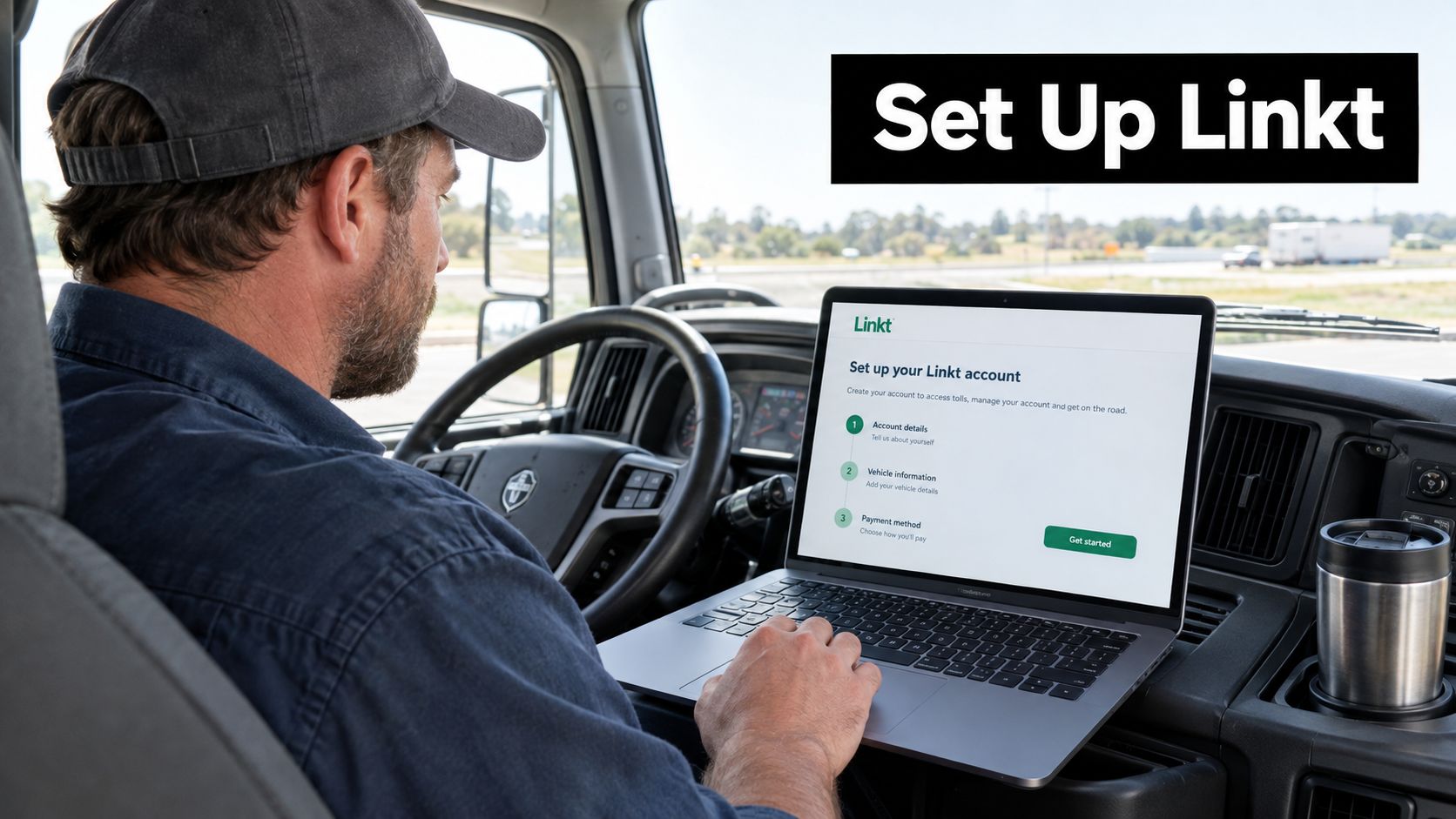
Setting the account up on a laptop the night before departure is normal practice for drivers on interstate runs, as the image below shows.
The Setup Sequence I Expect From Dispatch
- Confirm the registration: Match the exact plate of the allocated truck to the account. Not a similar truck, not last week's allocation.
- Verify the class: Check the truck's gross vehicle mass and axles so the account reflects Class 3 or Class 4 correctly.
- Record the route: Note the planned toll roads, expected gantry passages, and travel dates on the job sheet.
- Reconcile after delivery: Match the account transactions against the registration, date, and route within the week.
Existing Australian toll arrangements can work in Queensland, as noted in the earlier section, so a fleet with compatible coverage may not need a separate Brisbane-only setup. Verify that compatibility before departure rather than assuming it. Tags and accounts that work in Melbourne usually travel well, but a suspended account or an expired payment method fails until the unpaid notice arrives.
Operators who run several trucks get real value from pairing toll records with vehicle location data, and this fleet tracking technology guide explains how telematics feeds that kind of record keeping. When a toll transaction doesn't match the planned route, the tracking history tells you whether the driver detoured, swapped vehicles, or whether the charge belongs to a different job entirely.
The Swap That Breaks Everything
The most common setup failure isn't a missing account. It's a vehicle swap. A truck goes in for a service, the driver takes a replacement, and nobody updates the linked registration. The account is active, the tag might even be in the cab, but the plate the camera reads isn't the plate on the account.
Treat any vehicle change as a hard stop in dispatch. No updated registration, no departure. That one rule has saved my crews more admin fees than every other toll procedure combined, because it catches the problem while it's still a thirty-second account edit instead of a mailed invoice.
The Invoice Trap That Doubles a Cheap Quote
Plenty of customers pick the cheapest interstate quote and assume tolls are inside it somewhere. Then the job runs on an unlinked truck, the invoices surface weeks later, and the cheap quote stops being cheap. Skipping the toll system doesn't avoid the charge. It converts a small charge into a bigger one with paperwork attached.
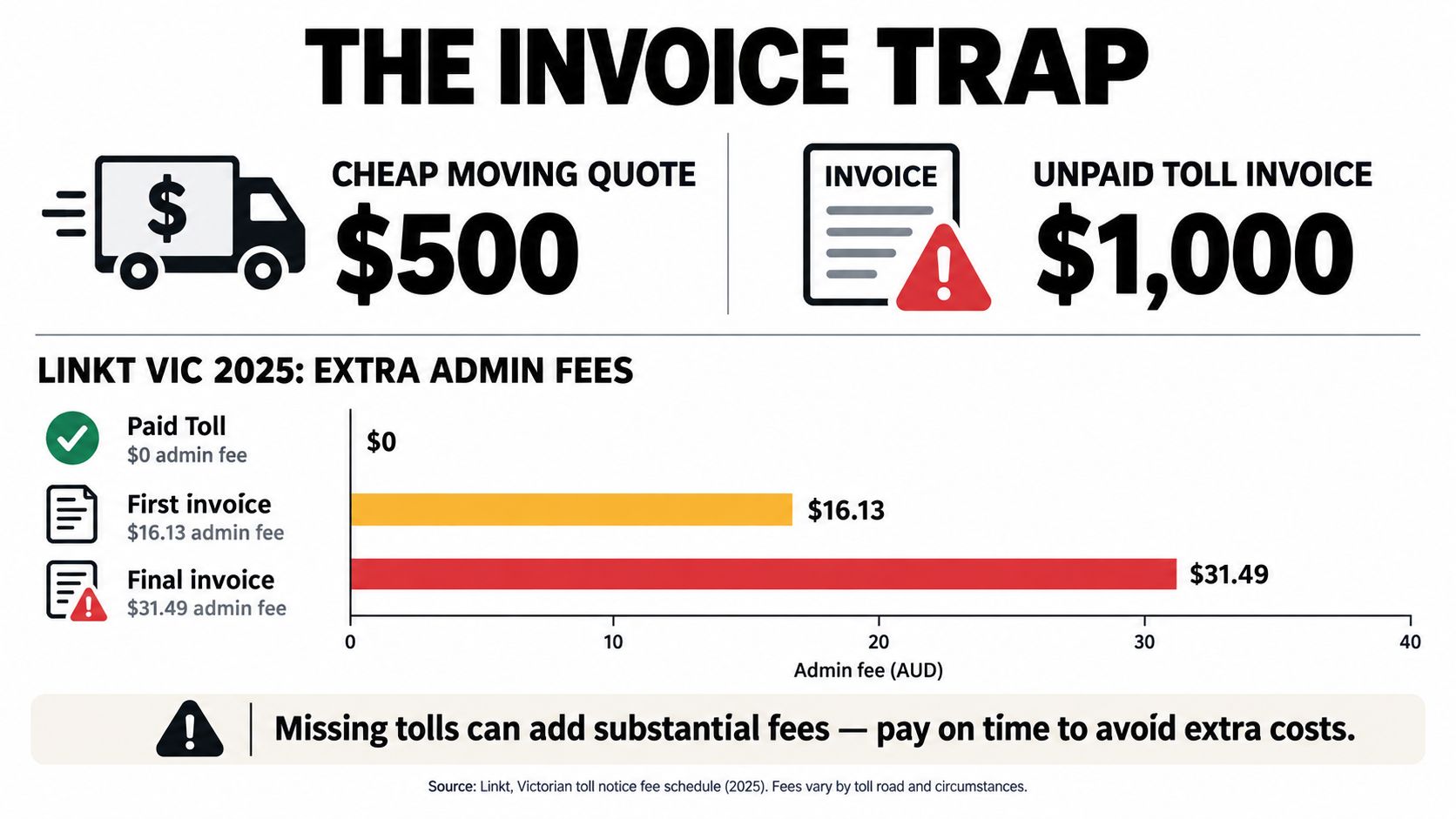
The comparison below shows how quickly the unpaid path outgrows the paid one once administration charges attach to the base toll.
What the Unpaid Path Actually Costs
For 2025, the listed toll-invoice administration charge was $10.81, the demand-notice administration charge was $30.28, and the video-matching fee was $0.62, which may apply each time a vehicle travels on a Queensland toll road without a detected tag, according to Linkt's Brisbane toll and fee changes notice. AirportlinkM7 calculates that video-matching fee per trip, while other roads generally charge it per toll point, per the same notice.
Now run a realistic delivery. A truck crosses several toll points on the way in, unloads, and crosses them again on the way out. Each undetected passage can attract the video-matching fee, the tolls themselves land on an invoice carrying the administration charge, and if that invoice sits unpaid because it went to an old address, the demand notice adds a larger charge on top. The base tolls haven't changed. The process around them has eaten the saving you thought you'd made.
This is one of the hidden costs in moving house that never appears in a headline quote comparison, because it only materialises after the job is done. Two quotes can look close on paper while carrying completely different admin exposure, depending on whether the operator's trucks are properly linked.
The video below walks through how these charges build on an actual trip, which is worth watching if you're planning to drive a hired truck into Brisbane yourself.
Delayed Mail Makes It Worse
Interstate movers are the worst placed people to receive a mailed toll invoice. You've just changed address. The notice goes to the registered operator's address on file, mail redirection is patchy in the first weeks, and by the time the envelope reaches you, the cheaper payment stage may have passed. The Linkt notice linked above also records that AirportLink M7 prices increased from 1 January 2026 in line with Brisbane CPI, while other road prices and fees were stated to remain unchanged until 30 June 2026. The numbers move, so an old invoice is nobody's reliable guide to a new trip.
Reality check: The registered owner stays responsible even when somebody else was driving. Lending the truck doesn't lend the liability.
Judge quotes on exposure, not just price. An operator who discloses tolls by class and route, and holds the account on their own fleet, has removed the invoice trap from your move entirely. An operator who waves the question away has left it sitting in your mailbox.
Daily Visitor Passes Versus a Full Linkt Account
Customers ask me whether they should grab a casual pass or open a full account. The honest answer depends on who's driving, how often, and who controls the vehicle. Price differences between the options are small. The admin differences aren't.
When a Full Account Wins
A full account is the right default for anyone running regular Brisbane trips. Charges settle cleanly against a card, every transaction is logged against a registration, and reconciliation is a weekly habit instead of a detective exercise. For a removal business running weekly interstate services, Get n Go Removals Melbourne is one example of an operator that runs its own fleet on scheduled east coast runs, so tolls are handled at fleet level rather than trip by trip. That structure is what you want to see, whichever company you book.
Accounts also handle vehicle flexibility better. A fleet spanning 4.5 to 12 tonne trucks can hold multiple registrations, each with its correct class. When dispatch swaps a truck, the account gets updated once and every future gantry reads correctly.
When a Visitor Pass Makes Sense
A casual pass suits the one-off private trip. You've hired a truck for a single self-managed move, you'll cross Brisbane's toll roads on one or two days, and you'll never drive that vehicle again. Setting up a short-term arrangement against that registration for your travel dates keeps you out of the invoice system without building account infrastructure you'll never reuse.
The pass path has one sharp edge. It only works if the registration and dates you supply are exactly right. A pass attached to the wrong plate, or one that starts a day late, leaves the same gap as having nothing at all. Double-check the plate against the vehicle itself, not against the hire paperwork alone, because depots do swap vehicles at collection.
The Decision Rule
- Operator's truck, regular runs: Full fleet account, held by the operator, reconciled weekly.
- Your own vehicle, occasional Brisbane trips: Full account, because you'll be back and the setup cost is paid once.
- Hired truck, one move, never again: Visitor pass matched carefully to the plate and dates.
- Hired truck with fleet coverage confirmed: Nothing extra, but get that confirmation in writing before you drive off.
If the vehicle will enter Brisbane more than once, open the account. If it will enter once and never return, a pass is enough.
Don't buy a pass and hold an account against the same plate at the same time, and don't assume a hire company's arrangement covers you until they've said so directly. Duplicated and missing coverage cause the same symptom, a confusing bill weeks later, and both are avoidable with one clear conversation before departure.
A Pre-Trip Dispatch Checklist for Brisbane-Bound Moves
Everything in this guide compresses into a routine my dispatchers run the day before a Brisbane-bound truck leaves. It takes minutes, and it converts Brisbane toll charges from a surprise into a costed line item. Print it, pin it near the allocation board, and run it in order.
The visual version below is the same sequence we hand to new drivers before their first Queensland run.
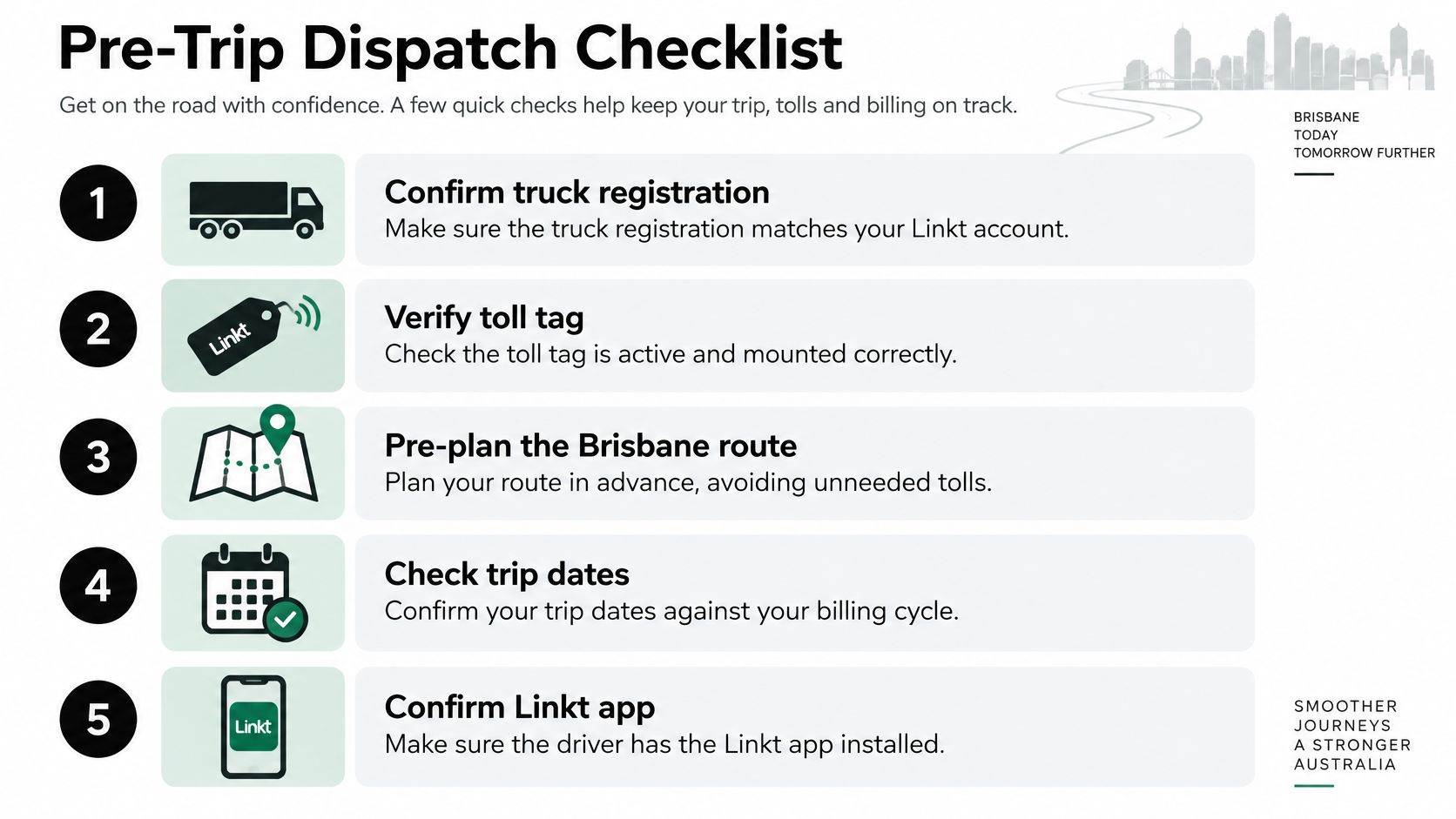
The Five Checks, In Order
- Classify the truck: Confirm gross vehicle mass and axles, then record whether this vehicle runs as Class 3 or Class 4 on the job sheet.
- Match the plate: Verify the toll account is active for that specific registration, especially after any vehicle swap or replacement.
- Map the route: Count expected gantry passages on the planned run in and out, and note any tunnel the navigation app is likely to suggest.
- Log the dates: Record travel dates so the payment window is tracked from the actual day of travel, not from when someone remembers.
- Reconcile within a week: Match account transactions against the registration, date, and route, and query any passage that doesn't fit the plan.
Step five is the one crews skip, and it's the one that catches misreads, wrong-truck charges, and quiet route deviations while the details are still fresh. Pair this routine with the broader interstate moving checklist your customer is working through at their end, and both sides of the move are running off checklists instead of memory.
One extra habit costs nothing. Photograph the truck's plate and the job sheet together at departure. If a toll query surfaces a month later, that photo settles which vehicle ran the job faster than any email thread. Administrative leakage thrives on fuzzy records. Starve it.
Treating Brisbane Tolls as a Pass-Through Cost in Your Quote
Disclose tolls as a separate pass-through line in every interstate quote. Burying them in an hourly rate hides the route and class assumptions from the customer, and makes your price impossible to verify against a competitor's. The network behind these charges is long-term infrastructure, built through milestones including the Gateway Bridge in 1986, the Logan Motorway in 1988, and a $2.12 billion Gateway upgrade completed in 2011, according to the Queensland Parliament's tolling inquiry record. These charges are a financing fixture, not a passing fee, so price them properly. Operators wanting the broader costing picture can read this guide for middle-mile operators, then sanity-check their numbers against published interstate moving costs before quoting.
Moving between Melbourne and Brisbane? Get n Go Removals runs weekly interstate services with its own fleet, toll accounts already linked, and charges disclosed on your quote before the truck leaves. Visit Get n Go Removals Melbourne to request a quote that prices your Brisbane tolls by truck class and route, so the only paperwork waiting at your new address is the kind you expected.