

Office Moving Melbourne: A Complete Guide to a Seamless Relocation
Relocating your Melbourne office is a monumental project, and it's about so much more than just shifting desks and chairs. This is a strategic business decision that directly impacts your team's productivity, operational continuity, and ultimately, your bottom line. A successful commercial relocation hinges on a detailed, forward-thinking plan, turning what could be a chaotic disruption into a smooth transition and an opportunity for growth.
Why Your Melbourne Office Move Demands a Strategic Plan
An office move is easily one of the most complex logistical challenges any business will face. Attempting to manage it without a clear roadmap is a direct path to extended downtime, unforeseen costs, and a highly frustrated team. A well-thought-out strategy, however, transforms this potential headache into a genuine opportunity to enhance your workplace culture and operational efficiency.
Putting in the planning time ensures every detail is meticulously covered, from migrating your critical IT systems to coordinating lift access with building management. For a deeper dive into all the moving parts, this comprehensive guide to office relocations is a great resource to get you started.
Melbourne's Evolving Commercial Landscape
The decision to move is often sparked by growth, downsizing, or simply the need for a more strategic location. Melbourne’s office market has undergone dramatic shifts recently, making these strategic decisions more critical than ever.
Since 2020, the city’s CBD has added a staggering 584,100 square metres of new office space—a 12.2% increase in total stock. This boom, combined with new hybrid work models, led to high vacancy rates. In early 2025, the CBD vacancy rate sat at 18%, significantly above the national average. This unique market presents both challenges and opportunities for businesses planning an office move in Melbourne.
The Core Benefits of a Planned Relocation
Taking a structured approach to your office move delivers tangible benefits that protect your business from the chaos of a poorly executed relocation.
- Minimised Downtime: A detailed plan allows you to schedule the physical move over a weekend or after hours. Your team can pack up on a Friday and walk into a fully functional, ready-to-go workspace on Monday morning, ensuring business continuity.
- Budget Control: Professional planning provides a transparent view of all costs upfront. Expenses like council permits, IT setup, and 'make-good' lease clauses won't emerge as last-minute surprises that blow your budget.
- Boosted Team Morale: When a move is organised and communication is clear, it removes a significant amount of stress from your employees. They feel valued and can stay focused on their roles instead of worrying about logistical uncertainties.
- Operational Efficiency: A relocation is the perfect opportunity to rethink your office layout, daily workflows, and technology. You have the chance to design and build a more productive and collaborative environment from the ground up.
Ultimately, understanding why hiring professional removal services is a smart move is the foundational step towards achieving a seamless, stress-free transition for your entire organisation.
Building Your Relocation Blueprint and Timeline
A successful office move in Melbourne is built on one thing: a comprehensive plan. "Winging it" is a recipe for chaos, blown budgets, and immense stress for your staff. By mapping out every stage months in advance, you transform a daunting project into a series of clear, manageable steps.
Think of this timeline as your project's command centre. It breaks the entire process into smaller, achievable goals, providing clarity for your team and keeping all vendors accountable.
This guide outlines the key phases of your relocation journey, from initial strategic planning right through to settling into your new, optimised workspace.
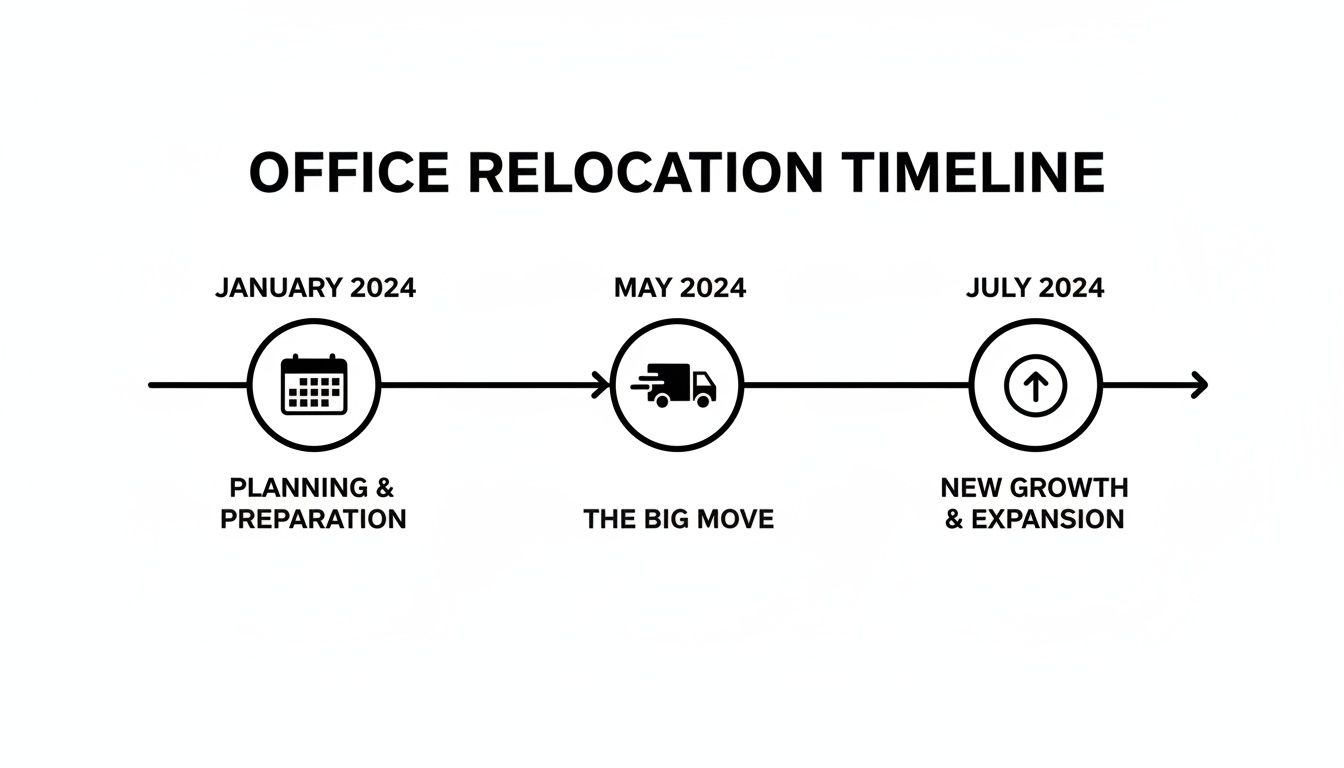
As you can see, a smooth move is a marathon, not a sprint. Each stage is designed to be strategic, ensuring no detail is overlooked.
The Foundation Phase: 3 to 6 Months Out
Your journey begins long before a single box is packed. This early stage is all about strategy and laying the groundwork that will define the entire project's success.
First, appoint an internal move coordinator or a small committee. This person or group will serve as the central point of contact for staff, vendors, and building managers, keeping the project on track and ensuring communication flows smoothly.
Next, you must set a realistic budget. This goes beyond the removalist's fee. You need to factor in costs for new furniture, IT upgrades, bond cleaning at the old premises, and any 'make-good' clauses in your current lease. A detailed budget prevents costly surprises down the line.
Finally, conduct a full audit of your current assets. Go room by room to determine what’s coming with you, what can be sold or donated, and what needs to be disposed of. This is also the perfect time to identify needs for new furniture or technology.
The Coordination Phase: 1 to 2 Months Out
As moving day approaches, the focus shifts from high-level strategy to logistical details. This is where all the pieces of the puzzle begin to fit together.
A critical task now is to finalise the floor plan for the new office. Work with designers and department heads to map out the precise location for every team, desk, and piece of equipment. This plan is an invaluable tool for the movers, IT technicians, and your own team on day one.
This is also the time to engage your IT team heavily. A seamless technology transition is non-negotiable. They must plan every detail, from server migration and data backups to setting up the network and ensuring every workstation is online and functional from the moment you move in.
Don't forget to sort out any permits! For many office moves in Melbourne, particularly in the CBD or inner suburbs, you may need council permits for truck parking or to book a loading dock. Missing this crucial step can lead to significant delays and fines.
The Final Stretch: The Last 4 Weeks
The final month is about locking in details, communicating clearly, and making final preparations. Meticulous attention to detail now will ensure a much smoother move day.
Your primary focus should be your communication plan. Inform all employees about key dates, their responsibilities (like packing personal desk items), and the move-day schedule. You also need to notify all external partners—clients, suppliers, and service providers—of your new address and the date of the change.
During these last few weeks, maintain constant communication with all your vendors.
- Confirm Dates and Times: Double-check your bookings with the removalist, IT technicians, cleaners, and any other involved parties.
- Provide Final Details: Share the finalised floor plan and any specific access instructions with your moving crew.
- Arrange Access: Ensure keys, security cards, and lift access are organised for both the old and new buildings.
To give you a clearer picture, we've created a comprehensive timeline checklist. This breaks down key tasks into a manageable schedule, ensuring nothing slips through the cracks as you count down to moving day.
Office Relocation Timeline Checklist
| Timeframe Before Move | Key Planning Tasks | Logistics & Coordination | Communication |
|---|---|---|---|
| 3-6 Months | Appoint move coordinator. Set budget. Review lease agreements. Audit current assets (furniture, IT). | Research and get quotes from removalists. Begin space planning for the new office. | Announce the move internally to key stakeholders. |
| 2-3 Months | Finalise new office floor plan. Order new furniture and equipment. Select your removalist and other vendors. | Book removalist. Plan IT infrastructure migration. Start decluttering and disposing of unwanted items. | Notify staff of the moving date. Create a detailed communication plan for employees, clients, and suppliers. |
| 1-2 Months | Assign packing responsibilities to departments/staff. Organise 'make-good' repairs for the old office. | Arrange necessary council/building permits. Coordinate with IT for network setup. Schedule cleaners for both locations. | Send out official change-of-address notifications to clients and suppliers. Update company website and materials. |
| Last 4 Weeks | Distribute packing materials (boxes, labels). Confirm insurance coverage for the move. | Finalise move schedule with all vendors. Arrange access (keys, security fobs, lift bookings) for the move team. | Send regular update emails to staff with packing instructions and move-day logistics. |
| Move Week | Complete all packing. Clearly label all boxes and furniture with their new location. Pack an "essentials" box. | Conduct a final walkthrough with vendors. Confirm disconnection/reconnection of utilities. | Remind staff of the final schedule and their roles. Set up an out-of-office message for the moving period. |
| Move Day | Supervise movers at both locations. Ensure protection for floors/walls. Check off inventory as it's loaded/unloaded. | Guide movers according to the floor plan at the new office. Begin workstation and IT setup. | Be available to answer staff questions. Send a "welcome to the new office" communication. |
Following a structured timeline like this is the most effective way to keep your office relocation organised, on schedule, and within budget, making the entire process far less stressful for everyone involved.
When building your blueprint, looking into dedicated storage units for offices can be a smart move to manage furniture and equipment. It’s especially useful for archiving documents or storing surplus items you don't need immediately. Finding the right professional assistance is a key part of this process; learn more about finding the right business moving companies near me to handle the logistics.
Mastering Your Move Day Logistics
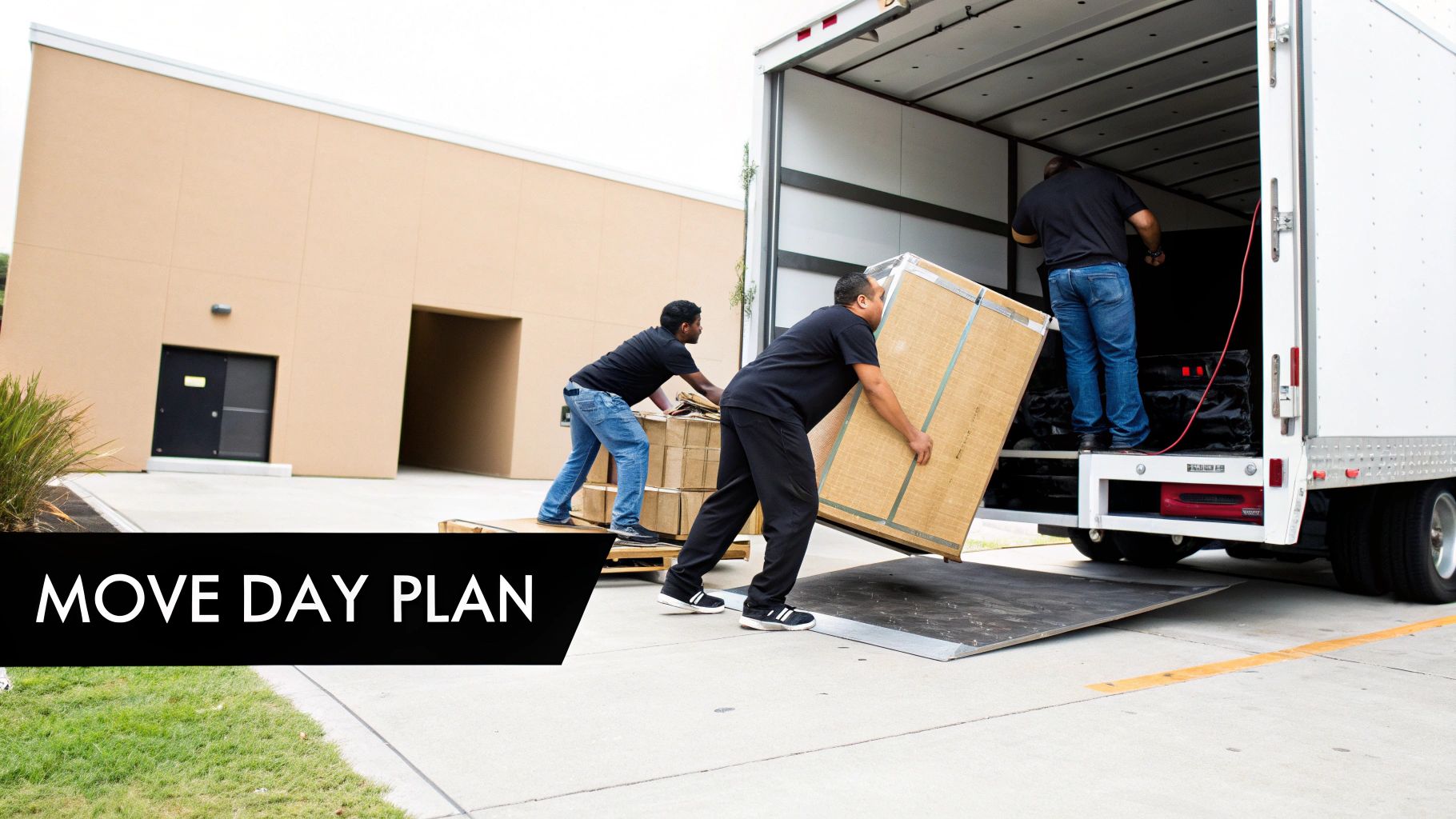
The difference between a move day from hell and one that’s barely a blip on the radar always comes down to on-the-day logistics. Get it right, and your team walks into a productive new space on Monday morning. Get it wrong, and you're facing frustrating delays and unexpected costs.
Success boils down to three core elements: a flawless IT migration, a careful plan for your furniture and physical assets, and expert navigation of Melbourne's unique building and street-level challenges. A failure in any of these areas can quickly derail your move.
Executing a Seamless IT Migration
Your technology is the central nervous system of your business. A bungled IT move can bring operations to a complete standstill. The goal is zero downtime, which demands a specialist plan that goes far beyond simply unplugging monitors.
This is a job for your IT team or a third-party tech specialist, who must be involved weeks in advance. They need to map out the entire process, from decommissioning servers and backing up data to getting the network fully operational at the new office. This is a technical task that should never be left to general movers.
Here’s what your IT migration plan must cover:
- Servers and Network Gear: This is the heart of your operation. It should be the absolute last thing disconnected at the old office and the very first thing connected, configured, and tested at the new one. No exceptions.
- Workstation Reconnection: A simple but brilliant tactic: create a clear labelling system. Every computer, monitor, and peripheral must be matched to a specific desk on the new floor plan. This single step prevents hours of chaos and confusion.
- Data Security: Before a single piece of hardware is moved, ensure everything is securely backed up. Whether to the cloud or an off-site server, a verified backup is your non-negotiable safety net.
Handling Furniture and Equipment with Care
Moving office furniture requires more than just brute strength. Modern workstations can be complex, and delicate equipment needs expert handling to avoid expensive damage. A systematic approach is essential.
Professional office removalists are skilled at dismantling and reassembling modular desks, partitions, and shelving systems. This is crucial for navigating tight doorways and ensuring everything is reassembled correctly at the destination, protecting your investment.
Key Takeaway: A move is the perfect opportunity for a clear-out. Audit your inventory and identify any furniture that’s broken, outdated, or unsuitable for the new space. Arranging for ethical disposal or donation beforehand saves time, effort, and money on move day.
Sensitive equipment like large-format printers, plotters, and specialised machinery requires extra care. We use industrial-grade wraps, custom crates, and purpose-built trolleys to ensure these high-value assets arrive in the exact same condition they left. For tips on packing smaller items, take a look at our guide on essential packing tips for moving.
Navigating Melbourne-Specific Building Logistics
This is where local, on-the-ground experience provides immense value. The unique challenges of moving within Melbourne’s CBD and inner suburbs can completely derail a relocation if you’re not prepared. High-rise buildings, narrow laneways, and strict council regulations demand meticulous forward planning.
One of the most common—and costly—mistakes we see is failing to coordinate with building management at both locations. It is absolutely essential to sort out these details well in advance to ensure the truck and crew have the required access.
Here's a checklist of Melbourne-specific hurdles you must clear:
- Loading Dock Bookings: Nearly every commercial building in Melbourne requires you to book a time slot for the loading dock. These slots fill up quickly, especially on Fridays, so book as early as possible.
- Dedicated Lift Access: You will almost certainly need to book a dedicated goods lift. This often requires arranging for a building manager to be present to lock it off for your exclusive use, which can sometimes involve a fee.
- Council Parking Permits: Attempting to park a large moving truck on the street in the CBD, Southbank, or Fitzroy without a permit is a recipe for disaster. You must apply to the local council in advance, or you risk fines and having nowhere to park.
Managing these logistics is a standard part of any professional office moving Melbourne service. A reputable local mover understands the specific permit requirements and has established relationships with building managers, taking a huge amount of stress off your plate. This expertise is particularly important as Melbourne has reclaimed its status as Australia's top moving destination, capturing 28% of all inbound metro moves recently. You can find more details in these fascinating reports on Australia's moving and migration statistics.
How to Minimize Business Downtime During Your Move
Every hour your business is offline during a move translates to lost revenue and productivity. The primary goal of a robust relocation strategy is to shrink that window of disruption as much as humanly possible. A perfectly executed move means your team powers down on a Friday afternoon and walks into a fully operational, connected, and organised new office on Monday morning.
This seamless transition doesn’t happen by chance; it is the result of intelligent scheduling and strategic delegation. For any business undertaking an office move in Melbourne, mastering this aspect is key to protecting your bottom line.

The current commercial property landscape in Melbourne adds another layer of urgency. A significant post-pandemic shift has left the CBD with soaring office vacancy rates, hitting 18% in January 2025—a huge jump from the pre-COVID figure of just 3.4%. While this provides more negotiating power to secure a great space, it also intensifies the pressure to operate with maximum efficiency. You can get more details from the Property Council of Australia's market analysis.
Embrace the After-Hours Advantage
The single most effective way to maintain business operations is to schedule the physical move outside of your standard 9-to-5 working hours. In almost every case, this means booking a weekend or after-hours move.
The logic is simple but incredibly powerful. By having professionals handle the heavy lifting while your business is naturally closed, you eliminate any conflict between moving-day chaos and revenue-generating activities.
Weekend Move Scenario: Picture this. Your team finishes work as normal on Friday. Over the weekend, the movers pack, transport, and set up everything at the new location. On Monday, your staff arrive at their new desks, log in, and resume their work with zero interruption to the business week.
This approach transforms what could be a multi-day operational halt into a smooth, background process that happens seamlessly.
Delegate Packing and Unpacking
It might seem cost-effective to have your employees pack their own desks, but this is almost always a false economy. Every hour your team spends wrapping monitors or boxing up files is an hour they aren't dedicating to their core job functions. The "soft cost" of that lost productivity adds up quickly.
Engaging professional packing and unpacking services is a game-changer for efficiency.
- Expert Packers: They are trained to pack office equipment securely and swiftly, using the right materials to protect everything from fragile tech to bulky furniture.
- Systematic Unpacking: We work directly from your new floor plan to place every box and piece of furniture in its designated spot, ready for your team to connect and start work.
- Focus and Continuity: Your employees remain focused on their core responsibilities right up until the last minute, ensuring client work and projects continue without interruption.
By delegating this labour-intensive task, you empower your team to do what they do best, making the entire relocation far more efficient. You can explore the full suite of options from our Melbourne commercial office removalists.
Prepare for a Productive First Day
A smooth start in the new space is vital for morale and a swift return to full productivity. Clear communication and thoughtful preparation are your best tools here.
Ensure every team member receives a detailed floor plan well before moving day. It should clearly show the location of their new desk, along with key areas like meeting rooms, kitchens, and bathrooms. This simple step eliminates the "where do I go?" confusion and helps everyone feel settled from the moment they arrive.
Another highly effective strategy is the 'Day One Essentials' kit. This is a clearly marked box for each employee containing everything they need to be productive immediately:
- Laptop and chargers
- Keyboard and mouse
- Essential documents or files
- Personal items like photos or stationery
By ensuring these boxes are the last to be packed and the first to be opened, you guarantee every employee can get online and start working within minutes of arriving. It’s a small detail that makes a massive difference in achieving a zero-downtime move.
Settling In and Finalizing Your Relocation
The moment the last box is placed in your new office, it’s easy to breathe a sigh of relief. While the heavy lifting is certainly over, the crucial work of settling in has just begun. This final phase is essential for transforming the new space into a fully functioning business hub and ensuring a smooth transition for your entire team.
The move isn't truly "complete" until every item is accounted for and all administrative details are finalised. Getting this stage right sets the tone for your company's success in its new Melbourne home.
Conduct a Thorough Post-Move Audit
Before your moving team signs off, it is vital to conduct a final walkthrough of the new premises. This isn't just a quick glance; it's a systematic audit to confirm that every aspect of the move has been completed to your satisfaction.
With your inventory checklist in hand, walk through the space with your move coordinator. Check that all furniture, equipment, and labelled boxes have arrived and are in their designated spots as per the floor plan. This is also the time to inspect for any damage that may have occurred during transit.
Pro Tip: Do not rush this process. A professional moving company will expect and encourage a detailed final inspection. It is far easier to address any issues, such as a missing box or a scuffed desk, while the crew is still on-site.
This final check ensures accountability and provides complete peace of mind before you officially sign off and finalise the project.
Manage the Unpacking Process Systematically
Now that everything is in place, the task of unpacking begins. A strategic approach here can make a world of difference, preventing chaos and getting your team back to full productivity much faster. If you’ve opted for a professional unpacking service, the crew will handle this efficiently.
If your team is managing it themselves, provide clear guidance to avoid a disorganised free-for-all.
- Prioritise Workstations First: The primary goal is to get your team operational. Focus on unpacking computers, monitors, keyboards, and the 'Day One Essentials' boxes for each employee so they can log in and resume work.
- Tackle Communal Areas Next: Once workstations are functional, move on to shared spaces like the kitchen, meeting rooms, and supply closets. This helps restore a sense of normalcy and office culture.
- Set a Deadline for Personal Items: Encourage staff to unpack their personal desk items within the first day or two. This small step helps them feel settled and fosters a sense of ownership over their new workspace.
A systematic unpacking process prevents the new office from feeling like a temporary storage unit for weeks on end.
Finalise Critical Administrative Updates
With the physical move handled, the last crucial step is updating your business details across all platforms. Overlooking this administrative task can lead to missed deliveries, confused clients, and even service interruptions. Your new address must be officially registered everywhere your business has a presence.
Create a comprehensive checklist to ensure nothing is missed:
- Government and Legal Bodies: Update your address with ASIC, the ATO, and any other relevant regulatory bodies.
- Online Presence: This is vital. Immediately update your Google Business Profile, company website, social media pages, and any online directories you're listed in.
- Suppliers and Service Providers: Notify your bank, insurance provider, utility companies, and all key vendors of your new address.
- Clients and Customers: Send a formal communication to all clients, informing them of your new location and updated contact details.
Organise for the Long Term
A new office provides a fantastic opportunity to implement better organisational systems from day one. It's the perfect time to consider how you'll manage assets that don't fit into the immediate floor plan. For items like surplus furniture, archival documents, or seasonal equipment, using a professional service can be a highly effective strategy. Learn more about how secure storage solutions in Melbourne can help keep your new workspace clutter-free and efficient right from the start.
Your Top Melbourne Office Moving Questions Answered
Moving your entire business generates a lot of questions. We understand. From determining the budget to ensuring your team isn't left unproductive, getting the right answers upfront is a game-changer. Here’s a rundown of the most common queries we receive about office moving in Melbourne, with practical, straightforward advice to help you plan effectively.
How Is the Cost of an Office Move in Melbourne Calculated?
There is no one-size-fits-all price for an office move, as the final cost depends on several key factors. The primary drivers are the size of your office, the volume of items to be moved, the distance between locations, and any additional services required.
A detailed quote will factor in the number of workstations, any specialised equipment (like server racks or heavy machinery), and the access conditions at both buildings. Navigating a multi-storey building with strict lift booking times or accessing a tight CBD laneway requires more planning and manpower, which naturally influences the price.
Additional services also impact the cost:
- Professional Packing and Unpacking: A full-service option that saves your team a significant amount of time and lost productivity.
- IT Disconnection and Reconnection: A specialist service required to ensure your technology is handled correctly and securely.
- Furniture Disassembly and Reassembly: Essential for modular desks, workstations, and large boardroom tables.
While a small office move might cost a few thousand dollars, a large corporate relocation is a more substantial investment. The only way to get an accurate figure is through an on-site assessment. This allows for a transparent, detailed quote you can trust, whether it's a fixed price or an hourly rate.
What Is the Best Way to Move Without Disrupting Our Business?
Minimising downtime is the absolute number one priority for any commercial relocation. The most effective strategy to achieve this is to schedule the physical move outside of your standard business hours.
By far, the best and most popular approach is the weekend move. This allows your team to finish their work week as normal on Friday, then walk into a fully set-up, operational new office on Monday morning. It transforms a potentially major disruption into a seamless background event.
To execute this, you need to partner with professional movers who offer flexible, 24/7 scheduling. Furthermore, utilising a full-service packing and unpacking team enables your staff to remain productive on their core tasks right up until the last minute, ensuring a genuinely uninterrupted transition.
What Should I Look for in a Melbourne Office Removalist?
Choosing the right moving partner is absolutely critical. You need a company with proven, specific experience in commercial relocations—not just a residential mover. Always verify that they hold comprehensive insurance, including Public Liability and Transit Insurance, to protect your assets during the move.
A reputable firm will own and operate a fleet of well-maintained trucks and employ trained, full-time staff rather than casual contractors. They should also provide a dedicated move coordinator for a single point of contact and insist on an on-site inspection before delivering a detailed quote. A quick review of their online reviews and client testimonials will also reveal a great deal about their track record for reliability and quality of service.
Are We Responsible for Arranging Parking Permits?
In most cases, yes, the client is responsible for arranging parking. Securing a permit for the moving truck is particularly important in busy areas of Melbourne like the CBD, Southbank, Docklands, and other inner-city suburbs. Your moving company should provide clear guidance on what your local council requires.
Failing to secure the correct permits can result in significant fines and costly delays on move day if the truck has nowhere to legally park. It is crucial to discuss all parking and building access details—such as booking loading docks and service lifts—with your move coordinator well in advance.
Ready to plan an office move that's smooth and efficient? The expert team at Get n Go Removals Melbourne has been handling commercial relocations for over a decade, offering solutions designed to minimise your downtime and protect your gear. Contact us today for a detailed, no-obligation on-site quote.