

Your Ultimate Guide to Finding the Best Removalists Near Me
That first search for “removalists near me” opens the door to countless options, but finding a truly professional and reliable service doesn't have to be overwhelming. The secret to a seamless move lies in preparation—understanding your needs before you start contacting companies. This foundational step ensures you get accurate quotes and find a team perfectly suited for your job.
How to Start Your Search for Local Removalists
The journey to finding a great moving team begins in your home, not on a search engine. A small amount of planning upfront will save you from significant stress and unexpected expenses down the line. It empowers you to request accurate quotes and identify the ideal crew for your specific requirements.
So, where do you begin? It’s a straightforward process.
- Assess the scale of your move. Are you relocating from a compact one-bedroom apartment or a large five-bedroom family home? This is the primary piece of information any removalist will need to provide an estimate.
- Create a basic inventory. You don’t need a detailed spreadsheet of every single item, but make a list of the major furniture pieces: sofas, beds, refrigerator, washing machine, dining table, etc. Also, estimate the number of boxes you anticipate having. This gives movers a clear picture of the job's scope.
- Identify any specialty items. Do you own a piano, a pool table, a fragile antique cabinet, or oversized artwork? These items require specialised equipment and handling expertise that not all companies possess. Note them down to discuss specifically.
Completing this simple groundwork allows you to approach potential movers with confidence, armed with the exact details they need.
This infographic outlines the most effective way to start your search.
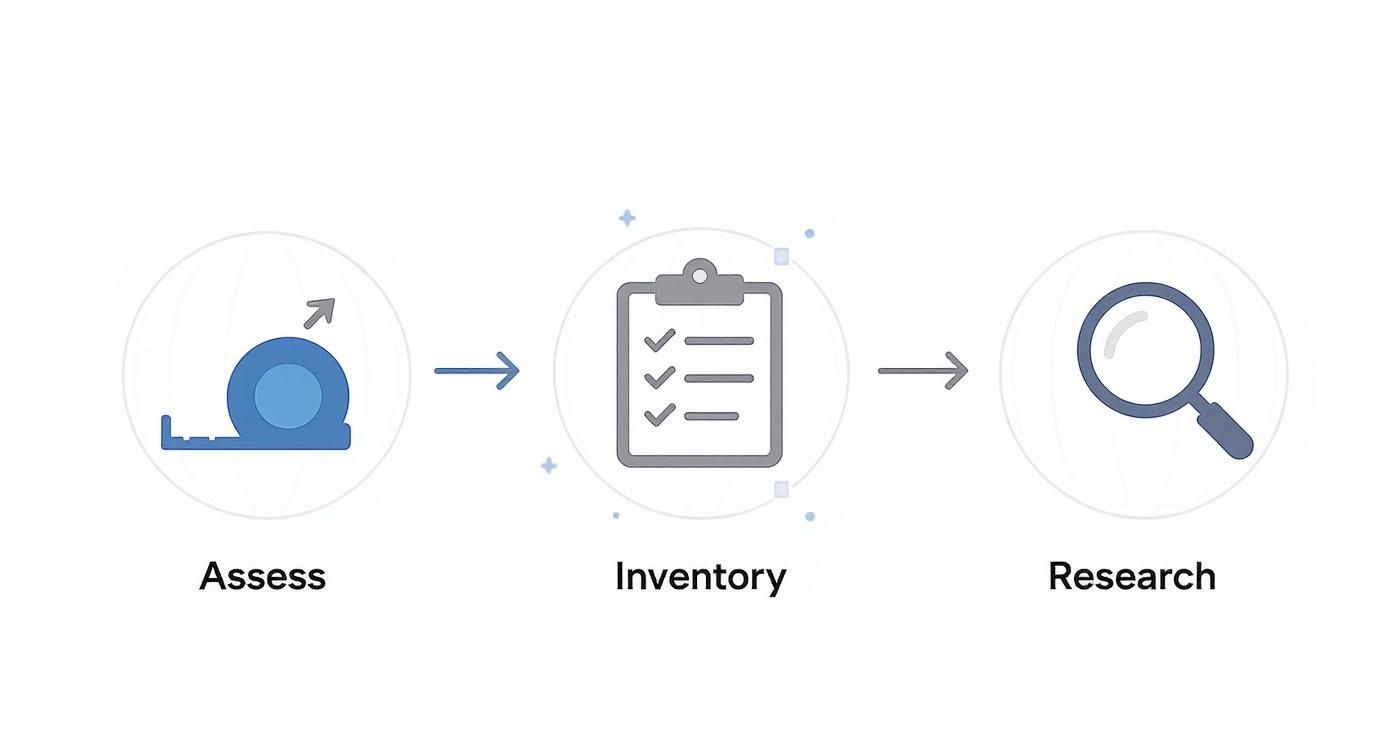
The process is simple: evaluate your belongings, compile a quick inventory, and then begin your detailed research.
Australia’s removalist industry is substantial, reaching a market size of $2.6 billion in 2024. As the industry is closely linked to the housing market, availability can become limited during peak seasons. This underscores the importance of being well-prepared.
If you're interested in the mechanics of how local businesses appear in your search, you can understand local SEO tactics for service providers to see the digital marketing efforts involved. Once you're ready to find a professional service, you can check the areas we service to see if our team covers your neighbourhood.
How to Vet Removalists and Spot True Professionals

You've completed your initial research and have a shortlist of potential moving companies. Now comes the critical stage: distinguishing the seasoned professionals from the unreliable operators. This vetting process is absolutely essential to protect your belongings and ensure your moving day proceeds without a hitch.
A professional website and a friendly voice on the phone are positive signs, but they don't reveal the full picture. You need to delve deeper to confirm their credibility.
First and foremost is insurance. Any legitimate removalist in Australia must hold Public Liability Insurance, which covers accidental damage to property (e.g., scuffed walls, scratched floors). They must also have Transit Insurance to protect your belongings while they are on the truck. Don't simply accept their word; ask for their current certificates of currency. A reputable company will provide them without hesitation.
Reading Between the Lines of Customer Reviews
Online reviews offer a wealth of information, but you must learn to interpret them critically. Analyse patterns in feedback across multiple platforms like Google, ProductReview.com.au, and social media.
- Spotting Authentic Feedback: Genuine reviews often contain specific details. They might mention the movers by name ("Big thanks to Dave and the team!") or describe how a particular challenge was handled. Be wary of a sudden influx of generic, five-star ratings with no detail.
- Evaluating Responses to Negative Feedback: This is incredibly revealing. Observe how the company responds to criticism. A professional business will address complaints calmly and offer a resolution. A lack of response or defensive replies should be considered a major red flag.
A detailed, itemised written quote is your best defence against unexpected costs. It should clearly outline all charges, including the hourly rate or fixed price, call-out fees, and any potential extras for stairs or difficult access. If a company is hesitant to put everything in writing, walk away.
A reliable company will also provide clear and comprehensive terms and conditions. These documents are not just legal formalities; they outline your rights and their responsibilities. Our in-depth guide on choosing the right removals firm for your move offers more expert tips on what to look for before signing any agreement.
Investing time in this stage will prevent significant issues later. To simplify the process, use this quick checklist for every company you consider.
Your Quick Removalist Vetting Checklist
Use this reference guide to quickly assess whether a moving company is reputable and reliable.
| Verification Check | What to Look For | Why It's Essential |
|---|---|---|
| Insurance Proof | Current certificates for Public Liability and Transit Insurance. | Protects you and your belongings from accidental damage during the move. |
| Written Quote | A detailed, itemised quote that lists all potential costs clearly. | Prevents hidden fees and ensures you know exactly what you're paying for. |
| Online Reviews | Consistent, detailed feedback and professional responses to complaints. | Shows a track record of good service and a commitment to customer satisfaction. |
| ABN Lookup | A valid Australian Business Number (ABN) registered on the ABR. | Confirms they are a legitimate, registered business operating legally in Australia. |
| Terms & Conditions | Clear, easy-to-understand T&Cs that outline responsibilities. | Defines the agreement between you and the mover, protecting both parties. |
Performing these simple checks will give you the confidence that you're hiring a team you can truly trust with your move.
Decoding Removalist Quotes to Avoid Hidden Fees

A removalist quote is more than just a price; it's the financial blueprint for your move. Understanding its components is the key to avoiding unexpected charges on moving day.
When you search for "removalists near me," you’ll discover two primary pricing models.
First, there is the hourly rate. This model can seem attractive for smaller, local moves. However, the final cost can easily escalate due to unforeseen delays, such as peak-hour traffic or slow elevator access at your new building.
The alternative is a fixed-price quote. This provides cost certainty from the start and is generally the recommended option for larger or more complex relocations, giving you complete peace of mind.
Spotting Potential Extra Charges
Regardless of the quote type, you must scrutinise it for potential hidden costs. These fees are often buried in the fine print or omitted entirely. It is your responsibility to ask direct questions.
Common extra charges to look for include:
- Stair Fees: A surcharge, often per flight of stairs, for properties without elevator access.
- Long-Carry Fees: Applied if the truck cannot be parked close to your entrance, requiring the crew to carry items over a significant distance.
- Difficult Access Fees: For navigating obstacles like narrow driveways, steep inclines, or other challenges that increase the job's difficulty.
- After-Hours or Weekend Rates: Expect to pay a premium for moves scheduled outside standard business hours.
A truly professional removalist will be upfront about every single potential charge. If a quote seems vague or the company gets shifty when you ask about extra fees, take that as a massive red flag.
For clarity and professionalism, choose movers who utilise modern, simplified invoicing and transparent payment practices.
For a more detailed breakdown, explore our guide on the hidden costs in moving house. And remember: always, always get the final, agreed-upon quote in writing.
Getting Ready for Moving Day
The key to a stress-free move isn't a secret trick on the day itself; it's the diligent preparation in the preceding weeks. Solid planning transforms potential chaos into a smooth, efficient operation. With your removalists booked, your focus should now shift to preparing your belongings for their arrival.
An organised packing system is essential. Instead of randomly filling boxes, a methodical approach will save you hours of frustration during unpacking. A highly effective technique is to label each box with two key pieces of information: its destination room (e.g., "Main Bedroom") and a brief summary of its contents ("Bedside Lamps," "Winter Clothes"). This makes locating items effortless.
For fragile items, be generous with packing paper and bubble wrap. A professional tip for packing plates is to place them vertically on their side, never flat. This orientation makes them far less susceptible to cracking under pressure.
The All-Important Essentials Box
One of the most valuable preparations you can make is to pack a "first-night" essentials box. This is the one container that travels with you in your car, not on the truck. It serves as your survival kit for the first few hours in your new home.
- Toiletries: Toothbrushes, toothpaste, soap, and a roll of toilet paper are non-negotiable.
- Basic Kitchen Supplies: A kettle, coffee or tea, mugs, snacks, and paper towels.
- Essential Tools: A box cutter for opening other boxes, a small toolkit for basic furniture assembly, and phone chargers.
- Personal Comforts: A change of clothes and any necessary medications.
This one box is a lifesaver. It stops that frantic, late-night hunt for a toothbrush when you're exhausted and surrounded by a sea of cardboard. For a complete rundown, our moving house checklist covers every little thing you'll need to remember.
Beyond packing, prepare the physical spaces. At your old home, ensure a clear, wide path for the crew to move items. Replicate this at your new property, and consider laying down protective coverings on floors in high-traffic areas. Having a rough idea of where large furniture will be placed saves time and prevents unnecessary reshuffling later.
It's also interesting to observe current moving trends. Despite a recent national dip in moving demand, Australia's "great regional migration" continues. Moves from cities to regional areas remain 20.5% higher than pre-pandemic levels, often indicating more planned, lifestyle-driven relocations. You can discover more insights about Australian moving patterns on findamover.com.au.
Managing Your Move Like a Pro on the Day

After weeks of planning and packing, moving day is all about execution. The primary goal is to remain calm and organised. A composed mindset ensures a smooth workflow from the moment your removalists arrive.
Position yourself as the project manager of the operation. Have your moving contract and inventory list accessible. When the crew arrives, greet them, conduct a brief walkthrough, and highlight any particularly fragile boxes or items requiring special care.
Supervising the Loading Process
Once the team begins, your main role is to be available to answer questions. It's best to stay clear of their direct path to avoid hindering their progress, but remain nearby. Your presence is especially important when they are handling large or awkward furniture.
Before the truck door is sealed, perform a final, thorough walkthrough of your old home. Check every room, cupboard, and closet. This simple five-minute check can prevent the major stress of discovering a forgotten item later.
Key Takeaway: Be present and communicative. A clear line of communication with the moving crew supervisor is the single most effective way to prevent misunderstandings and solve minor issues before they become major problems.
Unloading and Final Inspection
Upon arrival at your new home, your role shifts to that of a director. Guide the movers on the placement of each large piece of furniture. A pre-drawn basic floor plan can save a significant amount of time and physical effort.
As items are brought in, perform a quick visual inspection for any obvious damage. Once the final box is inside, review your inventory list and inspect your key furniture pieces before signing off on the completion paperwork. For more strategies for a successful moving day, consult our guide on how to move house efficiently.
Common Questions About Hiring Removalists
Whether it's your first time hiring a moving company or you're a seasoned mover, the details can be complex. Clear answers to common questions are key to a stress-free experience. Here are some of the most frequent queries people have when searching for "removalists near me."
It's also useful to be aware of broader economic trends. Currently, the Australian housing crisis is impacting the removals industry. Google searches for moving services recently fell to a two-decade low as high property prices and rental costs cause many to delay relocation plans. While it's a quieter period overall, some regions like the ACT remain busy. This highlights how economic factors can influence the moving landscape. You can read the full analysis on the housing crisis's impact on moving demand for more detail.
How Far in Advance Should I Book Removalists?
The golden rule is to book your removalists 4-6 weeks in advance. This is especially critical if you plan to move during a peak period, such as summer, the end of the month, or school holidays, when demand is highest.
Booking early not only secures your desired date but also provides a wider selection of reputable companies and greater scheduling flexibility. For off-peak moves, you might manage with 2-3 weeks' notice, but confirming your booking sooner is always the safer and more strategic choice.
What Is the Difference Between Transit and Public Liability Insurance?
Understanding the distinction between these two types of insurance is crucial for protecting your belongings and property.
Transit Insurance specifically covers your goods while they are being transported on the truck. It protects against incidents that occur in transit, such as a road accident.
Public Liability Insurance, conversely, covers accidental damage to the property at either your departure or arrival location. This insurance applies to incidents like a scratched floor, a damaged wall, or a broken door frame. Any professional removalist company must hold both policies and should readily provide proof of coverage. Do not hesitate to ask for it.
Should I Choose an Hourly Rate or a Fixed Quote?
The best choice depends on the specific details of your move, as there is no one-size-fits-all answer.
An hourly rate can be more cost-effective for smaller, local moves, provided you are completely packed and ready when the team arrives. If the process is efficient and free of delays, this model can result in savings.
A fixed-price quote offers certainty and peace of mind. It is the recommended option for larger homes, long-distance relocations, or any move with potential complexities. Knowing the exact cost upfront eliminates financial stress on moving day.
Do I Need to Empty Drawers Before the Move?
Yes, in almost all cases, you should completely empty drawers before moving furniture.
Even lightweight items like clothing add significant weight, making pieces like chests of drawers or dressers unstable and difficult for the crew to carry safely. Furthermore, loose contents can shift during transport, potentially causing damage to the furniture from the inside. Emptying drawers is a standard safety practice and the most secure approach for both your belongings and the moving team.
For a stress-free move with transparent pricing and professional service, trust the team at Get n Go Removals Melbourne. Let our experienced, police-checked staff handle the heavy lifting. https://www.getngoremovals.com.au