

Sydney to Brisbane Movers: 2026 Costs and Schedules
You've got a lease end date in Sydney, a start date in Brisbane, and a house full of furniture that has to survive 890 km between them. That gap is where most interstate moves go wrong. People compare Sydney to Brisbane movers on price alone, then discover the delivery window, the packing standard, or the insurance wording doesn't match what they assumed.
Treat this move as a handling problem first. Cost, timing, packing and cover all connect to what happens to your belongings between two front doors.
Why Sydney to Brisbane Moves Keep Growing
A Sydney couple in a two bedroom flat accepts a job offer in Brisbane. They've got six weeks to hand back keys, find a rental, book a truck, and get north before the new role starts.
Nothing about that timeline feels unusual, which is the point. Thousands of households are working to the same kind of deadline, and truck space around school holidays and month end settlements fills fast.
In 2024-25, Sydney recorded net internal migration of -33,282 people while Brisbane recorded a gain of 11,077 people, according to KPMG's analysis of ABS regional population data.
Most of these moves are household relocations. A smaller share are rental transfers and business moves, where the pressure is different. A renter works to a lease date, a buyer works to settlement, and an office works to reopening.
What follows runs in the order you'll need it. Cost, transit time, quote drivers, packing, insurance, vetting a mover, then booking. Treat every range as a planning figure only. Your written quote replaces it.
What Sydney to Brisbane Movers Charge in 2026
Use this table to place your home in a broad band, then get that band confirmed against your actual inventory.
Indicative Sydney to Brisbane moving costs by home size, 2026
| Home size | Typical volume | Indicative cost range | Usual service option |
|---|---|---|---|
| Studio or 1-bedroom | 8-15 m3 | $1,200-$2,200 | Shared load or small truck |
| 2-bedroom | 18-28 m3 | $2,200-$3,800 | Dedicated truck |
| 3-bedroom | 30-40 m3 | $3,500-$5,500 | Dedicated truck with two-person crew |
| 4-bedroom or larger | 45-60 m3 | $5,000-$8,000 | Large truck, sometimes two trucks |
These are indicative door to door planning ranges for a full service road move. They're built from typical quoted ranges, not a fixed price list, and they must be confirmed in writing for your addresses, dates and access.
Why two quotes for the same home can differ so much
Volume explains part of it, but service pattern explains more. A two bedroom home quoted at the low end is often travelling differently from the same home quoted at the high end, even if both crews load and unload at the same addresses.
One mover may include furniture wrapping, dismantling beds, and a set pickup day. Another may price transport only, then add packing, stairs and reassembly later. The cheaper document isn't always the cheaper move.
Shared load versus dedicated truck
A shared load puts your goods on a truck with other households heading north. You pay for the space you use, which suits a studio or small one bedroom home. The trade off is control. The truck waits for consolidation, runs to a set weekly pattern, and gives you a delivery window rather than a precise arrival time.
That works if your dates flex. It doesn't work well if you've got one day between settlement and starting work, or if you can't have someone waiting in Brisbane across several possible days.
A dedicated truck carries only your household. It costs more because you're paying for the whole vehicle and crew, but it runs to your booked date and usually involves less handling. Your goods go on in Sydney and come off in Brisbane without being sorted with other loads in between.
For larger homes, dedicated transport is often the practical option anyway. Once volume fills most of a truck, the saving from sharing shrinks while the scheduling disadvantage remains.
Getting a number you can compare
Don't accept a price based only on bedroom count. Two three bedroom homes can differ by a garage full of tools, an outdoor setting, a piano, or boxes from a study.
Ask for a cubic metre estimate from a video survey or in home inspection. Walk through every room, open the garage, and point out items that won't travel. Send measurements for oversized pieces.
Comparison rule: Only compare quotes that use the same inventory and list the same inclusions. If one includes packing and another doesn't, you're not comparing prices. You're comparing different jobs.
Check whether the figure is fixed for the listed inventory or an estimate that can change if volume changes. Both approaches can be fair, but you need to know which one you've signed. If extra items appear on pickup day, ask in advance how the mover recalculates the charge.
A sensible quote also names the pickup window, the expected delivery window, and what happens if your Brisbane keys aren't available. Price without those terms leaves the riskiest part of an interstate move unpriced.
Transit Times and Weekly Schedules on the 890 km Route
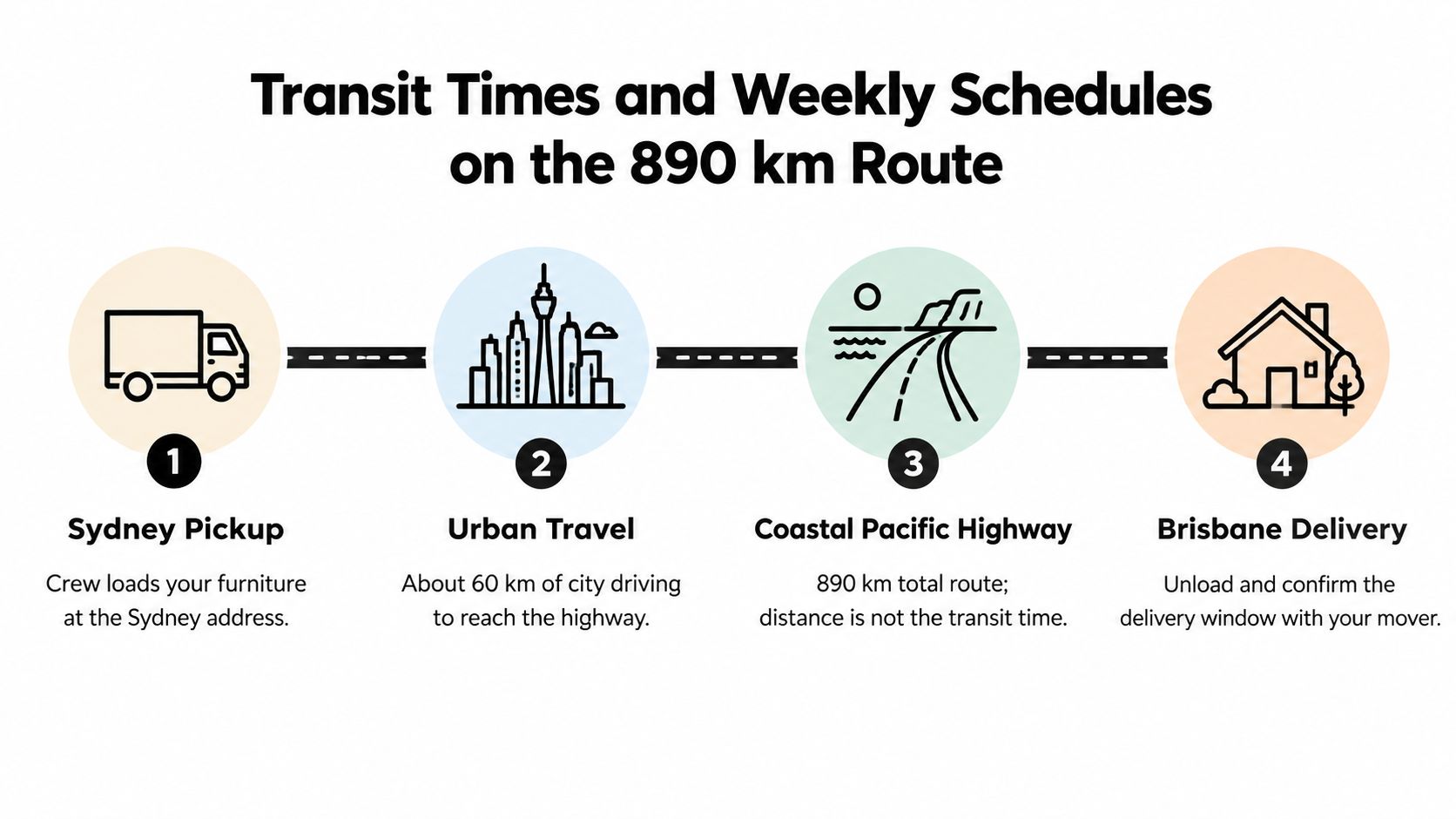
The road corridor runs about 890 km via the coastal Pacific Highway, including about 60 km of urban travel, as set out in research on the Sydney to Brisbane transport corridor. That distance is a route length, not a promise about when your furniture arrives.
Loading time, driver rest requirements, metropolitan congestion, inspections and delivery coordination all sit around the highway driving. A crew can lose more time reaching a tight inner city loading dock than it saves on a clear stretch of highway.
The visual below breaks the journey into its four practical stages, from pickup through to Brisbane delivery.
Sydney to Brisbane transit time by service pattern
| Service pattern | Typical pickup to delivery | Schedule pattern | Best suited to |
|---|---|---|---|
| Dedicated truck, direct | 1-2 days on the road plus loading | Booked to your date, within driver hours | Fixed settlements and tight timelines |
| Shared load, weekly run | 4-7 days from pickup | Weekly, sometimes fortnightly on set days | Small homes and flexible dates |
| Storage then delivery | 1-3 weeks overall | Set by the storage facility and both delivery dates | Gaps between settlement and possession |
What the urban section does to your load
Steady highway travel is comparatively predictable. Stop start city driving creates repeated braking and lateral movement, so cartons need packing that stops contents shifting inside the box, not just padding on the outside.
Fragile and high value furniture should be individually wrapped, held with load bars or straps, and separated from hard objects with edge protection and cushioning. Tall items such as wardrobes need low centre of gravity positioning and positive restraint.
Booking around a fixed date
Weekly runs create a simple risk. Miss the truck and you may lose a full week, not a day. For a fixed settlement or lease start, book three to four weeks ahead where possible and get the delivery window in writing.
School holidays and month end settlements tighten capacity. If your date falls in one of those periods, earlier booking matters more than small price differences between movers.
For broader planning around the gap between pickup and delivery, read this comprehensive guide for long distance relocation before you lock travel and accommodation.
Build your timeline in this order:
- Fix the earliest possession time: Confirm when keys will be released, not just the settlement date.
- Set the delivery target: Book arrival two to three days after that earliest possession time.
- Cover the gap: Arrange short term accommodation and keep essentials with you.
- Confirm the window: Get pickup and delivery windows, plus the contact process for delays, in writing.
That buffer feels inconvenient when you book it. It feels very different when settlement runs late and a loaded truck has nowhere to unload.
Cost Drivers, Hidden Charges and Tax Treatment
The biggest swing in most quotes is volume. Add a garage, a second living area and outdoor furniture, and you may need a larger truck, more crew time, or a second vehicle. Reduce volume before quoting and the price basis changes with it.
Access runs a close second. A ground floor house with driveway parking loads faster than a unit with stairs, a booked lift and a long carry. That difference applies at both ends, so easy access in Sydney doesn't cancel difficult access in Brisbane.
Charges to surface before you sign
- Volume and oversized items: Cubic metres, plus pianos, large wardrobes, machinery or bulky outdoor pieces.
- Stairs and distance to the door: Flights, lift bookings, long carries and shuttle vehicles where a large truck can't get close.
- Parking and kerb access: Permits, loading zones and building restrictions at both addresses.
- Travel date: Weekends, school holidays and month end dates usually carry stronger demand.
- Dismantling and reassembly: Beds, wardrobes, desks and modular furniture, including who supplies tools and refits hardware.
- Packing service and materials: Full packing, fragile only packing, cartons, wrapping and specialised crating.
- Storage: Days between pickup and delivery, handling into and out of storage, and redelivery terms.
- Insurance level: The cover type and value you choose for goods in transit and storage.
- Multi drop stops: Deliveries split between a home, storage unit or second address.
Ask what triggers each charge. For example, is the first flight of stairs included? What counts as a long carry? If the lift booking runs over, who pays for waiting time?
This breakdown of interstate moving costs is useful for checking whether a quote has separated transport from the extras that often appear later.
Tax treatment for a work related move
Don't budget on claiming the move at tax time. The Australian Taxation Office guidance on removal and relocation costs states that removal and relocation costs are not deductible, even for a job transfer or new employer, because they're classed as private or domestic.
If your employer pays a relocation allowance, it generally must be declared as assessable income. Confirm the treatment of both the moving invoice and any employer contribution before you rely on that money in your budget.
Ask for an itemised quote that lists inclusions, exclusions, and the exact event that triggers an extra charge. Vague wording is where hidden charges live.
How to Pack for an 890 km Interstate Trip
Packing for this route has to slow moisture exchange and stop internal movement, not just prevent scratches. Your goods travel between different indoor and outdoor conditions, and they may sit in storage if dates shift.
The photo below shows the standard you're aiming for. Furniture is wrapped before it moves through doorways or touches anything else in the truck.
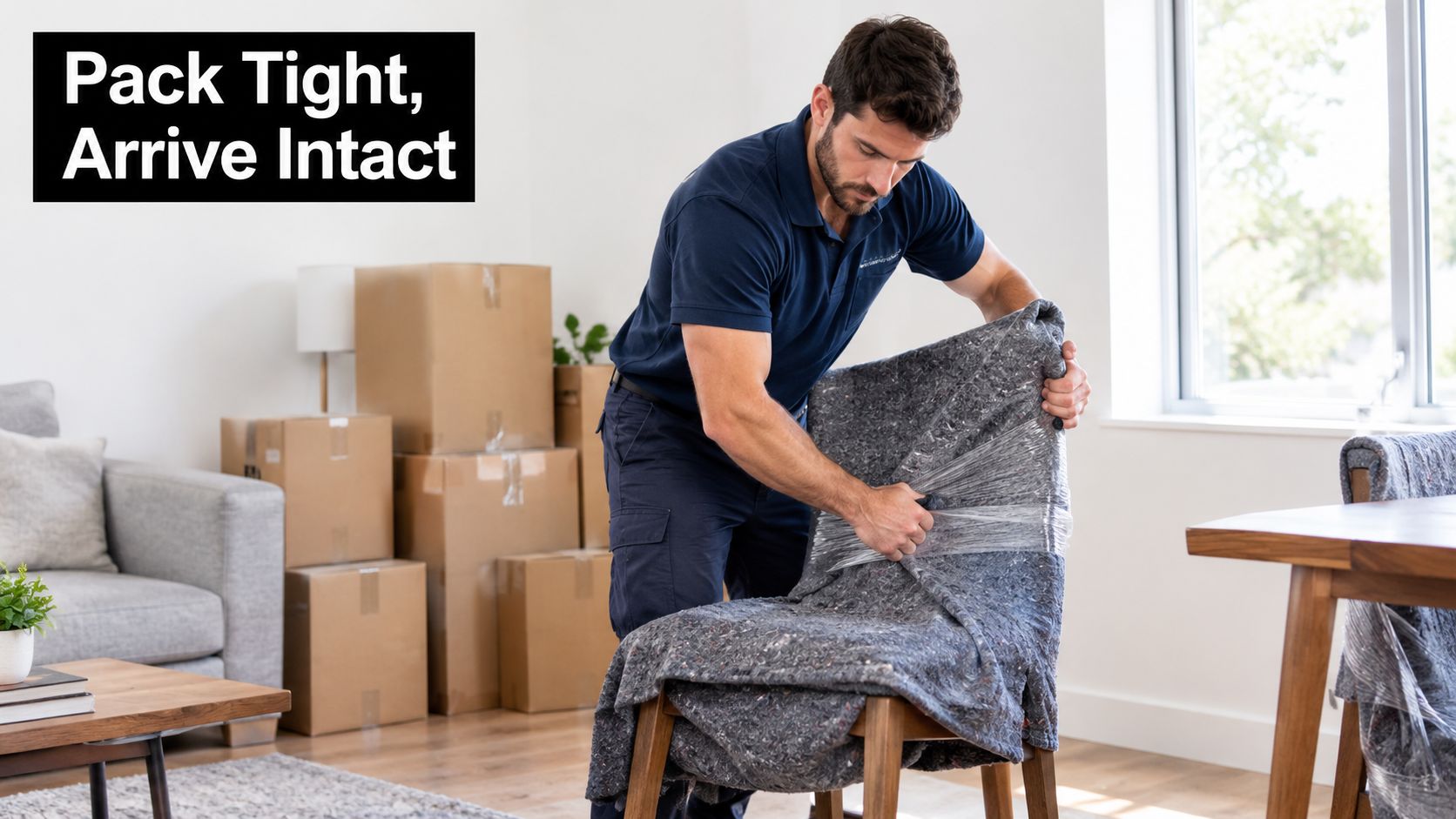
Timber, veneers, leather, photographs, documents, electronics and glued composite materials respond to temperature and humidity change. Moisture exchange can contribute to swelling, shrinkage, warping, corrosion or mould, which is why dry goods and breathable protection matter.
Australian archival guidance for paper records specifies 17-23°C and 30-50% relative humidity, with tolerable daily changes of only 3°C and 10% RH, under the Archival Storage Specification for stable storage conditions. Your furniture doesn't need archival conditions, but the mechanism behind those limits still applies.
Packing sequence that holds up on the road
- Declutter two to three weeks out: Sell or donate what won't travel, so you don't pay to move and store unwanted volume.
- Pack room by room: Start with rooms you use least and keep each carton's contents to one room where possible.
- Use breathable covers on timber and upholstery: Sealed plastic over damp material traps moisture against the surface.
- Dry everything before wrapping: Wipe down appliances and furniture, empty and dry fridges, and don't pack damp linen.
- Lift cartons off concrete: Store packed boxes on boards, shelving or furniture, and label each carton with its room and fragile status.
- Photograph contents and condition: Image valuable furniture from several angles before loading, including existing marks.
- Keep a valuables box with you: Documents, medications, chargers, jewellery, tools for beds, and first night essentials shouldn't go on the truck.
Fill cartons firmly so items can't knock together during braking. Heavy books belong in small cartons. Plates travel better packed vertically with padding between each piece than stacked flat with space above them.
For a fuller room by room method, use this guide on how to pack for moving alongside your mover's inventory so carton labels match delivery rooms.
The short video below is worth watching before you decide which rooms you'll pack yourself and which you'll hand to the crew.
Sensitive and oversized items
Records, artwork, instruments and electronics need extra care. Ask for monitored storage where relevant, request temperature and humidity logs, and allow gradual acclimatisation after arrival. Properly crated sensitive items should have about 24 hours for conditioning before opening.
Send doorway and item measurements with your quote request. Wardrobes and pianos need the mover's restraint system and enough crew, not last minute problem solving on the footpath.
Insurance Cover to Check Before You Sign
A mover saying it's insured doesn't mean your furniture is insured. Ask what happens if a sofa is damaged during loading in Sydney, overnight in a depot, or while stored before delivery in Brisbane. Those are three different moments, and they may fall under three different answers.
Insurance isn't one product. Vehicle cover protects the truck. Public liability generally concerns injury or damage to third party property. Goods in transit cover may cover loss or damage during packing, transport and unpacking. Storage cover and your own contents policy are separate questions again.
NSW Fair Trading states removalists aren't legally required to insure customers' property, and Queensland guidance on using a removalist warns many operators insure only their own vehicles. That's why you may need to arrange your own transit cover.
Use the checklist image below when you request policy documents, because the label on a quote rarely tells the whole story.
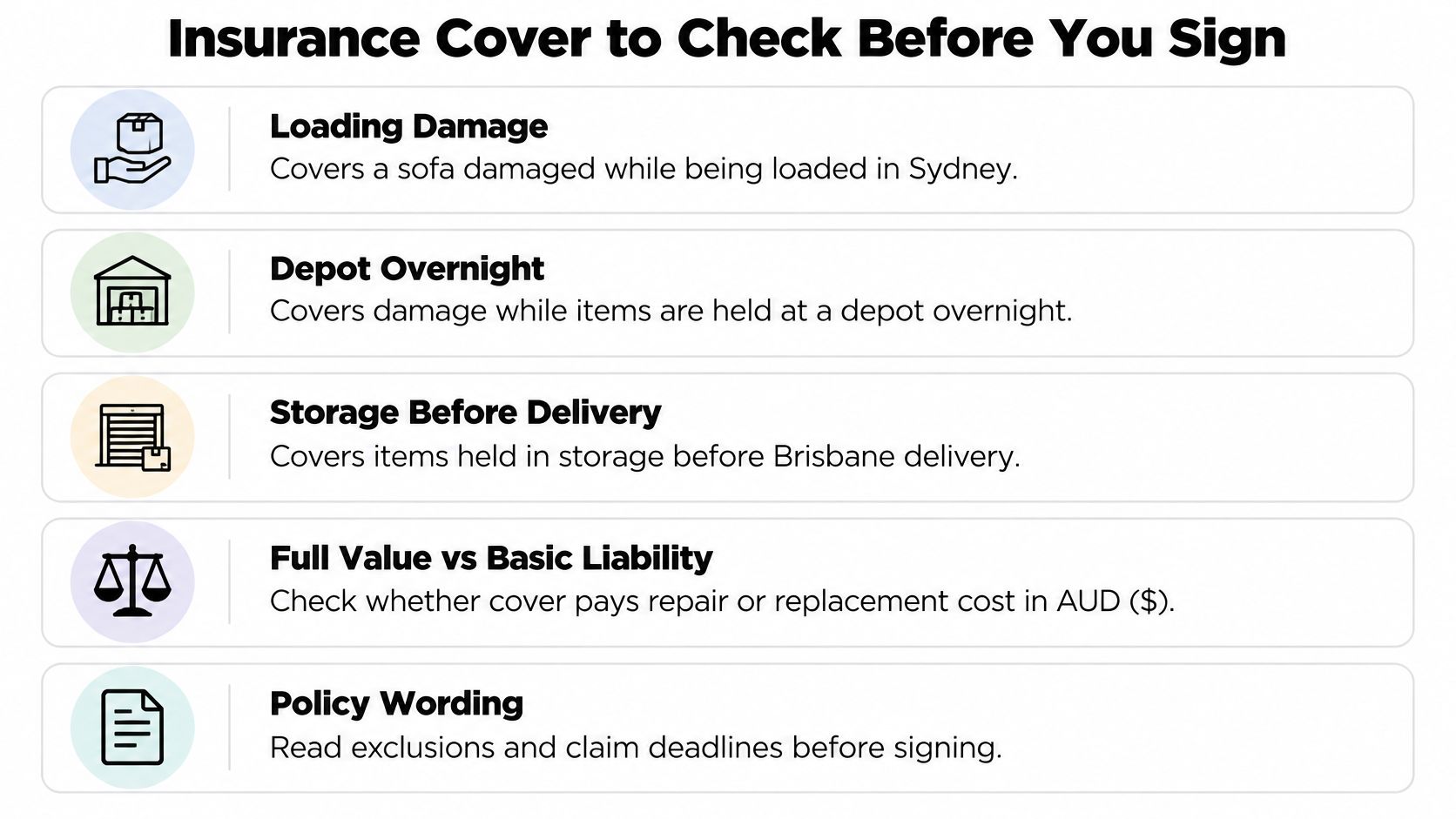
Documents and answers to request
- Certificate of currency: A current document naming goods in transit cover, not just vehicle or public liability cover.
- Basis of payment: Whether cover pays replacement value or a lower indemnity amount.
- Excess and item limits: What you'll pay per claim, plus caps for art, electronics, antiques or instruments.
- Exclusions: Packing errors, pre existing damage, inherent defects, or items packed by you.
- Storage extension: Whether cover continues if settlement is delayed, and for how long.
- Claim process: The deadline, required inventory, photos, receipts and damage notification steps.
This explanation of moving company insurance coverage helps separate the cover types before you compare premiums or included protection.
Before you pay a deposit: Read the policy wording for loading, transit, depot handling and storage. If a stage isn't named, ask whether it's covered in writing.
If your household includes high value furniture, artwork or electronics, paying for a higher cover level can be rational even when the base quote looks competitive. The relevant comparison isn't premium versus no premium. It's premium versus the cost of replacing the items you can't afford to lose.
Choose and Book a Reliable Sydney to Brisbane Mover
On an 890 km move, a low quote only works if the handling and delivery terms are clear. Compare movers against the same inventory and access details, then check how your belongings will be managed from pickup to delivery.
Mover checks for a Sydney to Brisbane move
| Criterion | Reliable sign | Red flag |
|---|---|---|
| Licence and registration | Business name, ABN and registered vehicles stated clearly | No fixed address or vague business details |
| Written quote | Itemised inclusions, exclusions and cubic-metre basis | Verbal estimate only, or no exclusions listed |
| Insurance certificate | Current certificate of currency naming goods-in-transit cover, available on request | Refusal to show the policy or discussion limited to vehicle cover |
| Trucks and crew | Company-operated or clearly contracted fleet, with identifiable, uniformed staff | Unmarked vehicles or drivers who cannot be identified |
| Delivery terms | Transit window and written process for delays | Guaranteed day with no terms attached |
| Reviews and complaints | Consistent reviews over time and no unresolved fair trading complaints | Only recent reviews or a pattern of unresolved complaints |
| Communication | One named contact and written confirmation of booking details | Unreturned calls and no written confirmation |
Three tests before any deposit
Get the quote in writing, including its cubic-metre basis and inventory. Ask for the current certificate of currency before paying. Check public complaint records with fair trading agencies in New South Wales and Queensland.
Use this guide to how to choose the best interstate removalists to organise your checks beyond star ratings.
A quote that leaves out packing, stairs or insurance may look cheaper, but those gaps can mean extra handling costs or less protection later. Ask what the deposit secures, when the balance is due, and what happens if your dates change. Confirm all terms before paying.
Booking order
- Fix your dates: Set pickup, earliest possession and latest acceptable delivery.
- Collect three written quotes: Give each mover the same inventory, access notes and service requirements.
- Confirm operational terms: Get the transit window, storage conditions, delay process and delivery contact in writing.
- Pay the deposit last: Pay only when the quote and terms are complete.
Get n Go Removals Melbourne is a Melbourne-based business with listed weekly interstate runs between Melbourne and Brisbane, and Melbourne and Sydney. Those routes do not establish availability for a Sydney-to-Brisbane move, so call 0403 559 241 to confirm whether the business can take your dates before shortlisting it.
Sydney to Brisbane Moving Checklist from Countdown to Arrival
Work backwards from pickup day. Most avoidable interstate problems come from access, paperwork or timing that could've been settled weeks earlier.
- Eight weeks out: Confirm settlement or lease dates, choose your service pattern, and book the mover with pickup and delivery windows in writing.
- Four weeks out: Arrange utility and internet transfers or cancellations at both addresses. Note appliances that need draining, cleaning or defrosting.
- Two weeks out: Book lift access, parking permits and kerb space at both ends. Confirm stairs, long carries and building rules in writing.
- One week out: Send the final inventory, photos and measurements. Confirm the pickup window, crew contact and who must attend each address.
- Pickup day: Check crew details and carton count against the quote. Walk through every room, cupboard and garage before the truck leaves, and keep your valuables box with you.
- Delivery day: Inspect items as they come off, note damage on delivery paperwork before signing, and photograph any issue straight away.
- First week in Brisbane: Update banks, employers, insurers and government agencies. Check Queensland vehicle registration requirements and put your insurance claim deadline in your calendar.
Small details that prevent delays
Keep keys, remotes, bed hardware and appliance transit bolts in labelled bags that travel with you or in one clearly marked carton. Tell the crew which boxes you need first, especially bedding, kitchen basics and children's items.
Have someone at the Brisbane address before the truck arrives. A crew waiting on keys or lift access can lose a delivery slot, create waiting charges, or need to return goods to storage.
Don't sign delivery paperwork as undamaged if you haven't checked the items. Note visible damage factually, keep packaging where it's relevant, and notify the mover within the claim period stated in your documents.
If you're weighing Sydney to Brisbane movers and interstate options connected with Melbourne, Sydney or Brisbane, contact Get n Go Removals Melbourne to confirm route availability, discuss your inventory, and ask what service pattern fits your dates. Bring your cubic metre estimate, access details and delivery deadline, and get the inclusions, transit window and insurance terms confirmed in writing before you book.