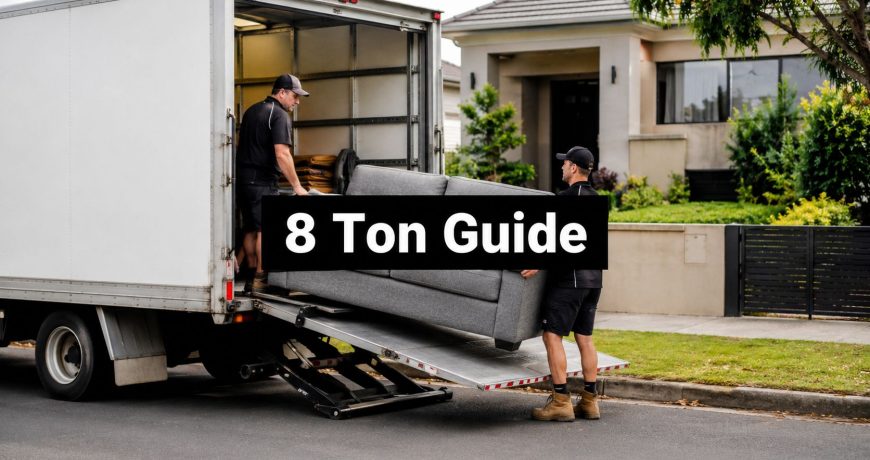
8 Ton Truck Guide for Melbourne Moves
You've booked the lift, arranged the settlement time, and started labelling boxes. Then someone asks the question that can change the whole day: will the truck fit outside the property, and will everything fit inside it without creating a weight or access problem?
For many Melbourne house, apartment, and office relocations, an 8 ton truck is a practical middle ground. It can offer substantial enclosed volume and useful loading equipment without automatically moving into the access difficulties associated with a larger vehicle. But the advertised capacity is only part of the decision. GVM, axle loading, licence boundaries, laneway width, loading zones, and lift bookings all affect whether the truck works for your move.
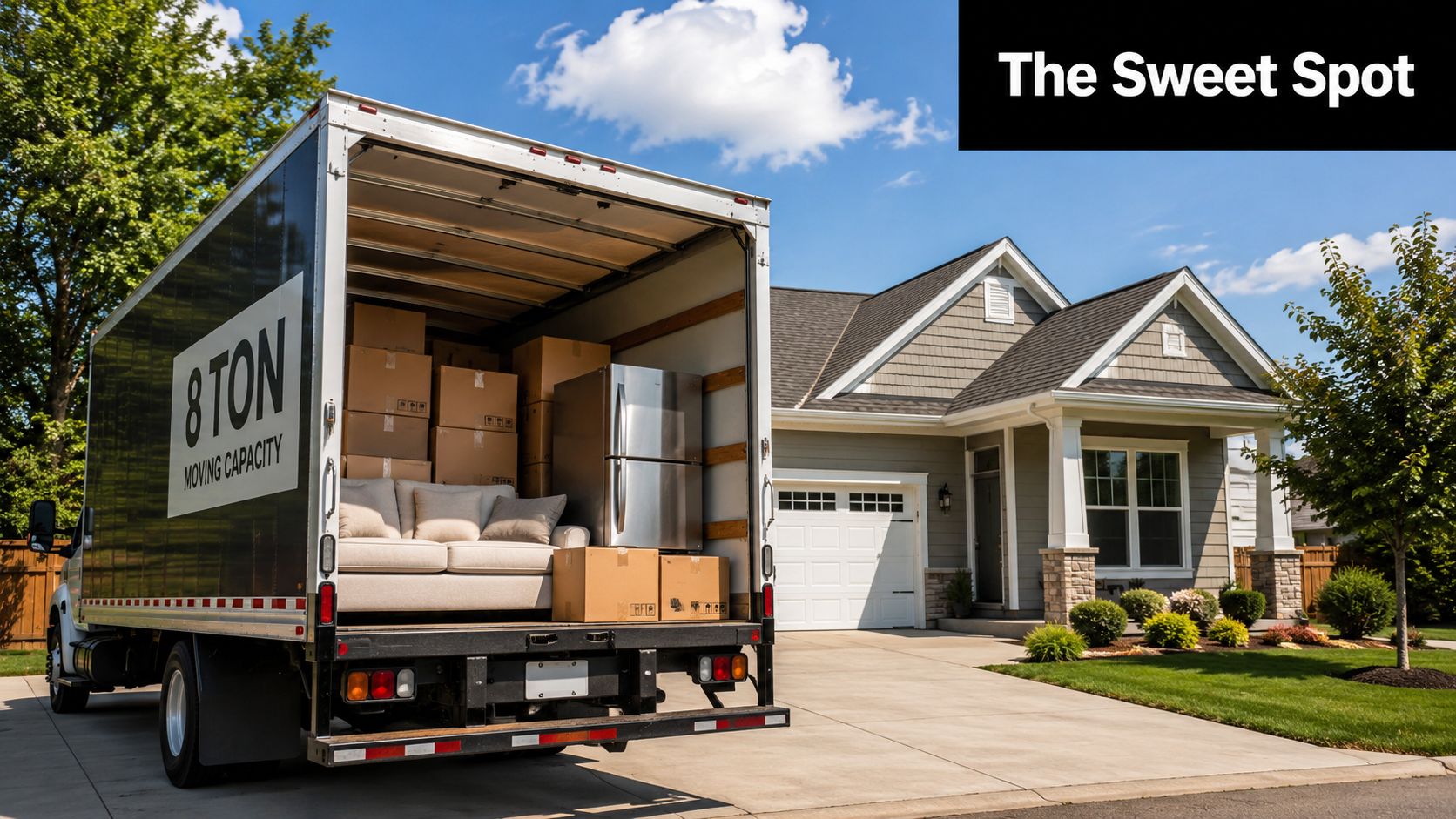
Why the 8 Ton Truck Is the Moving Sweet Spot
A three-bedroom move often looks manageable until the furniture is gathered in one place. Sofas, beds, mattresses, dining furniture, whitegoods, outdoor items, books, and packed cartons quickly turn a household into a serious load. A small van may handle the essentials, but it can leave you choosing between a second trip, a rushed late finish, or items left behind.
An 8 ton truck often suits this middle-sized job because it combines a sizeable enclosed body with the manoeuvrability of a rigid vehicle. It's commonly considered for three- to four-bedroom homes, larger apartments, and smaller office relocations, although the correct choice still depends on what you own and where the truck has to go.
Practical rule: A truck that fits the furniture but can't reach the property efficiently isn't the right truck for the move.
The benefit of choosing well is operational rather than cosmetic. One suitable vehicle can reduce repeated loading, protect the schedule, and keep the crew working through a planned sequence instead of reshuffling furniture at the destination. The wrong vehicle creates problems in both directions. A smaller truck can force multiple trips, while a larger truck may struggle with inner-Melbourne streets, apartment driveways, tight corners, or building loading areas.
Get the volume estimate first, then check the legal and physical limits. A two-man removal service with a van may be sensible for a compact move, but a full family relocation needs a more deliberate truck assessment. The 8-ton option is useful because it sits between light commercial transport and the more restrictive end of the heavy-vehicle range, but “8-tonne” on a quote isn't enough information by itself.
Dimensions and Carrying Capacity Explained
An 8-ton removal truck is best understood through two separate measures: body volume and legal payload. The body determines how much furniture and boxed property can be arranged inside. GVM determines how much the complete vehicle can legally weigh once the truck, fuel, crew, equipment, and load are combined.
Typical Australian 8-ton pantech specifications are around 8.5 metres long, 2.4 metres wide, and 2.4 metres high, providing roughly 48 to 50 cubic metres of usable enclosed space and a 2,000 kg hydraulic tail lift, as outlined in this Australian 8-tonne truck size guide.
What the dimensions mean on moving day
The enclosed body is useful for stacking cartons above and around furniture while protecting belongings from weather. The internal height can accommodate normal household pieces, but tall items still need careful placement, wrapping, and restraint. The body length gives the crew room to build a load from the heaviest and least flexible items first, then use cartons and smaller pieces to close gaps.
The tail lift changes the loading process. A 2,000 kg hydraulic tail lift can help move heavy appliances, solid timber furniture, and other dense pieces between ground level and the truck floor with less manual lifting. It doesn't mean every heavy object can be placed on the lift without planning. Crew members still need to consider dimensions, balance, handling points, ramp clearance, and the truck's overall legal limits.
| Specification | Typical Value | What It Means for Your Move |
|---|---|---|
| Body length | About 8.5 metres | Allows a structured load for a substantial household or office move |
| Body width | About 2.4 metres | Requires access checks at narrow streets, gates, and loading areas |
| Body height | About 2.4 metres | Matters under balconies, trees, awnings, and building entries |
| Usable enclosed space | Roughly 48–50 m³ | A useful guide for furniture volume, not a guarantee of payload |
| Hydraulic tail lift | 2,000 kg | Reduces manual handling for heavy items when used within operating limits |
Use a cubic metre calculator for moving estimates as a starting point, but don't treat the result as a packing promise. A home with fewer items can be heavier than a larger home filled with lightweight cartons. Books, dense shelving, workshop equipment, gym items, stone furniture, and commercial stock can consume payload faster than the box appears full.
Tare weight, fuel, the crew, blankets, trolleys, ramps, and other equipment all occupy part of the available GVM. Efficient loading means placing dense items low, spreading weight across the body, and checking axle distribution during the load rather than waiting until the doors are closed.
Licensing and Regulatory Boundaries in Australia
The important number on an Australian truck isn't just the marketing label. It's the vehicle's Gross Vehicle Mass, or GVM, which sets the legal boundary for classification and licensing.
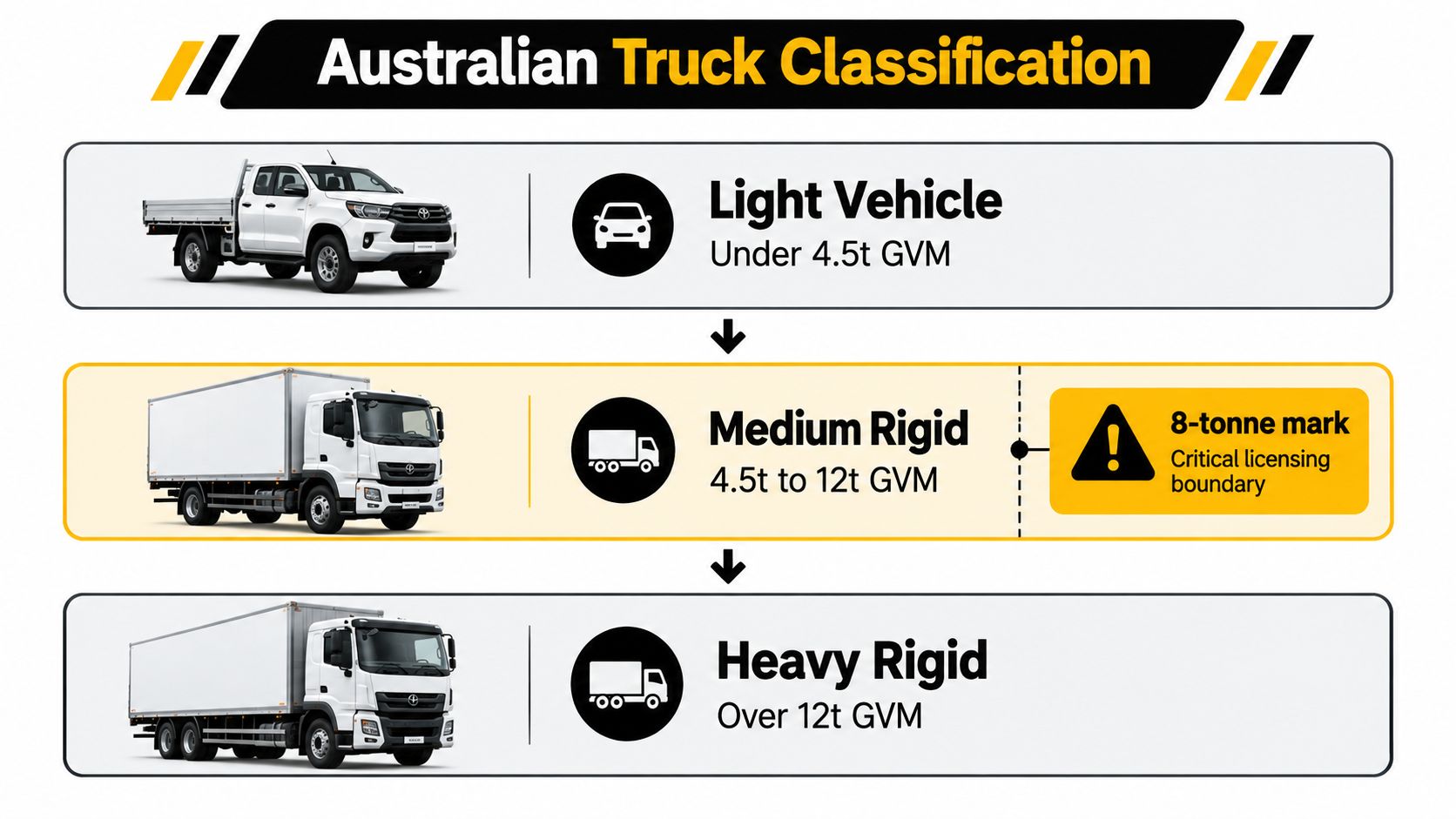
Australian truck categories place vehicles under 4.5 tonnes GVM in the light-duty range, vehicles from 4.5 to 15 tonnes GVM in the medium-duty range, and vehicles over 15 tonnes GVM in the heavy-duty range, according to this Australian heavy-duty and medium-duty truck classification guide. The National Heavy Vehicle Regulator administers laws for vehicles over 4.5 tonnes GVM across several Australian states and territories, while the Heavy Vehicle National Law defines a heavy vehicle as one exceeding 4.5 tonnes GVM.
Why the 8-tonne boundary matters
An 8-ton truck sits close to a practical licensing threshold. NSW guidance defines Light Rigid as a rigid vehicle with a GVM of more than 4.5 tonnes but not more than 8.0 tonnes, with a trailer limit of 9.0 tonnes GVM for that class, as summarised in this guide to light rigid vehicles.
That distinction matters for operators and customers hiring a vehicle. If the truck's plated GVM is exactly 8.0 tonnes, an LR licence may be sufficient under the relevant rules. If the plated figure is above 8 tonnes, the driver may need a higher licence class, and the operator must plan staffing and compliance accordingly. Don't assume the phrase “8-ton truck” proves the vehicle sits exactly at 8.0 tonnes. Ask for the plated GVM, vehicle class, and confirmation that the assigned driver is licensed for that truck.
The Medium Rigid class specifically covers two-axle trucks over 8 tonnes GVM, which makes the boundary a real operational milestone rather than a sales description. The same body style can therefore create different driver and compliance requirements depending on its plated mass and configuration.
For a customer, this usually means asking clear questions before booking:
- Plated GVM: What is the truck's actual GVM on its compliance plate?
- Driver eligibility: Is the assigned driver licensed for that vehicle?
- Load planning: Does the quoted capacity account for tare weight, crew, equipment, and dense items?
- Route compliance: Has the operator considered access restrictions and the planned route?
These checks protect the move from an avoidable mismatch. For a Victorian relocation, discuss the truck requirement alongside the wider house relocation service in Victoria rather than treating truck size as a separate decision.
When to Choose an 8 Ton Truck for Your Move
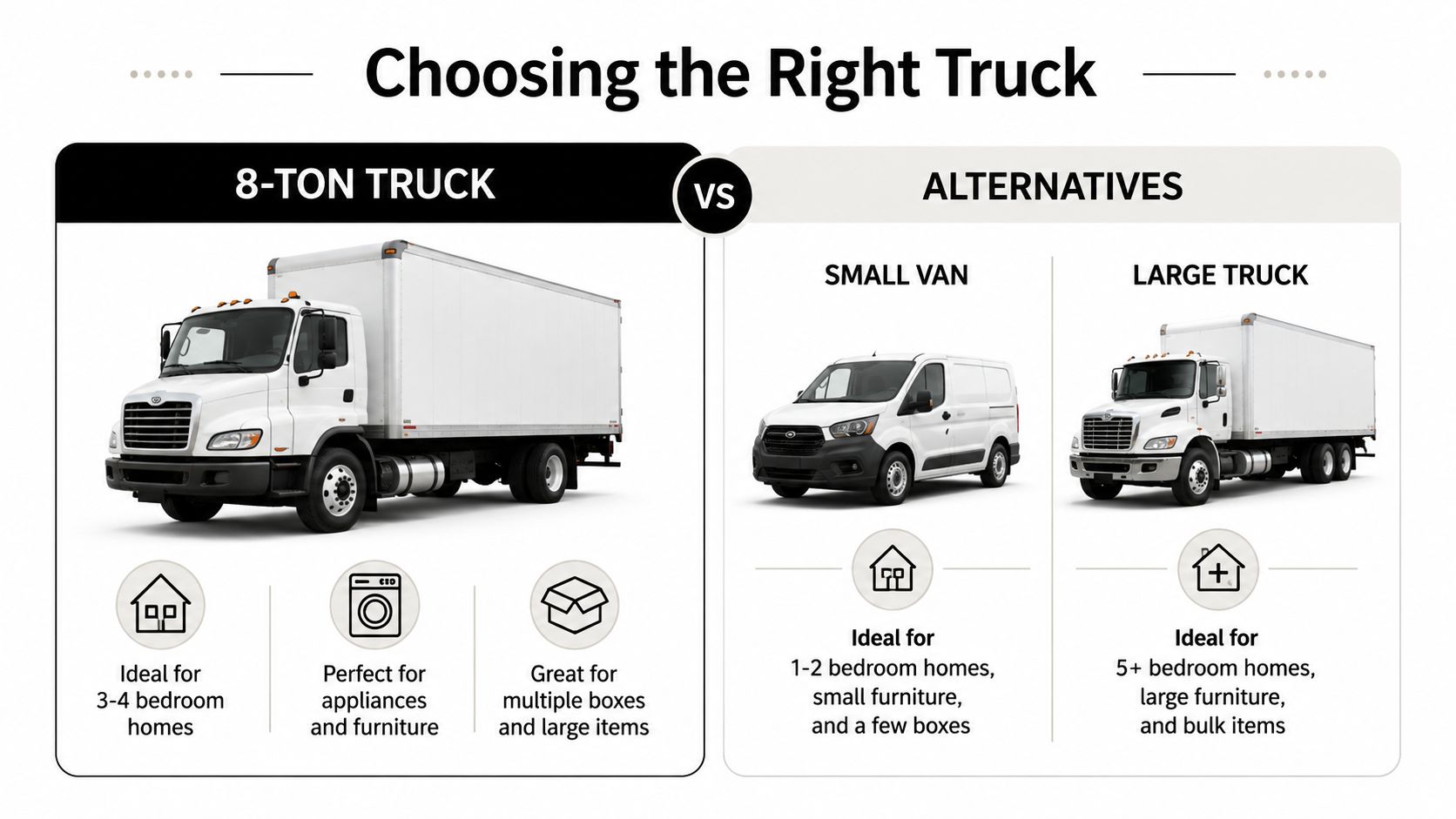
An 8 ton truck is often a sensible choice for a three- or four-bedroom home, a large apartment with substantial furniture, or a small to medium office. The deciding factor is the combination of item count, density, access, and travel distance. A sparsely furnished four-bedroom house may need less vehicle than a compact apartment filled with solid furniture and storage contents.
Australian guidance used by fleet and rental operators commonly places 6–10 tonne trucks in the medium category at roughly 7.5 x 2.5 x 2.6 metres, providing a useful benchmark for furniture volume and access planning, as shown in this Australian truck dimensions guide.
The practical comparison
A small van works well when the load is limited, the property is difficult to access, or the move involves selected furniture rather than a complete household. It becomes inefficient when beds, lounges, appliances, and cartons all need to travel together.
The 8-ton option suits the middle ground. It gives the crew room to protect furniture, separate fragile items, and build a stable load without immediately moving to a larger vehicle. It can be particularly useful for a family home where the customer wants one coordinated collection and delivery rather than a series of partial trips.
A larger truck may offer more body space, but bigger isn't automatically better in Melbourne. A larger vehicle can create problems at narrow inner-suburban properties, steep driveways, apartment complexes, or streets with limited stopping space. If the vehicle can't position close to the entrance, the crew may spend more time carrying items over a longer distance, and the loading area may become harder to manage.
A quick self-assessment
Count the major items before counting boxes. Note the number of beds, sofas, dining settings, refrigerators, washing machines, shelving units, desks, outdoor pieces, and unusually heavy objects. Then check whether the pickup and delivery addresses have stairs, lifts, tight corners, laneways, or restricted parking.
Choose an 8 ton truck when the load is substantial enough to need a medium rigid body, but the route still requires a vehicle that can operate in a residential environment. For interstate work, include route planning and delivery access in the conversation with long-distance movers in Melbourne, especially when both properties have different street conditions.
Navigating Melbourne Access and Loading Challenges
Melbourne access can decide the success of an 8-ton move before the first sofa leaves the house. A truck may have enough internal room, yet still be unsuitable for a narrow laneway, a basement ramp, a building loading dock, or a street where parking is tightly controlled.
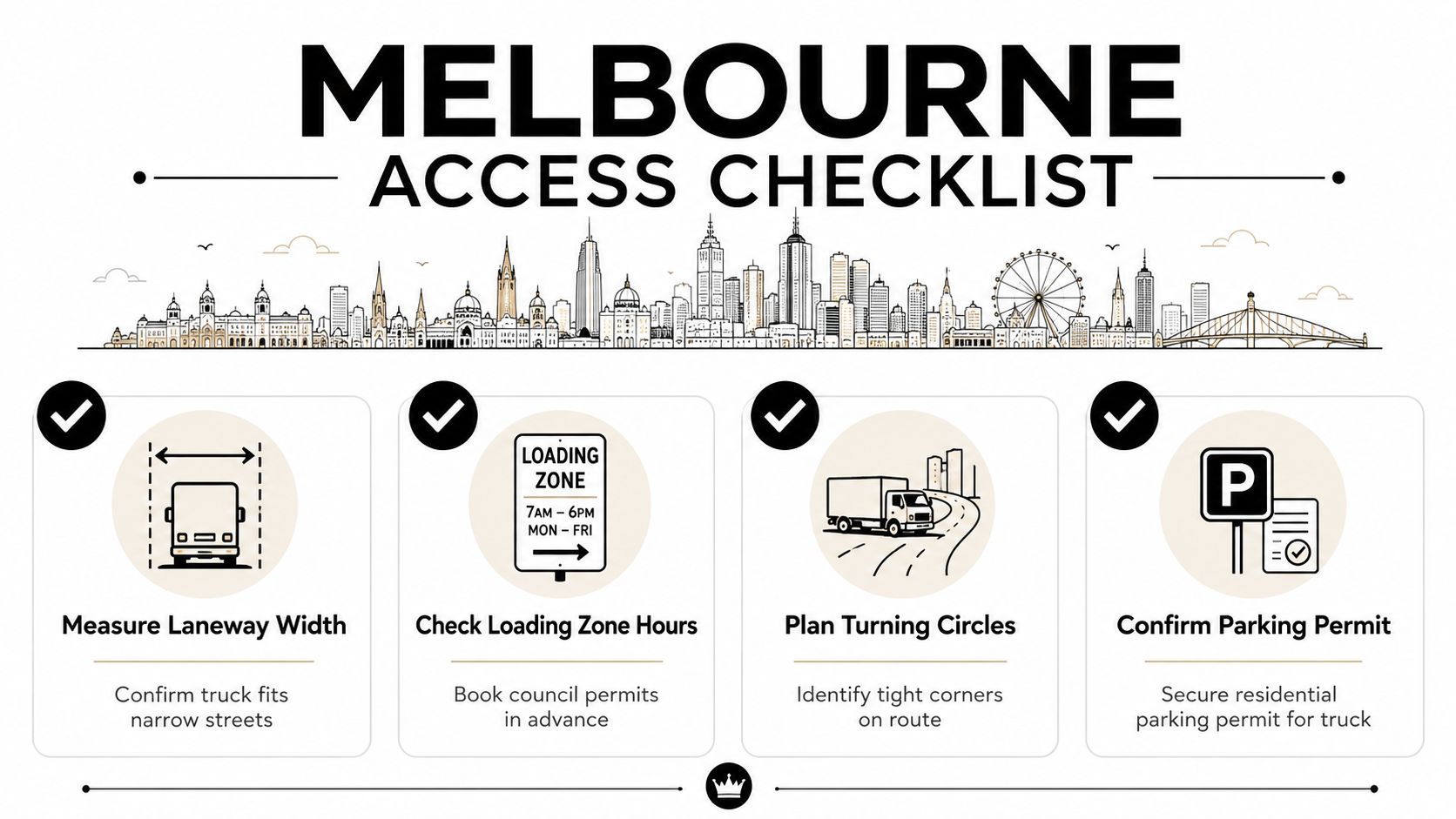
Start with the physical approach, not the furniture list. Measure the usable width of the narrowest entry, check overhead branches and balconies, identify tight turns, and confirm whether the truck can stop without blocking traffic or creating a safety issue.
Dimensions that affect the route
For heavy vehicles with a GVM of 4.5 tonnes or more, national loading guidance sets the maximum vehicle width at 2.5 metres and the maximum rigid vehicle length at 12.5 metres. The same guidance controls load overhang at 1.2 metres at the front and 3.7 metres at the rear, as outlined in this heavy-vehicle loading and driving guidance.
Those limits matter even when the truck body itself appears to fit. Mirrors, turning space, parked cars, poles, street trees, kerbs, and the angle needed to reverse into position can all change the practical clearance. A loading-zone location that works for a smaller vehicle may not provide enough room for an 8-ton truck to open the body safely or operate its tail lift.
Axle placement also matters. Under the relevant loading rule, if the distance between any two axles on a heavy vehicle that aren't part of the same axle group is less than 2.5 metres, the vehicle mass must not exceed 15 tonnes, as set out in the Queensland heavy-vehicle regulation. The point for removals is straightforward: the crew must distribute dense items properly. A truck can be under its total limit and still have an axle-loading problem.
Melbourne checks that prevent delays
- Measure the narrowest approach: Include laneways, gates, basement entries, and the space required to turn.
- Check loading-zone hours: Confirm whether the street permits commercial loading at the planned arrival time.
- Book apartment lifts: Give the building manager the truck details and reserve the lift for both loading and unloading.
- Arrange parking permissions: Confirm whether council or building approval is required for the truck to occupy the kerb.
- Share photographs: A clear street view, driveway image, and lift-entry photo can reveal issues that an address alone won't show.
For route planning, a truck-specific navigation tool can be more useful than an ordinary car map. This review of truck GPS apps by OnRoute is a useful reference when checking restrictions and planning an approach, but the removalist still needs to verify the actual property access.
How Get n Go Removals Plans Your Move Around the Right Truck
Truck selection works best when it happens during the quote process, not when the crew arrives. Get n Go Removals operates a company-owned fleet ranging from 4.5 to 12 tonne trucks, allowing the team to consider volume, access, route requirements, and the handling needs of the load before assigning a vehicle.
That approach is useful for Melbourne properties where the truck body, not just the internal volume, affects the plan. A customer should expect the assessment to consider the pickup street, delivery street, stairs, apartment lift bookings, loading distance, and items that require specialist handling. More than 10 years of Melbourne removals experience also gives the team practical familiarity with the differences between open suburban access, dense inner-city streets, and apartment loading arrangements.
Service planning beyond the vehicle
A well-planned truck still needs an organised crew and a sensible loading sequence. Get n Go Removals uses full-time, police-checked staff and provides services that can be coordinated with the vehicle plan, including:
- Packing and unpacking: Valet white-glove packing can reduce loose-item delays and help keep cartons organised.
- Furniture preparation: Disassembly and reassembly can make large beds, desks, and wardrobes easier to move through doors and stairs.
- Specialist handling: Pianos and pool tables need separate handling decisions because their weight, shape, and access requirements differ from standard furniture.
- Storage: Secure short- and long-term storage can help when settlement dates, renovations, or lease timing separate collection from delivery.
Flexible 24/7 scheduling can also matter when a move depends on settlement access, a building lift booking, or a narrow handover window. Weekly direct runs connect Melbourne with Sydney, Brisbane, and key East Coast destinations, giving interstate customers another planning factor to discuss before the truck is allocated.
Businesses comparing providers can also consider how movers use AI receptionists to manage enquiries and scheduling. The technology doesn't replace a site-specific access assessment, but responsive communication helps when customers need to coordinate packing, storage, lift times, and transport details. For broader decision-making, review the points in this guide to choosing the right removals firm before accepting a truck-only quote.
Key Takeaways for Planning Your Next Move
An 8 ton truck is often well matched to a three- or four-bedroom move, a heavily furnished apartment, or a modest office relocation. The right choice depends on more than the quoted cubic metres.
Before booking, ask the removalist:
- What is the plated GVM? Confirm the truck's legal mass, not just its advertised name.
- What are the body dimensions? Check width, height, and length against both properties.
- Is there a tail lift? Confirm its rated capacity and whether it suits your heavy items.
- Has access been assessed? Discuss laneways, turning space, loading zones, permits, driveways, and apartment lifts.
- How will the load be distributed? Dense items need careful placement to manage axle and total vehicle limits.
- What happens if access changes? Clarify the plan for a smaller vehicle, shuttle arrangement, or revised loading position.
An 8 ton truck can be an efficient Melbourne moving vehicle when the volume, GVM, driver licensing, load distribution, and route all match. It won't solve an access problem by itself, and a fuller-looking truck isn't automatically a better result.
Get n Go Removals Melbourne can assess your household or office volume, property access, tail-lift needs, and route before allocating a suitable vehicle from its 4.5 to 12 tonne fleet. Visit Get n Go Removals Melbourne to request a quote for a carefully planned local or interstate move.