
Your Ultimate Change of Address List When Moving House in 2025
Moving house is an exciting new chapter, but it comes with a mountain of administrative tasks. One of the most critical, yet easily overlooked, jobs is notifying everyone of your new address. Failing to complete a thorough change of address can lead to frustrating consequences, including missed bills that affect your credit score, lost personal documents, and even an increased risk of identity fraud if sensitive mail falls into the wrong hands. A disorganised approach almost guarantees that something important will be forgotten in the chaos of packing and coordinating logistics.
To make your transition seamless, we’ve created the ultimate, expert-approved change of address list when moving house. This comprehensive guide is designed for anyone moving locally within Melbourne, relocating interstate along the East Coast, or even organising a complex office move. It breaks down exactly who you need to notify, the ideal time to do it, and the most efficient methods for updating your details.
This isn’t just a generic list; it's a strategic action plan. We'll cover everything from essential government bodies and financial institutions to your digital subscriptions and loyalty programs, ensuring nothing falls through the cracks. By following this structured checklist, you can prevent administrative headaches and ensure your important mail arrives at your new doorstep from day one. Let's get you organised for a smooth and stress-free move.
1. Australia Post (Postal Service)
Your first and most crucial step in any change of address list when moving house is notifying Australia Post. Arranging a mail redirection service is the ultimate safety net, ensuring that any mail sent to your old address is automatically forwarded to your new one for a designated period. This simple action prevents critical documents, bills, and personal letters from falling into the wrong hands, safeguarding you against identity theft and missed payments.
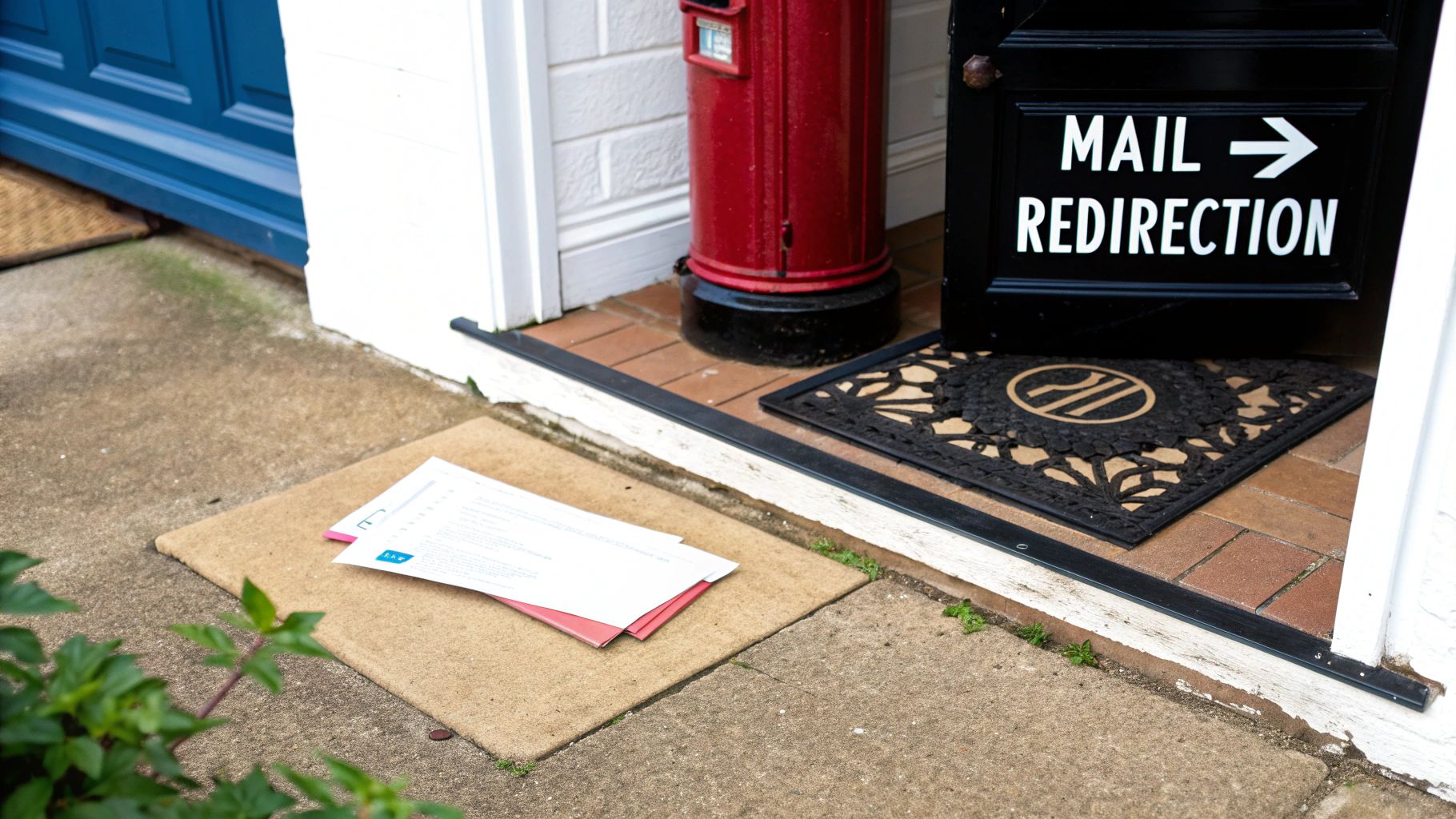
This service acts as a buffer, giving you precious time to update your address directly with every company and service provider without the stress of missing something important. Recent movers consistently report that the redirection service catches unexpected mail from organisations they had completely forgotten about, proving its value time and again. It is also an indispensable tool for those taking extended holidays or working interstate, ensuring a secure and uninterrupted flow of mail.
How to Set Up Mail Redirection
The process is straightforward and can be completed online or in person at a Post Office. You will need to provide proof of identity and details of everyone at the address whose mail needs to be redirected. You can select the duration of the service, typically for 1, 3, 6, or 12 months, with options for concessions. For an in-depth guide, explore our complete moving house address change checklist for more details.
Pro Tip: While mail redirection is fantastic, it doesn't cover most parcels or courier deliveries. Treat it as your primary safety measure for letters while you proactively update your delivery address with online retailers and other services.
Actionable Steps for a Smooth Transition
- Apply Early: Submit your redirection application at least 5-7 business days before your move to guarantee it is active on moving day.
- Keep Your Records: Save your application reference number. You will need it if you have to amend or inquire about your service.
- Verify Activation: A few days before you move, consider sending a test letter to your old address to confirm the redirection is working correctly.
- Don't Get Complacent: Use the service as intended: a temporary solution. Pay close attention to the mail that gets redirected and use it as a prompt to update that specific sender with your new details immediately.
2. Bank & Financial Institutions
Immediately after organising mail redirection, your next priority on the change of address list when moving house should be your financial institutions. Informing your bank, credit union, and any other financial service providers of your move is a critical security measure. This ensures that new debit and credit cards, bank statements, and sensitive financial correspondence are sent directly to your new home, significantly reducing the risk of mail fraud and identity theft.
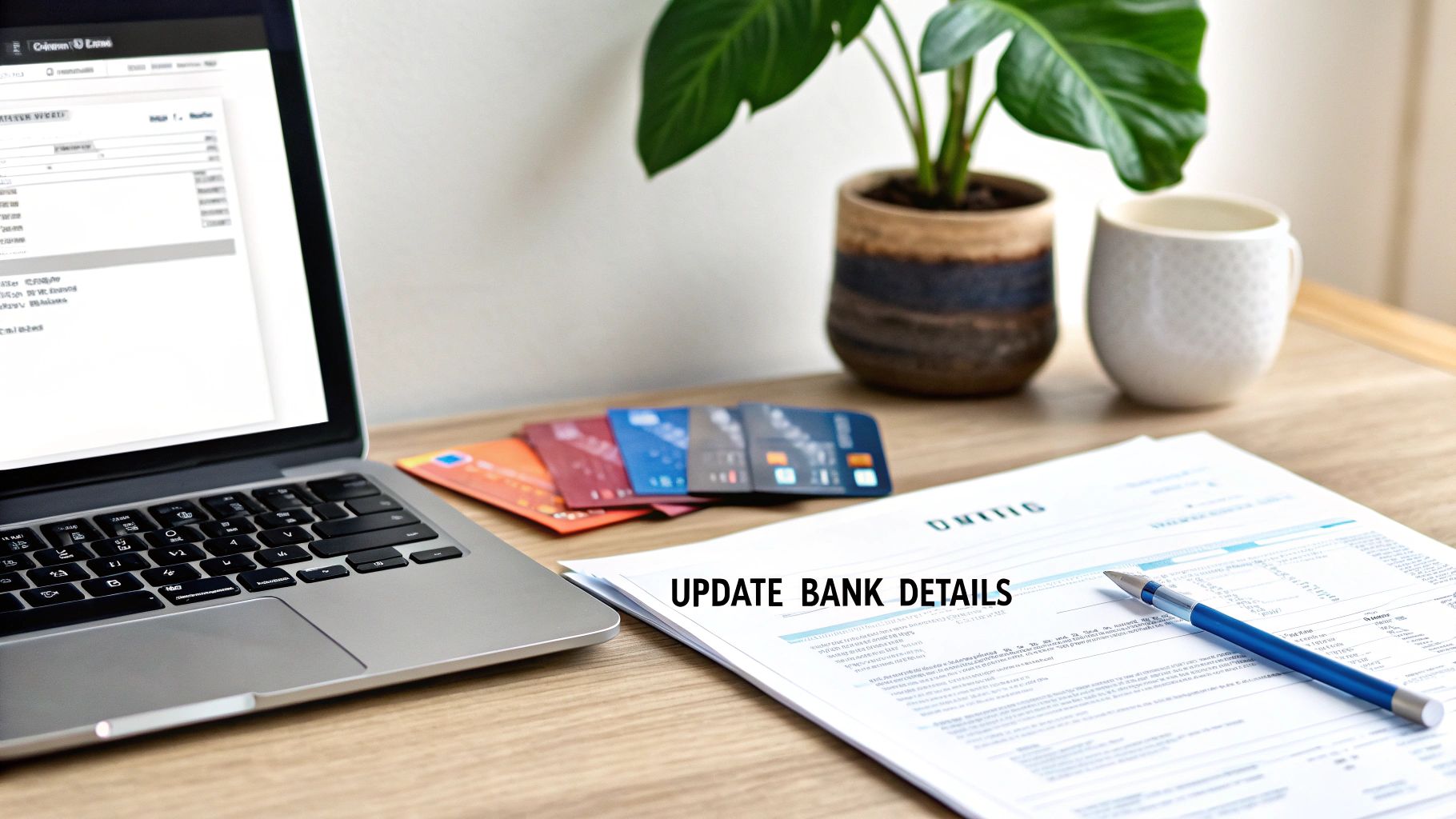
Failing to update these details can lead to major complications, from declined online purchases due to a billing address mismatch to missing important notifications about your accounts. Many major Australian banks, including Commonwealth Bank, NAB, and Westpac, now offer simple online portals or mobile app features to update your details in minutes. This immediate action protects your financial well-being and ensures seamless access to your funds throughout the moving process.
How to Update Your Financial Details
Most institutions provide multiple channels for updating your address. The quickest method is typically through your online banking portal or mobile app, which often uses two-factor authentication for security. Alternatively, you can visit a branch in person with identification or call their customer service line. Remember to update the billing address for all associated debit and credit cards, as this is often a separate step.
Pro Tip: Don't forget about less obvious financial accounts. This includes superannuation funds, share trading platforms, personal loan providers, and any 'buy now, pay later' services like Afterpay or Zip Pay. Create a master list to ensure none are missed.
Actionable Steps for a Smooth Transition
- Create a Financial Checklist: Before you do anything, list every single financial account you hold. This includes savings, cheque, credit cards, superannuation, investments, and loans.
- Update Your Billing Address First: Your credit and debit card billing address is used for online purchase verification. Update this information immediately to avoid transaction failures after you move.
- Check for Automatic Payments: Review any automatic payments or direct debits tied to your old address, as some billers may use this address for correspondence, creating unexpected moving costs. Discover more about the hidden costs in moving house to stay on budget.
- Request Confirmation: After updating your details, ask for a confirmation email or letter. File this away with your other moving documents for your records.
3. Australian Taxation Office (ATO)
Informing the Australian Taxation Office (ATO) is a non-negotiable task on your change of address list when moving house. As the government body responsible for taxes and superannuation, the ATO needs your correct address for all official correspondence. Failing to update them can lead to serious consequences, including missed tax assessments, delayed refunds, and lost communication about your superannuation.
This update ensures the continuity of your tax affairs and prevents your sensitive financial information from being compromised. The ATO uses your address to send critical documents such as your notice of assessment after lodging a tax return. Ensuring they have your correct details is fundamental to maintaining a compliant and stress-free financial record during your move.
How to Update Your Address with the ATO
The most efficient method is through your myGov account, which is linked to the ATO's online services. This allows for instant updates and ensures your details are consistent across multiple government services. You can also update your address via your registered tax agent, by phone, or by mail. You will need your Tax File Number (TFN) and other personal details for verification.
Pro Tip: If you run a business with an Australian Business Number (ABN), you must update your business, trading, and postal addresses separately through the Australian Business Register (ABR). These details do not automatically update when you change your personal ATO record.
Actionable Steps for a Smooth Transition
- Update Promptly: Change your address with the ATO as soon as your move is confirmed, ideally just before or immediately after you relocate.
- Use myGov: If you haven't already, link the ATO to your myGov account. It is the quickest and most secure way to manage your personal tax details.
- Check Superannuation: Your super fund also needs your new address. While some updates may filter through from the ATO, it is best practice to notify your fund directly to ensure you receive annual statements and other important notices.
- Confirm the Change: After updating online or by phone, log back in a few days later to confirm the new address has been successfully registered on their system.
4. Australian Electoral Commission (AEC)
An essential, non-negotiable task on any change of address list when moving house is notifying the Australian Electoral Commission (AEC). This ensures you are correctly enrolled to vote at your new address, preventing fines for not voting and ensuring you can participate in local, state, and federal elections. Timely notification keeps your enrolment details current and fulfils your civic duty.
By law, you must update your enrolment within 21 days of moving. This single notification handles your voting registration, making it an efficient and vital step in the moving process. It ensures you receive all necessary voting information and are ready for any upcoming elections without any last-minute stress.
How to Update Your Enrolment
The AEC has streamlined this process, allowing you to complete the entire update online through their official website. You will typically need to provide your driver's licence number or Australian passport number for verification. The process is quick, simple, and ensures your democratic rights are maintained.
Pro Tip: If you are moving to a new federal electorate, updating your address with the AEC is particularly important. Your new address determines who represents you in parliament and which polling stations you can use on election day.
Actionable Steps for a Smooth Transition
- Act Promptly: Update your enrolment with the AEC online as soon as you have moved into your new property to comply with the 21-day legal requirement.
- Check Your Enrolment: After submitting your update, use the AEC's "Check your enrolment" tool a week later to confirm your new address is correctly listed on the electoral roll.
- Update State Electoral Commissions: While the AEC manages federal elections, it's wise to double-check if your state's electoral commission (e.g., VEC in Victoria, ECQ in Queensland) requires a separate update, although AEC updates often sync automatically.
- Inform All Household Members: Remind every eligible voter in your household to update their own enrolment details individually.
5. Insurance Providers (Home & Contents)
A critical, and often overlooked, item on your change of address list when moving house is notifying your insurance providers. Your home and contents insurance policies are calculated based on your specific address, as location is a primary factor in assessing risk. Failing to update these details can render your policy invalid, leaving you completely unprotected against theft, damage, or unforeseen events at your new property.
Your premium is directly tied to factors like the suburb's crime rate, local environmental risks (like bushfires or flooding), and the construction materials of your new home. This is why it’s not just a simple administrative update; it’s a fundamental reassessment of your coverage. For example, comparison sites often show that insurance premiums can vary by hundreds of dollars between neighbouring postcodes, highlighting how significant this single change is.
Updating your address also presents a perfect opportunity to review and adjust your coverage. Your new home may have different security features, or you might need to adjust the total value of your contents. A prompt update ensures your policy accurately reflects your new circumstances, providing complete peace of mind from day one.
How to Update Your Insurance Policy
Most major insurers like Allianz and QBE offer quick and easy online portals or phone services to update your address. You will need your policy number and the full details of your new property, including its construction type, age, and any security systems like alarms or deadlocks. It is also wise to get new quotes, as your current provider may no longer be the most competitive for your new location.
Pro Tip: Don't forget to ask about 'transit insurance'. Many policies do not automatically cover your belongings while they are being moved between properties. You may need to arrange a separate, temporary cover for moving day itself to protect against accidental damage.
Actionable Steps for a Smooth Transition
- Notify Early: Contact your insurer at least two weeks before you move to arrange for the policy to be transferred or updated from your move-in date.
- Avoid Coverage Gaps: Confirm the exact date and time your old policy ends and the new one begins to ensure you are continuously covered throughout the moving process.
- Review Your Contents Value: Moving is an ideal time to reassess the value of your possessions. For guidance on creating an inventory, our packing tips for moving house can be a useful resource.
- Get It in Writing: Always request a new Certificate of Currency or policy document that clearly states your new address and updated coverage details for your records.
6. Healthcare Providers (Doctor, Dentist, etc.)
Ensuring your healthcare providers have your new address is a non-negotiable part of any change of address list when moving house. Your GP clinic, dentist, and any specialists need your correct details for crucial communications, including appointment reminders, test results, and referral letters. Maintaining an accurate address with Medicare is also vital for claims and benefits.
An outdated address can lead to missed appointments and, more critically, delays in receiving important health information or prescriptions. Forgetting this step can create significant stress and administrative headaches at a time when your health should be a priority. It's essential to update Medicare and then notify each of your healthcare providers individually.
How to Update Your Medical Records
First, update your address with Medicare through your myGov account or the Express Plus Medicare app. After that, contact each of your healthcare providers. Many modern clinics allow you to update your details online through a patient portal. If this option is not available, you may need to call or visit the practice in person with proof of your new address.
Pro Tip: If you are moving outside your current GP's catchment area, you will need to find and register with a new local practice. Start this process before your move to avoid any gaps in healthcare coverage, and ensure you have at least a one-month supply of any repeat prescriptions to cover the transition period.
Actionable Steps for a Smooth Transition
- Notify Early: Contact your healthcare providers at least two to four weeks before you move to inform them of your new address and moving date.
- Update Medicare First: Your Medicare details are central to your public healthcare records. Make this your first step in updating health-related contacts.
- Request Prescriptions: If you rely on repeat medication, request a new prescription before you move to ensure you have an adequate supply.
- Update All Providers: Don't forget to separately notify your dentist, optometrist, physiotherapist, and any other private or specialist clinics you attend. Their records are not automatically linked to Medicare.
7. Employer & Payroll
Ensuring your employer has your new details is a critical, yet often overlooked, part of any change of address list when moving house. Your HR and payroll departments rely on this information for everything from sending payslips and annual tax summaries (Income Statements) to updating your superannuation contributions and general employee records. An incorrect address can lead to delays in receiving vital documents, misdirected confidential information, and potential tax complications.
Keeping your employment records current ensures seamless communication and legal compliance. Many large organisations now utilise online HR portals like Workday, making the process as simple as logging in and updating a field. This direct control minimises administrative errors and puts the power to maintain accurate records directly in your hands, ensuring your employment and financial information remains secure and up-to-date.
How to Update Your Employer
The method for updating your address will vary depending on your workplace. Many modern businesses use self-service HR systems, while others may require you to complete a form or send a formal email to the HR or payroll manager. Regardless of the process, it is vital to act promptly to prevent any disruption to your pay or superannuation.
Pro Tip: Don't just tell your direct manager. While it is good practice to keep them informed, they often don't have the authority to change your details in the official payroll or HR system. Always follow the official company procedure.
Actionable Steps for a Smooth Transition
- Notify Early: Inform your HR department at least two weeks before your move. This gives them ample time to process the change before the next payroll cycle.
- Use Official Channels: Always use the designated method, whether it's an online portal, a specific form, or a direct email to the HR department.
- Provide Proof: Be prepared to offer proof of your new address, such as a new utility bill or your updated tenancy agreement, as some companies require it for verification.
- Confirm the Update: After the next pay cycle, check your payslip to confirm that your new address has been correctly recorded in the system.
- Consider Company Assets: If you have a company car, a designated parking spot, or other company property linked to your address, ensure you update these details with the relevant department as well.
8. Utilities (Gas, Electricity, Water & Internet)
Managing your utilities is a time-sensitive task that is absolutely essential in any change of address list when moving house. Failing to notify your gas, electricity, water, and internet providers can lead to being charged for services you no longer use at your old address, or arriving at your new home to find the power or internet disconnected. A smooth transfer ensures continuity of service and accurate final billing, preventing unexpected costs and major inconveniences on moving day.
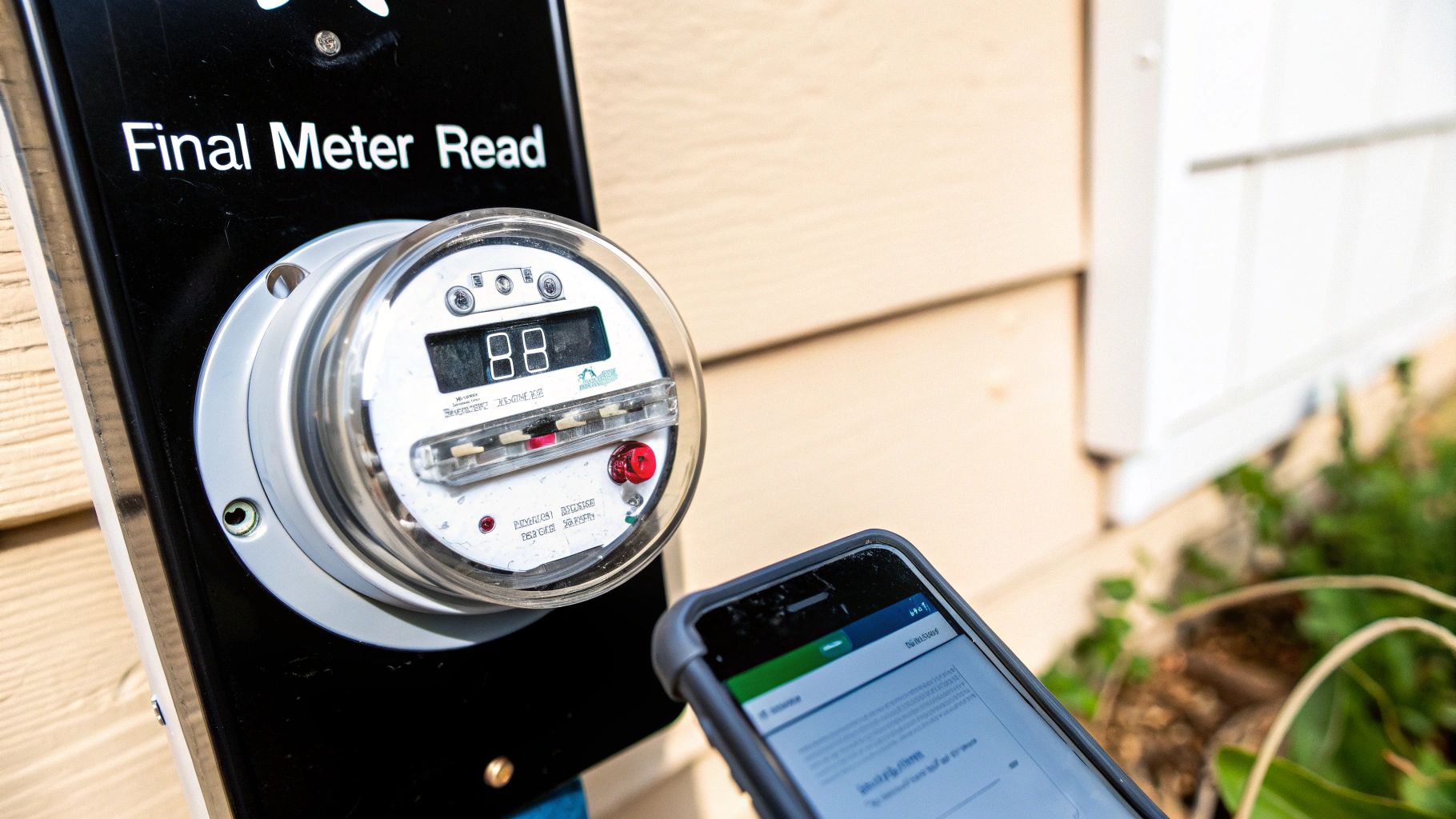
This process involves two key parts: disconnecting services at your old residence and connecting them at your new one. For some providers like your internet service, it may be a simple transfer. For energy, moving to a new area might be the perfect opportunity to compare plans from providers like AGL, Origin Energy, or EnergyAustralia to ensure you're getting the best rate. Proactively managing these accounts prevents billing errors and ensures your new house feels like home from the moment you arrive.
How to Transfer Your Utility Services
Each provider will have its own process, but most can be managed online or over the phone. You will need your account numbers and the dates for disconnection at your old property and connection at your new one. For a comprehensive guide on managing these and other crucial moving tasks, our complete moving house checklist provides a detailed timeline. Remember to take final meter readings at your old home and initial readings at your new one as a personal record.
Pro Tip: Don't assume the same water company services your new address, as providers are often specific to the council or region. Always check which company is responsible for the water supply at your new postcode and set up an account accordingly.
Actionable Steps for a Smooth Transition
- Book in Advance: Contact all your utility providers at least 4-6 weeks before your move. This gives them ample time to schedule disconnections and new connections, which is especially important during peak moving seasons.
- Take Meter Readings: On your last day, take photos of your gas, electricity, and water meters. This photographic evidence can be invaluable if a dispute arises over your final bill.
- Confirm Connection Dates: Double-check with your providers that services will be active at your new home the day before you move in. The last thing you want is to arrive with a truck full of belongings and no power.
- Check the First Bill: Once you receive your first bill at the new address and the final bill for the old one, review them carefully to ensure the dates and meter readings are correct.
9. Vehicle Registration & Licensing
Keeping your vehicle-related documents up to date is a legal requirement and a critical part of any change of address list when moving house. Failing to notify the relevant state or territory transport authority can lead to fines, demerit points, and missed correspondence for vital notices like registration renewals, traffic infringements, or safety recalls. Ensuring your details are correct prevents your licence from being suspended or your vehicle from being unregistered without your knowledge.
This process covers your driver's licence, vehicle registration (rego), and any toll accounts linked to your car. Each state has a slightly different process, but most now offer convenient online portals to update your details in minutes. Forgetting this step can cause significant administrative headaches, especially if an important notice is sent to your old address and you only discover the issue months later.
How to Update Your Vehicle Details
Most state transport authorities, such as VicRoads in Victoria or Transport for NSW, require you to update your address within 14 days of moving. This can typically be done online through their respective websites, in person at a service centre, or sometimes by phone. You will need your licence number and vehicle details handy. Remember to update your CTP (Compulsory Third Party) insurance provider and any toll tag accounts (like Linkt) separately.
Pro Tip: Your vehicle registration and insurance premiums can be affected by your new postcode. Some suburbs have higher or lower risk profiles, so inform your insurance provider immediately to ensure your policy remains valid and your premium is accurate.
Actionable Steps for a Smooth Transition
- Update Your Licence First: Your driver's licence is often the primary proof of identity and address. Update it as soon as you move.
- Update Each Vehicle: If you own multiple vehicles (cars, motorcycles, trailers), you must update the registration address for each one individually.
- Check Toll Accounts: Don't forget to log into your e-toll or tag provider's website to change your address and prevent invoices from going astray.
- Confirm with Your Insurer: After updating the transport authority, call your car insurance provider. Confirm your new "garaging address" to maintain full coverage and adjust your premium if necessary.
10. Online Accounts & Digital Services
In our digitally connected world, your physical address is intrinsically linked to your online identity. Failing to update your details across various online accounts and digital services is a modern moving pitfall. From e-commerce sites like Amazon and eBay to streaming platforms like Netflix and essential payment services like PayPal, your old address can cause delivery errors, billing failures, and even create security vulnerabilities.

This step on your change of address list when moving house is crucial for maintaining seamless service and security. An incorrect billing address can lead to subscription cancellations for services like Spotify or Apple Music, while an outdated delivery address could send your online purchases to the previous occupants. Systematically updating these accounts prevents logistical headaches and ensures your digital life transitions smoothly along with your physical one.
How to Update Your Digital Accounts
Most platforms allow you to update your address within your account settings, usually under a "Profile," "Billing," or "Shipping" section. Major accounts like your Apple ID or Google Account are high-priority as they often sync payment and address information across multiple apps and devices. Create a simple spreadsheet to track which accounts you've updated to ensure nothing is missed during this critical process.
Pro Tip: Don't just add your new address; be sure to delete your old one from e-commerce sites. This simple action prevents accidentally selecting the wrong address during a quick checkout, a common and frustrating mistake after a move.
Actionable Steps for a Smooth Transition
- Prioritise Key Accounts: Start with services that have your payment information, such as Amazon, PayPal, and any "buy now, pay later" services, to avoid billing issues.
- Audit Saved Addresses: Check web browsers like Chrome or Safari that autofill address information and update them to reflect your new residence.
- Verify Subscription Services: Log in to streaming services (Netflix, Stan) and software subscriptions to confirm the billing address on file is current.
- Use Your First Purchase: Make a small online purchase for delivery to your new home. This forces you to check and update your saved address, as detailed in our comprehensive moving into a new house checklist.
Change-of-Address: 10-Item Contact Comparison
| Item | Implementation Complexity (🔄) | Resource / Effort (⚡) | Expected Outcomes (📊) | Ideal Use Cases (💡) | Key Advantages (⭐) |
|---|---|---|---|---|---|
| Australia Post | Low — simple online/post setup 🔄 | Low — small fee, minimal documents ⚡ | Reliable redirection; reduces lost mail 📊 ⭐⭐⭐ | Moving homes, expats, short-term forwarding 💡 | Broad coverage for letters; essential safety net ⭐⭐⭐ |
| Bank & Financial Institutions | Medium — multiple providers to update 🔄🔄 | Moderate — ID/proof per institution ⚡⚡ | Prevents fraud; ensures statements & billing accuracy 📊 ⭐⭐⭐ | Updating billing, credit accounts, card delivery 💡 | Protects finances and credit record accuracy ⭐⭐⭐ |
| Australian Taxation Office (ATO) | Low–Medium — online via myGov 🔄🔄 | Low — free to update; proof helpful ⚡ | Ensures correct tax records, notices, refunds 📊 ⭐⭐ | Tax filing, superannuation admin, business records 💡 | Official tax record update; links to myGov ⭐⭐ |
| Australian Electoral Commission (AEC) | Low — usually online/phone 🔄 | Low — free but proof required ⚡ | Correct voting enrolment and local services 📊 ⭐⭐ | Mandatory notification after move; voting 💡 | Prevents fines; maintains right to vote ⭐⭐ |
| Insurance Providers | Low–Medium — may need new quotes/review 🔄🔄 | Medium — detailed property info; possible premium changes ⚡⚡ | Maintains policy validity and claim eligibility 📊 ⭐⭐ | Changes in property type/area; before coverage lapse 💡 | Avoids invalid claims; opportunity to find better rates ⭐⭐ |
| Healthcare Providers | Low — portal/phone; may need re-registration 🔄 | Low — ID; possible re-registration if distant ⚡ | Ensures prescriptions/appointments reach you 📊 ⭐⭐ | Continuity of care, repeat prescriptions, new GP 💡 | Maintains medical records; prevents missed medication ⭐⭐ |
| Employer & Payroll | Low — HR portal or form; proof needed 🔄 | Low — official proof; payroll processing time ⚡ | Accurate payslips, tax/pension communication 📊 ⭐⭐ | Payroll tax accuracy, superannuation updates, notices 💡 | Keeps payroll/tax and super records correct ⭐⭐ |
| Utilities (Gas, Electricity, etc) | Medium — coordinate multiple providers 🔄🔄 | Medium — meter reads, possible connection fees ⚡⚡ | Correct final bills and active new connections 📊 ⭐⭐ | Final meter reads, setup broadband/energy at new address 💡 | Avoids billing overlap; ensures uninterrupted service ⭐⭐ |
| Vehicle Registration (VicRoads, etc) | Low — online portal but some paper forms 🔄 | Low — minimal info; quick processing time ⚡ | Updated licence, registration and vehicle records 📊 ⭐⭐ | Driver's licence address, rego, toll account updates 💡 | Free official update; prevents fines and delays ⭐⭐ |
| Online Accounts & Digital Services | Medium — many accounts to update 🔄🔄 | Medium — time, passwords, payment verification ⚡⚡ | Correct deliveries, billing, and improved account security 📊 ⭐⭐ | E‑commerce, subscriptions, payment services, streaming 💡 | Reduces delivery issues; secures billing & subscriptions ⭐⭐ |
Ticking Off the Final Box: Making Your Move a Success
Navigating the labyrinth of administrative tasks is often the most underestimated part of moving house. You’ve now journeyed through the definitive change of address list when moving house, covering every critical entity from government bodies like Australia Post and the Australian Taxation Office (ATO) to the everyday services that keep your life running smoothly. By methodically working through this comprehensive checklist, you are building a strong foundation for a seamless and stress-free transition.
The power of this list lies not just in its breadth but in its structured approach. We’ve dissected the process into manageable categories, from the non-negotiable government and financial updates to the essential utility transfers and often-overlooked digital and personal subscriptions. This ensures that no stray piece of mail gets lost and no critical service is interrupted, saving you from potential identity theft risks, missed payments, and significant logistical headaches down the line.
Key Takeaways for a Flawless Transition
To crystallise the insights from this guide, let’s recap the most crucial takeaways that will transform your moving experience from chaotic to controlled:
- Start Early and Create a Master Checklist: Procrastination is the enemy of a smooth move. Begin the change-of-address process at least four to six weeks before your moving day. Use a digital spreadsheet or a physical notebook to track who you've contacted, the date of the request, and any confirmation details.
- Prioritise High-Stakes Contacts: Certain updates carry more weight than others. Government agencies (ATO, AEC, Centrelink), financial institutions, and your employer should be at the very top of your list. Delays with these can have immediate financial and legal repercussions.
- Confirm, Don't Assume: After submitting an address change request, always follow up to confirm it has been processed correctly. A quick phone call or checking your account online can prevent a minor error from escalating into a major problem.
- Leverage Digital Tools: Many organisations now offer simple online portals for updating your details. This is often faster and more efficient than mailing forms or waiting on hold. Keep your digital security in mind and use strong, unique passwords for each service.
Mastering this process is about more than just avoiding inconvenience; it's about taking control of your personal administration and safeguarding your identity and finances during a period of significant change. Beyond the immediate address changes, considering the broader implications of your move, especially when you are seeking insights on moving cities or countries, can help ensure a smooth transition. A well-organised move allows you to focus on the excitement of setting up your new home, rather than chasing down misdirected bills and important documents.
Ultimately, this comprehensive change of address list when moving house is your strategic roadmap. By following it diligently, you are not just moving your belongings; you are efficiently and securely relocating your entire life. This empowers you to close the door on your old property with confidence and step into your new one with peace of mind, ready to begin your next chapter on the right foot.
While you expertly manage the paperwork, let our team handle the physical logistics with precision and care. Get n Go Removals Melbourne specialises in seamless residential and office relocations, ensuring your belongings are transported safely and efficiently. Contact Get n Go Removals Melbourne today for a transparent quote and experience a five-star move without the stress.